
Results
-
 £104.99
Kefas - Rob Goorhuis
The composition Kefas was written for the brass band 'Apollo' from Grou (The Netherlands), by order of the Unisono Foundation, the organisation for wind music in The Netherlands.The assignment was given on account of earning the Champions Title during the Dutch Brass Band Championships in the year 2001 (4th division). The theme of the composition links the tradition of the village Grou, not to celebrate Sint Nicolaas but Sint Pieter.By this typical Dutch festivity (in December) the holy Nicolaas gives presents to the children. It is a popular custom where young and old participate. Grou is the only place where this is not done by Sint Nicolaas but by Sint Pieter.Apart from that, on the 22th of Februari, a lot of festivities that take place,resemble those of the Sinterklaas celebration. In the composition two Sint Pieter songs are processed, set through bible scenes, wherein in among others the visit of Christ to the house of Peter's Mother-in-law and the calling of Peter are depicted. The title refers to the pronouncement of Christ, where he named Peter the rock on which he shall build his church. The Hebrew word for rock is Kephas. Kefas was premiered in 2003.
Estimated dispatch 5-14 working days
-
 £89.99
Frida's Whiskers - David Well
David Well composed 'Frida's Whiskers' in commemoration of his own cat, who met an untimely end. Frida (whose real name was 'Godefrida van Coopersburg thoe Nieuwenhuys') was a lively creature, who led a playful and uncomplicated life. She used to sleep in her basket for hours, but when she woke up she upset the entire house and its furnishing. Curtains were inspected from top to bottom and flower pots fell from window-sills just like that! Outside, in the open air she was in her element. She used to frolic, bouncing into the air. After such playful moods she would return to her basket tired but satisfied where, being the cleanly cat that shewas, she subjected her entire body, whiskers included, to a thorough wash.
Estimated dispatch 5-14 working days
-
 £59.95
Music from Kantara - Kenneth Downie
Despite the exotic sounding title, the origins of Kenneth Downies fine composition are somewhat more prosaic. When the composer and his wife moved into a new home they were intrigued to find it called Kantara. Not wanting to upset the outgoing owners, and wishing to find out more, they decided to keep the name.Some judicious research found that Kantara was a ruined castle in Northern Cyprus which the previous owners had once visited. A picture of it was left hanging on the wall of the house for the new owners to enjoy.Written in 1993 for the National School Band Association Composer Competition, it has subsequently been used at youth and senior level - from the National Youth Band Championships of Great Britain to the Pontins Championship.The three-movement work is in no way descriptive, but each has individual character - from a light hearted spiritoso followed by a short lyrical middle section to an animated presto finale.
Estimated dispatch 5-14 working days
-
 £54.99
Footprints - Jerry B. Bensman
Bring the house down with Jerry Bensman's sparkling Footprints. Everyone is, or at least feels, important in this simple but very effective march which works equally well on stage as on parade. Often a march does not have to be difficult to possess a thorougly pleasing 'full' sound. In understanding this, Jerry Bensman added a valuable repertoire-piece to the music available for youth-bands. In performing Footprints your beginning bandsmen take a major step forward in advancing their budding musical careers. Tip: Put the spotlights on your cymbals-player and make him (or her) the star of the evening.
Estimated dispatch 5-14 working days
-
£60.99
Old Paintings - Patrick Millstone
The composer depicts five little paintings which were hanging on the wall of the spare room of his grandparents' house when he used to stay there as a young boy. Each painting had its own place and story. Even a replica of Rembrandt's Night Watch was there and his eyes were always focussed on the person with the drums. Imaginative music of high educational value. Playing together, articulation, and playing in tune are familiar, but useful, ingredients of this varied piece.
Estimated dispatch 5-14 working days
-
 £10.99
Show me - Alan Jay Lerner
The musical My Fair Lady (a book and lyrics by Alan Jay Lerner and music by Frederick Loewe), is based on George Bernard Shaw's Pygmalion. Show Me, arranged by Mark Freeh, is taken fromAct II of My Fair Lady and is when Liza storms out of Higgins' house to stumble outside into Freddy. Freddy protests that he is in love with her, but Liza is sceptical and brushes him off. Brass Band Grade 4: AdvancedYouth and 3rd Section Duration: 4 minutes
Estimated dispatch 5-14 working days
-
 £79.99
Summon the Heroes - John Williams
John Williams has written ceremonial music for many major events and ceremonies but of all these occasional pieces Summon the Heroes is the most elaborate and musically complex. It was composed for the Atlanta Olympic Games in 1996 and performed at the opening ceremony. As with all of John Williams' ceremonial compositions this work makes an ideal Brass Band work that will bring the house down as a concert opener.
Estimated dispatch 5-14 working days
-
 £61.11
Heligan - Kevin Ackford
Score & Parts A descriptive piece of around 13 minutes telling the story of and taking you on a journey around the Lost Gardens of Heligan. Following the introduction, we begin our journey at the Grand House with the staff scurrying around carrying out their work. Next comes the outbreak of World War 1 when all of the male staff of the house signed up with the Duke of Cornwall's Light Infantry. Following the war only 6 of the gardens 22 staff survived and returned to Heligan. After the war the gardens "Go to Sleep" and become overgrown. Then comes the modern-day workers rediscovering the gardens and beginning to put them back to their former glory. Then the sun rises over the gardens and the birds begin to sing and we find ourselves in the serene lost valley. We then pass through the Jungle before turning the corner and once again see the House and lawns in all their glory.
Estimated dispatch 5-7 working days
-
 £74.95
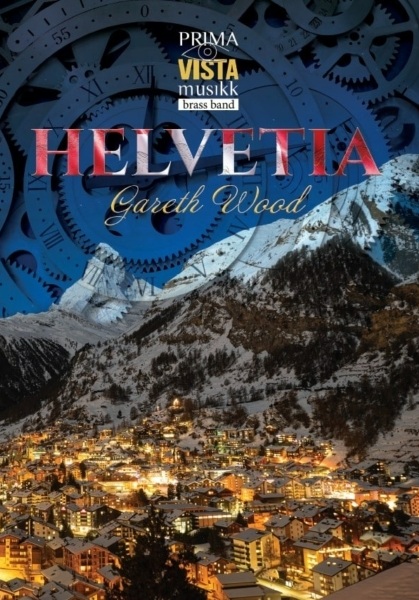
Helvetia (Brass Band - Score and Parts)
I first went to Switzerland in the early 1970's and regularly played at the Lucerne Festival with the Royal Philharmonic Orchestra. It is a beautiful city, one of my favourite European cities.In writing Helvetia (the Roman name for Switzerland) I wanted to encapsulate the moods that remind me of this wonderful place. The work is in four distinct sections and is on the whole, self-explanatory.It opens with An Alpine Dawn and sunrise, the tubas and euphoniums substituting for the Swiss Alphorns. Next The Clock Shop at Mid-day, a loud ticking, chiming and the sad sound of a cuckoo, builds into the cacophony of the mid-day chimes. The third section is A Walk to Wagner's House. Just along the lake from the centre of town is Tribschen. This walk I have done many times, and it is here that Wagner wrote 'Tristan'. I have quoted the Dresden Amen (written by J.G. Naumann) which is much used in Parsifal. The final section is The Cesta Run, the most famous bob-sleigh run in the world. As we take each corner, the feeling of speed is demonstrated as only a brass band can do!The work is dedicated to the Cory Band and also to the memory of James Watson, a great cornet player, trumpeter and conductor. It was he who got me into writing for brass band and I hope this piece is worthy.- Gareth Wood (Feb. 2011)Duration: 11.00
Estimated dispatch 7-14 working days
-
£31.95
Helvetia (Brass Band - Score only)
I first went to Switzerland in the early 1970's and regularly played at the Lucerne Festival with the Royal Philharmonic Orchestra. It is a beautiful city, one of my favourite European cities.In writing Helvetia (the Roman name for Switzerland) I wanted to encapsulate the moods that remind me of this wonderful place. The work is in four distinct sections and is on the whole, self-explanatory.It opens with An Alpine Dawn and sunrise, the tubas and euphoniums substituting for the Swiss Alphorns. Next The Clock Shop at Mid-day, a loud ticking, chiming and the sad sound of a cuckoo, builds into the cacophony of the mid-day chimes. The third section is A Walk to Wagner's House. Just along the lake from the centre of town is Tribschen. This walk I have done many times, and it is here that Wagner wrote 'Tristan'. I have quoted the Dresden Amen (written by J.G. Naumann) which is much used in Parsifal. The final section is The Cesta Run, the most famous bob-sleigh run in the world. As we take each corner, the feeling of speed is demonstrated as only a brass band can do!The work is dedicated to the Cory Band and also to the memory of James Watson, a great cornet player, trumpeter and conductor. It was he who got me into writing for brass band and I hope this piece is worthy.- Gareth Wood (Feb. 2011)Duration: 11.00
Estimated dispatch 7-14 working days
 View Music