
Results
-
 £29.88
How Shall I Woo Thee (Cornet Solo with Brass Band) Coleridge-Taylor arr.Bushnell
The 7 African Romances, Op. 17 for voice and piano has words by Paul Laurence Dunbar and music by Samuel Coleridge-Taylor. Published in 1897, it comprises of 7 songs, "An African Love Song", "A Prayer", "A Starry Night", "Dawn", "Ballad", "Over the Hills" and "How Shall I Woo Thee?", of which the last is arranged here.This arrangement was requested by Besses o' th' Barn Band for the The Samuel Coleridge-Taylor Festival held in Liverpool on 11 October 2025. The song is wonderfully lilting with moments to indulge in the music.This arrangement is for the UK-style brass band and either solo B-flat cornet, solo E-flat soprano cornet or soprano singer. It also has alternative parts for horns in F and bass-clef lower brass. A recording of the original song can be found here: https://www.youtube.com/watch?v=tglGpaBsWOo Duration: Approx. 3.10 minutes Difficulty Level: 4th Section + This PDF download includes the full score and parts. Includes alternative parts for soloist in Eb, horns in F and lower brass in bass clef. Sheet music available at www.brassband.co.uk (UK) or https://satradecentral.org (USA) Instrumentation: Cornet Soloist Bb Soprano Cornet Eb Solo Cornet Bb Repiano Cornet Bb 2nd Cornet Bb 3rd Cornet Bb Flugel Horn Bb Solo Horn Eb 1st Horn Eb 2nd Horn Eb 1st Baritone Bb 2nd Baritone Bb 1st Trombone Bb 2nd Trombone Bb Bass Trombone Euphonium Bb Bass Eb Bass Bb Timpani Percussion 1-2
In Stock: Estimated dispatch 1-3 working days
-
 £44.83
Illuminate - Brass Band (Andrew Wainwright)
Written for the Chicago Staff Band's tour of England in 2015, this exhilaratingwork was premiered at The Salvation Army's Boundless International Congress at London's O2 Arena to an audience of 20,000 people. The piece is structured as a through-composed triptych, weaving together the popularcontemporary worship songs Shine on Us (Michael W. Smith) and Speak, O Lord (Keith and Kristin Getty) with the historic Salvationist anthem The World for God (Evangeline Booth) to explore themes of light, guidance, and mission. The work opens with energy and rhythmic drive, centering on Shine on Us. A stark contrast follows in the meditative middle section. Here, the music explores the contemplative depths of Speak, O Lord, featuring the solo horn. The final section introduces a nostalgic and stirring reference to General Evangeline Booth's classic hymn, The World for God. The finale juxtaposes all three themes. As the disparate melodies intertwine and layer upon one another, the music builds to a triumphant climax - a representation of 'illumination' that celebrates a shared faith across generations. To view The International Staff Band performing the piece, please visit: www.youtube.com/watch?v=T5gVsBrdvio Duration: approx. 7 minutes Includes score and full set of parts. Sheet music available exclusively from World of Brass - www.worldofbrass.com Difficulty Level: 2nd Section + Instrumentation: Soprano Cornet Eb Solo Cornet Bb 1st Cornet Bb 2nd Cornet Bb Flugel Horn Bb Solo Horn Eb 1st Horn Eb 2nd Horn Eb 1st Baritone Bb 2nd Baritone Bb 1st Trombone Bb 2nd Trombone Bb Bass Trombone Euphonium Bb Bass Eb Bass Bb Timpani Percussion 1-2
In Stock: Estimated dispatch 1-3 working days
-
 £33.62
Les Chasseresses from 'Sylvia' (Brass Band) Delibes arr. Rob Bushnell
Clement Philibert Leo Delibes was a French composer, best known for his ballets and operas, including works such as Lakme (with its famous "Flower Duet"), Coppelia and Sylvia (both key works in the development of modern ballet). The latter started as a play, Aminta, by the Italian poet Torquato Tasso, which Delibes set to music. It was then adapted for the Paris Opera with rehearsals starting in August 1875. The premiere took place on 14 June 1876 and was the first ballet to be shown at the newly-built Opera Garnier. Whilst the scenery and costumes were created by top artists and designers (Cheret and Lacoste), it was Delibes's music that shown thrown, being said to have saved the production, preventing the ballet from drifting into obscurity.Sylvia is said to be one of the first modern ballets, with Tchaikovsky remarking to composer Sergei Taneyev upon its ingenuity: "... the first ballet, where the music constitutes not only the main, but the only interest. What charm, what elegance, what richness of melody, rhythm, harmony." Although Swan Lake, a contemporary to Sylvia, is considered one of the best ballets there is, Tchaikovsky preferred Sylvia to his own work, saying Swan Lake was "poor stuff in comparison". Tchaikovsky said to Taneyev, "I was ashamed. If I had known this music early then, of course, I would not have written Swan Lake". The music to Sylvia, rather than setting only the mood, also sets the action and is noted for its use of leitmotifs - Delibes was an admirer of Wagner - and more dominant use of brass and wind. The most famous piece from this ballet is the Pizzicati in the third act.Act I of the ballet takes place in sacred wood, where creatures are worshipping before Eros when Sylvia arrives with her huntresses to mock the god of love. Aminta, a lowly shepherd and infatuated with Sylvia, protects the deity and Sylvia is wounded by Eros's arrow. The hunter Orion kidnaps Sylvia, whilst Eros revives Aminta. Act II takes place in Orion's Island cave, where Sylvia tries to bribe Orion with jewels and wine. Unsuccessful, she appeals to Eros for help, who arrives and takes her to the temple of Diana (where the final act takes place). Orion and Aminta fight, Sylvia and Orion cause the goddess of the hunt, Diana, to be outraged, smiting Orion and denying the love of Aminta and Sylvia. Eros shows Diana a vision, which changes her mind and the couple finally come together.This brilliant and lively fanfare that introduces the huntresses in the first act is arranged here for the UK-style brass band, with alternative parts for horns in F and bass-clef lower brass. The piece has been lowered by a tone compared to the original. A recording of the original composition can be found here https://youtu.be/6yoGrUH38PI?si=0L0bFa1qXnYNvkR3 Duration: Approx. 3.10 minutes Difficulty Level: 1st Section + This PDF download includes the full score and parts. Includes alternative parts for soloist in Eb, horns in F and lower brass in bass clef. Sheet music available at www.brassband.co.uk (UK) or https://satradecentral.org (USA) Instrumentation: Soprano Cornet Eb Solo Cornet Bb Repiano Cornet Bb 2nd Cornet Bb 3rd Cornet Bb Flugel Horn Bb Solo Horn Eb 1st Horn Eb 2nd Horn Eb 1st Baritone Bb 2nd Baritone Bb 1st Trombone Bb 2nd Trombone Bb Bass Trombone Euphonium Bb Bass Eb Bass Bb Timpani Percussion - Triangle, Cymbal & Bass Drum
In Stock: Estimated dispatch 1-3 working days
-
 £33.62
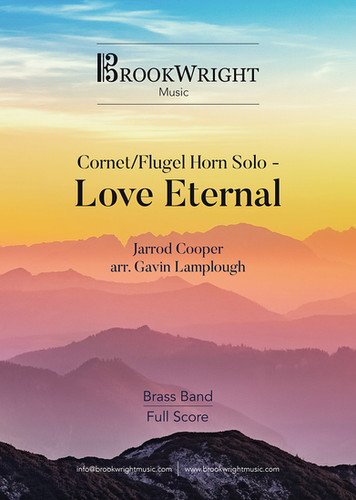
Love Eternal (Cornet/Flugel Solo with Brass Band) Jarrod Cooper arr. Lamplough
Love Eternal was written by Gavin Lamplough for Neil Blessett, who at the time of writing was the Principal Horn player of both Birmingham (UK) Citadel Band and the International Staff Band of The Salvation Army. After popular demand, it was set as a cornet or flugel horn solo, both with piano accompaniment and this version with brass band. The arranger uses Jarod Cooper's popular contemporary worship song King of Kings, Majesty as the basis for the work and the piece seeks to provide a vehicle for the rich timbres of the tenor horn to be enjoyed by the listener. The music reflects the Christian musician's desire to offer their talents to God to be used by Him, and the lyrics of the song are ones of contrast as the musical journey of this piece seeks to emulate the juxtaposition through contrasting moods. To view a video of Helen Williams performing the solo (version with piano accompaniment) please visit www.youtube.com/watch?v=ww3B06TBKMM PDF download includes score and parts. Sheet music available from: UK - www.brassband.co.uk USA - https://satradecentral.org Difficulty Level: 4th Section + Length: 5.00 minutes Instrumentation: Cornet/Flugel Horn Soloist Bb Soprano Cornet Eb 1st Cornet Bb 2nd Cornet Bb Flugel Horn Bb 1st Horn Eb 2nd Horn Eb 1st Baritone Bb 2nd Baritone Bb 1st Trombone Bb 2nd Trombone Bb Bass Trombone Euphonium Bb Bass Eb Bass Bb Percussion 1-3
In Stock: Estimated dispatch 1-3 working days
-
 £33.62
Metamorphosis on 'Finlandia' (Brass Band - Full Score Print) Andrew Wainwright
This major work was commissioned by Five Lakes Silver Band and its Musical Director Christopher Ward in February 2024, and is featured on the band's CD Resurget Cineribus. The music is based on the hymn tune by Katharina von Schlegel, Be Still, My Soul, found in Sibelius' famous tone poem Finlandia (Op. 26). While the only source material used in Metamorphosis on 'Finlandia' is the hymn itself as opposed to any of the developmental music found in the tone poem, it does also seek to depict the strife of the Finnish people against the censorship of the Russian Empire. It is therefore both rousing and turbulent at various times. Metamorphosis on 'Finlandia' commences with a quartet playing a full statement of the hymn in its simplest form, featuring a solo flugel. This leads into a sprightly 6/8 section where a fanfare-like figure proclaims the theme. The music in this section is at times unstable and off-kilter as references to the hymn come and go, often in a very chromatic or dissonant form - a reflection of the struggles that the Finnish people went through. Despite this, there is still a sense of optimism. A somewhat reflective slower section follows, featuring another full rendition of the hymn, with a number of solo voices taking up the tune. This is followed by several cadenzas - for cornet, trombone, Eb bass, and Bb bass, which represent different voices speaking out against the oppression of the Finnish people. This leads into an energetic final movement before a resounding proclamation of the hymn in its full glory. A return to the fanfare heard earlier in the work brings the piece to a glorious conclusion. To listen to a recording of Five Lakes Silver Band performing the work please visit www.youtube.com/watch?v=GeJJF6asD2k Duration: Approx. 13.15 minutes Difficulty Level: 1st Section + This product includes a print copy of the full score. PDF parts and score available here. Sheet music available here (UK) or https://satradecentral.org (USA) Instrumentation: Soprano Cornet Eb Solo Cornet Bb Repiano Cornet Bb 2nd Cornet Bb 3rd Cornet Bb Flugel Horn Bb Solo Horn Eb 1st Horn Eb 2nd Horn Eb 1st Baritone Bb 2nd Baritone Bb 1st Trombone Bb 2nd Trombone Bb Bass Trombone Euphonium Bb Bass Eb Bass Bb Timpani Percussion 1-3
In Stock: Estimated dispatch 1-3 working days
-
£67.24
Metamorphosis on 'Finlandia' (Brass Band) Andrew Wainwright
This major work was commissioned by Five Lakes Silver Band and its Musical Director Christopher Ward in February 2024, and is featured on the band's CD Resurget Cineribus. The music is based on the hymn tune by Katharina von Schlegel, Be Still, My Soul, found in Sibelius' famous tone poem Finlandia (Op. 26). While the only source material used in Metamorphosis on 'Finlandia' is the hymn itself as opposed to any of the developmental music found in the tone poem, it does also seek to depict the strife of the Finnish people against the censorship of the Russian Empire. It is therefore both rousing and turbulent at various times. Metamorphosis on 'Finlandia' commences with a quartet playing a full statement of the hymn in its simplest form, featuring a solo flugel. This leads into a sprightly 6/8 section where a fanfare-like figure proclaims the theme. The music in this section is at times unstable and off-kilter as references to the hymn come and go, often in a very chromatic or dissonant form - a reflection of the struggles that the Finnish people went through. Despite this, there is still a sense of optimism. A somewhat reflective slower section follows, featuring another full rendition of the hymn, with a number of solo voices taking up the tune. This is followed by several cadenzas - for cornet, trombone, Eb bass, and Bb bass, which represent different voices speaking out against the oppression of the Finnish people. This leads into an energetic final movement before a resounding proclamation of the hymn in its full glory. A return to the fanfare heard earlier in the work brings the piece to a glorious conclusion. To listen to a recording of Five Lakes Silver Band performing the work please visit www.youtube.com/watch?v=GeJJF6asD2k Duration: Approx. 13.15 minutes Difficulty Level: 1st Section + PDF download includes parts and score. Sheet music available here (UK) or https://satradecentral.org (USA) Instrumentation: Soprano Cornet Eb Solo Cornet Bb Repiano Cornet Bb 2nd Cornet Bb 3rd Cornet Bb Flugel Horn Bb Solo Horn Eb 1st Horn Eb 2nd Horn Eb 1st Baritone Bb 2nd Baritone Bb 1st Trombone Bb 2nd Trombone Bb Bass Trombone Euphonium Bb Bass Eb Bass Bb Timpani Percussion 1-3
In Stock: Estimated dispatch 1-3 working days
-
£33.62
Metamorphosis on 'Finlandia' (Brass Band - Full Score PDF) Andrew Wainwright
This major work was commissioned by Five Lakes Silver Band and its Musical Director Christopher Ward in February 2024, and is featured on the band's CD Resurget Cineribus. The music is based on the hymn tune by Katharina von Schlegel, Be Still, My Soul, found in Sibelius' famous tone poem Finlandia (Op. 26). While the only source material used in Metamorphosis on 'Finlandia' is the hymn itself as opposed to any of the developmental music found in the tone poem, it does also seek to depict the strife of the Finnish people against the censorship of the Russian Empire. It is therefore both rousing and turbulent at various times. Metamorphosis on 'Finlandia' commences with a quartet playing a full statement of the hymn in its simplest form, featuring a solo flugel. This leads into a sprightly 6/8 section where a fanfare-like figure proclaims the theme. The music in this section is at times unstable and off-kilter as references to the hymn come and go, often in a very chromatic or dissonant form - a reflection of the struggles that the Finnish people went through. Despite this, there is still a sense of optimism. A somewhat reflective slower section follows, featuring another full rendition of the hymn, with a number of solo voices taking up the tune. This is followed by several cadenzas - for cornet, trombone, Eb bass, and Bb bass, which represent different voices speaking out against the oppression of the Finnish people. This leads into an energetic final movement before a resounding proclamation of the hymn in its full glory. A return to the fanfare heard earlier in the work brings the piece to a glorious conclusion. To listen to a recording of Five Lakes Silver Band performing the work please visit www.youtube.com/watch?v=GeJJF6asD2k Duration: Approx. 13.15 minutes Difficulty Level: 1st Section + This PDF download includes the full score. Parts and score available here. Sheet music available here (UK) or https://satradecentral.org (USA) Instrumentation: Soprano Cornet Eb Solo Cornet Bb Repiano Cornet Bb 2nd Cornet Bb 3rd Cornet Bb Flugel Horn Bb Solo Horn Eb 1st Horn Eb 2nd Horn Eb 1st Baritone Bb 2nd Baritone Bb 1st Trombone Bb 2nd Trombone Bb Bass Trombone Euphonium Bb Bass Eb Bass Bb Timpani Percussion 1-3
In Stock: Estimated dispatch 1-3 working days
-
 £37.35
Nicaea - Band Warm-up (Brass Band) John Bacchus Dykes arr. Steve Kellner
This warm-up is designed to help players and conductors hear and improve section, group, and full band intonation, rhythmic precision, and balance in an efficient and musically satisfying way. The tune Nicaea was selected because of its easy-to-hear triads and intervals, and the harmonisation used throughout is purposely simple and consistent, so that the players can become very familiar with potential intonation trouble spots. Likewise, discrepancies in precision and balance will easily be heard. Keys have been carefully selected to expose specific intonation problems within the sections and groups, like the overlap between Eb and Bb instruments in the horns/baritones and later in euphoniums/basses, and 5th position tuning in the trombones. The format in sections 2 through 5 is consistent, beginning with a single section of the band playing in unison, then expanding into two-part and four-part harmony. After eight bars that section is joined by another section or sections to form a common multi-section group used in brass band scoring, such as the 'mellow choir', 'low brass', 'tuba-euphonium choir', and 'bright choir'. Section 6 features the two largest groupings, the 'all but cornets' and 'high brass'. Section 7 brings the whole band together for a majestic and powerful finish. To view a rolling score video please visit https://www.youtube.com/watch?v=RR3zQhsNTuc Duration: Approx. 5.10 minutes Difficulty Level: 4th Section + Sheet music available from www.brassband.co.uk Instrumentation: Soprano Cornet Eb Solo Cornet Bb Repiano Cornet Bb 2nd Cornet Bb 3rd Cornet Bb Flugel Horn Bb Solo Horn Eb 1st Horn Eb 2nd Horn Eb 1st Baritone Bb 2nd Baritone Bb 1st Trombone Bb 2nd Trombone Bb Bass Trombone Euphonium Bb Bass Eb Bass Bb Percussion 1-2
In Stock: Estimated dispatch 1-3 working days
-
 £33.62
O Holy Night (Flugel Solo with Brass Band) arr. Kevin Larsson
VIEW SCORE PDF O Holy Night, also known as Cantique de Noel, was originally based on a poem by Placide Cappeau before being set to music by Adople Adam. This carol has become a favourite to many, being performed all over the world in various styles and forms. This jazz-style arrangement for flugel horn and brass band was written for John Docter for The Salvation Army's Night of Wonder Carol Service in Los Angeles. To view a performance video please visit: www.youtube.com/watch?v=tMobVKBLmMY Sheet music available from: UK - www.brassband.co.uk USA - www.solidbrassmusic.com Difficulty Level: 3rd Section + Instrumentation: Flugel Horn Soloist Bb Soprano Cornet Eb Solo Cornet Bb 1st Cornet Bb 2nd Cornet Bb Solo Horn Eb 1st Horn Eb 2nd Horn Eb 1st Baritone Bb 2nd Baritone Bb 1st Trombone Bb 2nd Trombone Bb Bass Trombone Euphonium Bb Bass Eb Bass Bb Timpani Drum Kit Percussion Bongos
In Stock: Estimated dispatch 1-3 working days
-
 £33.62
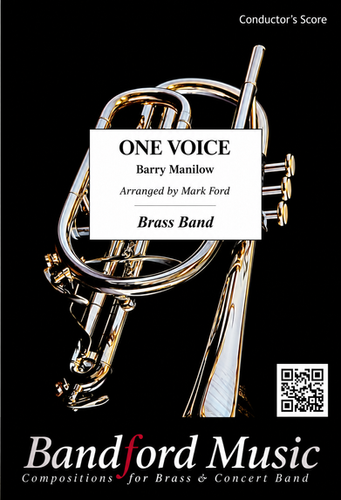
One Voice (Brass Band) Barry Manilow arr. Mark Ford
Originally released in 1979 as the title track of Barry Manilow's sixth studio album, One Voice has become an enduring anthem for unity and social courage. It is a stirring ballad that reminds us how a single, brave voice can ignite a chorus of solidarity and lead the way toward positive change. Expertly crafted for brass band by Mark Ford, this setting captures the intimate, soaring spirit of the original while leveraging the unique textures of the brass band. The piece begins with a delicate, lyrical flugel horn solo, representing the 'single voice' of the title. As the arrangement progresses, the rest of the ensemble joins in, building from a gentle accompaniment into a magnificent, wall-of-sound finale that is sure to leave your audience inspired. To view a rolling score video of the work please visit https://youtu.be/RcQ5xbnyNjs Duration: Approx. 3.15 minutes Difficulty Level: 4th Section + This PDF download includes the full score and parts. Sheet music available at www.brassband.co.uk (UK) or https://satradecentral.org (USA) Instrumentation: Soprano Cornet Eb Solo Cornet Bb Repiano Cornet Bb 2nd Cornet Bb 3rd Cornet Bb Flugel Horn Bb Solo Horn Eb 1st Horn Eb 2nd Horn Eb 1st Baritone Bb 2nd Baritone Bb 1st Trombone Bb 2nd Trombone Bb Bass Trombone Euphonium Bb Bass Eb Bass Bb Timpani Glockenspiel Percussion
In Stock: Estimated dispatch 1-3 working days