
Results
-
 £17.50
The Mansions of Glory (Brass Band - Score only) - Bates, Jonathan
"A young, talented and tender-hearted actress was passing along the street of a large city. Seeing a pale, sick girl lying upon a couch just within the half-open door of a beautiful dwelling, she entered, with the thought that by her vivacity and pleasant conversation she might cheer the young invalid. The sick girl was a devoted Christian, and her words, her patience, her submission and heaven-lit countenance so demonstrated the spirit of her religion that the actress was led to give some earnest thought to the claims of Christianity, and was thoroughly converted and became a true follower of Christ. She told her father, the leader of a theatre troupe, of her conversion and of her desire to abandon the stage, stating that she could not live a consistent Christian life and follow the life of an actress. Her father was astonished beyond measure and told his daughter that their living would be lost to them and their business ruined if she persisted in her resolution. Loving her father dearly, she was shaken somewhat in her purpose and partially consented to fill the published engagement to be met in a few days. She was the star of the troupe, and a general favourite. Every preparation was made for the play in which she was to appear. The evening came and the father rejoiced that he had won back his daughter and that their living was not to be lost. The hour arrived; a large audience had assembled. The curtain rose and the young actress stepped forward firmly, amid the applause of the multitude. But an unwonted light beamed from her beautiful face. Through Christ she had conquered and, leaving the audience in tears, she retired from the stage, never to appear upon it again. Through her influence her father was converted, and through their united evangelistic labours many were led to God."
Estimated dispatch 7-14 working days
-
 £62.00
Set To (Brass Band - Score and Parts) - Turnage, Mark-Anthony - Houlding, Christopher
Set To is dedicated to London Brass and arranged for brass band by Christopher Houlding. It was commissioned by the Aldeburgh Foundation and received its first performance on August 24th 1993 at the Maltings, Snape. Originally divided into two movements, a pensive and richly harmonic Blues and an aptly named Bacchanale, sometimes slow but mostly fast and furious. "I remember playing the original brass ensemble version of "Set To" numerous times in the early nineties with London Brass and always wondered if the composer would consider writing something for Brass Band. As Director of The Guildhall Brass Band, a possible performance opportunity arose in 2010 and I successfully approached Mark and gained his permission to scale it up for brass band with added percussion parts. I conducted the premier of this new Brass Band version at the Guildhall School of Music & Drama in February 2011 with the composer present and he liked it. Although very contemporary compared to most brass music, I feel that Mark's easily accessible style makes this rhythmically quirky and harmonically 'bluesy' work a really interesting concert piece, suitable for any occasion" - Chris Houlding. Duration: 7.30. Suitable for Championship Section Bands
Estimated dispatch 7-14 working days
-
 £43.00
Fugatango (Brass Band - Score and Parts) - Waterman, Steve
Composer and Internationally reknown jazz trumpeter Steve Waterman writes... "When Roger Argente approached me to write a composition for his Spanish flavoured brass project he made the suggestion that a Tango, although more Argentinian than Spanish, would fit in well with the overall concept. I have always been a very big fan of the music of Argentinian composer Astor Piazzolla and particularly the way that the Tango could be combined with jazz. A favourite recording of mine is of Piazzolla himself performing (on the bandoneon) with the jazz saxophonist Gerry Mulligan. As the composing progressed, a fugato also emerged hence the title Fugatango." Originally "Fugatango" featured a french horn improvised introduction section. This new brass band version allows the flugelhorn to enjoy the moment with a wonderful 8 bar solo section, now notated. Later in the work the solo trombone is given a solo section. Duration: 5.30. Suitable for 3rd Section Bands and above.
Estimated dispatch 7-14 working days
-
 £38.00
Inchcolm (Horn Solo with Brass Band - Score and Parts) - Johns, Terry
Inchcolm is an island in the Forth estuary first visited by St Columba in 567 and mentioned in Shakespeare's Macbeth. The ruins of Columba's abbey are regularly shrouded in mist and bring with it a flavour of mystery and legend. Composer and distinguished French horn player Terry Johns (Drac to his friends) was commissioned to write this work for Superbrass and their water influenced 2nd album, Brass Taps. Drac requested that he be allowed to write a solo feature with a proper tune for horn. Kingdom Brass in Scotland premiered Inchcolm in its new brass band form and the solo part is playable by either a tenor or french horn player. Duration: 5.00. Suitable for 2nd Section Bands and above.
Estimated dispatch 7-14 working days
-
 £118.99
Abaddon (The Dark Angel) (Brass Band - Score and Parts) - Houben, Kevin
Abaddon was commissioned by the NLBB (Noord-Limburgse Brassband - North Limburg Brass Band) from Belgium. Abaddon is the demon reigning over the underworld. In the New Testament - in the Book of Revelation by John (9:11) - he is called the angel of the bottomless pit. The work Abaddon lives up to its name. Technically and physically, it holds an enormous challenge for every band in the champions division. The composition has a traditional form structure (fast-slow-fast), and it consists of ornamentations around the letters IVAN, after Ivan Meylemans, the conductor who since 2001 has obtained great successes with the NLBB, and who in this case has also been essential in taming the demon in Abaddon.Suitable for Championship Section BandsDuration: 14:15
Estimated dispatch 7-14 working days
-
£34.95
The Southern Cross (Brass Band - Score and Parts) - Bowen, Brian
The Southern Cross is one of several excellent marches by Brian Bowen in which he carried on the more sophisticated pattern of British marches by Wilfred Heaton, Leslie Condon and Ray Steadman-Allen. It was written for the Box Hill (Australia) Corps jubilee celebrations in 1970 and formed part of the band's repertoire when it toured Great Britain in the same year. The first half of the march features part of the song, 'March on!' by Klaus Ostby, an early pioneer of Salvation Army music in Scandinavia. The contrapuntal layering of melodies in the trio, especially in the finale where 'March on!' sounds one more triumphant time, is notable, as is the shift to a slower, more stately tempo. The harmonic and rhythmic style also represents the more modern sounds of Salvation Army brass band music in the late 1960s and early 1970s. Right from the opening gestures, listeners at early performances knew that a page had turned in the evolution of the Salvation Army march.
Estimated dispatch 7-14 working days
-
£17.50
The Southern Cross (Brass Band - Score only) - Bowen, Brian
The Southern Cross is one of several excellent marches by Brian Bowen in which he carried on the more sophisticated pattern of British marches by Wilfred Heaton, Leslie Condon and Ray Steadman-Allen. It was written for the Box Hill (Australia) Corps jubilee celebrations in 1970 and formed part of the band's repertoire when it toured Great Britain in the same year. The first half of the march features part of the song, 'March on!' by Klaus Ostby, an early pioneer of Salvation Army music in Scandinavia. The contrapuntal layering of melodies in the trio, especially in the finale where 'March on!' sounds one more triumphant time, is notable, as is the shift to a slower, more stately tempo. The harmonic and rhythmic style also represents the more modern sounds of Salvation Army brass band music in the late 1960s and early 1970s. Right from the opening gestures, listeners at early performances knew that a page had turned in the evolution of the Salvation Army march.
Estimated dispatch 7-14 working days
-
 £40.00
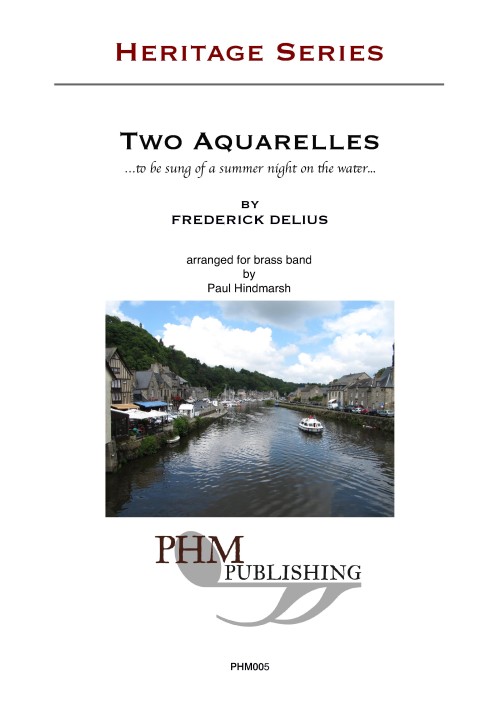
Two Aquarelles (Euphonium Feature with Brass Band - Score and Parts) - Delius, Frederick - Hindmarsh, Paul
In the late spring of 1917, the Bradford born composer, Frederick Delius (1856 - 1934) composed two short part-songs at his home in Grez-sur-Loing. The river ran along the bottom of his garden and he called the two miniatures To be sung of a summer night on the water. The First World War was at its height, but one would never guess that from the languid and serene quality of these richly textured nocturnes. The songs were first heard in London on 28 June, sung by the Oriana Madrigal Society, conducted by Charles Kennedy Scott. In 1932 Delius's amanuensis, Eric Fenby, arranged them for string orchestra as Two Aquarelles. While I have taken Fenby's title, my arrangement is a note-for-note transcription of the choral original. It was prepared in early in 1993 for Besses o' th' Barn Band, of which I was Musical Director at the time. In the second song, the prominent tenor solo has been given to the solo euphonium, who should stand apart from the band in performance.- Paul HindmarshDuration: 5.00
Estimated dispatch 7-14 working days
-
 £43.99
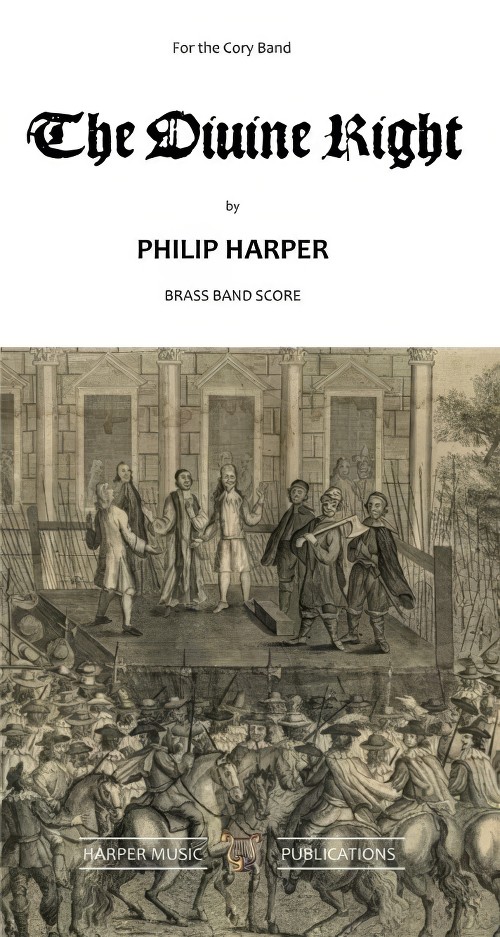
The Divine Right (Brass Band - Score only) - Harper, Philip
At the time of composing this piece, the Arab Spring was sweeping through the Middle East. It seemed that almost every week a new country's people had risen up against the regimes and dictatorships which had prevailed for generations, leaving many nations at a defining crossroads in their history. There were so many possible ways ahead: so many hopes, yet so many uncertainties.This music is a depiction of these revolutionary times, and several musical themes are in turn presented, discussed, considered, fought over, altered, rejected or accepted.Most nations have had, or probably will have, their own Arab Spring, including the United Kingdom. Events of 17th Century Britain provide the context for this piece, particularly those following the execution of the tyrant King Charles I on 30 January 1649. The regicide was in part due to Charless steadfast belief in the Divine Right of Kings, and led to a tumultuous interregnum, where England stood at its own defining crossroads. The music begins turbulently, before King Charles appears and is led to the gallows outside Banqueting House in central London where he is brutally decapitated. From the assembled crowd rose, according to one observer,a moan as I never heard before and desire I may never hear again.The music descends to emptiness.The musical argument which follows is not strictly programmatic, but a number of musical themes are all thrown into the melting pot, representing ideas such as: religion; military force; reasoned Parliamentary debate; and the chattering, irrepressible voice of the people. Additionally, there are some quotations from the music of royalist composer Thomas Tomkins (1572-1656), who was often in tune with the feeling of the times.This defining episode in England's history was brought to a close with the Restoration of the monarchy in 1660, and as the exiled King Charles II rode back into London the diarist John Evelyn wrote:Never was so joyful a day seen in this nation. I stood in the Strand and beheld it, and blessed God.At the end of the piece the bells ring out, and the musical appearance of the King has transformed from turbulent to triumphant.Duration: 17.00
Estimated dispatch 7-14 working days
-
£104.99
The Divine Right (Brass Band - Score and Parts) - Harper, Philip
At the time of composing this piece, the Arab Spring was sweeping through the Middle East. It seemed that almost every week a new country's people had risen up against the regimes and dictatorships which had prevailed for generations, leaving many nations at a defining crossroads in their history. There were so many possible ways ahead: so many hopes, yet so many uncertainties.This music is a depiction of these revolutionary times, and several musical themes are in turn presented, discussed, considered, fought over, altered, rejected or accepted.Most nations have had, or probably will have, their own Arab Spring, including the United Kingdom. Events of 17th Century Britain provide the context for this piece, particularly those following the execution of the tyrant King Charles I on 30 January 1649. The regicide was in part due to Charless steadfast belief in the Divine Right of Kings, and led to a tumultuous interregnum, where England stood at its own defining crossroads. The music begins turbulently, before King Charles appears and is led to the gallows outside Banqueting House in central London where he is brutally decapitated. From the assembled crowd rose, according to one observer,a moan as I never heard before and desire I may never hear again.The music descends to emptiness.The musical argument which follows is not strictly programmatic, but a number of musical themes are all thrown into the melting pot, representing ideas such as: religion; military force; reasoned Parliamentary debate; and the chattering, irrepressible voice of the people. Additionally, there are some quotations from the music of royalist composer Thomas Tomkins (1572-1656), who was often in tune with the feeling of the times.This defining episode in England's history was brought to a close with the Restoration of the monarchy in 1660, and as the exiled King Charles II rode back into London the diarist John Evelyn wrote:Never was so joyful a day seen in this nation. I stood in the Strand and beheld it, and blessed God.At the end of the piece the bells ring out, and the musical appearance of the King has transformed from turbulent to triumphant.Duration: 17.00
Estimated dispatch 7-14 working days
 View Music