
Results
-
 £55.00
Triumph Series Brass Band Journal, Numbers 1387 - 1391, July 2026
1387: March - Temple Foundations (Stephen Gibson)This march was composed for the Newcastle City Temple Band for the official opening of their new church buildings. It features several musical references (Showers of blessing (T.B. 411), I would be thy holy temple (S.A.S.B. 591), Come, ye thankful people, come (S.A.S.B. 9), All the promises of God are sure (S.A.S.B. 893) and Count your blessings (T.B. 183)), opening with the announcement that 'With timbrel and drum, and with flags they come' (N.S.Y.P. January 1977) to commence worship and witness in a new area of the city.1388: Holy Forever (arr. Marcus Venables)This is an arrangement of the popular worship song, written by Brian Johnson, Chris Tomlin, Jason Ingram, Jenn Johnson and Phil Wickham.1389: Goodness of God (arr. Paul Sharman) This is an arrangement of the well-known worship song, written by Ben Fielding, Brian Johnson, Ed Cash, Jason Ingram and Jenn Johnson.1390: The first Nowell (Noel Jones)This is an arrangement of the beautiful carol The first Nowell (C.C. 86). It commences with the motif 'Born is the King' which which is referenced throughout the work and the finishes with the spirited 'Nowell, Nowell, Nowell, Nowell, Born is the King of Israel'.1391: Gloria a Dios (Ian Clarke)Translated into English, the Spanish phrase 'Gloria a Dios' means 'Glory to God'. The style of this music has its roots in the small musical combinations that entertain the crowds in some Latin American towns and villages (many of which are Spanish speaking, hence the title). Once a melodic idea had taken hold, the chorus Jesus saves me now! (S.A.S.B. 478) seemed to fit perfectly, the words and the music complementing each other in this testament of praise.
Estimated dispatch 7-14 working days
-
 £55.00
Triumph Series Brass Band Journal, Numbers 1367 - 1370, November 2024
1367: March - Risen, conquering Son (Noel Jones)Two uplifting Easter songs are featured in this march; Low in the grave he lay (S.A.S.B. 228) with words and music written by Robert Lowry, and Thine is the glory (S.A.S.B. 276) with words by Edmond L. Budry and music by George F. Handel. Both serve as a powerful reminder of the resurrection of Jesus.1368: Horn Solo - O how much he cared for me (Keith Wilkinson)This solo was originally penned for Bandsman Frank Taylor, who plays Solo Horn at Stapleford Citadel Corps. As its basis, it uses the popular hymn No one ever cared for me like Jesus by Charles F. Weigle, a Baptist evangelist who wrote more than a thousand hymns.1369: My Redeemer lives (Olaf Ritman)This arrangement of Reuben Morgan's well-known worship song (S.A.S.B. 223) was first written as an accompaniment for congregational singing and can still be used in that way. It was inspired by the American R&B group Tower of Power and is meant to sound soulful and funky.1370: Selection - With life anew (Mervyn Clarke)This selection features music associated with two hymns; Blessd Saviour, now behold me (S.A.S.B. 575) by William Baugh and Breathe on me, breath of God (S.A.S.B. 294) by Edwin Hatch. Although Edwin Hatch's hymn-writing output was very small, this hymn has seen numerous settings and melodies associated with the words from which the piece takes its title; two of these melodies are featured here in Trentham and Carlisle.
Estimated dispatch 7-14 working days
-
 £38.95
Unity Series Band Journal - Numbers 506 - 509, June 2022
506: Lord of all hopefulness (Gary Rose)The hymn Lord of all hopefulness, Lord of all Joy (S.A.S.B. 772) and its associate tune, Slane, creates a reflective work beautifully penned by Gary Rose507: Carol Arrangement - Glory in the highest (Sam Creamer)This Christmas favourite is given the classic Count Basie big band swing style - a perfect addition to your December concerts.508: Meditation - In Holiness (Dean Jones)Written for Merthyr Tydfil Corps band, this expressive work pieces together the tunes Hereford (T.B. 16) and Beethoven (T.B. 5).509: March - Ellan Vannie (Paul Sharman)The opening statement of this march reference the tune Ellan Vannin (T.B. 366) which gives rise to the title. 'Ellan Vannin' is Manx Gaelic for 'Isle of Man' and this music was written for a musician's weekend at Douglas Corps
Estimated dispatch 7-14 working days
-
 £70.00
General Series Band Journal April 2017 Numbers 2166-2169
Festival March - Faith on track (Andrew Blyth)Originally written for the Peterborough Citadel Band where the composer is the Bandmaster. This march features 'This train is bound for Glory' and 'The Gospel Train' in reference to the association with the City of Peterborough and its strong links with the Railway. Also found is the song 'Share your faith' which speaks of the evangelistic nature of the Corps and its people.Flashpoint (Martin Cordner)Written for The Melbourne Staff Band and featured at the Boundless Congress in 2015, the 'John Williams type' main theme is supplemented with an exciting setting of the song 'I'll stand for Christ'.Wells (Sam Creamer)A simple hymn tune arrangement based on the title of the work.All your anxiety (Brian Hogg)The tune 'All your anxiety' has been given a developed and thoughtful setting by Australian Salvationist Brian Hogg.
Estimated dispatch 7-14 working days
-
 £45.00
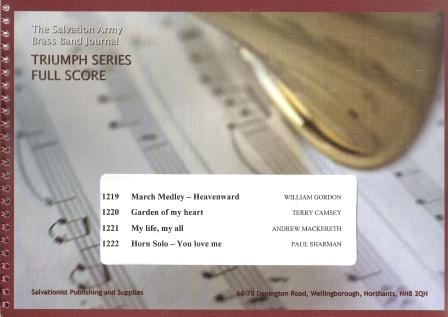
Triumph Series Band Journal November 2011 Numbers 1219-1222
No.1219 March Medley - Heavenward (William Gordon)A variety of songs are used in this up-tempo march medley which potrays the celebration of a life looking forward to an eternity in Heaven. The tunes used are 'When we all get to Heaven', 'When the roll is called up yonder' and 'We shall win'.No.1220 Garden of my heart (Terry Camsey)The publication of this music is, in a small part, a fitting tribute to Major Terry Camsey who was Promoted to Glory in June 2011. The title is taken from the refrain from a much-loved Sidney Cox song; 'Jesus, Jesus, Lily of the valley, Bloom in all thy beauty in the garden of my heart'.No.1221 My life, my all (Andrew Mackereth)This selection attempts to emphasise the personal nature of Christian commitment hence the emphasis given to the words 'my' and 'I' in the songs chosen. The tunes 'Rockingham', 'All I have I am bringing to thee' and 'At thy feet I bow adoring' are included.No.1222 Tenor Horn Solo - You love me (Brian Willetts arr. Paul Sharman)This arrangement was made at the request of David Lynch, Solo Horn player in The International Staff Band. Originally published in April 1993, the song speaks of the fact that, despite the wonder and vastness of God's creation, he still loves each one of us individually.
Estimated dispatch 7-14 working days
-
 £95.00
Tenor Horn Concerto 'Three Gods' (Tenor Horn Solo with Brass Band - Score and Parts)
Edward Gregson's Tenor Horn Concerto (Three Gods) was commissioned by the Belgian tenor horn soloist Tim de Maeseneer for a recording of commissioned works he made in 2024 with his own band, Brass Band Willebroek.The subtitle of 'Three Gods' refers to three mythological Greek Gods: Zeus, Hermes and Apollo. The idea for this came from Gregson's Viola Concerto, which he composed in 2023 and which was similarly subtitled 'Three Goddesses'. Indeed, the first movement of the horn concerto shares some common material with the viola concerto, although the other movements are newly composed.The concerto exploits the noble character of the horn, but the writing is also virtuosic in character as well as lyrical and melodic, demanding an extended playing range of nearly four octaves with a variety of colouration in its sonorities. The unifying motif of the whole concerto is the interval of a rising 5th, heard at the outset. The opening also has some other surprises (both seen and heard).The musical ideas, cast in three separate movements, take their starting point from the characters of the Three Gods in the title:Zeus, ruled as King of the Gods on Mount Olympus, and was the God of Thunder and Lightning and of War. His music is often threatening and violent, but also has a more tender side as portrayed in the lyrical second subject. However, the dominant mood is one of foreboding.Hermes was the great messenger to the Gods who could travel between realms on his winged sandals. Thus, his music is fast, fleet of foot, and mercurial - a dashing scherzo, but with lyrical and expressive moments.Apollo, the God of Music and Dance (and the Sun), symbolises virtue and beauty. This final movement, 'Hymn to Apollo', is mainly slow and hymn-like and cast in a continuous stream of melody passed between soloist and band. Brief fanfares herald a triumphant march, before the music returns to its quiet opening, gradually rising to a triumphant climax with glittering melodic percussion leading the way. The music ends in a blaze of glory!Duration: 17.00
Estimated dispatch 7-14 working days
-
 £29.95
Judd: Christmas Presence
Written for Birmingham Citadel Band to play at their annual carol concert at Symphony Hall, Birmingham, this piece tells the story of the Nativity using the carols 'Who is he?' and 'Calypso Carol' (Christmas Collection 16). Brief appearances are made by the shepherds ('While shepherds watched'), the angels ('Ding dong! merrily on high') and the wise men ('Three kings' march' and 'We three kings of Orient are'). The music finishes with a majestic setting of the chorus of 'Who is he?', reminding us who the baby Jesus is:'Tis the Lord! O wondrous story,'Tis the Lord, the king of Glory!At his feet we humbly fall,Crown him, crown him Lord of all!
Estimated dispatch 7-14 working days
-
 £69.95
Judd: Chain Reaction
March 2017 ReleaseChain Reaction (Philip Wilby)This larger scale work was written for Dr Stephen Cobb and the International Staff Band. It features and develops the song 'To God be the Glory' which brings an exciting challenge to players and is a fine concert work.
Estimated dispatch 7-14 working days
-
 £24.95
Christmas Angels (Brass Band - Score and Parts)
This sparkling music features two carols, 'Angels from the realms of Glory' and 'Masters in this Hall'. Both of them have come down the centuries to us from France but their styles are very different. The march seeks to capture both the choral style of the first and the energetic, dance-like style of the second.
Estimated dispatch 7-14 working days
-
 £34.95
Chalk Farm No.2 (Brass Band - Score and Parts) - Gregson, Edward
Like so many of the best composers for brass band - Eric Ball, Wilfred Heaton, Elgar Howarth and Robert Simpson - Edward Gregson's youthful talents came to the fore in the Salvation Army. In 1975 Gregson was commissioned by the Chalk Farm Band of the Salvation Army to write a march for the centenary of the birth of the band's most long-serving bandmaster Alfred W Punchard, who conducted the band from 1894 to 1944. In 1909 the Salvation Army published a march called Chalk Farm featuring the old Army chorus 'March on, we shall win the day'.Gregson uses the same tune in his Chalk Farm No 2 march, but this is a symphonic march clearly to be played sitting down. He includes irregular bars of 5 and 7 beats as well as a tongue-in-cheek treatment of the tune, complete with bongos (in the march) and bi-tonality (in the trio). Chalk Farm No 2 imaginatively composed. Gregson's own main theme 'fits' the chorus as a counter-subject. The playful irreverence of the style has more in common with Wilfred Heaton's Praise or Glory, than the conventional Salvation Army March.Duration: 4.00
Estimated dispatch 7-14 working days
 View Music