
Results
-
 £30.00
That Moaning Trombone - Carl D Bethel, Sandy Coffin
Comic March One-StepCommissioned by John Wallace, this arrangement of That Moaning Trombone has been crafted by Sandy Coffin through close listening of the available recordings of the Harlem Hellfighters Band. Sandy had been heavily involved with the Historic Brass Society symposium 2017 held in New York and assisted John with his research on this fascinating band and the style of music it generated.Eye-witness accounts refer to the 369th band 'dancing' rather than 'marching'. Above all, in modern performance, finding a 'dancing beat' is crucial to a successful performance of this Ragtime march in order to do justice to the great pioneering work of James Reese Europe.Note the the reckless abandon with which glissando, at that time a novel effect, is used!Look and Listen (courtesy of the Tullis Russell Mills Band):Background to the Harlem HellfightersThe US Army 369th Regiment, made up largely of African-Americans from New York, became known as the Harlem Hellfighters because of the heroic reputation which accrued to them during the actions they engaged in during the First World War in Europe.James Reese Europe was one of the most active African-American composer/musical directors in the pre-war American music scene. The legendary Harlem Hellfighters Band, which he assembled in 1917 from African-American and Puerto Rican musicians, came at an important transitional point in musical history. A new form of music called jazz was emerging from Ragtime and the performing style of Europe's band was immersed in the flow of this new direction.Europe's Harlem Hellfighters influenced and inspired everyone who heard them, including the welcoming crowd when they disembarked in France, bowled over by their swinging rendition of La Marseillaise. Reese Europe became a war hero, commanding a machine-gun unit as well as the band.On return from War in 1919 the band led a ticker-tape parade along Fifth Avenue in New York and soon made about 30 shellac recordings. These recordings display some of the fingerprints of their performing style: ragging, improvising, muting, wailing, smearing (their word for glissando) - and from the evidence of their recordings they took the printed page as a blueprint for individuality.In May 1919 during the Hellfighters' triumphant coast-to-coast tour after their return, James Reese Europe was tragically murdered, bringing to premature close, at the age of 39, the work of a great musical innovator.
In Stock: Estimated dispatch 3-5 working days
-
 £30.00
The St Louis Blues - Sandy Coffin, W C Handy
Two-Step MarchCommissioned by John Wallace, this arrangement of The St Louis Blues has been crafted by Sandy Coffin through close listening of the available recordings of the Harlem Hellfighters Band. Sandy had been heavily involved with the Historic Brass Society symposium 2017 held in New York and assisted John with his research on this fascinating band and the style of music it generated.Eye-witness accounts refer to the 369th band 'dancing' rather than 'marching'. Above all, in modern performance, finding a 'dancing beat' is crucial to a successful performance of this Ragtime march in order to do justice to the great pioneering work of James Reese Europe.Note the flutter-tonguing and use of muting, the counter-melody in soprano cornet, and the wilder and yet wilder nature of each repetition of the Chorus.Look and Listen:Background to the Harlem HellfightersThe US Army 369th Regiment, made up largely of African-Americans from New York, became known as the Harlem Hellfighters because of the heroic reputation which accrued to them during the actions they engaged in during the First World War in Europe.James Reese Europe was one of the most active African-American composer/musical directors in the pre-war American music scene. The legendary Harlem Hellfighters Band, which he assembled in 1917 from African-American and Puerto Rican musicians, came at an important transitional point in musical history. A new form of music called jazz was emerging from Ragtime and the performing style of Europe's band was immersed in the flow of this new direction.Europe's Harlem Hellfighters influenced and inspired everyone who heard them, including the welcoming crowd when they disembarked in France, bowled over by their swinging rendition of La Marseillaise. Reese Europe became a war hero, commanding a machine-gun unit as well as the band.On return from War in 1919 the band led a ticker-tape parade along Fifth Avenue in New York and soon made about 30 shellac recordings. These recordings display some of the fingerprints of their performing style: ragging, improvising, muting, wailing, smearing (their word for glissando) - and from the evidence of their recordings they took the printed page as a blueprint for individuality.In May 1919 during the Hellfighters' triumphant coast-to-coast tour after their return, James Reese Europe was tragically murdered, bringing to premature close, at the age of 39, the work of a great musical innovator.
In Stock: Estimated dispatch 3-5 working days
-
Sharpe's Theme - John Tams & Dominic Muldowney - Len Jenkins
"Sharpe" is a popular British series of television dramas starring Sean Bean as Richard Sharpe, a fictional British soldier in the Napoleonic Wars, principally in Spain, Portugal and France. His activities and adventures are based on a number of novels by Bernard Cornwell, which reflect the military campaigns of the Duke of Wellington (as he became) and were filmed mainly in Turkey and Crimea, although some filming was also done in England, Spain and Portugal. This music, composed by John Tams and Dominic Muldowney, contains two aspects of the series; the iconic introductory signature tune and the equally familiar 'Over the Hills and Far Away' originally sung by John Tams (who also acted in the series) which features in the closing scenes of each episode. This arrangement is within the capabilities of a good 4th section brass band.
-
Dance On (Je me sens bien aupres de toi) - Adams, Murtagh, Murtagh & Stellman - Len Jenkins
"Dance On" is probably best remembered in the UK by two versions. One by the Shadows which went to Number 1 in the UK Singles chart and the other by Kathy Kirby which made number 11 in the 1963 UK charts. The other side of the Channel, in France, Petula Clark recorded the song in French ("Je me sens bien aupres de toi") and Italian ("Sto volentieri con te") which made the Top 5 of the French and Italian charts. She also recorded an English version for album release on the Canadian market. The infectious rhythm will get you tapping your feet or even getting up to dance. It's a real bopping number from the 60's, and well within the capabilities of most bands. Enjoy.
-
Ah! Les Crocodiles - French Traditional - Lennox Rhodes
'Ah! Les crocodiles' is a popular children's song in France. The song has been around since at least 1860 and relates the adventures of an Egyptian crocodile going to war against Elephants. It has a very catchy tune! This nineteenth-century nursery rhyme is derived from Jacques Offenbach's song Hooray for the Crocodile, part of the "Tromb-al-ca-zar ou les Criminels dramatiques", premiered in April 1856.
-
 £74.95
A Portrait of Paris (Cornet and Euphonium Duet with Brass Band)
A Portrait of Paris was written for Alexis Demailly and Bastien Baumet of the Paris Brass Band. The three movements, Promenade (aux Champs-Elysees), Sur La Seine and Tour de France, are the composer's musical impressions of some of the city's landmarks and events (with occasional references to a famous Parisian composer thrown in for good measure...)
Estimated dispatch 7-14 working days
-
 £144.99
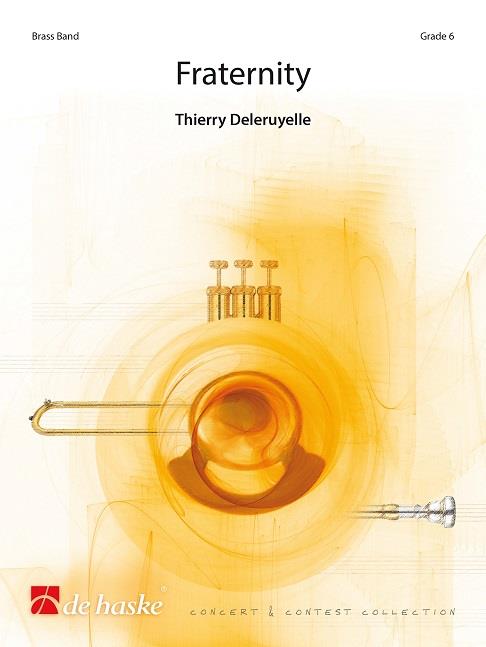
Fraternity (Brass Band - Score and Parts)
This piece by Thierry Deleruyelle is based on one of the most significant events in the history of coal mining; the catastrophe at Courrieres, Northern France. It took place on 10th March 1906 and is considered the most momentous mining accident in Europe and the second most significant in the world. This work is both emotional and spectacular and tells in 7 contrasting sections the catastrophe that occurred. Fraternity was the test piece in the Champion category at the European Brass Band Competition 2016 in Lille, thus commemorating 110 years since the disaster at Courrieres.Duration: 15:45
Estimated dispatch 7-14 working days
-
£26.99
Fraternity (Brass Band - Score Only)
This piece by Thierry Deleruyelle is based on one of the most significant events in the history of coal mining; the catastrophe at Courrieres, Northern France. It took place on 10th March 1906 and is considered the most momentous mining accident in Europe and the second most significant in the world. This work is both emotional and spectacular and tells in 7 contrasting sections the catastrophe that occurred. Fraternity was the test piece in the "Champion" category at the European Brass Band Competition 2016 in Lille, thus commemorating 110 years since the disaster at Courrieres.Duration: 15:40
Estimated dispatch 7-14 working days
-
£11.99
Fraternity (Brass Band - Study Score)
This piece by Thierry Deleruyelle is based on one of the most significant events in the history of coal mining; the catastrophe at Courrieres, Northern France. It took place on 10th March 1906 and is considered the most momentous mining accident in Europe and the second most significant in the world. This work is both emotional and spectacular and tells in 7 contrasting sections the catastrophe that occurred. Fraternity was the test piece in the Champion category at the European Brass Band Competition 2016 in Lille, thus commemorating 110 years since the disaster at Courrieres.Duration: 15.40
Estimated dispatch 7-14 working days
-
 £45.00
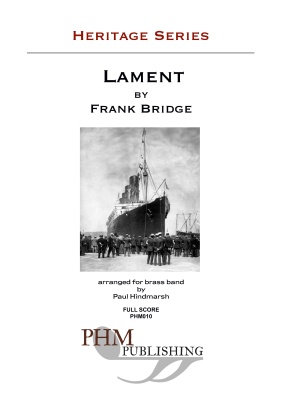
Lament (Brass Band - Score and Parts)
The English composer Frank Bridge (1879 - 1941) did not take an active part in the First World War. However, he was devastated by the slaughter on the western and the eastern fronts, especially the loss of so many of his musicians friends and colleagues. Writing in 1963, his former pupil Benjamin Britten confessed that 'a lot of my feelings about the First World War which people seemed to see in the War Requiem came from Bridge. He had written a piano sonata in memory of a friend killed in France and though he didn't encourage me to take a stand for the sake of a stand, he did make me argue and argue and argue. His own pacifism was not aggressive, but typically gentle'.Bridge composed this Lament for string orchestra on 14 June 1915, in memory of Catherine Crompton, who drowned when the Cunard liner Lusitania was torpedoed by a German submarine on 7 May, 1915. According to figures researched by Liverpool historian Kevin Roach (www.lusitania.net), 1201 men, women and children lost their lives out of the 1962 people aboard. Ninety-four children died, including Catherine, her twin brother Paul and four other siblings. Paul Crompton, Snr. (44), a British businessman working in Philadelphia, his wife Gladys (40) and the family nanny were also drowned. How Bridge's dedication came about is uncertain. The music critic Edwin Evans, who knew Bridge well, has written that the Catherine was a young friend. It is also possible that he came across the family photograph which was published in many newspapers in the wake of the tragedy. By that time, Bridge was greatly distressed by the war as a whole. It seems perfectly in keeping with his pacifist leanings and the strength of his reaction, that this poignant and deeply touching 'war memorial' should mourn a child who he did not know, rather than one of the thousands of young men who fell in battle.Through the musical tears of this melancholy lullaby, Bridge may have regarded the death of young Catherine Crompton as symbolic of the loss of so many innocent lives in wartime. His response to this personal tragedy was characteristically spontaneous and utterly sincere. It is one of his most effective miniatures, poignant yet restrained in its lyrical beauty, with a compelling directness and simplicity of construction.This brass band transcription is pitched one tone lower than the original for string orchestra.- Paul HindmarshDuration: 5.00
Estimated dispatch 7-14 working days