
Results
-
£60.00
Enchantment in Paris - Offenbach, J - Harper, P
To commemorate the 200th Anniversary of the famous cornetist Jean-Baptiste Arban's birth in 2025, Philip Harper arranged this pastiche cornet solo in the style of great air-varies of the 19th century.Using a lilting melody from Offenbach's La Vie Parisienne, there are four variations of increasing complexity.A great challenge for your principal cornet, and an absolute knock-out in your concerts.2nd section + (accompaniment) Championship (soloist)Duration 5 minutes
In Stock: Estimated dispatch 1-3 working days
-
£30.00
Enchantment in Paris (Score) - Offenbach, J - Harper, P
To commemorate the 200th Anniversary of the famous cornetist Jean-Baptiste Arban's birth in 2025, Philip Harper arranged this pastiche cornet solo in the style of great air-varies of the 19th century.Using a lilting melody from Offenbach's La Vie Parisienne, there are four variations of increasing complexity.A great challenge for your principal cornet, and an absolute knock-out in your concerts.2nd section + (accompaniment) Championship (soloist)Duration 5 minutes
In Stock: Estimated dispatch 1-3 working days
-
£38.50
Intrada - Farr, R
Based on the Chorale 'Ein' Feste Burg' (A Safe Stronghold) by Martin Luther this song became a battle song for the Reformation. The setting contrasts the piety of the chorale with modern rhythms and harmonies in a dramatic and daring presentation.The piece works best with four trombones but small note 'cues' are provided. The cornets should be divided into three groups, spread as widely as is practical.
In Stock: Estimated dispatch 1-3 working days
-
£40.00
Lionheart - Harper, P
Lionheart was commissioned by the British Federation of Brass Bands for the 2007 European Brass Band Championships held at the Symphony Hall, Birmingham, and first performed at the Gala Concert by the European Youth Brass Band. It is a triumphant concert opener of about four minutes duration playable by second, first and championship bands.2nd section +
In Stock: Estimated dispatch 1-3 working days
-
£33.00
The Lonely Ballerina - Carr, M - Broadbent, D
Featuring four cornets
In Stock: Estimated dispatch 1-3 working days
-
£33.00
Love is all around - Presley, R - Barry, D
Recorded by the English band 'The Troggs' it was written by lead singer Reg Presley. The song was first released as a single in the UK in October 1967, peaking at number 5.It has been covered by many artists over the years, from REM to Wet Wet Wet. Famously used as the cover song for the 1994 film 'Four Weddings & a Funeral' it became an international hit and remained at number 1 in the UK for 15 consecutive weeks.A hit with all ages!
In Stock: Estimated dispatch 1-3 working days
-
 £95.00
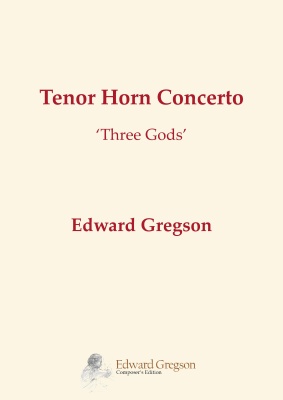
Tenor Horn Concerto 'Three Gods' (Tenor Horn Solo with Brass Band - Score and Parts)
Edward Gregson's Tenor Horn Concerto (Three Gods) was commissioned by the Belgian tenor horn soloist Tim de Maeseneer for a recording of commissioned works he made in 2024 with his own band, Brass Band Willebroek.The subtitle of 'Three Gods' refers to three mythological Greek Gods: Zeus, Hermes and Apollo. The idea for this came from Gregson's Viola Concerto, which he composed in 2023 and which was similarly subtitled 'Three Goddesses'. Indeed, the first movement of the horn concerto shares some common material with the viola concerto, although the other movements are newly composed.The concerto exploits the noble character of the horn, but the writing is also virtuosic in character as well as lyrical and melodic, demanding an extended playing range of nearly four octaves with a variety of colouration in its sonorities. The unifying motif of the whole concerto is the interval of a rising 5th, heard at the outset. The opening also has some other surprises (both seen and heard).The musical ideas, cast in three separate movements, take their starting point from the characters of the Three Gods in the title:Zeus, ruled as King of the Gods on Mount Olympus, and was the God of Thunder and Lightning and of War. His music is often threatening and violent, but also has a more tender side as portrayed in the lyrical second subject. However, the dominant mood is one of foreboding.Hermes was the great messenger to the Gods who could travel between realms on his winged sandals. Thus, his music is fast, fleet of foot, and mercurial - a dashing scherzo, but with lyrical and expressive moments.Apollo, the God of Music and Dance (and the Sun), symbolises virtue and beauty. This final movement, 'Hymn to Apollo', is mainly slow and hymn-like and cast in a continuous stream of melody passed between soloist and band. Brief fanfares herald a triumphant march, before the music returns to its quiet opening, gradually rising to a triumphant climax with glittering melodic percussion leading the way. The music ends in a blaze of glory!Duration: 17.00
Estimated dispatch 7-14 working days
-
 £15.99
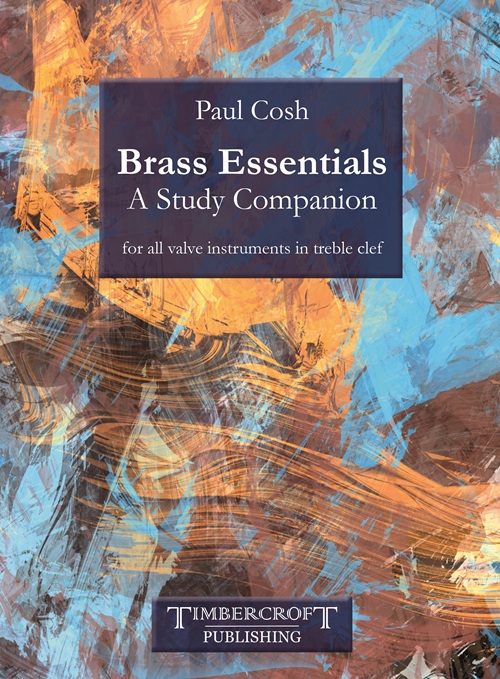
Brass Essentials - An Study Companion (for all valve instruments in treble clef)
This book of 32 studies has been drawn from those Paul Cosh used as a student at the Royal Academy of Music, throughout his years as a professional player and as a teacher at the Guildhall School of Music & Drama.The studies are divided into four main sections: Articulation, Finger Technique, Lyrical & Flexibility and Stamina & Technique and are drawn from those written by Arban, Charlier, Boehme, Brandt, Kopprasch and Sachse. Some of the studies have been re-imagined and edited to include new tempi and expression.There are helpful tips at the start of each section with most of the studies given suggested practice and performance tempi, although these are just a guide. Slow practise of the highly technical passages is vital to adhere to the overriding principle that every note counts.The Brass Essentials Study Companion can also work in conjunction with both the Brass Essentials: Arban Companion and the Brass Essentials: Practice Companion to vary your practice diet.
Estimated dispatch 7-14 working days
-
 £74.95
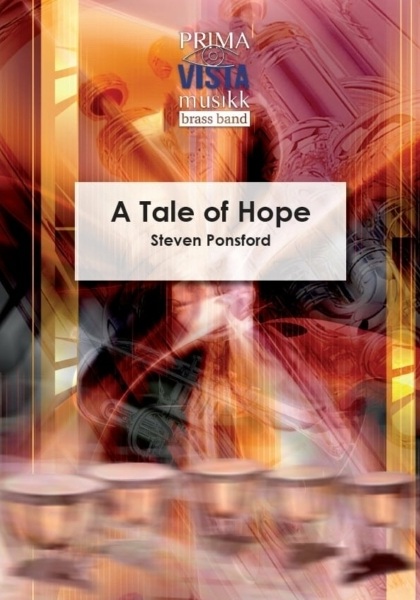
A Tale of Hope (Brass Band - Score and Parts)
The piece tells the story of Chicago lawyer and Presbyterian church elder Horatio Gates Spafford. In 1873, the Spafford family planned a vacation to England, but last-minute business demands prevented Horatio from sailing with them. Tragedy struck when the ship collided with an iron sailing vessel while crossing the Atlantic, killing 226 people, including all four of Spafford's daughters. His wife, Anna, survived the tragedy, and upon arriving in Cardiff, Wales, she sent a telegram to Spafford that simply read "Saved alone." Shortly afterwards, as Spafford travelled to meet his grieving wife, he was inspired to write the hymn It Is Well with My Soul as his ship passed near where his daughters had died. The hymn was subsequently set to music by fellow American Philip Bliss, with the tune named after the ship on which Spafford's daughters died, Ville du Havre.Composer Steven Ponsford has chosen to portray this story in a substantial composition for brass band. Much of the early music is turbulent, reflecting the long voyage, and then the disaster that claimed Spafford's daughters. After a darker 'Grave' section, the hymn It Is Well With My Soul softly emerges, with the piece ending on a note of optimism and hope.Duration: 11.30
Estimated dispatch 7-14 working days
-
£31.95
A Tale of Hope (Brass Band - Score only)
The piece tells the story of Chicago lawyer and Presbyterian church elder Horatio Gates Spafford. In 1873, the Spafford family planned a vacation to England, but last-minute business demands prevented Horatio from sailing with them. Tragedy struck when the ship collided with an iron sailing vessel while crossing the Atlantic, killing 226 people, including all four of Spafford's daughters. His wife, Anna, survived the tragedy, and upon arriving in Cardiff, Wales, she sent a telegram to Spafford that simply read "Saved alone." Shortly afterwards, as Spafford travelled to meet his grieving wife, he was inspired to write the hymn It Is Well with My Soul as his ship passed near where his daughters had died. The hymn was subsequently set to music by fellow American Philip Bliss, with the tune named after the ship on which Spafford's daughters died, Ville du Havre.Composer Steven Ponsford has chosen to portray this story in a substantial composition for brass band. Much of the early music is turbulent, reflecting the long voyage, and then the disaster that claimed Spafford's daughters. After a darker 'Grave' section, the hymn It Is Well With My Soul softly emerges, with the piece ending on a note of optimism and hope.Duration: 11.30
Estimated dispatch 7-14 working days
 View Music