
Results
-
 £29.95
Ye Joyous Bells in Heaven - Jonathan Bates
'Ye Joyous Bells in Heaven' was composed for the Thurlstone Brass Band near Sheffield in memory of their band's stalwart John Wilmot. The Sheffield area is synonymous for it's local musical culture and melodies, and one of these - Stannington, was a particular favourite of John's. This short and bustling concert work is a joyous fantasy on the melody, with short solo features for a number of players within the band.
In Stock: Estimated dispatch 1-3 working days
-
 £34.99
Submerged... (Cornet Concerto No.2) - Jonathan Bates
'Submerged..' is a virtuoso concerto for Cornet composed as a response to the 'lost' Derbyshire villages of Ashopton & Derwent,. both of which were drowned in the early 1940's to make way for a new reservoir to aid the ever-increasing water demand from nearby. Sheffield and it's steel industry during World War 2. The work is through-composed but is defined by 3 clear main sections, 'The . Packhorse Bridge, Derwent', 'Ashopton Chapel' and 'Operation Chastise'. Much of the melodic and harmonic material throughout the. concerto is inspired by 3 contrasting sources; an original motif of towering block chords which opens the concerto, the famous opening. fragment of Eric Ball's 'High Peak' (1969) which was composed as a tribute to the district of Derbyshire where Ashopton & Derwent lie, . and finally Claude Debussy's haunting 'La Cath drale Engloutie' or 'The Sunken Cathedral', which was composed in 1910 around the legend of. the submerged cathedral of Ys. . I. Packhorse Bridge, Derwent (1925). One of the most striking features of the former village of Derwent was it's Packhorse Bridge, which spanned the River Derwent. adjacent to the Derwent Hall - a grand, picturesque Jacobean country house. In 1925, the renowned impressionist artist Stanley. Royle painted a striking image of the two in midwinter, with the partially frozen river sat quietly underneath the snow-topped. bridge in the foreground, while the old hall sits peacefully and dark in the background. The opening setion of this concerto paints. this picture in a quite schizophrenic manner; with frosty, shrill march-like material picturing the villagers crossing the narrow icy. bridge, combined with wild and frenzied waltz music of the grand hall and it's masquerade balls laying, for now, quietly mysterious. across the river. . II. Ashopton Chapel (1939). Ashopton was much the smaller and less-populated of the 2 'lost' villages, but still bore home to a Roman Catholic Chapel which was. the focal point of the village. The chapel - along with the rest of Ashopton - was drowned in 1943, but the final service to take place there. was held in 1939, with the final hymn being 'Day's Dying in the West'. This hymn forms a haunting coda to the 2nd section, with firstly the . piano leading the melody before an audio track containing an old recording of the hymn is accompanied by the sound of flowing water and . the rumble of storms as the village hypothetically disappears from existence with the hymn tune still echoing around the valley, before . subsiding into the growing roar of the engine of a Lancaster Bomber as it soars overhead towards Derwent to practise it's 'Dam-Buster' raid. . III. Operation Chastise (1943). The Derwent Reservoir lies adjacent to Ladybower Reservoir (of which Ashopton & Derwent were flooded to make way for) in the . Derbyshire High Peak, and during the 2nd World War was used as one of the central low-atitude practise areas of the 617 Squadron - more . commonly known affectionately as the 'Dambusters'. Before the destruction of Derwent, it's 'Packhorse Bridge' was dismantled stone by stone . and re-assembled upstream at Howden Dam to the north end of Derwent Reservoir. This is where the music begins, with a reconstruction of . the opening material before taking flight into a whirlwind tour of virtuosity from the soloist. .
In Stock: Estimated dispatch 1-3 working days
-
 £30.00
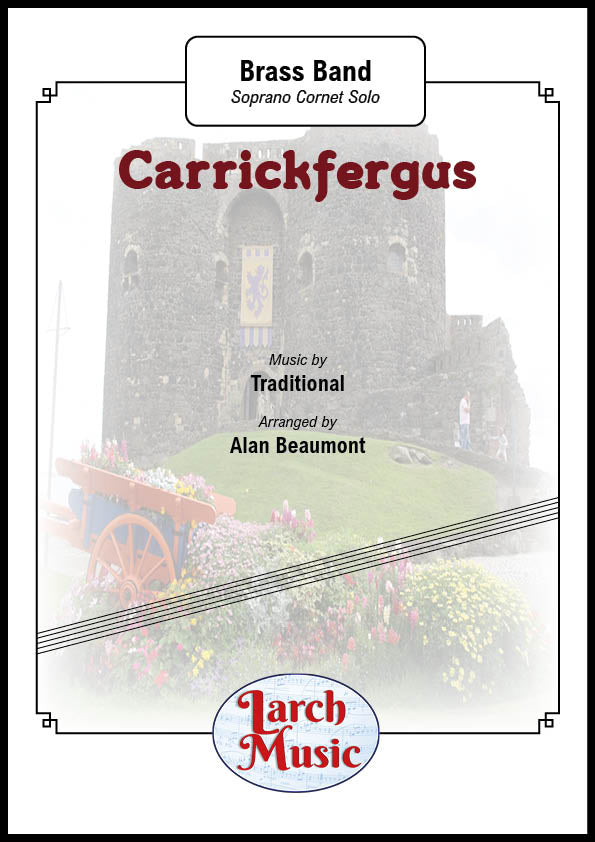
Carrickfergus - Soprano Cornet & Brass Band Sheet Music Full Score & Parts - LM399
COMPOSER: TraditionalARRANGER: Alan BeaumontThe famous Irish tune given a fresh solo approachBrass Band Sheet Music Full Score & Parts"Carrickfergus" is a famous Irish folk song and traditional lament, often interpreted as a heartfelt ballad oflost love, loneliness, and a deep, aching longing for one's home or a past life. Named after the town in County Antrim, Northern Ireland, it features lyrics about a wanderer reflecting on unattainable love, often evoking themes of emigration, old age, and nostalgia.LM399 - ISMN : 9790570003990
In Stock: Estimated dispatch 3-5 working days
-
 £30.00
Dark Lochnagar - Flugel Horn & Brass Band - Full Score & Parts - LM738
COMPOSER: TraditionalARRANGER: David BealA beautiful setting of this Scottish Traditional tuneFeatures Flugel Horn in a lyrical playing style
In Stock: Estimated dispatch 3-5 working days
-
 £25.00
Eloise (Paul Ryan arr. David Beal) (The Damned - Barry Ryan) - Brass Band Sheet Music Full Score & Parts - LM368
COMPOSER: Paul RyanARRANGER: David BealISMN : 9790570003686UK SALES ONLYPDF DOWNLOAD - NOT AVAILABLE DUE TO COPYRIGHTSuperb Opener or closer for your next Concert!A great brass band title suitable for most bandsPROGRAMME NOTESBarry Ryan - 1968"Eloise" is a song first released in 1968 on theMGMlabel.It was sung byBarry Ryan, and written by histwinbrotherPaul Ryan.Running for over five minutes, it features strongorchestration,melodramaticvocals, and a brief slowinterlude.It sold three million copies worldwide,and reached No. 2 in theUK Singles Chartas published byRecord Retailer,but hit No. 1 in theNMEandMelody Makercharts.It topped the chart in 17 countries,including Italy,the Netherlandsand Australia.The single was released as "Barry Ryan with the Majority".The Majority were a pop band, who for a period, were the backing band for Ryanand who, after renaming to Majority One, had some success in Europe.Ryan also released an Italian-language version of the song,"Eloise (Versione Italiana)", in 1968.After not being able to cope with the success of some of his hits as a duo with Barry,Paul decided to take a step away from the limelight and to concentrate on songwriting."Eloise" was the second song he wrote and was influenced byRichard Harris'arrangement of "MacArthur Park"after listening to a rough mix of it at a party at Harris' house.After listening to it, Paul locked himself away and wrote "Eloise" in three days.The Damned - 1986In January 1986, the non-album single "Eloise",a cover version of the 1968 hit byBarry Ryan,was a No.3 chart success in the UK,the band's highest chart placing to date.LM368 - ISMN : ISMN : 9790570003686
In Stock: Estimated dispatch 3-5 working days
-
 £30.00
Hamilton (An American Musical) - Brass Band - LM986
COMPOSER: Lin-Manuel MirandaARRANGER: Stephen JoyUK sales onlyThis arrangement is based on the popular Broadway musical.Hamilton: An American Musicalis asung-and-rapped-throughmusical byLin-Manuel Miranda. It tells the story of AmericanFounding FatherAlexander Hamilton.Miranda said he was inspired to write the musical after reading the 2004 biographyAlexander HamiltonbyRon Chernow. The show draws heavily fromhip hop, as well asR&B,pop,soul, andtraditional-style show tunes.It castsnon-whiteactors as the Founding Fathers and other historical figures.Miranda describedHamiltonas about "America then, as told by America now.A great sounding arrangement with complex rhythms and motifs.FEATURES THE FOLLOWING SONGSAlexander HamiltonHelplessHistory Has Its Eyes On YouThe Room Where It HappensThat Would Be EnoughYou'll Be BackAlexander Hamilton (Reprise)8 1/2 minutes of pure musical magicSorry UK sales onlyLM986 - ISMN : 9790570009862
In Stock: Estimated dispatch 3-5 working days
-
 £69.95
Heroes of the North (Peter Graham)
Heroes of the North(Peter Graham)Gramercy Music | 10 minutesHeroes of the North was commissioned by Henning Annundsen for Skodvin Skulemusikk and pays tribute to the development of brass band activity in the Nordhordland region of Norway.The music is a set of character variations based upon personalities long associated with both the band and the region. The opening 5 note motif (C D E F G) might be considered the starting point for beginner brass students, and this mini-theme is developed throughout the work.Five variations follow:-Mr Brevik's Galop(representing Tom Brevik, a key figure in Norwegian brass band music)-Frode's Dance(with apologies to Edvard Grieg), portraying soprano cornet player Frode Rydland, one of Skodvin Skulemusikk's most famous "old boys"-Mr Bjorge's Walkrepresenting Viggo Bjorge, "Mr Eikanger Bjorsvik Band"-Hymn for Knut-Harald, known as "Mr Skodvin Skulemusikk" having over many years played a central role in the teaching and training of the band-Maestro Snell's Russian Adventurefeatures music with more than a hint of Russian (Khachaturian to be precise) and calls to mind Howard Snell whose arrangements and presence have made such a huge contribution to Norwegian Brass Banding over many years.
In Stock: Estimated dispatch 3-5 working days
-
 £90.00
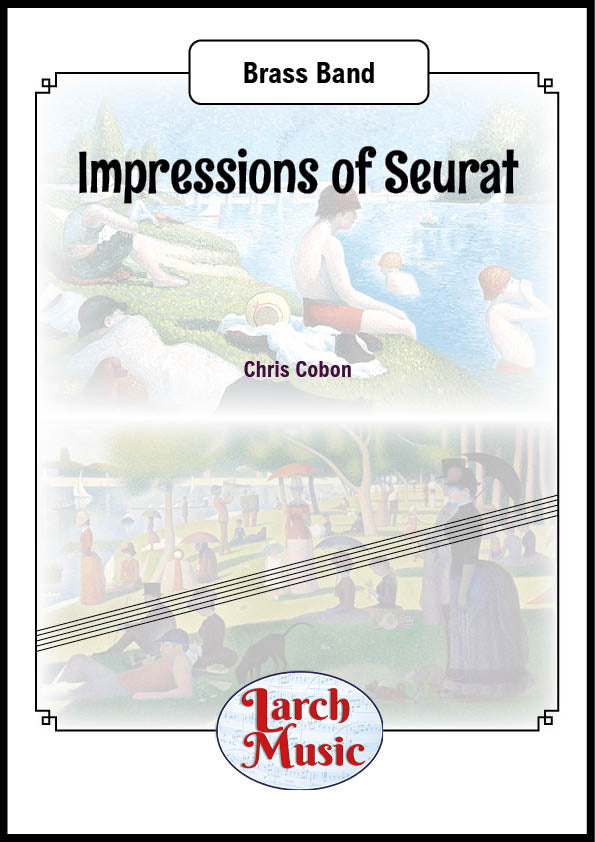
Impressions of Seurat (Chris Cobon) - Brass Band Full Score and Parts - LM482 - Chris Cobon
COMPOSER: Chris Cobon1 - Stone breakersThe Suite opens with the only picture, of the five, which is not in the pointillist style. Several pictures were produced on the Stone Breaker theme, painted in oil on small panels called croquetons. The subjects in the art are breaking stones for use in road building. Musically the piece starts canonically alluding to the repetitive nature of the labour. A more direct, rhythmic link of three hammer blows, are first heard in the opening passages in the percussion. These hammer blows are also built into each third bar of the cannon and, therefore, become embedded into the opening section. Arising from the flurry of activity are two, three bar legato phrases in a majestic style until it falls to a more dramatic sounding of the legato phrase over a resounding of the cannon in a new textural order. This leads to a short, new section, featuring a trombone trio underneath rising scales in the cornet section.2: Bathers at AsnieresBathers at Asnieres was Seurat's first major painting...The canvas is of a suburban, Parisian riverside scene. Isolated figures, with their clothes, piled sculpturally on the riverbank, together with trees, austere boundary walls and buildings, and the River Seine are presented in a formal layout. This moment aims to capture the tranquillity of a summer's day in the park. This painting led the development of the pointillist technique whereby the colours were applied as small dots that combine to form a picture when viewed at a distance. The trombones capture this idea in the opening bars with their carillon-style entries. The 2nd/3rd cornets make a more direct link by individual picking out single notes of a melody being sounded on Baritones and trombones at C. The use of mutes adds a subtle darker side to this movement which nods to the industrial working-class aspects of the painting.3: White DogWhite Dog features a few characters relaxing in the sun, and a white dog with its tail held high. Having two dogs myself, I've taken the idea of an excited dog with a waggy tail as the basis for this short, middle, movement.4: Sunday Afternoonon the Island of La Grande Jatte Sunday Afternoon on the Island of La Grande Jatte is arguably Seurat's most famous work.5: Parade de CirqueCircus Sideshow Parade de Cirque encompasses a circus scene's boisterousness, vitality and chaos. However, the painting, constructed with the new pointillist technique, also portrays stillness, calmness and precision. As expected from looking at the picture, the trombone takes centre stage in various locations on either side of the calming circus waltz and pointillist section (I).LM482ISMN : 9790570004829
In Stock: Estimated dispatch 3-5 working days
-
 £30.00
Ode To Joy - Brass Band & Choir - LM906
COMPOSER: BeethovenARRANGER Brian HarperA great addition to the brass band repertoire from Brian HarperFeatures full band with Choir (Soloists as well!)One for your next choir and band concert
In Stock: Estimated dispatch 3-5 working days
-
 £21.50
Reelin' In The Years - Brass Band - LM768
COMPOSER: Walter Becker & Donald FagenARRANGER: Stephen Joy"Reelin' In the Years" (sometimes "Reeling In the Years") is a song by Jazz/rock band Steely Dan, released as the second single from their 1972 album, Can't Buy A Thrill, It reached number 11 in theBillboard ChartsThe song was written by Donald Fagen and Walter Becker and features Fagen on vocals. The song was also a No. 11 hit on the Pop singles chart in 1973. In March 2005,Q magazineplaced the song at number 95 in its list of the 100 Greatest Guitar Tracks. Led Zeppelin guitarist Jimmy Page has reportedly said that Elliott Randall's guitar solo on "Reeling In the Years" is his favorite solo of all time. That solo was also ranked the 40th best guitar solo of all time by the readers ofGuitar Worldmagazine.
In Stock: Estimated dispatch 3-5 working days


