
Results
-
£40.00
Fanfare - John Woolrich
This lively Fanfare was composed in 1994 for the brass band of the Guildhall School of Music and Drama Junior Department, which gave the first performance on 4 July 1994.Brass Band Grade 3: Youth and 4th SectionDuration: 4 minutes
In Stock: Estimated dispatch 1-3 working days
-
£50.00
Liberty Fanfare (Score & Parts) - John Williams
Liberty Fanfare is one of John Williams' lesser-known works, simply because it is not a film theme! In fact, the orchestral original was written for the re-opening of the Statue of Liberty following extensive repairs. This took place 4th July 1986, hence the music's sense of celebration and national pride. Brass Band Grade 4: Advanced Youth and 3rd Section Duration: 5 minutes
In Stock: Estimated dispatch 1-3 working days
-
 £33.09
Les Chasseresses from 'Sylvia' (Brass Band) Delibes arr. Rob Bushnell
Clement Philibert Leo Delibes was a French composer, best known for his ballets and operas, including works such as Lakme (with its famous "Flower Duet"), Coppelia and Sylvia (both key works in the development of modern ballet). The latter started as a play, Aminta, by the Italian poet Torquato Tasso, which Delibes set to music. It was then adapted for the Paris Opera with rehearsals starting in August 1875. The premiere took place on 14 June 1876 and was the first ballet to be shown at the newly-built Opera Garnier. Whilst the scenery and costumes were created by top artists and designers (Cheret and Lacoste), it was Delibes's music that shown thrown, being said to have saved the production, preventing the ballet from drifting into obscurity.Sylvia is said to be one of the first modern ballets, with Tchaikovsky remarking to composer Sergei Taneyev upon its ingenuity: "... the first ballet, where the music constitutes not only the main, but the only interest. What charm, what elegance, what richness of melody, rhythm, harmony." Although Swan Lake, a contemporary to Sylvia, is considered one of the best ballets there is, Tchaikovsky preferred Sylvia to his own work, saying Swan Lake was "poor stuff in comparison". Tchaikovsky said to Taneyev, "I was ashamed. If I had known this music early then, of course, I would not have written Swan Lake". The music to Sylvia, rather than setting only the mood, also sets the action and is noted for its use of leitmotifs - Delibes was an admirer of Wagner - and more dominant use of brass and wind. The most famous piece from this ballet is the Pizzicati in the third act.Act I of the ballet takes place in sacred wood, where creatures are worshipping before Eros when Sylvia arrives with her huntresses to mock the god of love. Aminta, a lowly shepherd and infatuated with Sylvia, protects the deity and Sylvia is wounded by Eros's arrow. The hunter Orion kidnaps Sylvia, whilst Eros revives Aminta. Act II takes place in Orion's Island cave, where Sylvia tries to bribe Orion with jewels and wine. Unsuccessful, she appeals to Eros for help, who arrives and takes her to the temple of Diana (where the final act takes place). Orion and Aminta fight, Sylvia and Orion cause the goddess of the hunt, Diana, to be outraged, smiting Orion and denying the love of Aminta and Sylvia. Eros shows Diana a vision, which changes her mind and the couple finally come together.This brilliant and lively fanfare that introduces the huntresses in the first act is arranged here for the UK-style brass band, with alternative parts for horns in F and bass-clef lower brass. The piece has been lowered by a tone compared to the original. A recording of the original composition can be found here https://youtu.be/6yoGrUH38PI?si=0L0bFa1qXnYNvkR3 Duration: Approx. 3.10 minutes Difficulty Level: 1st Section + This PDF download includes the full score and parts. Includes alternative parts for soloist in Eb, horns in F and lower brass in bass clef. Sheet music available at www.brassband.co.uk (UK) or https://satradecentral.org (USA) Instrumentation: Soprano Cornet Eb Solo Cornet Bb Repiano Cornet Bb 2nd Cornet Bb 3rd Cornet Bb Flugel Horn Bb Solo Horn Eb 1st Horn Eb 2nd Horn Eb 1st Baritone Bb 2nd Baritone Bb 1st Trombone Bb 2nd Trombone Bb Bass Trombone Euphonium Bb Bass Eb Bass Bb Timpani Percussion - Triangle, Cymbal & Bass Drum
In Stock: Estimated dispatch 1-3 working days
-
 £30.00
Edward Gregson: Music of the Angels, for Symphonic Brass and Percussion
DescriptionProgramme NoteMusic of the Angels is a dramatic work of some 16 minute's duration, scored for a large symphonic brass ensemble, including seven trumpets, and percussion. The percussion section deploys 'dark' instruments such as three tam-tams, a bass drum and two sets of timpani.The title of the work is based on a quotation from the Book of Revelations:And I saw the seven angels which stood before God; and to them were given seven trumpetsThus, the idea behind the work is a dramatic one and the composer has emphasised this by the partial spatial arrangement of the ensemble, with six solo trumpets standing centre stage, but behind the main ensemble, and the seventh trumpet off-stage throughout.The work opens with a four-note motif, dominant throughout the work, announced initially by four off-stage horns and answered by fanfare figures on four solo trumpets. Then in turn each of the first four solo trumpets announce their own cadenzas before joining together, independently playing their own music. This reaches an intense climax before subsiding into slow music which might be described as a Kyrie eleison - a lament for humanity - a cantilena for flugel horn and euphonium, accompanied by trombones. The drama soon returns with the entry of trumpets 5 and 6, playing music that is fast, more urgent and foreboding, and describing in musical terms the horsemen of the Apocalypse.At the climax of this section trumpet 7 enters dramatically, representing the words of the seventh angel ... and time shall be no more. The opening four-note motif is here transformed into a cadenza of epic proportions, to the partial accompaniment of three tam-tams (representing the Holy Trinity). The ensuing scherzo, scored for the ensemble, is fast and furious, but despite the somewhat desolate mood of this music (briefly interrupted by the re-appearance of trumpet 7), it slowly moves towards a more optimistic conclusion, transforming the 'lament for humanity' music into an affirmative and triumphant climax.This work has been commercially recorded on a critically acclaimed CD from London Brass on the Chandos label, available HERE.For more information on Edward Gregson's music please visit the composer's website: www.edwardgregson.com
Estimated dispatch 7-14 working days
-
£132.00
Celebration for Band - John Brakstad
Many Norwegian bands have grown up around factories; but Norwegian factories are often located in the countrysides - by a fjord or lake, by a river or waterfall that provided power for the factory.The factory was the foundation for the existence of the community, but it was also essential for the community's cultural life; choirs, bands etc. (cp. British brass bands and mining)."Celebration for band" tries to give a picture of the environment and life around a band like this, with both factory noise and the natural world (Pastorale), as well as the challenges and development of the band itself.The composition is built up of five connected episodes:- Fanfare and Prologue (concludes with a feeling of the untamed power of the river) - Pastorale I: " At the river"- Intermezzo: " The Factory" (starts with the opening of water for the turbines: snare drum. Factory whistle and bell call to work, and the spinning and weaving machinery starts up.)- Pastorale II: " Summer evening on the fjord." - Finale: " Challenge and Progress"
Estimated dispatch 7-14 working days
-
 £33.09
Gobsmacked! (Brass Band) Robbert Vos
VIEW SCORE PDF Gobsmacked was commissioned by Ravnanger Brass Band (Norway). The composer Robbert Vos writes: 'Gobsmacked is composed as an opening or encore piece which, as the title already reveals, is meant to surprise or overwhelm the audience! After a brief opening fanfare, the main theme is introduced by the solo cornet and euphonium. An accelerando leads to a quick movement, where this main theme is transformed into a con brio. In this section there's a lot of energy to be unleashed and every band member plays a roll in creating that. Throughout the piece there are many surprises, for example some unexpected time changes, percussion effects to wake you and some trombone glissandi to make you smile. After a short and atmospheric reminiscence by the flugel to the solos from the beginning of the piece, there comes a brief percussion interruption which leads to a reprise of the con brio, but this time in slightly different form. This all comes together in the finale where a big accelerando will lead to an exciting close.' Sheet music available from: UK - www.brassband.co.uk USA - www.solidbrassmusic.com Difficulty Level: 1st Section + Instrumentation: Soprano Cornet Eb Solo Cornet Bb Repiano Cornet Bb 2nd Cornet Bb 3rd Cornet Bb Flugel Horn Bb Solo Horn Eb 1st Horn Eb 2nd Horn Eb 1st Baritone Bb 2nd Baritone Bb 1st Trombone Bb 2nd Trombone Bb Bass Trombone Euphonium Bb Bass Eb Bass Bb Timpani Percussion 1-4
In Stock: Estimated dispatch 1-3 working days
-
 £64.95
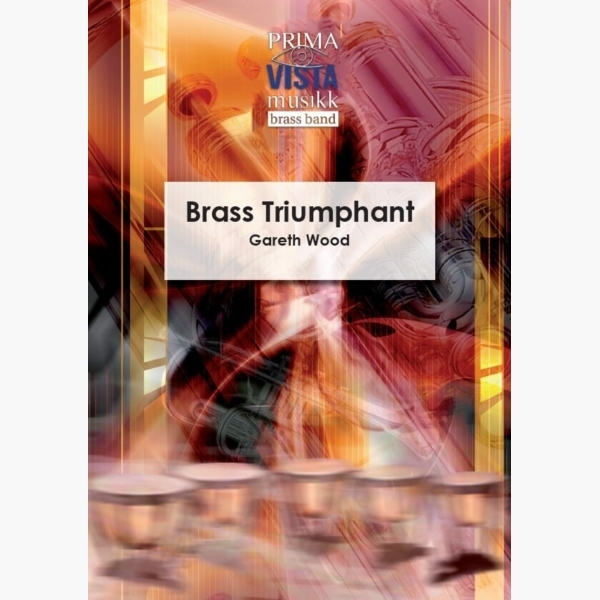
Brass Triumphant - Gareth Wood
Brass Triumphant is a four-movement work and was composed for the Cory Band during their 125th anniversary year of 2009. The first movement is a celebratory fanfare featuring a strong melody as the thread which runs throughout the whole work....
Estimated dispatch 5-7 working days
-
£59.95
PLANTAGENETS, The (Brass Band Set) - Edward Gregson
The Plantagenets was composed for the Championship Section of the Regional contests of the National Brass Band Championships of Great Britain 1973. The work is not intended to be programme music but rather it tries to portray the mood and feelings of an age, that of the House of Plantagenet, which lasted from the middle of the 12th century to the end of the 14th century. To many, it conjures up an Age of Chivalry and this is represented by fanfare motifs which occur throughout the work in varied form. The opening thematic figure, rising through the band in thirds and followed by the fanfares, is important as nearly all the subsequent material is based upon it. There follows two themes, the second of which is lyrical and introduced by horns. In the long, slow middle section, a new theme is introduced by a solo horn (recurring on cornet and euphonium in canon) and is developed at some length. A lively fugato scherzino, however, leads to a recapitulation of the opening section music and the work ends with a maestoso statement of the slow movement theme. A final reference to the fanfares ends the work.
Estimated dispatch 7-14 working days
-
 £33.09
Metamorphosis on 'Finlandia' (Brass Band - Full Score Print) Andrew Wainwright
This major work was commissioned by Five Lakes Silver Band and its Musical Director Christopher Ward in February 2024, and is featured on the band's CD Resurget Cineribus. The music is based on the hymn tune by Katharina von Schlegel, Be Still, My Soul, found in Sibelius' famous tone poem Finlandia (Op. 26). While the only source material used in Metamorphosis on 'Finlandia' is the hymn itself as opposed to any of the developmental music found in the tone poem, it does also seek to depict the strife of the Finnish people against the censorship of the Russian Empire. It is therefore both rousing and turbulent at various times. Metamorphosis on 'Finlandia' commences with a quartet playing a full statement of the hymn in its simplest form, featuring a solo flugel. This leads into a sprightly 6/8 section where a fanfare-like figure proclaims the theme. The music in this section is at times unstable and off-kilter as references to the hymn come and go, often in a very chromatic or dissonant form - a reflection of the struggles that the Finnish people went through. Despite this, there is still a sense of optimism. A somewhat reflective slower section follows, featuring another full rendition of the hymn, with a number of solo voices taking up the tune. This is followed by several cadenzas - for cornet, trombone, Eb bass, and Bb bass, which represent different voices speaking out against the oppression of the Finnish people. This leads into an energetic final movement before a resounding proclamation of the hymn in its full glory. A return to the fanfare heard earlier in the work brings the piece to a glorious conclusion. To listen to a recording of Five Lakes Silver Band performing the work please visit www.youtube.com/watch?v=GeJJF6asD2k Duration: Approx. 13.15 minutes Difficulty Level: 1st Section + This product includes a print copy of the full score. PDF parts and score available here. Sheet music available here (UK) or https://satradecentral.org (USA) Instrumentation: Soprano Cornet Eb Solo Cornet Bb Repiano Cornet Bb 2nd Cornet Bb 3rd Cornet Bb Flugel Horn Bb Solo Horn Eb 1st Horn Eb 2nd Horn Eb 1st Baritone Bb 2nd Baritone Bb 1st Trombone Bb 2nd Trombone Bb Bass Trombone Euphonium Bb Bass Eb Bass Bb Timpani Percussion 1-3
In Stock: Estimated dispatch 1-3 working days
-
£66.19
Metamorphosis on 'Finlandia' (Brass Band) Andrew Wainwright
This major work was commissioned by Five Lakes Silver Band and its Musical Director Christopher Ward in February 2024, and is featured on the band's CD Resurget Cineribus. The music is based on the hymn tune by Katharina von Schlegel, Be Still, My Soul, found in Sibelius' famous tone poem Finlandia (Op. 26). While the only source material used in Metamorphosis on 'Finlandia' is the hymn itself as opposed to any of the developmental music found in the tone poem, it does also seek to depict the strife of the Finnish people against the censorship of the Russian Empire. It is therefore both rousing and turbulent at various times. Metamorphosis on 'Finlandia' commences with a quartet playing a full statement of the hymn in its simplest form, featuring a solo flugel. This leads into a sprightly 6/8 section where a fanfare-like figure proclaims the theme. The music in this section is at times unstable and off-kilter as references to the hymn come and go, often in a very chromatic or dissonant form - a reflection of the struggles that the Finnish people went through. Despite this, there is still a sense of optimism. A somewhat reflective slower section follows, featuring another full rendition of the hymn, with a number of solo voices taking up the tune. This is followed by several cadenzas - for cornet, trombone, Eb bass, and Bb bass, which represent different voices speaking out against the oppression of the Finnish people. This leads into an energetic final movement before a resounding proclamation of the hymn in its full glory. A return to the fanfare heard earlier in the work brings the piece to a glorious conclusion. To listen to a recording of Five Lakes Silver Band performing the work please visit www.youtube.com/watch?v=GeJJF6asD2k Duration: Approx. 13.15 minutes Difficulty Level: 1st Section + PDF download includes parts and score. Sheet music available here (UK) or https://satradecentral.org (USA) Instrumentation: Soprano Cornet Eb Solo Cornet Bb Repiano Cornet Bb 2nd Cornet Bb 3rd Cornet Bb Flugel Horn Bb Solo Horn Eb 1st Horn Eb 2nd Horn Eb 1st Baritone Bb 2nd Baritone Bb 1st Trombone Bb 2nd Trombone Bb Bass Trombone Euphonium Bb Bass Eb Bass Bb Timpani Percussion 1-3
In Stock: Estimated dispatch 1-3 working days
 Watch video