
Results
-
 £183.20
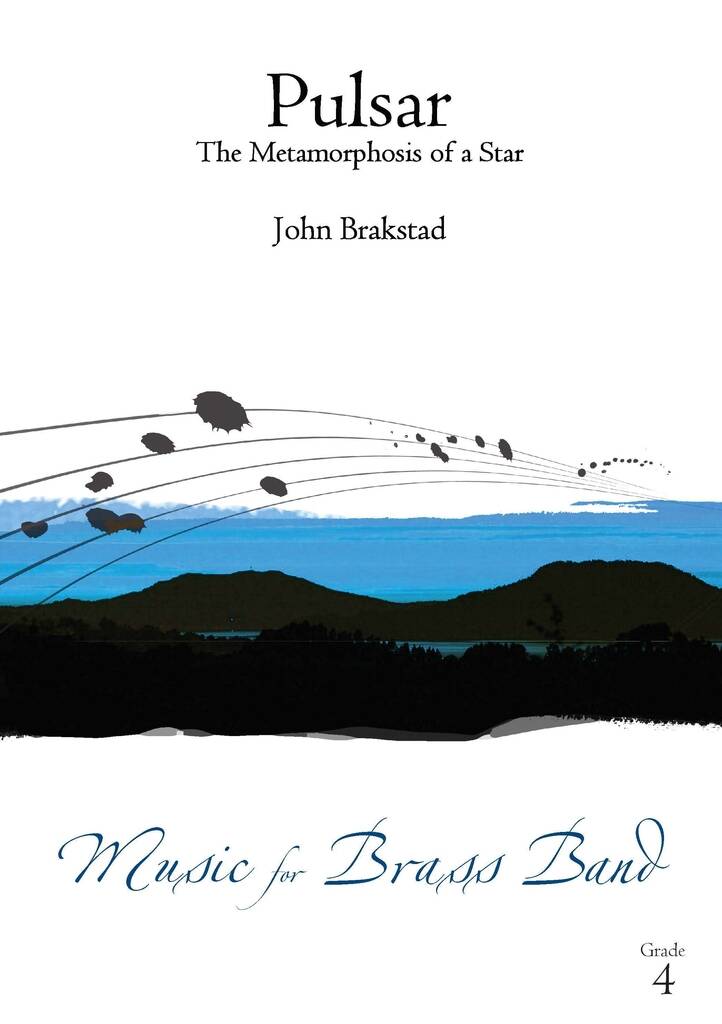
Pulsar - The Metamorphosis of a Star - John Brakstad
4th July in 1054 AD one of the most spectacular events was witnessed in the Cosmos. A massive star blew out; a supernova explosion.From the Earth it appeared as a new, bright star; the most brilliant in the sky. It was visible for three weeks, also in daylight, before it then faded away.But what was left of it is spectacular. Today we call it the "Crab Nebula".And in the very centre of the Nebula lies the remnant of the star; the core crushed by the force of gravity.This is a rotating neutron star, a pulsar, just 20 kilometres across, but so dense that it weighs more than our sun.As the neutron star spins, ejected particles stream out from its poles at almost the speed of light.These jets create powerful beams that sweep around as the star rotates.When the beams sweep across the Earth, they can be heard as regular pulses. We call them pulsars.In this piece there are three percussion parts. In addition there is an "optional part" to replace the marimba and vibraphone written in the three original percussion parts if desired. This fourth part is shown in the full score.
Estimated dispatch 5-14 working days
-
 £109.99
The Power of the Megatsunami - Carl Wittrock
The word 'tsunami' is of Japanese origin. When you look it up in a dictionary, you will find that it means 'a great sea wave produced by submarine earth movement or volcanic eruption'. A megatsunami is the superlative of this awesome expressionof power that nature can create, and has catastrophic consequences. When Carl Wittrock completed this composition not many such big earth movements had occurred, but since then we have become all too familiar with the disastrousconsequences which a tsunami may have. On the 26th of December 2004 a heavy seaquake took place near the Indonesian island of Sumatra. Tidal waves 10 meters in height ravaged the coastal regions of many countries for miles around. The tsunamitook the lives of thousands of people and destroyed many villages and towns. There are more areas which run the risk of being struck by a tsunami, such as the island of La Palma, one of the Canary Islands. This island is based on oceaniccrust at a fracture zone and as such is one of nature's time bombs. The consequences of a natural calamity like a megatsunami are immense. In the case of La Palma, the tidal wave will move in the direction of South America, where it may reach 50km inland, destroying everything on its way. In his composition Wittrock describes an ordinary day which will have an unexpected ending. Right from the beginning there seems to be something in the air, the music creating an oppressiveatmosphere of impending disaster. Themes are interrupted, broken off suddenly, followed by silence, suggesting the calm before the storm. Suddenly a short climax (glissandi in the trombone part) indicates the seaquake, and the megatsunami isa fact. Hereafter follows a turbulent passage symbolising the huge rolling waves. After nature's force has spent itself, resignation sets in and the composition ends with a majestic ode to nature.
Estimated dispatch 5-14 working days
-
 £379.99
Tranquil Abiding - Paul Mealor
An 18-minute work for brass band, written for the world renowned Foden's Band. This is a melodic work divided into three movements. All sections of the band are featured with solo parts. Each movement is headed by a line from a poem by James Agee, the American novelist and poet. 'Tranquil Abiding', often referred to as 'Shamatha' in Buddhist traditions, signifies a state of peaceful and calm mental stillness, achieved through focused meditation, where the mind rests peacefully and without agitation."The term has always resonated with me particularly during my long, regular walks into, around and along the amazingly beautiful woodlands, mountains and streams of North Wales at night lit only by the stars. It's during these walks that my meditative focus is at its most emotive and I am at one with the 'it' that surrounds us", says Paul Mealor. "Often on these walks and meditations I am reminded of the American poet, James Agee's pantheistic vision of the natural world and the stars above, 'Sure on this Shining Night' which conjures a serene and harmonious image of a summer night, illuminated by celestial bodies and bathed in kindness. The poem evokes a sense of peace and tranquillity as nature heals and the earth is rejuvenated".
Estimated dispatch 5-14 working days
-
 £94.99
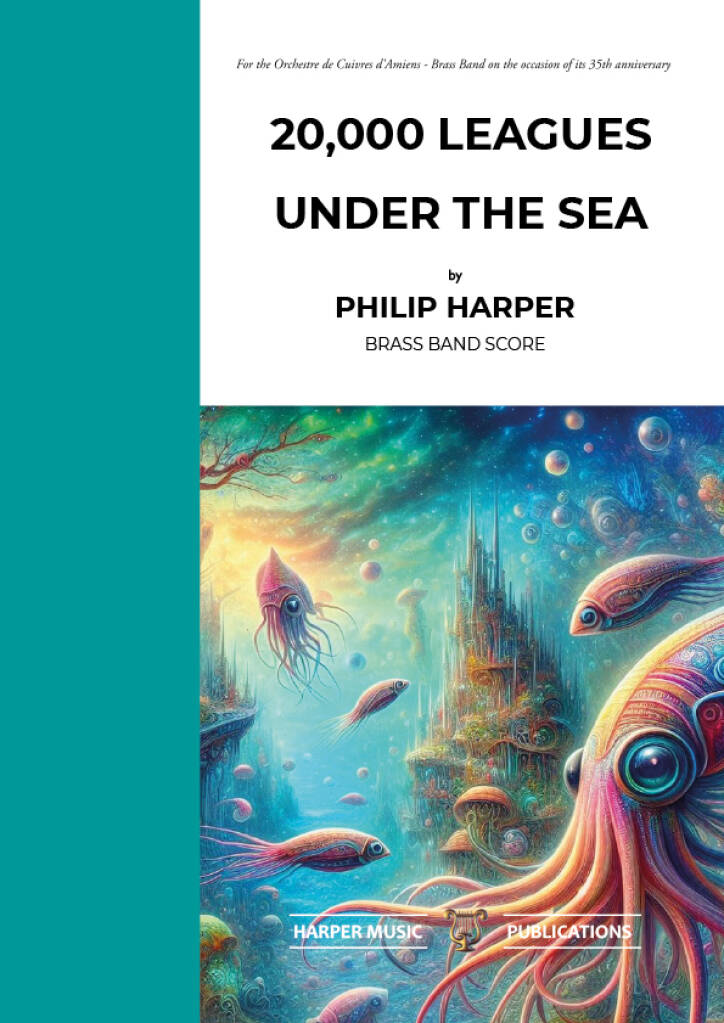
20,000 Leagues under the Sea - Philip Harper
Frenchman Jules Verne was a pioneer in science fiction during the late 19th Century, penning some classic stories such as Journey to the Centre of the Earth and Around the World in 80 Days - both of which have already been the subject of brass band test-pieces. It was therefore natural for me to choose Verne's 1869 watery magnum opus as the subject for this piece to which there are five sections, as well as an introduction and a finale.I. THE NAUTILUS. After a mysterious introduction we are introduced to The Nautilus - a fantastical submarine.II. THE CORAL KINGDOM. We visit awe-inspiring underwater coral formations.III. SQUID ATTACK. The Nautilus is attacked by a school of giant squid, or 'devilfish'.IV. CAPTAIN NEMO. Captain Nemo is a loner and an eccentric. Some say he is a madman. Soloists of the band help to uncover the character of this enigmatic but powerful figure.V. MAELSTROM. The Nautilus is dragged into the ocean's deadliest whirlpool but Captain Nemo lives to fight another day.
Estimated dispatch 5-14 working days
-
 £154.60
Circius - Torstein Aagaard-Nilsen
The work is important for me because it was my first piece to be performed outside Norway. Black Dyke Band/David King performed it and did a recording of it in 1991. In the original score I quote a Swedish bishop (Olaus Mangnus) who lived in the 15th century. He travelled around Scandinavia and drew maps - very important historic material. When he came to the north of Norway (where I come from) he decribed the wind from the north as Ciricus: (something like) Worst of all winds is Circius, that revolves (?= turn upside down) heaven and earth. (Well, not a good translation Im afraid). The fast sections reflects the mighty winds from the north. In the middle section, I borrowed afolksong-like tune (by C. Elling, a Norwegian composer). The text (by Kristoffer Janson) tells about old times when the fishermen used open boats: they had to put their lives in the hands of God.
Estimated dispatch 5-14 working days
-
 £169.99
Destination Moon - Paul Raphael
Destination Moon was first performed by Cory Band at the 2017 European Championships in Ostend, Belgium, and is inspired by the Belgian comic-book hero Tintin. The first part is called 'Science' and describes the development of the theory of space travel. The second part is 'Humanity' which addresses human concerns and philosophies about our place in the universe. The third part is 'The Launch' which ends with a repetition of the words 'Earth to Moon Rocket are you receiving me?' as the rocket vanishes into a tiny speck in the sky.
Estimated dispatch 5-14 working days
-
 £59.99
Old Hundredth - Louis Bourgeois - Philip Sparke
The tune Old Hundredth is one of the best-known melodies in all Christian musical traditions and first appeared in the 1551 psalter "Pseaumes Octante Trois de David", where it is used as a setting for a version of Psalm 134; it is usually attributed to the French composer Louis Bourgeois (c.1510 - c.1560). The melody was then used in 1561 by the Scots clergyman, William Kethe in Sternhold and Hopkins' Psalter for his paraphrase of Psalm 100 - All People that on Earth do Dwell, which is still the most familiar hymn sung to this noble tune. When Tate and Brady's "New Version of the Psalms" was published in 1696, the melody became know as the 'old' version - henceits current title. This arrangement presents three contrasting verses and is effective as a concert piece as well as an instrumental interlude as part of a church service or wedding.
Estimated dispatch 5-14 working days
-
£60.99
Aurora Borealis - Morten J. Wallin
Aurora Borealis, more popularly known as the Northern Lights, was a source of superstition in the Middle Ages. This dazzling spectacle, which is accompanied by whispering sounds, put the fear of God into those who didn't know that this was simply one of nature's grand shows. Many heathen attributed the phenomenon to the incomprehensible ways of the gods. Today we know better. Every 11 years, the amount of particles emitted by the sun is at its highest level, as is the case this year. These particles are hurled away from the sun, beyond its magnetic field. A small percentage of these particles are able to penetrate the earth's atmosphere. Once they are here, they begin tocollide and form the beautiful patterns in the night sky which we call the Aurora Borealis.
Estimated dispatch 5-14 working days
-
 £60.99
He Shall Feed His Flock - Georg Friedrich Händel - Wil van der Beek
It is interesting to recall that Handel wrote Messiah, his most famous work whilst at the lowest point of his career, suffereing from fianantial hardship and depression. It was only composing that distracted him from this misery. In He Shall Feed His Flock,based on texts of Isaiah and Matthew, we hear praise for the peace that the Messiah has brought to earth.
Estimated dispatch 5-14 working days
-
 £186.20
E.T. - John Williams - Ton van Grevenbroek
Steven Spielberg made this big box office success film 'E.T.', telling the story of a boy, named Eliot, and his friendship with a fascinating little alien 'E.T.'. The film score, written by the internationally famous composer and conductor John Williams, brings their 'adventures on earth' back to life. This science fiction fantasy appeals to the imagination of both young and older people. Ton van Grevenbroek signs this fine orchestration for symphonic band.
Estimated dispatch 5-14 working days
 View Music