
Results
-
 £34.95
Judd: The Covenanters
In 1638, many members of the Presbyterian Church of Scotland signed a document called the National Covenant. By doing so, they were declaring that they acknowledged only Jesus Christ as the spiritual head of their church, and not any king or queen. This had become necessary because the Stuart kings believed in the Divine Right of Monarchs and saw themselves as head of the church. In the previous year, Charles I had forcibly introduced the Book of Common Prayer, invoking the wrath of the common people who faced the threat of torture, transportation or execution if they did not use the new liturgy and worship at their local church. The net result of this was that many met illegally in the countryside or in barns and large houses. These meetings became known as 'conventides' and many took place in the south-west of the country. Anyone caught attending was at risk of execution by the muskets of the dragoons who were employed in the area for that specific purpose. This music was written to honour the bravery and loyalty of these Christians to their faith, in the face of extreme danger, in the hope that it will inspire us also to be faithful. There are overtones of military threat, secrecy and solidarity. An old pentatonic tune is used, which the composer heard as a boy being sung to the words The Lord's My Shepherd.
Estimated dispatch 7-14 working days
-
 £19.95
Islands in the Sky (Brass Quartet)
Islands in the Sky (2012) is a three-movement work for Euphonium Quartet. Written in June 2012, the title is a metaphor of mountains, suggesting that they're so tall they're islands in the sky. The sublime Euphony Euphonium Quartet who the work was commissioned by were successful in gaining a place in the International Tuba & Euphonium Conference Ensemble Competition, held in Linz, Austria; a country particularly noted for its fair share of the Alps which proved the basis of the work.The first movement is a fierce journey on a glacier's edge - the drama of the music and constant rhythmic drive throughout suggests danger and the unknown. The second movement is calm and reflective, inspired by a beautiful Alpine Sunset, slowly going down between mountains and pine trees. Finally, the third movement takes the listener on a journey up the mountain to the peak, upon which a grandioso section is heard with the soaring melody that has been building up throughout the movement played in its entirety.
Estimated dispatch 7-14 working days
-
£35.00
Darkwood (Score Only)
Born in the Vale of Evesham, Worcestershire, Dan took a keen interest in music from an early age playing tuba and trombone with his local brass band. After leaving school he embarked on a 10 year career as a hotelier integrating it with a developing career as a freelance musician playing double bass, sousaphone and bass saxophone with big bands including the internationally Pasadena Roof Orchestra.In 2003, he enrolled in the Band Musicianship course at Salford University where he studied composition and arranging with Prof. Peter Graham. Dan's first test-piece An Elgar Portrait was selected as the 4th Section set work at the Swiss National Brass Band Championships in 2007 and again at the Pontins Championships the following year. He then went on to write the test-piece New World Sketches which was set as the 2nd Section test-piece for the British Regional Contests in 2009.In 2009, Dan became Composer in Association with the Cory Band, helping them with their winning programmes at several Brass in Concert Championships. In 2012 he became the Arranger in Association with Black Dyke Band and has been involved with many of the band's exciting projects including his arrangement of Recycled for the ground breaking multimedia campaign - Danger Global Warming Project and the band's collaboration with British composer Tolga Kashif in 2012 for his Olympic Anthem Let Your Light Shine.In 2015, Dan had a number of major works performed at International contests which included Realms of Asgard: Yggdrassil - a new test-work commissioned by Jaren Hornmusikkforening to be used as their choice work at the Norwegian Brass Band Championships, Ocean of Storms - an exciting new work for Grimethorpe Colliery Band's Brass in Concert programme and his test-piece Visions which was used as a 4th Section National Finals test-piece.Dan is currently working full time at the University of Salford, lecturing in Composition and Arranging. He continues to work as a freelance composer working with a number of leading soloists, brass and wind bands around the world.
Estimated dispatch 7-14 working days
-
 £76.99
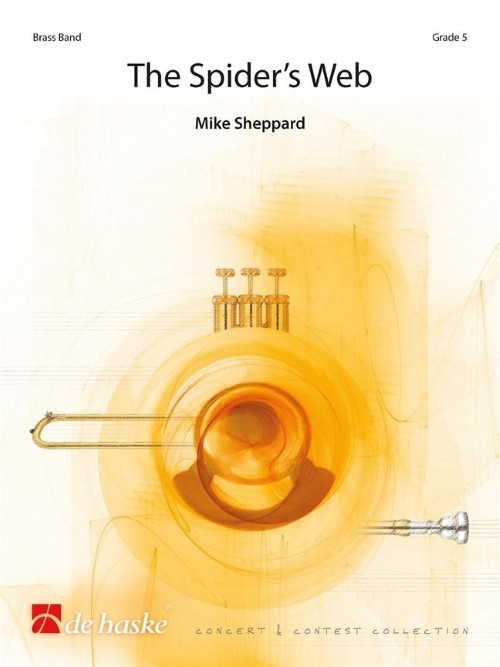
The Spider's Web (Brass Band - Score and Parts) - Sheppard, Mike
The Spider's Web is a metaphor for danger, uncertainty and risk. Throughout the piece moments of danger contrast with moments of tranquility - at certain points these two ideas merge and in others they battle against one another. In this piece which requires a lot of technical skills for the players, the composer moves unexpectedly from moments of peacefulness to situations of threat and danger. An impressive, versatile and truly spectacular piece! Duration: 5.00
Estimated dispatch 7-14 working days
-
 £74.95
Song of Courage (Brass Band - Score and Parts) - Ball, Eric
New Contest VersionThe music reflects many moods. There is, to commence, joyfulness, and later some sense of fear and effort against great odds. The old chorus 'Stand like the brave' typifies the call to action in the face of danger, and 'A prayer for courage' - the central part of the composition - is a reminder of the true source of Christian fortitude.
Estimated dispatch 7-14 working days
-
 £37.50
Song of Courage (Brass Band - Score only) - Ball, Eric
New Contest VersionThe music reflects many moods. There is, to commence, joyfulness, and later some sense of fear and effort against great odds. The old chorus 'Stand like the brave' typifies the call to action in the face of danger, and 'A prayer for courage' - the central part of the composition - is a reminder of the true source of Christian fortitude.
Estimated dispatch 7-14 working days
-
 £124.95
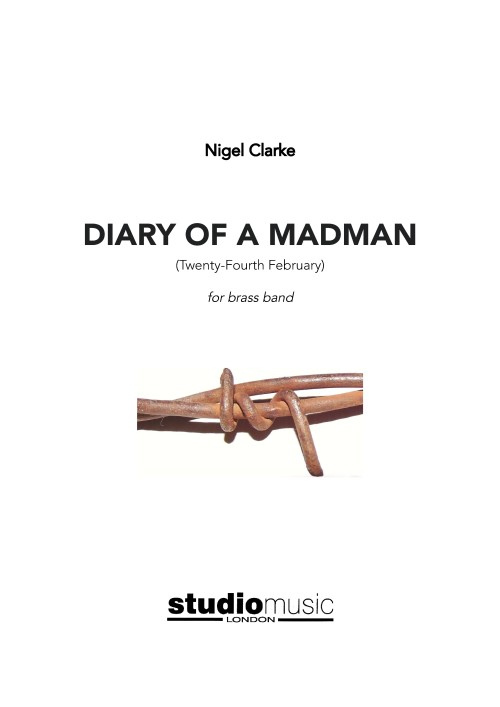
Diary of a Madman (Twenty-Fourth February) (Brass Band - Score and Parts) - Clarke, Nigel
From the beginning of history, warlords, emperors and dictators have risen up, some benign but many of them a scourge on humanity. Names that resonate to this day include Julius Caesar, Caligula, Genghis Khan, Ivan IV (The Terrible), Attila the Hun, Vlad IV (The Impaler), Hitler, Stalin, Mao Zedong, Pol Pot, all of whom were responsible for wanton destruction and the torture and death of millions of victims, either citizens of invaded countries and territories and or indeed, their own peoples.Diary of a Madman starts with a light-hearted march that gives the impression of toy tin soldiers parading in a brightly-coloured ceremonial pageant from a fairy tale, conveying peace and innocence. This spectacle is abruptly interrupted by a 'shock and awe' fanfare-like march, symbolising aggression and war. This theme grinds slowly to a halt, and an atmosphere of introspection, sadness and despair takes over. Rising above the smoky theatre of war, we then hear a distant cornet give a rendition of the Ukrainian Nation Anthem (The glory and freedom of Ukraine has not yet perished. Luck will still smile on us brother-Ukrainians). The solo cornet soon enters a fragile duet with a second cornet accompanied by dark undertones. One by one, we hear short shards of aggressive fanfare-like figures from various instruments in the band. The mood breaks - we hear strident fortissimo whole-tone scales representing pealing church bells, warning of danger. In contrast, we also hear pianissimo whole-tone scales announcing that the enemy's troops are falling back. A counter-offensive soon takes centre stage, and battles and skirmishes are heard, with short quotations from Mussorgsky's `Great Gates of Kyiv' symbolising the defenders' heroic struggle.All sides are victims of the Dictator's ambition! The slow central section offer us moments of melancholic beauty and utilises Henry Purcell's `When I am laid in earth' (`Dido's Lament' from Dido and Aeneas 1688). This music represents the loss of homes, dignity and loved ones. There are occasional hints at better times as the theme of the parading toy tin soldiers is heard from afar, like a distant memory.To announce the final push, we hear a church bell strike and an air raid siren signalling a ferocious musical counter-attack. After one final rendition of the Purcell theme, Diary of a Madman closes with a mood of triumph over tyranny.- Nigel Clarke
Estimated dispatch 7-14 working days
-
£57.95
Diary of a Madman (Twenty-Fourth February) (Brass Band - Score only) - Clarke, Nigel
From the beginning of history, warlords, emperors and dictators have risen up, some benign but many of them a scourge on humanity. Names that resonate to this day include Julius Caesar, Caligula, Genghis Khan, Ivan IV (The Terrible), Attila the Hun, Vlad IV (The Impaler), Hitler, Stalin, Mao Zedong, Pol Pot, all of whom were responsible for wanton destruction and the torture and death of millions of victims, either citizens of invaded countries and territories and or indeed, their own peoples.Diary of a Madman starts with a light-hearted march that gives the impression of toy tin soldiers parading in a brightly-coloured ceremonial pageant from a fairy tale, conveying peace and innocence. This spectacle is abruptly interrupted by a 'shock and awe' fanfare-like march, symbolising aggression and war. This theme grinds slowly to a halt, and an atmosphere of introspection, sadness and despair takes over. Rising above the smoky theatre of war, we then hear a distant cornet give a rendition of the Ukrainian Nation Anthem (The glory and freedom of Ukraine has not yet perished. Luck will still smile on us brother-Ukrainians). The solo cornet soon enters a fragile duet with a second cornet accompanied by dark undertones. One by one, we hear short shards of aggressive fanfare-like figures from various instruments in the band. The mood breaks - we hear strident fortissimo whole-tone scales representing pealing church bells, warning of danger. In contrast, we also hear pianissimo whole-tone scales announcing that the enemy's troops are falling back. A counter-offensive soon takes centre stage, and battles and skirmishes are heard, with short quotations from Mussorgsky's `Great Gates of Kyiv' symbolising the defenders' heroic struggle.All sides are victims of the Dictator's ambition! The slow central section offer us moments of melancholic beauty and utilises Henry Purcell's `When I am laid in earth' (`Dido's Lament' from Dido and Aeneas 1688). This music represents the loss of homes, dignity and loved ones. There are occasional hints at better times as the theme of the parading toy tin soldiers is heard from afar, like a distant memory.To announce the final push, we hear a church bell strike and an air raid siren signalling a ferocious musical counter-attack. After one final rendition of the Purcell theme, Diary of a Madman closes with a mood of triumph over tyranny.- Nigel Clarke
Estimated dispatch 7-14 working days
-
 £34.95
The Covenanters (Brass Band - Score and Parts) - Downie, Kenneth
In 1638, many members of the Presbyterian Church of Scotland signed a document called the National Covenant. By doing so, they were declaring that they acknowledged only Jesus Christ as the spiritual head of their church, and not any king or queen. This had become necessary because the Stuart kings believed in the Divine Right of Monarchs and saw themselves as head of the church. In the previous year, Charles I had forcibly introduced the Book of Common Prayer, invoking the wrath of the common people who faced the threat of torture, transportation or execution if they did not use the new liturgy and worship at their local church. The net result of this was that many met illegally in the countryside or in barns and large houses. These meetings became known as 'conventides' and many took place in the south-west of the country. Anyone caught attending was at risk of execution by the muskets of the dragoons who were employed in the area for that specific purpose. This music was written to honour the bravery and loyalty of these Christians to their faith, in the face of extreme danger, in the hope that it will inspire us also to be faithful. There are overtones of military threat, secrecy and solidarity. An old pentatonic tune is used, which the composer heard as a boy being sung to the words The Lord's My Shepherd.
Estimated dispatch 7-14 working days
-
£17.50
The Covenanters (Brass Band - Score only) - Downie, Kenneth
In 1638, many members of the Presbyterian Church of Scotland signed a document called the National Covenant. By doing so, they were declaring that they acknowledged only Jesus Christ as the spiritual head of their church, and not any king or queen. This had become necessary because the Stuart kings believed in the Divine Right of Monarchs and saw themselves as head of the church. In the previous year, Charles I had forcibly introduced the Book of Common Prayer, invoking the wrath of the common people who faced the threat of torture, transportation or execution if they did not use the new liturgy and worship at their local church. The net result of this was that many met illegally in the countryside or in barns and large houses. These meetings became known as 'conventides' and many took place in the south-west of the country. Anyone caught attending was at risk of execution by the muskets of the dragoons who were employed in the area for that specific purpose. This music was written to honour the bravery and loyalty of these Christians to their faith, in the face of extreme danger, in the hope that it will inspire us also to be faithful. There are overtones of military threat, secrecy and solidarity. An old pentatonic tune is used, which the composer heard as a boy being sung to the words The Lord's My Shepherd.
Estimated dispatch 7-14 working days
 View Music