
Results
-
 £59.99
Hava Nagila (Brass Band - Score and Parts) - Sparke, Philip
Hava Nagila (the title means 'let us rejoice') is perhaps the best known example of a style of Jewish music called 'klezmer'. Klezmer music originated in the 'shtetl' (villages) and the ghettos of Eastern Europe, where itinerant Jewish troubadours, known as 'klezmorim', had performed at celebrations, particularly weddings, since the early Middle Ages. 'Klezmer' is a Yiddish term combining the Hebrew words 'kley' (instrument) and 'zemer' (song) and the roots of the style are found in secular melodies, popular dances, Jewish 'hazanut' (cantorial music) and also the 'nigunim', the wordless melodies intoned by the 'Hasidim' (orthodox Jews).Since the 16th century, lyrics had been added to klezmer music, due to the 'badkhn' (the master of ceremony at weddings), to the 'Purimshpil' (the play of Esther at Purim) and to traditions of the Yiddish theatre, but the term gradually became synonymous with instrumental music, particularly featuring the violin and clarinet. The melody of Hava Nagila was adapted from a folk dance from the Romanian district of Bucovina. The commonly used text is taken from Psalm 118 of the Hebrew bible.Duration: 3:00
Estimated dispatch 7-14 working days
-
 £110.00
Diversions after Benjamin Britten (Brass Band - Score and Parts)
Suite by Lucy Pankhurst, Simon Dobson, Paul McGhee and Gavin HigginsHaving devised a collective centenary tribute for Michael Tippett at the 2006 RNCM Festival of Brass (Variations on a Theme of Michael Tippett by five eminent composers of brass band music, PHM002), I commissioned this companion piece as a Benjamin Britten tribute for the 2013 festival. In the late 1970s, while researching a book about the English composer, and Britten's first teacher, Frank Bridge (1879 - 1941), I came across a copy of the printed score of Benjamin Britten's Variations on a Theme of Frank Bridge (Op.10) for string orchestra, in which Britten had written descriptive titles for each of the variations suggesting appropriate character traits of his much loved mentor and guide. The character variations are cast in march, song and dance forms.Taking inspiration from Britten's youthful tribute, I invited four award-winning composers, who have all made significant contributions to the brass band medium, to create their own personal reflections on four aspects of Britten's character and music, designed to form a suite of Diversions after Benjamin Britten, but which can also be played separately.Lucy Pankhurst's hauntingly lyrical Prelude: His Depth refers to the emotional and symbolic subtexts that underpin Britten's operas, taking its musical cue from Britten's many arrangements of folk songs. The flugel horn takes a prominent role throughout.Simon Dobson's breathless Scherzo: His Vitality reminds us with its rapid passage work and leaping bass 'groove' that Britten loved tennis and fast cars in his younger days.Paul McGhee's evocative interpretation of the March: His Sympathy represents Benjamin Britten's pacifism, as the composer writes: 'We view the music through the eyes of a pacifist. Whilst war and violence surround us, we do not engage in it and though it continues to happen around us. With the use of muted effects in most of the band throughout the piece, the flugel horn is the lone voice of reason, standing firm against the mechanical and destructive society in which it is forced to live. As the machine of war continues around the lone voice, the voice is gradually dismissed and mocked as the war machine rumbles on into the distance.'In an extended finale, entitled Toccata: His Skill, Gavin Higgins celebrates Benjamin Britten's consummate creativity. For the RNCM Festival of Brass premiere, the four contrasting movements were framed and connected by Britten's Fanfare for St. Edmundsbury for three trumpets, with the trumpet soloists spaced round the hall. I am grateful to the Britten Estate and publishers Boosey & Hawkes for giving permission for the elements of Britten's fanfare to be incorporated in the collective work.- Paul HindmarshDuration: 19.30
Estimated dispatch 7-14 working days
-
£45.00
Diversions after Benjamin Britten (Brass Band - Score only)
Suite by Lucy Pankhurst, Simon Dobson, Paul McGhee and Gavin HigginsHaving devised a collective centenary tribute for Michael Tippett at the 2006 RNCM Festival of Brass (Variations on a Theme of Michael Tippett by five eminent composers of brass band music, PHM002), I commissioned this companion piece as a Benjamin Britten tribute for the 2013 festival. In the late 1970s, while researching a book about the English composer, and Britten's first teacher, Frank Bridge (1879 - 1941), I came across a copy of the printed score of Benjamin Britten's Variations on a Theme of Frank Bridge (Op.10) for string orchestra, in which Britten had written descriptive titles for each of the variations suggesting appropriate character traits of his much loved mentor and guide. The character variations are cast in march, song and dance forms.Taking inspiration from Britten's youthful tribute, I invited four award-winning composers, who have all made significant contributions to the brass band medium, to create their own personal reflections on four aspects of Britten's character and music, designed to form a suite of Diversions after Benjamin Britten, but which can also be played separately.Lucy Pankhurst's hauntingly lyrical Prelude: His Depth refers to the emotional and symbolic subtexts that underpin Britten's operas, taking its musical cue from Britten's many arrangements of folk songs. The flugel horn takes a prominent role throughout.Simon Dobson's breathless Scherzo: His Vitality reminds us with its rapid passage work and leaping bass 'groove' that Britten loved tennis and fast cars in his younger days.Paul McGhee's evocative interpretation of the March: His Sympathy represents Benjamin Britten's pacifism, as the composer writes: 'We view the music through the eyes of a pacifist. Whilst war and violence surround us, we do not engage in it and though it continues to happen around us. With the use of muted effects in most of the band throughout the piece, the flugel horn is the lone voice of reason, standing firm against the mechanical and destructive society in which it is forced to live. As the machine of war continues around the lone voice, the voice is gradually dismissed and mocked as the war machine rumbles on into the distance.'In an extended finale, entitled Toccata: His Skill, Gavin Higgins celebrates Benjamin Britten's consummate creativity. For the RNCM Festival of Brass premiere, the four contrasting movements were framed and connected by Britten's Fanfare for St. Edmundsbury for three trumpets, with the trumpet soloists spaced round the hall. I am grateful to the Britten Estate and publishers Boosey & Hawkes for giving permission for the elements of Britten's fanfare to be incorporated in the collective work.- Paul HindmarshDuration: 19.30
Estimated dispatch 7-14 working days
-
 £64.95
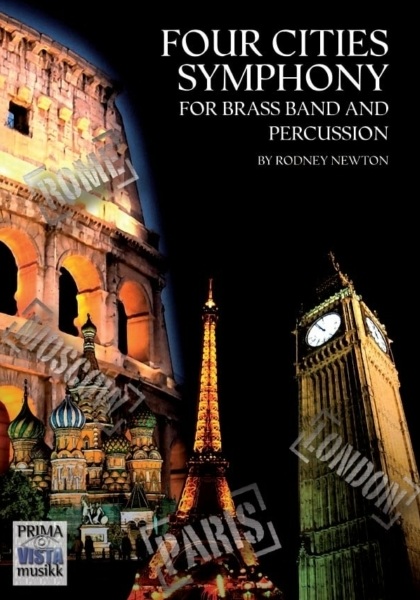
Four Cities Symphony (Brass Band - Score and Parts) - Newton, Rodney
This piece was commissioned by the National Contesting Council as the 4th section test piece for the 2008 Regional Brass Band Championships of Great Britain.This symphony (the composer's 12th) has four movements played without a break. The first centres on two aspects of the city of London: its history and pageantry and its role as a busy modern metropolis.The second movement depicts Paris, its street cafes and boulevards and riverside walks, in the form of a romantic waltz.The third movement is constructed around the Gregorian chants of the Lord's Prayer (Pater noster, qui es in caelis) and the Creed (Credo in unum Deum) in an evocation of the city of Rome. After a powerful climax, mysterious tramping footsteps are heard as the ghosts or a Roman legion march through the city by night. The vision fades and the pater noster is heard once again before the movement is brought to a close with the ancient Ambrosian chant, Christus Vincit, Christus Regnet, Christus Imperat.The final movement is an evocation of the city of Moscow, with its great historic buildings, its turbulent history and its fiery traditional music. At the outset a rather dour folk-like melody is heard which is transformed into a lively Cossack dance.This work is dedicated to Howard Wilson, former principal euphonium of City of Coventry Band who, in 1972, introduced the composer to top section brass band contesting.Duration: 11.00
Estimated dispatch 7-14 working days
-
 £94.95
ELECTRA (Brass Band - Score and Parts) - Ellerby, Martin
2012 British Open and the Netherlands Brass Band Championships. Championship Section Test Piece. Electra is loosely based on the play by Sophocles. The 'Elektra Chord' provides the signature chord and motivic elaboration used by composer Richard Strauss to represent the eponymous character of his opera Elektra. There are three clear sections to the work. The first is subtitled 'Lust for Revenge' which is a highly charged element with an ensemble approach to the writing; the second is the lyrically inspired 'Laments' where all the key solos occur and the musical language exploits the more poetic properties of the chord, and the final section, 'Dance to Death' which represents a return to rhythm as the main driving force.
Estimated dispatch 7-14 working days
-
£49.95
ELECTRA (Brass Band - Score only) - Ellerby, Martin
2012 British Open and the Netherlands Brass Band Championships. Championship Section Test Piece. Electra is loosely based on the play by Sophocles. The 'Elektra Chord' provides the signature chord and motivic elaboration used by composer Richard Strauss to represent the eponymous character of his opera Elektra. There are three clear sections to the work. The first is subtitled 'Lust for Revenge' which is a highly charged element with an ensemble approach to the writing; the second is the lyrically inspired 'Laments' where all the key solos occur and the musical language exploits the more poetic properties of the chord, and the final section, 'Dance to Death' which represents a return to rhythm as the main driving force.
Estimated dispatch 7-14 working days
-
 £79.95
Introduction, Elegy and Caprice (Brass Band - Score and Parts) - Calvert, Morley
This work was written by Morley Calvert, the Canadian composer, especially for the first European Brass Band Championships held in 1978.The piece consists of three contrasting movements. The Introduction opens with a slow, mysterious figure after the first fanfare-like unison notes. This leads to the main section, a quick 'one-in-a-bar' movement centred around a persistent figure.The Elegy opens with an unaccompanied Euphonium solo, which is then passed through to horn, cornet, and basses in the manner of a passacaglia. This is broken and then the movement fragments.After the tension of the Elegy, the Caprice provides much needed relief: a spritely dance, very rhythmical in character, the theme of which is thrown around the band with great abandon.
Estimated dispatch 7-14 working days
-
£39.95
Introduction, Elegy and Caprice (Brass Band - Score only) - Calvert, Morley
This work was written by Morley Calvert, the Canadian composer, especially for the first European Brass Band Championships held in 1978.The piece consists of three contrasting movements. The Introduction opens with a slow, mysterious figure after the first fanfare-like unison notes. This leads to the main section, a quick 'one-in-a-bar' movement centred around a persistent figure.The Elegy opens with an unaccompanied Euphonium solo, which is then passed through to horn, cornet, and basses in the manner of a passacaglia. This is broken and then the movement fragments.After the tension of the Elegy, the Caprice provides much needed relief: a spritely dance, very rhythmical in character, the theme of which is thrown around the band with great abandon.
Estimated dispatch 7-14 working days
-
 £44.95
Patterns (Brass Band - Score and Parts) - Gregson, Edward
Building musical paragraphs using short, irregular rhythmical patterns became a favourite Gregson formula in the early 1970s. Patterns is the clearest and most disciplined example. By limiting himself to a single musical motif, heard at the outset on trombones, Gregson offers a true test of technique and musicianship in a concise three part structure. The opening is another Gregson prelude with alternating patterns of 3s, 4s, 5s and 7s that are bonded by a constant quaver pulse. The music here possesses a neo-classical, pristine quality. In the central episode, the same triadic figure is transformed into a lilting barcarolle-like dialogue beginning on solo cornet and horn. When the whole band becomes involved, the trombones add a moment of bi-tonal ambiguity, which sets in motion an exuberant Latin dance and final flourish.Patterns was commissioned by the Butlins Youth Brass Band Championships for the 1974 competition at the Royal Albert Hall.Duration: 5.00
Estimated dispatch 7-14 working days
-
 £60.99
Klezmeriana (Brass Band - Score and Parts) - De Haan, Jan
The instrumental music of the Yiddish-speaking Jews, especially those of Eastern Europe, is known as klezmer. This terminology was originally used in Jewish cultural life as the name of a musician who played at weddings. At Jewish weddings, which usually last several days, klezmer musicians played not only dance music but also ceremonial music - for example during the wedding ceremony, and also music that was listened to during the wedding feast. Originally, there was no special term for this style of music. It was simply referred to as 'Jewish wedding music'. In the 1970s, the music - which is actually a fusion of different influences - enjoyed a resurgence in popularity and came to be known as klezmer. This music contains not only the sounds of the Balkans, but also influences of oriental and gypsy music too. Jan de Haan used no original klezmer melodies for Klezmeriana, but composed a series of sound-alike in an instrumentation for brass band.Duration: 6.00
Estimated dispatch 7-14 working days
 View Music