
Results
-
£73.00
Stealing Apples - Fats Waller - Reid Gilje
"Stealing Apples" is an old swing-tune written by Fats Waller. Performances by Benny Goodman and his big band made the song very popular.In this arrangement for brass band, the mallet percussion is very essential. Mallet Percussion presents the melody from letter A and is also featured as soli-instruments from letter L to P. These parts can alternatively be played as vibraphone solo.Please be aware of the balance at letter A. Horn and Trombones must play piano but well articulated. Letter D must sound sparkling and fresh with articulated and powerful trombones and cornets (using straight-mute).Make shue that the 8th-notes are not played too dotted two bars before letter G. Almost even 8th-notes accentuated on the start of the slur is a good tip.Watch the balance at letter H. This part have to sound homogeniously.The soloistic Soprano Cornet at letter Q must be played in the style of Benny Goodan. The accompaniment must not be too powerful from letter R to S. Best of luck with the performance!
Estimated dispatch 7-14 working days
-
 £27.95
Three Fanfares (Brass Ensemble - Score and Parts)
This set includes three fanfares by Edward Gregson for symphonic brass and percussion ensemble:Fanfare for a New EraFanfare for the NorthFanfare for EuropeFanfare for a New Era: This fanfare was commissioned by Lady Sheila Stoller to celebrate the opening of the Stoller Hall at Chetham's School of Music in Manchester (UK). It is dedicated to Sir Norman Stoller, who generously donated the funding for the new concert hall. It was first performed by students of Chetham's School of Music, conducted by Stephen Threlfall, at the Royal Opening of the Stoller Hall on 24 April 2017. Ideally, the fanfare should be performed using as much spatial arrangement as possible, so that the antiphonal effects are heard to their best advantage. Whatever the chosen lay-out, the 1st Trumpet should be positioned off-stage in a suitable position. This could be a rear balcony if the venue is not too large, or in a side balcony in a larger concert hall. Duration: 3.00Fanfare for the North: This fanfare was commissioned by the Gateshead Garden Festival of 1990 and was first performed by London Brass Virtuosi, directed by David Honeyball, at the Royal Opening by HM The Queen. Its four-note motif (G, A, E, D), which is heard throughout the fanfare, is derived from the letters of 'Gateshead'. Duration: 1.15Fanfare for Europe: This fanfare was specially commissioned for two concerts celebrating the UK's entry into Europe (or the European Economic Community as it was then known) in 1973. The first performances were given at York Minister and the Royal Albert Hall, London, in January 1973. The fanfare was also featured as the opening music for the first episode of a series of short documentary programmes made for BBC Radio 4 in 2018 by Mark Mardell entitled Brexit: A Love Story? Duration: 1.15Duration: 5.30
Estimated dispatch 7-14 working days
-
 £39.95
When Thunder Calls (Brass Band - Score and Parts)
When Thunder Calls was commissioned by Dr Nicholas Childs and the Black Dyke Band for their performance at the Gala Concert of the Swiss Open Championships in September 2011. When composing this piece, I decided to focus on both the music and the stage presentation. The way the piece has been composed and designed makes it a very effective way of starting a concert or a second half of a concert.At the start of the piece, the percussion enter the stage and take their positions in their usual place behind the band. They begin playing the piece without a conductor. They keep repeating the opening section while the Basses, Horns, Baritones and Euphoniums march onto the stage.This group of musicians take their seats with the Horns, Baritones and Euphoniums sitting where they usually sit in the band but the Basses sit where the solo cornets usually sit, forming an inner semi-circle of lower brass. When seated and when the music gets to the end of bar 4 the piece continues onto section A. All performers keep repeating this next 4-bar phrase until the trombones march onto stage and stand at the front of the stage with the Bass Trombone standing in between the other two trombones.All performers then play from figure B to C with the trombones taking the lead at the front. When the performers get to rehearsal figure C they repeat this section (the same as section A) while the trombones move from the front of the stage and take their positions where the Basses would normally sit (between the horns and the percussion) and remain standing. Meanwhile, the flugel enters the stage and stands at the front of the stage (standing where the trombones did). When in position the flugel soloist picks up into rehearsal figure D.When the flugel soloist finishes playing, just before rehearsal figure F they then move to their normal seat in the band. At figure F the cornets march onto the stage from either side, they turn and stand side by side each other facing outward towards the audience forming two 'fanfare' lines either side of the lower brass. The conductor follows the cornets on stage and on cue they lift their instruments at the same time and perform when the piece gets to figure G.There is no more moving around from this point on other than the solo cornet to move forward with the solo euphonium and perform their duet at letter H. Also the horns are required to stand and play at letter I and then sit just before J.When performed with all the choreography, this piece makes for an exciting addition to any concert repertoire both for the performer and the audience.Suitable for 3rd Section Bands and Above
Estimated dispatch 7-14 working days
-
 £124.95
Hyperlink (Brass Band - Score and Parts) - Graham, Peter
Hyperlink was commissioned by the National Youth Brass Band of Great Britain (funded by Arts Council England and the Department for Education) for its 70th Anniversary Year. Since the anniversary coincided with other significant celebrations in 2022 (including the Royal Albert Hall/Ralph Vaughan Williams 150th and the Platinum Jubilee of Elizabeth II) it was requested that these also be recognised in some way.Where better to begin this challenging brief but with a computer search for the NYBBGB founder Dr Denis Wright (coincidently born in Kensington, home of the RAH). The subsequent rabbit warren of hyperlinks led me to structure the work through a series of associations:Movement I - The Voice of Jupiter. Alongside the discovery that Denis Wright had been a church organist was the realisation that while the RAH has hosted thousands of musical events the fabric of the building actually incorporates a musical instrument, the famous Henry Wills organ (aka The Voice of Jupiter). Organ and J S Bach are synonymous (e.g. Toccata in D min) and so both become fundamental to the content of the movement. An opening 7 note quote from the Toccata leads to a mammoth sound cluster, as if every note on the huge RAH organ is sustained. The material which follows is based upon the notes BACH (in German notation). The notes are manipulated in various ways in a 12 tone matrix; reversed, inverted and so on. Other techniques employed in the movement are ones of which Bach was master, including ground bass and fugue.Movement II - Remember Me. The lives of Salvationist composer Ray Steadman-Allen (born 1922) and Ralph Vaughan Williams are remembered here, with RSA in musical notation and fragments of RVWs famous Tuba Concerto providing the source material. While writing the movement my father passed away and to close his funeral service the family chose the uplifting Robert Lowry hymn They'll sing a welcome home. It seemed fitting to conclude the movement with a reflective setting of the chorus, the repeated phrase 'Welcome, welcome home' eventually disappearing into the ether.Movement III - Vivat. The finale takes the form of a short fantasy upon Hubert Parry's marvellous coronation anthem I Was Glad, truly a celebratory note with which to conclude. The first performance of Hyperlink was given by the NYBBGB conducted by Martyn Brabbins at the Royal College of Music, London on August 6th 2022.- Peter Graham
Estimated dispatch 7-14 working days
-
£44.95
Hyperlink (Brass Band - Score only) - Graham, Peter
Hyperlink was commissioned by the National Youth Brass Band of Great Britain (funded by Arts Council England and the Department for Education) for its 70th Anniversary Year. Since the anniversary coincided with other significant celebrations in 2022 (including the Royal Albert Hall/Ralph Vaughan Williams 150th and the Platinum Jubilee of Elizabeth II) it was requested that these also be recognised in some way.Where better to begin this challenging brief but with a computer search for the NYBBGB founder Dr Denis Wright (coincidently born in Kensington, home of the RAH). The subsequent rabbit warren of hyperlinks led me to structure the work through a series of associations:Movement I - The Voice of Jupiter. Alongside the discovery that Denis Wright had been a church organist was the realisation that while the RAH has hosted thousands of musical events the fabric of the building actually incorporates a musical instrument, the famous Henry Wills organ (aka The Voice of Jupiter). Organ and J S Bach are synonymous (e.g. Toccata in D min) and so both become fundamental to the content of the movement. An opening 7 note quote from the Toccata leads to a mammoth sound cluster, as if every note on the huge RAH organ is sustained. The material which follows is based upon the notes BACH (in German notation). The notes are manipulated in various ways in a 12 tone matrix; reversed, inverted and so on. Other techniques employed in the movement are ones of which Bach was master, including ground bass and fugue.Movement II - Remember Me. The lives of Salvationist composer Ray Steadman-Allen (born 1922) and Ralph Vaughan Williams are remembered here, with RSA in musical notation and fragments of RVWs famous Tuba Concerto providing the source material. While writing the movement my father passed away and to close his funeral service the family chose the uplifting Robert Lowry hymn They'll sing a welcome home. It seemed fitting to conclude the movement with a reflective setting of the chorus, the repeated phrase 'Welcome, welcome home' eventually disappearing into the ether.Movement III - Vivat. The finale takes the form of a short fantasy upon Hubert Parry's marvellous coronation anthem I Was Glad, truly a celebratory note with which to conclude. The first performance of Hyperlink was given by the NYBBGB conducted by Martyn Brabbins at the Royal College of Music, London on August 6th 2022.- Peter Graham
Estimated dispatch 7-14 working days
-
 £69.95
Heroes of the North (Brass Band - Score and Parts) - Graham, Peter
Heroes of the North was commissioned by Henning Annundsen for Skodvin Skulemusikk and pays tribute to the development of brass band activity in the Nordhordland region of Norway.The music is a set of character variations based upon personalities long associated with both the band and the region. The opening 5 note motif (C D E F G) might be considered the starting point for beginner brass students, and this mini-theme is developed throughout the work.Five variations follow: Mr Brevik's Galop (representing Tom Brevik, a key figure in Norwegian brass band music); Frode's Dance (with apologies to Edvard Grieg), portraying soprano cornet player Frode Rydland, one of Skodvin Skulemusikk's most famous "old boys"; Mr Bjrge's Walk representing Viggo Bjrge, "Mr Eikanger Bjrsvik Band"; Hymn for Knut-Harald, known as "Mr Skodvin Skulemusikk" having over many years played a central role in the teaching and training of the band, and finally Maestro Snell's Russian Adventure features music with more than a hint of Russian (Khachaturian to be precise) and calls to mind Howard Snell whose arrangements and presence have made such a huge contribution to Norwegian Brass Banding over many years.Heroes of the North is playable by 4th section bands.Duration: 10.00
Estimated dispatch 7-14 working days
-
 £29.95
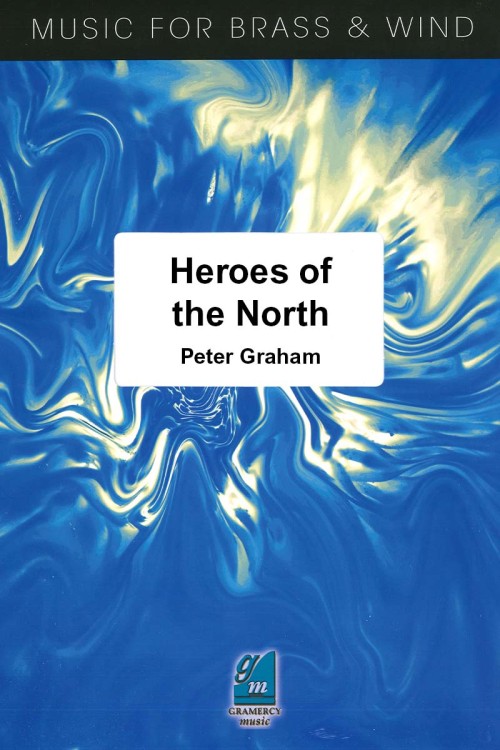
Heroes of the North (Brass Band - Score only) - Graham, Peter
Heroes of the North was commissioned by Henning Annundsen for Skodvin Skulemusikk and pays tribute to the development of brass band activity in the Nordhordland region of Norway.The music is a set of character variations based upon personalities long associated with both the band and the region. The opening 5 note motif (C D E F G) might be considered the starting point for beginner brass students, and this mini-theme is developed throughout the work.Five variations follow: Mr Brevik's Galop (representing Tom Brevik, a key figure in Norwegian brass band music); Frode's Dance (with apologies to Edvard Grieg), portraying soprano cornet player Frode Rydland, one of Skodvin Skulemusikk's most famous "old boys"; Mr Bjrge's Walk representing Viggo Bjrge, "Mr Eikanger Bjrsvik Band"; Hymn for Knut-Harald, known as "Mr Skodvin Skulemusikk" having over many years played a central role in the teaching and training of the band, and finally Maestro Snell's Russian Adventure features music with more than a hint of Russian (Khachaturian to be precise) and calls to mind Howard Snell whose arrangements and presence have made such a huge contribution to Norwegian Brass Banding over many years.Heroes of the North is playable by 4th section bands.Duration: 10.00
Estimated dispatch 7-14 working days
 View Music