
Results
-
 £100.00
King Arthur (Scenes from a Radio Drama) (Brass Band - Score and Parts) - Britten, Benjamin - Hindmarsh, Paul
King Arthur (Scenes from a radio drama) was the first of 28 scores Benjamin Britten (1913-1976) composed for radio between 1937 and 1947. It was an ambitious dramatisation of King Arthur's life and times - part pageant, part play, part cantata - written by D.G. Bridson.This colourful suite incorporates the Introduction, a dramatic Wild Dance, some of the music underscoring the scenes for Galahad and The Holy Grail, and two vivid battle scenes, ending with The Final Battle and Apotheosis.King Arthur (Scenes from a radio drama) for brass band should not be confused with a much longer orchestral suite which Paul Hindmarsh devised from the same source in 1995.Suitable for Premier Youth/2nd Section Bands and aboveDuration: 14.00
Estimated dispatch 7-14 working days
-
£19.99
King Arthur (Scenes from a Radio Drama) (Brass Band - Score only) - Britten, Benjamin - Hindmarsh, Paul
King Arthur (Scenes from a radio drama) was the first of 28 scores Benjamin Britten (1913-1976) composed for radio between 1937 and 1947. It was an ambitious dramatisation of King Arthur's life and times - part pageant, part play, part cantata - written by D.G. Bridson.This colourful suite incorporates the Introduction, a dramatic Wild Dance, some of the music underscoring the scenes for Galahad and The Holy Grail, and two vivid battle scenes, ending with The Final Battle and Apotheosis.King Arthur (Scenes from a radio drama) for brass band should not be confused with a much longer orchestral suite which Paul Hindmarsh devised from the same source in 1995.Suitable for Premier Youth/2nd Section Bands and aboveDuration: 14.00
Estimated dispatch 7-14 working days
-
 £76.99
Praise to the Lord - Carl Wittrock
This composition, based on the hymn Praise to the Lord, is comprised of eight separate parts that can be played together as a concert piece or opening work. The A and B sections are different openings, C is four-part arrangement of the hymn, D is a solo for four saxophones, or two trumpets and two trombones, E is a calm intermezzo, F a solo for trumpet or cornet, and G and F finally are a majestic or peaceful closing section. How will you choose to present this piece on stage?
Estimated dispatch 5-14 working days
-
 £35.00
Cranborne Chase - Philip Harper
Cranborne Chase was commissioned by the Charles Church Camberley Band in 2011 in memory of solo horn player and life-long member Libby Godden.Libby joined the band in 1966 which marked the start of a long association, during which she progressed to the solo horn position, recruited four family members to play with the band, and had spells on the committee as publicity officer and chairman. Most recently she led the Training Ensemble in her role as Assistant Bandmaster. Libby continued to be active with the band despite a diagnosis of cancer, which finally claimed her life in February 2011.Programme notes from the composer, Philip Harper:The Music: As well as invoking the joyous spirit befitting Libby's approach to life, there are several musical ideas woven into the score. After a brief introduction, the main theme uses the musical letters of Libby's surname: G, O(A), D, D, E, N(G), whilst the harmonic progression here is based on that of the slow movement of Edward Gregson's Partita for Brass Band, one of Libby's favourite passages of music.To further imbue the piece with Libby's persona, the lyrical theme is first introduced as a traditional brass band quartet (two cornets, horn and euphonium), one of her favourite musical genres.After the first rehearsal of the piece the band members, with the composer's blessing, decided on the name Cranborne Chase, which is the name of a place in Dorset with which Libby Godden had a great affinity.Raising Funds for Cancer Research UK. The Music Company (UK) Ltd has been involved in charitable work for many years both nationally and internationally. Through publishing Cranborne Chase, The Music Company is extending its charitable support by helping to raise funds for the Cancer Research UK charity, in memory of Libby Godden (a band-friend since childhood of Clair Tomalin, Business Director of The Music Company (UK) Ltd).A donation will therefore be made by The Music Company (UK) Ltd for every purchased set of this piece. There is a hope that every band in the UK will have Cranborne Chase as part of their library and included in their concert programmes, enabling a significant amount of money to be raised for Cancer Research UK through the enjoyment of music.
In Stock: Estimated dispatch 3-5 working days
-
 £49.95
On the Face Too! (Value Set)
Value Set includes: a score and one of each part:Part A: Trumpet 1 in BbPart B: Trumpet 2 in BbPart C: Horn in EbPart C: Horn in FPart C: Trombone/Euphonium TCPart C: Trombone/Euphonium BCPart D: Trombone TCPart D: Trombone BCPart D: Bass in EbPart D: Tuba BDPercussionAdditional score and parts are also available individually.On the Face Too! is to the secondary school brass teacher as On the Face! is to the primary: namely a collection of pieces for intermediate brass ensemble in various jazz and popular styles, aiming to give a ready supply of material for concerts and assemblies, which nevertheless still allows for the developing technique of the young players to whom it is addressed.Generally speaking, the technical difficulty of the material here goes no further than grade 4 or 5 (even the first trumpet part never goes higher than a written G), though some pieces will offer considerable rhythmic challenges.
Estimated dispatch 7-14 working days
-
 £29.95
The Strong Tower (Brass Band - Score and Parts)
Following the popularity of Turris Fortissima, I decided, albeit many years later, to revisit some of the material it contains and create a shorter piece, expanding on some of the ideas and motifs, allowing myself to follow those in different directions altogether. The result is this piece which I hope will also excite players and listeners alike.The music is marked at a quick tempo from the start, but despite several changes in meter, the tempo doesn't change until the small accelerando leads us into the presto section. In order to maintain the excitement and drama, it's important to set the pace and keep it consistent throughout.Section A introduces a few of the motifs that will be developed during the piece, including the main Turris Fortissima theme from bar 13 to 18.At section B, ensure the quavers are tight across the whole band with a strong attack, making an obvious difference in dynamic when fff is marked, in bars 23, 25 and 27. A more lyrical approach will be effective from the Horns in section C, with vigorous interruptions from the rest of the band breaking up their melody.Section D features long notes from muted 1st and 2nd Cornets and Trombones, with crescendos each time. These should be significant and sound as though they emerge from nowhere, completely cutting through the overall texture.Section D features long notes from muted 1st and 2nd Cornets and Trombones, with crescendos each time. These should be significant and sound as though they emerge from nowhere, completely cutting through the overall texture.Sections E and F are both passages of building intensity. Various contrasting motifs are layered, including a subtle reference to the hymn tune Ein' feste Burg (A mighty fortress is our God) from the Euphonium. The music becomes more busy and muddled, before reaching its climax at section G where the lyrical melody is heard again, this time from the Solo Cornets and Euphonium.In bars 141 to 145, there is a reference to Dean Goffin's My strength, my tower in the Basses, as used in Turris Fortissima. Allow this motif to dominate, keeping the notes full and grand-sounding. In bars 149 to 151 there is further use of the line from Ein' feste Burg in the Baritones, Trombones, Euphoniums and Basses leading into the final section.- Steven Ponsford
Estimated dispatch 7-14 working days
-
 £124.95
Hyperlink - Peter Graham
Hyperlink was commissioned by the National Youth Brass Band of Great Britain (funded by Arts Council England and the Department for Education) for its 70th Anniversary Year. Since the anniversary coincided with other significant celebrations in 2022 (including the Royal Albert Hall/Ralph Vaughan Williams 150th and the Platinum Jubilee of Elizabeth II) it was requested that these also be recognised in some way.
Where better to begin this challenging brief but with a computer search for the NYBBGB founder Dr Denis Wright (coincidently born in Kensington, home of the RAH). The subsequent rabbit warren of hyperlinks led me to structure the work through a series of "associations":
Movement I - The Voice of Jupiter.
Alongside the discovery that Denis Wright had been a church organist was the realisation that while the RAH has hosted thousands of musical events the fabric of the building actually incorporates a musical instrument, the famous Henry Wills organ (aka The Voice of Jupiter).Organ and J S Bach are synonymous (e.g. Toccata in D min) and so both become fundamental to the content of the movement. An opening 7 note quote from the Toccata leads to a mammoth sound cluster, as if every note on the huge RAH organ is sustained. The material which follows is based upon the notes BACH (in German notation). The notes are manipulated in various ways in a 12 tone matrix; reversed, inverted and so on. Other techniques employed in the movement are ones of which Bach was master, including ground bass and fugue.
Movement II - Remember Me.
The lives of Salvationist composer Ray Steadman-Allen (born 1922) and Ralph Vaughan Williams are remembered here, with "RSA" in musical notation and fragments of RVWs famous Tuba Concerto providing the source material.While writing the movement my father passed away and to close his funeral service the family chose the uplifting Robert Lowry hymn They'll sing a welcome home. It seemed fitting to conclude the movement with a reflective setting of the chorus, the repeated phrase "Welcome, welcome home" eventually disappearing into the ether.
Movement III - Vivat.
The finale takes the form of a short fantasy upon Hubert Parry's marvellous coronation anthem I Was Glad, truly a celebratory note with which to conclude.The first performance of Hyperlink was given by the NYBBGB conducted by Martyn Brabbins at the Royal College of Music, London on August 6th 2022.
Estimated dispatch 3-7 working days
-
 £30.00
Beneath The River Severn (Chris Cobon) - Brass Band Sheet Music Full Score and Parts - LM283
COMPOSER: Chris CobonBeneath The River SevernProgramme NotesBeneath The River Severn follows on, chronologically,from three pieces about steam engines;LMR600 Gordon, Tornado (LNER Peppercorn Class A160163),The Lady Armaghdale and also 'Moments in Brass' Sets 1+2Living 3 miles from the River Severn, the longest river in Great Britain,I regularly cross it on the way to conduct Highley Colliery Brass Band.Beneath The River Severn aims to capture not only the beauty of the river but also the dangerous undercurrents that lie under the calm surface.The length of the complete piece is 4 minutes 11 secondsMusical Traits:Attempting to avoid stereotype water music,I started with sketches based on quartal harmony but inverted (so 5ths)For example, the first run onEuphonium starts on concert pitch G, Hrns = D, Bari=A, 1st Hrn=E etc."A" represents the undercurrent,which has claimed many lives over the years.An 11-note salute to the greatest river piece,Smetana's Vltava, is worked into this sectionSuitable Section 4 Upwards
In Stock: Estimated dispatch 3-5 working days
-
£73.00
Stealing Apples - Fats Waller - Reid Gilje
"Stealing Apples" is an old swing-tune written by Fats Waller. Performances by Benny Goodman and his big band made the song very popular.In this arrangement for brass band, the mallet percussion is very essential. Mallet Percussion presents the melody from letter A and is also featured as soli-instruments from letter L to P. These parts can alternatively be played as vibraphone solo.Please be aware of the balance at letter A. Horn and Trombones must play piano but well articulated. Letter D must sound sparkling and fresh with articulated and powerful trombones and cornets (using straight-mute).Make shue that the 8th-notes are not played too dotted two bars before letter G. Almost even 8th-notes accentuated on the start of the slur is a good tip.Watch the balance at letter H. This part have to sound homogeniously.The soloistic Soprano Cornet at letter Q must be played in the style of Benny Goodan. The accompaniment must not be too powerful from letter R to S. Best of luck with the performance!
Estimated dispatch 7-14 working days
-
 £27.95
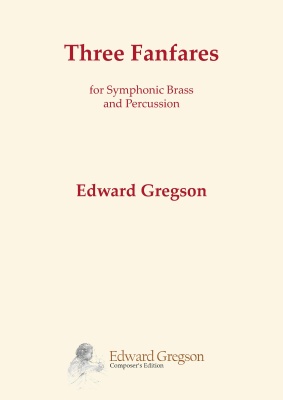
Three Fanfares (Brass Ensemble - Score and Parts)
This set includes three fanfares by Edward Gregson for symphonic brass and percussion ensemble:Fanfare for a New EraFanfare for the NorthFanfare for EuropeFanfare for a New Era: This fanfare was commissioned by Lady Sheila Stoller to celebrate the opening of the Stoller Hall at Chetham's School of Music in Manchester (UK). It is dedicated to Sir Norman Stoller, who generously donated the funding for the new concert hall. It was first performed by students of Chetham's School of Music, conducted by Stephen Threlfall, at the Royal Opening of the Stoller Hall on 24 April 2017. Ideally, the fanfare should be performed using as much spatial arrangement as possible, so that the antiphonal effects are heard to their best advantage. Whatever the chosen lay-out, the 1st Trumpet should be positioned off-stage in a suitable position. This could be a rear balcony if the venue is not too large, or in a side balcony in a larger concert hall. Duration: 3.00Fanfare for the North: This fanfare was commissioned by the Gateshead Garden Festival of 1990 and was first performed by London Brass Virtuosi, directed by David Honeyball, at the Royal Opening by HM The Queen. Its four-note motif (G, A, E, D), which is heard throughout the fanfare, is derived from the letters of 'Gateshead'. Duration: 1.15Fanfare for Europe: This fanfare was specially commissioned for two concerts celebrating the UK's entry into Europe (or the European Economic Community as it was then known) in 1973. The first performances were given at York Minister and the Royal Albert Hall, London, in January 1973. The fanfare was also featured as the opening music for the first episode of a series of short documentary programmes made for BBC Radio 4 in 2018 by Mark Mardell entitled Brexit: A Love Story? Duration: 1.15Duration: 5.30
Estimated dispatch 7-14 working days
 View Music