
Results
-
 £89.95
Songs of Ascent - Jonathan Bates
DURATION: 14 minutes. DIFFICULTY: Championship. 'Songs of Ascent' was composed for the Royal Northern College of Music Brass Band, as part of their programme for the 2019 RNCM Festival of Brass. In my view, the festival itself is the leading showcase for original contemporary music for the medium (in a concert setting) in the world and therefore an ideal place to explore new ideas and sounds, which was a notion fundamental to the construction of this work. The piece is subtitled 'Out of the Depths, I cry to you, O Lord'; the opening line of Psalm 130 (which forms part of a set of 15 psalsm, 120-134 known as the Songs of Ascent") which forms the main inspiration for much of the musical material. Following an extended opening for four individual tuba lines, there are a number of solos for members of the band off stage, with bleak and deep accompaniment lines, reflecting the words of Psalm 130. Amongst these 'songs of ascents', the most common and strong themes are repentance and redemption; with the central core of this work emerging 'from the depths' to reveal one of very few calming and reflective passages of the work utilising the tune of 'Guide Me O Thy Great Redeemer' in a new setting, featuring the Solo Horn and Bass Trombone, before returning to the ethereal and dark timbres that form much of the music up to this point. In terms of compositional technique, this work is solely based on a set of 4 9-note scales in their various unique transpositions (below). Each of these scales provide a set of 2 whole tone scales, 6 minor triads, 6 major triads and is built on 9 augmented triads. Whilst most of the music in this work is based melodically on the set of notes (heard right at the outset in the motif in the tuba line), the central section delves into the harmonic capabilities of these 'modes', using a number of the 7 'keys' which can be derived from the minor & major chords derived in each scale. All 4 scales are used independantly to each other, with whole sections of the work focussing on each mode. 'Songs of Ascent' was selected as the set work for the Championship Section at the Butlin's Mineworker's Championships in 2020.
In Stock: Estimated dispatch 1-3 working days
-
 £59.95
That Promised Land - Jonathan Bates
DURATION: 8 minutes. DIFFICULTY: 1st+. That Promised Land was the culmination of 5 years of my personal interest in spiritual music since performing Michael Tippett's wonderful Oratorio 'A Child of Our Time' at the RNCM. Tippett's work combines original material, with music inspired and based upon spirituals, whilst all of the major 'chorus' sections are direct settings of those tunes. This was a work that had stuck with me for a long time, and one I tried to emulate in a smaller form with this work. The title is a quote from one of the verses of the spiritual 'Deep River'. This piece was composed for Jaren Hornmusikkforening as part of their programme for the 2018 SIDDIS Championships held in Stavanger, Norway. .
In Stock: Estimated dispatch 1-3 working days
-
 £34.95
Water Lilies - Jonathan Bates
DURATION: 5'00". DIFFICULTY: 1st Section+. 'Water Lilies' is a setting of a short poem by the American War poet Sara Teasdale from 1937. Teasdale's evocative writing is steadily becoming a renowned influence for composers - particularly in the choral scene, and this was where my first introduction to her work was founded in a work by Eriks Esenvalds entitled 'Stars'. . The percussion writing in this depicts a gentle ripple on a lake as water lilies float by at dusk, whilst the band writing explores a deep and personal interpretation of Teasdale's words which whilst on the face seem quite dark and brooding, yet really seem to express a feeling of longing and determination. . Water Lilies . If you have forgotten water lilies floating . On a dark lake among mountains in the afternoon shade, . If you have forgotten their wet, sleepy fragrance, . Then you can return and not be afraid. . But if you remember, then turn away forever . To the plains and the prairies where pools are far apart, . There you will not come at dusk on closing water lilies, . And the shadow of mountains will not fall on your heart. . Sara Teasdale (1937). .
In Stock: Estimated dispatch 1-3 working days
-
 £39.95
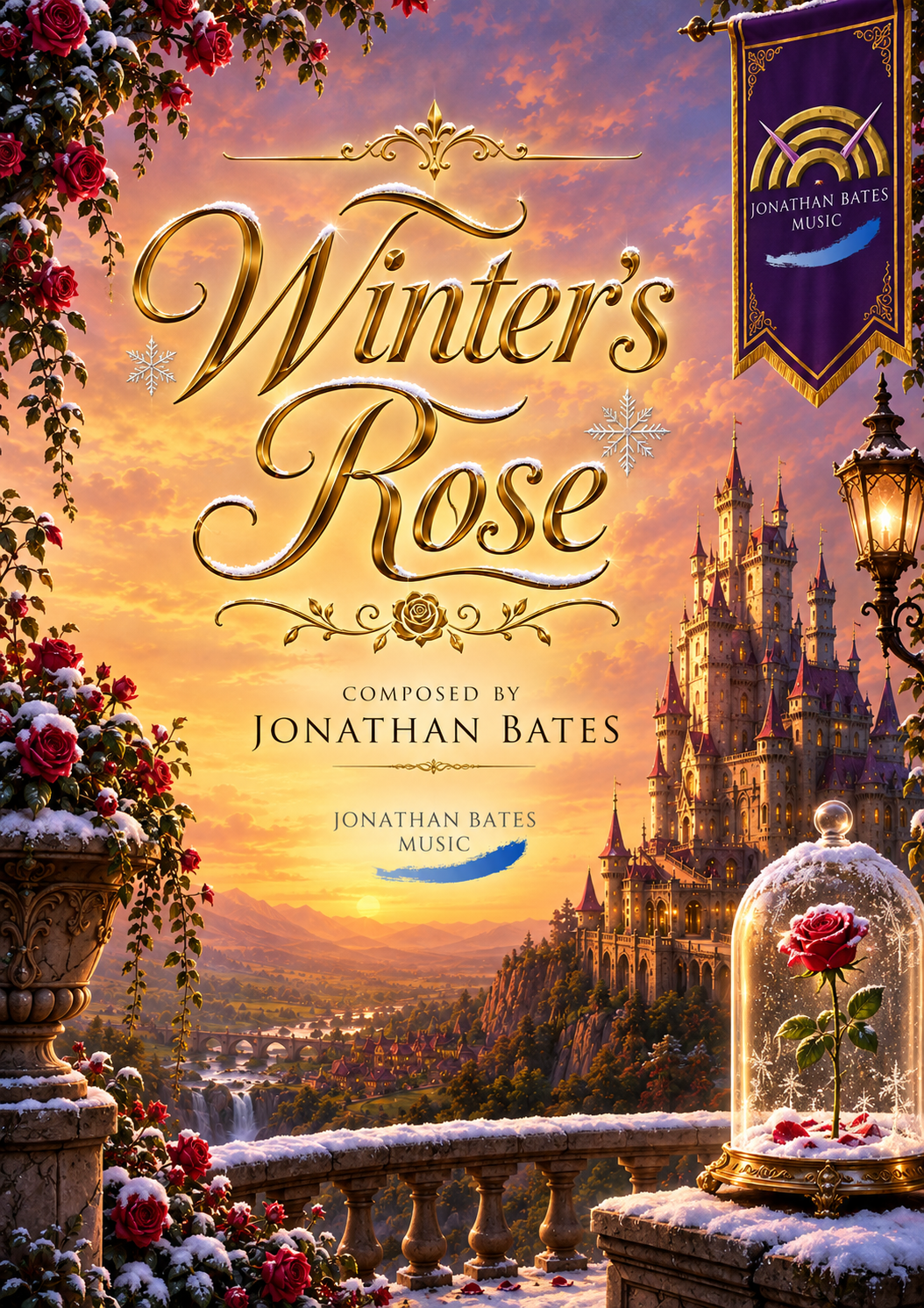
Winter's Rose - Jonathan Bates
Long ago, in a grand castle hidden deep within the forest, there lived a selfish and arrogant prince. One winter s night, an old beggar woman asked for shelter in return for a single rose, but the prince turned her away. Revealing herself as an enchantress, she placed a curse on the prince and all within his castle. Until he learned to love another and earn love in return, he would remain a beast forever.
In Stock: Estimated dispatch 1-3 working days
-
 £30.00
Carrickfergus - Soprano Cornet & Brass Band Sheet Music Full Score & Parts - LM399
COMPOSER: TraditionalARRANGER: Alan BeaumontThe famous Irish tune given a fresh solo approachBrass Band Sheet Music Full Score & Parts"Carrickfergus" is a famous Irish folk song and traditional lament, often interpreted as a heartfelt ballad oflost love, loneliness, and a deep, aching longing for one's home or a past life. Named after the town in County Antrim, Northern Ireland, it features lyrics about a wanderer reflecting on unattainable love, often evoking themes of emigration, old age, and nostalgia.LM399 - ISMN : 9790570003990
In Stock: Estimated dispatch 3-5 working days
-
 £30.00
Repton (Sir Hubert Parry arr. by David Grace) - Brass Band Sheet Music Full Score & Parts - LM557
COMPOSER: Sir Hubert ParryARRANGER: David Grace"Dear Lord and Father of Mankind" is ahymnwith words taken from a longer poem, "The Brewing of Soma" by AmericanQuakerpoetJohn Greenleaf Whittier. The adaptation was made byGarrett Horderin his 1884Congregational Hymns.In many countries the hymn is most usually sung to thetune"Repton" byHubert Parry; however, in the United States, the prevalent tune is "Rest" byFrederick Charles Maker.The text set appears below. Some hymnal editors omit the fourth stanza or resequence the stanza so that the fifth stanza as printed here comes last.If sung to Parry's tune, "Repton", the last line of each stanza is repeated.It is often customary, when singing the final stanza as printed here, to gradually sing louder from "Let sense be dumb...", reaching a crescendo on "...the earthquake, wind and fire", before then singing the last line "O still, small voice of calm" much more softly.Dear Lord and Father of mankind,Forgive our foolish ways!Reclothe us in our rightful mind,In purer lives Thy service find,In deeper reverence, praise.In simple trust like theirs who heardBeside the Syrian seaThe gracious calling of the Lord,Let us, like them, without a wordRise up and follow Thee.O Sabbath rest by Galilee!O calm of hills above,Where Jesus knelt to share with TheeThe silence of eternityInterpreted by love!With that deep hush subduing allOur words and works that drownThe tender whisper of Thy call,As noiseless let Thy blessing fallAs fell Thy manna down.Drop Thy still dews of quietness,Till all our strivings cease;Take from our souls the strain and stress,And let our ordered lives confessThe beauty of Thy peace.Breathe through the heats of our desireThy coolness and Thy balm;Let sense be dumb, let flesh retire;Speak through the earthquake, wind, and fire,O still, small voice of calm.
In Stock: Estimated dispatch 3-5 working days
-
 £53.00
Far Eastern Dream - Paul Voet
The longest trip we make is to the Far East. Japan, China, Tibet,... all countries with an enormous cultural background and history. Percussion is very important here to give a rich dimension to this Japanese 'Black Bamboo' theme. Tam-tam, Chinese cymbals, Tibetan gong and a kododrum (if not possible, large floor tom) together with marimba and glockenspiel are used all the time in a carefulway. A solo cornet presents the main theme that is answered by the whole lower brass section. While this theme develops now and then the sounds of the impressive 'dung' is heard. (dung is the Tibetan very large trumpet-like instrument with loud and very deep sounds) In a quicker tempo Eb bass, euphonium and solo cornet start with the theme and even the counter theme. The whole group joins the party but everything ends very silently with mute.
Estimated dispatch 10-14 working days
-
£132.00
Myte - Torstein Aagaard-Nilsen
Commissioned by Radoy Brass for their 20 years anniversary.This version was first performed by Manger Skulemusikklag in 2005.The Work is devided into Five Scenes:1. Sverdet (The Sword) 3:452. Advarsel - fra en vis mann (Warning - from a Wise Man) 2:303. Dragen (The Dragon) 3:004. Advarsel II - fra syngende fugler (Warning II - from singing birds) 1:355. Gull - forbannelsen (Gold - The Curse) 2:50Total durata 13:30This work is based on five scenes from the tale about "Sigurd Favnesbane" (Sigurd the dragonslayer). Moods and atmospheres in the piece represent my way of retelling the old myth.1. The SwordThe dwarf blacksmith Regin is hammering and sharpening the edges of the magical sword Gram. After three attempts the sword is finally sharp enough to kill a dragon. 2. Warning - from a Wise manRichard Wagners opera Sigfried is based on the same story. In the opera the hero get warned by a wise man. He tells the secret of how to survive an attack of the dragon by hiding in a hole in the pathway and then kill the dragon with the sword as the dragon passes on its way to the river to drink water.3. DragonThe Dragon (Favne) guards a fantastic treasure, but he is also the brother of the blacksmith Regin. Favne get killed and his blood flows slowly while he laments (trombone/bass trombone).4. Warning II - from singing birdsWhile frying the heart, Sigurd burns his thumb and put it into his mouth to cool it down. Then he swallow a drop of fresh magic dragon blood which transfers the ability to understand the birdlanguage. The birds sing warnings to Sigurd telling him that Regin will betray him and later kill him. Sigurd then kills Regin instead.5. Gold - the CurseSigurd takes the gold treasure and escapes on the horseback of Grane. But his robbery of the gold lead him into trouble: The gold is banned and a curse will hit everyone whotakes it...Myth is a programmatic work where the story is quite clearly illustrated throughout the piece:In the first movement you can hear the blacksmith working with hammer on ambolt while the heat is intense from the glows. The dwarf has got his own theme i lower brass (bar 4-5). The hero Sigurd has his own identifying chord (2 bars before F). The chord is also a symbol of the sword.In the second movement the warning from the wise man is expressed in the lyric bass line.The airblow in instruments illustrate the dragon Favne on his way out of his cave, and later the blood flows slowly. The dragon takes his last deep breath after a painful duet in trombones. The birds sing their motifs (lightly, but not cheerful though), until Sigurd cuts the head off Regin and it hits the ground.The last movement describes the atmosphere andstate of mind as the curse infects the obsessed thief.
Estimated dispatch 7-14 working days
-
£67.00
Riv i hjertet - Sondre Justad - John Philip Hannevik
The singer/ songwriter Sondre Justad was born in Lofoten in the north of Norway in 1990. His first album Riv i hjertet was released in 2015, and it became a huge success. He got very fine reviews in some of the largest norwegian newspapers, and the title-song was played frequently on the national radio-stations.The song title could loosely be translated as pulling at my heartstrings, and the song has a deep and dark meaning, with the opening lyrics sounding:If I knew - that I would be dying soon, would I be happy with the way I am living my life
Estimated dispatch 7-14 working days
-
£70.00
Fire in the Sky - Peter Meechan
Fire in the Sky takes its inspiration from the stunning town of Montreux in Switzerland. I was commissioned to write the work 5 days before I visited this Montreux and was at work forming ideas for the piece as I arrived on the shore of Lake Geneva and its amazing views of the Alps.Whilst the scenery is without doubt some of the most incredible views I have ever witnessed, it was the history of the town that set Fire in the Sky in motion. Whilst there, it occurred to me that many of my musical heroes had lived or performed there, and three of them in particular had a strong connection with the town. Miles Davis, Igor Stravinsky and Freddie Mercury graced Montreux - the large convention centre, where the famous summer jazz festival is held, named its two halls after Davis and Stravinsky, and there is a quite breathtaking statue of Mercury in the town too.Each musician also commemorates an anniversary in 2011, the year of the premiere of Fire in the Sky; it is 40 years since the death of Stravinsky and both Miles Davis and Freddie Mercury died in 1991, making it 20 years since their deaths. So it seemed fitting to write a piece that in some way acknowledges them, and is a kind of personal "thanks" for all they have given, and continue to give, me.The title comes from the famous Deep Purple song, Smoke on the Water - whose second line is "Fire in the Sky" and is a reference to the night the town's casino was set alight by a Frank Zappa fan. The piece tries to recreate the atmosphere of that night, paint a picture of fire in the sky (and smoke on the water) and also uses small "nuggets" of the music of my three greatest musical heroes, Miles Davis, Freddie Mercury and Igor Stravinsky.Fire in the Sky was commissioned by the Tomra Brass Band, Norway, and is dedicated to Stijn Berbe and Nick Ost - both of whom are connected with the band (teaching and conducting), and both have been close friends - personally and musicaly - for many years. I am indebted to them for the opportunity to write this piece.
Estimated dispatch 12-14 working days
 View Music