
Results
-
 £89.99
Cry of the Falcon (Brass Band - Score and Parts) - Houben, Kevin
The Cry of the Falcon refers to the Germanic Goddess Freya, who had a cloak of feathers that gave her the ability to change into a falcon. As a falcon Freya could make her way among people. Weeping and screaming, she searched for her lost husband Odur. Power and justice are the main ideas portrayed by Kevin Houben in this lyrical concert work.Duration: 11:30
Estimated dispatch 7-14 working days
-
 £59.99
The Bandwagon (Brass Band - Score and Parts) - Sparke, Philip
Band director and radio presenter Yutaka Nishida hails from Tokyo and is the Frank Renton of the Japanese brass band world. He presents a weekly two-hour music programme on the Japanese national radio station, Digital Radio Musicbird. The programme is called The Bandwagon and the station commissioned Philip Sparke to compose a march, which could be used as the theme tune. The result is this bright and breezy march in simple ABA form. A great lively item for any concert.Duration: 2:45
Estimated dispatch 7-14 working days
-
 £69.99
Pastime with Good Company (Brass Band - Score and Parts) - Sparke, Philip
The English king, Henry VIII (1491-1547), is mainly remembered for disposing of his wives on a regular basis and breaking with the Catholic Church when the Pope Clement VII refused to grant him a divorce so he could marry Anne Boleyn. He was, however, a gifted athlete, dancer and composer, writing many songs, poems and consort pieces (though not Greensleeves, as is often believed). Pastime with Good Company is undoubtedly the best-known of these, written in the first years of the 16th century while he was still a handsome prince, newly married to Catherine of Aragon and the envy of Europe. The lyrics tell of the joys of hunting, dancing and singing and would have been sung as part of the court entertainment.Duration: 6:00
Estimated dispatch 7-14 working days
-
 £119.95
Harrison's Dream (Brass Band - Score and Parts) - Graham, Peter
At 8.00pm on the 22nd of October 1707, the Association, flagship of the Royal Navy, struck rocks off the Scilly Isles with the loss of the entire crew. Throughout the rest of the evening the remaining three ships in the fleet suffered the same fate. Only 26 of the original 1,647 crew members survived. This disaster was a direct result of an inability to calculate longitude, the most pressing scientific problem of the time. It pushed the longitude question to the forefront of the national consciousness and precipitated the Longitude Act. Parliament funded a prize of �20,000 to anyone whose method or device would solve the dilemma.For carpenter and self-taught clockmaker John Harrison, this was the beginning of a 40 year obsession. To calculate longitude it is necessary to know the time aboard ship and at the home port or place of known longitude, at precisely the same moment. Harrison's dream was to build a clock so accurate that this calculation could be made, an audacious feat of engineering.This work reflects on aspects of this epic tale, brilliantly brought to life in Dava Sobel's book Longitude. Much of the music is mechanistic in tone and is constructed along precise mathematical and metrical lines. The heart of the work however is human - the attraction of the �20,000 prize is often cited as Harrison's motivation. However, the realisation that countless lives depended on a solution was one which haunted Harrison. The emotional core of the music reflects on this, and in particular the evening of 22ndOctober 1707.- Peter GrahamJuly 2000 Recorded on Polyphonic QPRL219D Master Brass (Volume Fifteen). Duration: 14'30"
Estimated dispatch 7-14 working days
-
£44.95
Harrison's Dream (Brass Band - Score only) - Graham, Peter
At 8.00pm on the 22nd of October 1707, the Association, flagship of the Royal Navy, struck rocks off the Scilly Isles with the loss of the entire crew. Throughout the rest of the evening the remaining three ships in the fleet suffered the same fate. Only 26 of the original 1,647 crew members survived. This disaster was a direct result of an inability to calculate longitude, the most pressing scientific problem of the time. It pushed the longitude question to the forefront of the national consciousness and precipitated the Longitude Act. Parliament funded a prize of �20,000 to anyone whose method or device would solve the dilemma.For carpenter and self-taught clockmaker John Harrison, this was the beginning of a 40 year obsession. To calculate longitude it is necessary to know the time aboard ship and at the home port or place of known longitude, at precisely the same moment. Harrison's dream was to build a clock so accurate that this calculation could be made, an audacious feat of engineering.This work reflects on aspects of this epic tale, brilliantly brought to life in Dava Sobel's book Longitude. Much of the music is mechanistic in tone and is constructed along precise mathematical and metrical lines. The heart of the work however is human - the attraction of the �20,000 prize is often cited as Harrison's motivation. However, the realisation that countless lives depended on a solution was one which haunted Harrison. The emotional core of the music reflects on this, and in particular the evening of 22ndOctober 1707.- Peter GrahamJuly 2000 Recorded on Polyphonic QPRL219D Master Brass (Volume Fifteen). Duration: 14'30"
Estimated dispatch 7-14 working days
-
 £60.99
Conzensus (Brass Band - Score and Parts) - Van der Roost, Jan
This stately concert opener was originally written by Jan Van der Roost for a special event in which six respected wind orchestras (two Belgian and four Dutch) of different composition (two symphonic bands, two fanfare bands and two brass bands) were featured during six concerts. Each evening brought forth a performance by a symphonic band, a fanfare, and brass band, so that the audience could experience all three types of ensembles. This was indeed an original concept. The name, ConZEnSus, comes from a combination of the words, 'Concert Cyclus' (concert series) and 'zes' (Dutch for 'six'). This leads to a new word, which refers to 'consensus'. The general tenor of the cycle is thus immediately indicated. The richness of color of the various ensembles is revealed through an open and friendly atmosphere. During all six concerts (over a span of three years), ConZEnSus functioned as a permanent opening number for each orchestra. Thus the same musical story was portrayed in three different packages.Duration: 2:30
Estimated dispatch 7-14 working days
-
 £76.99
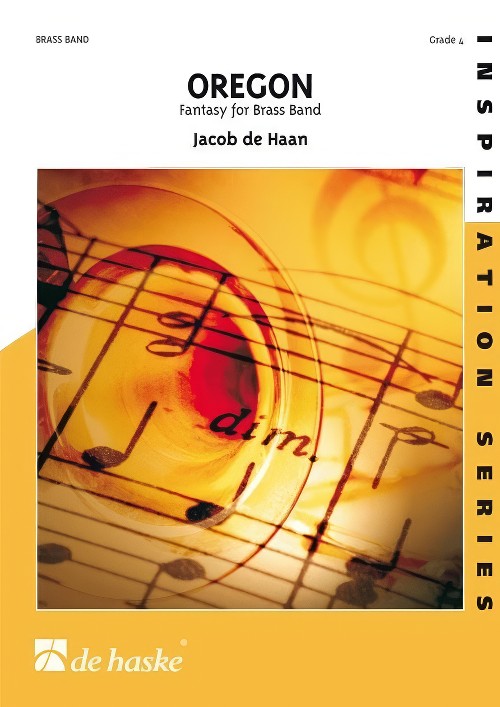
Oregon (Brass Band - Score and Parts) - De Haan, Jacob
This fantasy tells the story of Oregon, one of America's north-western states. Traveling by train on the Northern Pacific Railroad, the listener is taken through the fascinating Oregon landscape. Indians, cowboys, golddiggers and hooded wagons will file past on this adventurous journey. The piece has some similarities with a soundtrack of a movie. Various melodies, which could be the main themes of a movie, pass the review.The piece begins in a slow movement, introducing the first theme in minor. Then we hear in the following fast movement the trombones imitate the train, whistling the steam-flute. We hear the characteristic minor theme again, but now in different variants (also in major). The rhythmic structure of "western" stile and rock succeed each other. This is leading to the slow movement, where the signals of horns and trumpets introduce a wonderful vocal melody. After this characteristic melody, the fast movement appears shortly again, the trombones whistling the steam-flute again (now in major). We hear also some musical elements, that plays a part in the following Presto. Barchanges, jazzy chords, interesting rhythmic patterns (with bongo) and an original theme are the characteristics of this Presto. After this, the horns announce the last section of the piece. Interesting is the fact that we hear in this Allegro section a variant of the vocal melody in the slow movement. Also the Presto theme returns shortly, followed by the Allargando, which is a grand characteristic end of a soundtrack. The movie of our travelling fantasy has come to an end.Duration: 9:10
Estimated dispatch 7-14 working days
-
 £134.99
Dreams (Brass Band - Score and Parts)
This composition by Bertrand Moren presents various dreams which could have an effect on a dreamer's life. Its very high level of difficulty provides a great challenge for the conductor and musicians. You will be taken through a living Nightmare, with spine-chilling passages as dissonant chords alternate with aggressive percussion. Daydream is a patchwork of solos with all the brass band soloists playing serene and soft melodic lines with a virtuosic trombone cadenza. Finally, Visions portrays visions of insanity reflected by violent and discordant descending motifs leading to visions of joy presented in a sparkling and cheerful finale. 15:00
Estimated dispatch 7-14 working days
-
 £58.60
FAMOUS MUSICAL MELODIES (Vocal Solo (Soprano) with Brass Band) - Fernie & Lorriman
Three Movements including: Memory from Cats; I Don't Know How to Love Him from Jesus Christ Superstar; I Could Have Danced All Night from My Fair Lady. Grade: Medium.
Estimated dispatch 7-14 working days
-
 £95.00
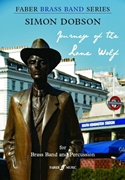
Journey of the Lone Wolf (Brass Band - Score and Parts) - Dobson, Simon
Championship Section Test Piece for the 2016 National Finals of the British Brass Band Championship.The Lone Wolf of the title is the great Hungarian composer and folklorist Bla Bartok. Bartok's journey took him from the hills of the Balkans to the heart of the new world. His singular vision may have meant a life out in the cold, a life without warmth and love, a life without true happiness, a death mourned by a few in a strange land.The first of the three linked movements is capturing the Peasants' Song and follows the young Bartok and fellow composer Zoltan Kolday as they embark on Summertime adventures through the Hungarian countryside to collect and catalogue the astonishing variety of Gypsy and folk music heard in the Balkan hills. The arrival of WW1 plunges Bartok's beloved Hungary into chaos.Bartok was at times a cold man, aloof and lonely. The occasional moments of tenderness he showed are portrayed in Night Music. His brief but intense affairs speak of a love he could only long for. Jazz is my night music and here there are hints of what Bartok may have heard in the USA later in his life.Having been forced by the world's evils to leave his homeland of Hungary for America Bartok, the anti-fascist, felt isolated and angry. In the finale, Flight and Fight, we hear his longing for a simpler time of Gypsy folk dances as well as his maturity and depth as a composer finally exploring deeper colours and darker themes.Duration: 15.00
Estimated dispatch 7-14 working days
 View Music