
Results
-
 £109.99
Fantasy for Brassband and Organ - Jan Bosveld
When I was approached to compose a work for brassband and church organ I already envisioned the concept I would use. It would indeed literally become a work for brassband and organ. Without the traditional solos, the organ would form an addition to the brassband orchestration as would the brassband provide an extra register for the organ. In short a homogeneous entity. The most important reason for doing this is quite simple. Since this work can only be performed in a church and because of the specific acoustics of the church, the brassband would sound in al its tone colour like an organ. By using certain registers of the organ and combining these with the brassband a wonderfulsound palette can be created. The use of complementary or contrasting tone quality is also possible. The primary theme of this composition is based on these three methods of "colouring". As far as structure is concerned this work consists of two parts. slow fast. It is built on a number of motifs in which some behave like a consecutive canon. In the fast movement the primary motif develops into a fugue-like section. The canon and fugato are techniques frequently used in classical and contemporary organ literature. The liberal use of structure and motif has lead to the title. "Fantasy for Brassband and Organ".
Estimated dispatch 5-14 working days
-
 £67.50
Glee Showstoppers - Adam Anders - John Blanken
The hit TV series Glee keeps rolling along with a talented and engaging cast performing contemporary versions of classic rock hits. Here is a medley of some of their most memorable numbers - Jump, Total Eclipse of the Heart, The Safety Dance and Dream On.
Estimated dispatch 5-14 working days
-
 £60.99
Stille Nacht - Franz Xaver Gruber - Jacob de Haan
Jacob de Haan wrote this arrangement for concert band, fanfare band and brass band and optional male voice choir. The original carol was written by the Austrian composer and organist Franz Gruber (1787-1863). He was asked to write Silent Night) on the 24th of December 1818 by the priest of the Church of St. Nicolas in Oberndorf, who had himself written the text. It is a romantic carol, with nuances of contemporary Austrian folk and Italian pastorale music.
Estimated dispatch 5-14 working days
-
 £54.99
Slavonic Rock March - David Well
According to his teachers, Pyotr Ilyich Tchaikovsky (1840-1893), was not particularly gifted. His special talents were acknowledged only in 1865 when he had been working for the Ministry of Finances for some years. In 1866 he was appointed teacher at the Conservatory and applied himself to composing. His oeuvre is fairly extensive and many of his compositions receive a high ranking on the international list of classical music, including his six symphonies, solo concertos (violin concerto and piano concertos), ballets (The Nut Cracker, Swan Lake), and his overtures (1812 and Romeo and Juliette). In 1893 Tchaikovsky died of Cholera after drinking a glass of infectedwater. His Slavonic March is a popular concert piece for symphonic orchestra that is still frequently performed in concert halls. David Well arranged the theme and created a contemporary march in rock style. Tchaikovsky once said to an unsatisfied teacher: 'I will be a great composer within 10 years time.'
Estimated dispatch 5-14 working days
-
 £20.00
atrium phase
Descriptionatrium phase was inspired by listening to works performed at the 2013 Huddersfield Contemporary Music Festival in the atrium of the Huddersfield University Creative Arts Building. The atrium, despite being a functional area incorporating meeting areas and a cafe, has almost coincidentally evolved into a fantastic (if somewhat resonant) performance space. Performers can be positioned on three different sides and three different levels, making the atrium ideally suited to spatially separated performances of a variety of music from Gabrieli to Christian Wolff.In atrium phase the band is separated into four groups - ideally these should be positioned around the audience as follows: group A to the left of the audience, group B in front of the audience, group C to the right of the audience and group D (the four basses) behind the audience. The music "phases" between the groups in the manner of contemporary electroacoustic music, with the bass group acting as a kind of "subwoofer". Starting very slowly, the music accelerates using metrical modulations to finish at considerable speed.The music is intended to be performed without a conductor wherever possible - the three percussionists should set and control the tempo, and there are clear points of overlap for percussionists to allow synchronisation between groups.atrium phase won the inaugural Foden's Band Composition Competition in 2014 and the first performance was given on 24 January 2015 at the RNCM Festival of Brass by Foden's Band.Performance Notes:The band is separated into four groups - ideally these should be positioned around the audience as follows: group A to the left of the audience, group B in front of the audience, group C to the right of the audience and group D (the four basses) behind the audience. The music "phases" between the groups in the manner of contemporary electroacoustic music, with the bass group acting as a kind of "subwoofer". Starting very slowly, the music accelerates using metrical modulations to finish at considerable speed.Instruments in group A require cup mutes (soprano, 2 x cornets, horn, baritone, trombone, euph), group B harmon mutes (4 x cornets, baritone and trombone - the baritone should use a trombone mute) and group C require fibre straight mutes (3 x cornets, flugel, 2 x horns, euph., bass trom - NOT metal mutes if possible).Percussion instruments required are claves, wood block and 2 x temple blocks. The music is intended to be performed without a conductor wherever possible - the three percussionists should set and control the tempo, and there are clear points of overlap for percussionists to allow synchronisation between groups.Approximate duration 6'17"
Estimated dispatch 7-14 working days
-
 £77.00
General Series Brass Band Journal, Numbers 2242 - 2245, April 2024
2242: Fanfare Prelude - Faithful in every way (Simon Gash)Lord, I come before your throne of grace (S.A.S.B. 378) has become a popular song for Sunday worship. These words of great assurance are married to a strong tune which, unlike many contemporary worship songs, suits the brass band idiom well. Although this piece will work without Percussion, the Snare Drum part, which underpins a lot of the piece, will help drive the music forward.2243: The wonders of thy grace (Norman Bearcroft)Herbert Booth's song Within my heart, O Lord, fulfil (S.A.S.B. 211) was the inspiration behind Lieut-Colonel Norman Bearcroft's three-verse setting of the hymn tune Wareham, with the title being taken from the lyrics of verse two.2244: Trombone Solo - I will wait (Andrew Mackereth)Major Leonard Ballantine has an astonishing gift for contemporary song writing. This song is a brilliant example of this, taking the idea of Jesus waiting patiently for us to accept the fullness of his offer of love.This arrangement was made at the request of Andrew Justice, former Principal Trombonist of The International Staff Band. For many years, Andrew has used this song with piano accompaniment. In making this arrangement, the composers aim was to capture the transparency you can create in piano playing.2245: The battle cry! (David Edmonds)Inspired by Lorne Barry's Trinity (F.S. 599), this piece would be well suited as a concert opener but would work in many settings as a contribution to worship. Its main feature is the driving rhythmic pattern in the Bass and Percussion sections. The music needs to be played with confidence and purpose. As the title suggests, it is a strong, inspiring battle cry, corralling the troops. This is a setting of the song by Stuart Townend and Keith Getty, O Church, arise (S.A.S.B. 819), which has become popular in recent years, not only within The Salvation Army, but also the wider Christian church.
Estimated dispatch 7-14 working days
-
 £38.95
Unity Series Band Journal October 2017 Numbers 458-461
March Medley I Believe (Noel Jones)This potpourri of songs brings the strong assurance of faith and hope together in an attractive and enjoyable manner. The tunes featured are 'I believe we shall win', 'I believe God answers prayer', 'I believe in God the Father' and 'I believe in the word of God'.Horn Solo - Promises (Jorgen Ljserdorn)This is a brass setting of a song by Captain Matthew Spencer with the same title. The contemporary setting is simple in design and should prove to be popular amongst many who feature this journal.Suite Like a melody (Steve Forman)Major Stephen Foreman has written a short suite which will bring an easy yet attractive addition to most band's repertoire. I am praying (Jared Proellocks)A contemporary setting of the much loved chorus 'I am praying blessed Saviour' written by a young Salvationist from the Australian Southern Territory.
Estimated dispatch 7-14 working days
-
 £38.95
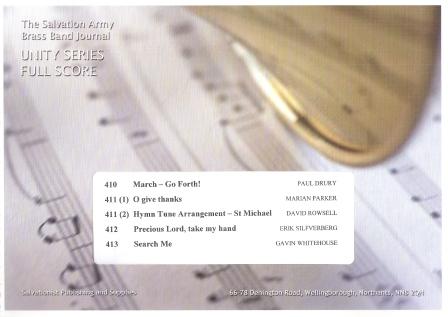
Unity Series Band Journal October 2013 Numbers 410 - 413
No. 410 March - Go Forth! (Paul Drury)This march was written as a tribute to Bandmaster Jack Spowart and the Bo'ness Salvation Army Band. The composer lives in the twon of Bo'ness and has had numerous opportunities to share with the band and the wider corps at various events. This march serves as recognition of the faithful service given in the Lord's name in the town by The Salvation Army for over 100 years. Two tunes are featured, both well-known and instantly recognisable, namely, Forward! be our watchword and We're marching on.No.411 (1) O give thanks (Marian Parker)The composer, Marian Parker, is a new contributor and is the Recruiting Sergeant at Leicester South Corps. This simple, yet rhythmic piece should not pose any technical problems for most bands and features the attractive arrangement of Joanne Pond's contemporary song, 'O give thanks'.No.411 (2) Hymn Tune Arrangement - St Michael (David Rowsell)The hymn tune 'St Michael' was composed in 1551 by French composer Louis Bourgeois and the composer provides a very useful arrangement of this historic hymn.No. 412 Precious Lord, take my hand (Erik Silfverberg O.F.)This well-known Gospel Song is a favourite of many. It has been recorded by many great artists, including Rosetta Tharpe, Elvis Presley and Aretha Franklin. The words were written by Reverend Thomas A. Dorsey, who is often known as the 'Father of Gospel song'.No. 413 Search Me (Gavin Whitehouse)The second new contributor to this journal is Gavin Whitehouse. gavin is the Assistant Music Director for the Greater New York Division and is also the USA Eastern Territorial Songster Leader. This piece combines two songs - one old and one new - which speak of a God who knows us intimately. 'Search me, O God and know my heart today' (associated with the beautiful Maori melody, 'Now is the hour') is woven with a contemporary setting of Psalm 139 by Rebecca St James, the first line of which says, 'You searchme, you know me'.
Estimated dispatch 7-14 working days
-
 £45.00
Starburst
Commissioned by the Greater Manchester Hub Youth Brass Band for their 2014 season, Starburst is a high-octane work in a contemporary style with elements of rock and funk fusion. The piece features soloistic input from all sections, with vibrant percussion colours adding to the overall effectiveness. Although the piece sounds extremely virtuosic it is accessible for most bands, and is fun to rehearse as well as exciting to listen to. Duration: 00:04:00 Grade: 3 (Works well when paired with Aurora Awakes)
Estimated dispatch 5-7 working days
-
 £55.00
Could it be Magic
ABOUT THIS PIECE: It's finally here... Bring the energy and nostalgia of a pop classic to your next programme with this sensational arrangement by Adam D J Taylor of Could It Be Magic. Written by Barry Manilow and Adrienne Anderson, the song draws inspiration from Frdric Chopin's Prelude in C Minor, blending classical influences with a contemporary pop style. First released by Manilow in 1973, the song gained further fame through a dynamic reinterpretation by Take That in the 1990s, making it a favourite across generations. This arrangement captures the dramatic flair and infectious rhythm that have made Could It Be Magic a timeless hit. From its serene opening to its soaring melodies, it's a guaranteed showstopper that will we're sure will have audiences on the edge of their seats. Whether as a thrilling concert feature or a lively encore, this arrangement is sure to be a huge hit with bands and audiences alike. Don't miss the chance to add a touch of magic to your next performance! ENSEMBLE: Standard British Brass Band WHEN YOU BUY THIS PRODUCT, YOU GET: High-quality printed score and parts LEVEL: 2 LISTEN: DURATION: c. 5-minutes, 30-seconds EXAMPLE SCORE: Click here LEVEL GUIDE: Level 1- Accessible to all Level 2 - c. UK third section and higher Level 3 - c. UK second section and higher Level 4 - c. UK first section and higher Level 5 - c. UK championship section level
Estimated dispatch 5-7 working days
 View Music