
Results
-
-
-
 £76.99
New Waves - Torstein Aagaard-Nilsen
New Waves is a special composition. Although contemporary but still attractive to musicians and listeners. Norwegian composer Aagaard-Nilsen has failed in a special way to add new elements to the contemporary wind music. Original exciting rhythms and contrasting harmonies make this composition enjoyable and challenging together. Interrupted by a slow middle section New Waves may be seen as five minutes jazz, rock and funk optima forma! New Waves is een bijzondere compositie. Weliswaar eigentijds maar toch aantrekkelijk voor muzikanten en luisteraars. De Noorse componist Aagaard-Nilsen is er op bijzondere wijze in geslaagd nieuwe elementen toe te voegen aan dehedendaagse blaasmuziek. Oorspronkelijke ritmes en spannende contrastrijke samenklanken maken het spelen van dit werk plezierig en uitdagend tegelijk. Onderbroken door een langzaam middendeel kan New Waves beschouwd worden als vijf minuten jazz, rock en funk optima forma!
Estimated dispatch 5-14 working days
-
 £134.99
West Wind - Oliver Waespi
West Wind is structured in three parts, each bearing a subtitle drawn from poems of Emily Bronte (1818-1848). Poetry of the Romantic period, Bronte's in particular, often presents a gentle, almost innocent surface, beneath which lies the most elemental and volatile emotional forces capable of erupting at any moment.Accordingly, the opening movement, West-wind, in the glory and pride!, begins with a mellow, warm soundscape, underpinned by lightly pulsating patterns, almost like an aquarelle. Gradually however, the music transitions into far rougher, forward-driven gestures - turbulent, restless, and at times unpredictable, much like the west wind itself.The ensuing Adagio reflects on the poem Stars, in which a fundamental tension between exaltation and regret, another recurring feature of Bronte's poetry, is palpable throughout. Introspective solo and chamber music statements give way to a broad ecstatic sound field involving the full ensemble, before finally receding into a solitary euphonium soliloquy.The final movement, Wild words of an ancient song, takes the form of an extended rondo-scherzo, driven by virtuosic, perpetual motion. The sense of relentless pursuit bears a nod to The Boy on the Moor by the German poet Annette von Droste-Hulshoff, a contemporary of Bronte who explored similar narratives, albeit from a different perspective.Although certain core musical elements recur - pulsating patterns, a chorale, a tone row - the work is guided less by systematic symphonic development than by an intuitive stream of variants. These generate a sequence of metamorphoses that illuminate the material from shifting vantage points, projecting the emotional landscapes of Romantic poetry into the present day.West Wind was commissioned by the Flowers Band and was first performed under Musical Director Paul Holland, at the 2026 European Brass Band Championships in Linz (AT), where they also became European Champions.
Estimated dispatch 5-14 working days
-
 £44.00
Fairfield Fanfare (expanded version) - Roxanna Panufnik
Fairfield Fanfare (expanded version) by Roxanna Panufnik is a 4-minute work for youth and mixed choirs, brass band and orchestra. Originally commissioned to celebrate the 50th anniversary of the Fairfield Halls, Croydon in 2012, the opening chords are based on all the alphabetic note names from FA-ir-F(#)-i-E-l-D, heralding a flourishing section of hustle and bustle that is the city of Croydon today.This expanded version includes brass band and choirs, with a setting of the text from Psalm 127. The expanded version was commissioned by the London Mozart Players, who premiered the piece on 30 June 2016 at Fairfield Halls, Croydon.This edition is the full score in C (EP 72880). It is available for sale as part of the Peters Contemporary Library. The performance material can be hired as well as a transposed full score, if preferred.
Estimated dispatch 5-14 working days
-
 £78.20
Lights, Camera, Action - Dean Jones
Lights, Camera, Action! is a playful and contemporary work for student band composed by Dean Jones. Three sections depict the making of a film. I. Preparing the scene, II. On location, III. The red carpet award ceremony. This is an interactive musical work where various sections give alternating film directions and are also allowed to use the flashlights of their mobile phones. Carefully composed and orchestrated by Dean Jones for flexible band setting.
Estimated dispatch 5-14 working days
-
 £127.30
Graceful Ghost - William Bolcom
I came to know of this piece when hearing famous Norwegian ragtime pianist Morten Gunnar Larsen playing it at a concert with the Norwegian Navy Band Bergen. I was struck by its melancholic beauty and wanted to arrange it for band.Ragtimes are rarely in a minor key (which this one is) and when you first hear it, you might think it was written around the time when Scott Joplin was the main ragtime composer. But, if you listen more carefully, you notice that some of theharmonies are more advanced than one might expect in traditional ragtime, giving the piece a slightly more contemporary feel. The composer William Bolcom wrote Graceful Ghost in 1970 to honour the memory of his father and it is one of hismost popular pieces.
Estimated dispatch 5-14 working days
-
 £69.95
Chi - Gary Carpenter
A BBC commission, this challenging piece has been recorded by Grimethorpe Colliery Band and is set to become one of the great contemporary brass works of the decade.
Estimated dispatch 5-14 working days
-
£76.99
Jubilant Prelude - Toon Hagen - Dirk Annema
'Jubilant Prelude' is an orchestration of the 'Preludium over Psalm 150' originally composed for organ by Toon Hagen. Since 1998 Toon Hagen has been organ-player of the 'Grote or Sint Michaelskerk' in Zwolle (the Netherlands). He has written several 'contemporary' compositions for organ.'Jubilant Prelude' has a capricious character by the use of irregular measures and its many measure changes. The structure of the Prelude is that of a fugue and is based on motives from the psalm.After the first climax, which is both dynamic and harmonic, the theme in the Andante Jubiloso is clearly audible and it is alternated with erratic motifs. Tension increases until at last the psalm itself isheard in all its glory. The melody of the psalm sounds as a cantus firmus in tenor register, with motifs in ornamentation for saxophones, bugles and trumpets. The finale, like the prelude is capricious and vehement.The instrumentation for brassband was made by Dirk Annema. It is particularly colourful and has a surprising role for the percussion section.
Estimated dispatch 5-14 working days
-
 £184.00
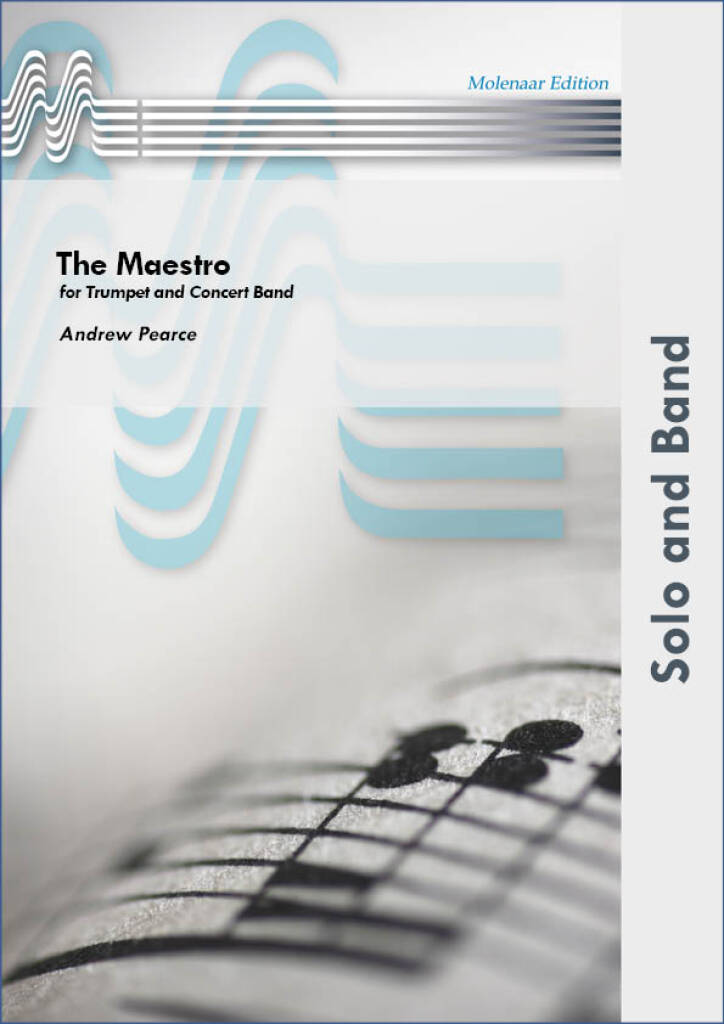
The Maestro - Andrew Pearce
The Maestro, a concertino voor trompet en band, was commissioned by Philip Cobb, principal trumpet of the London Symphony Orchestra. I spent most of Summer 2011 in Prague and London composing this demanding piece, for this was a wonderful opportunity to write a large scale work for one of the world's finest Trumpet virtuosos and I accepted the assignment with great enthusiasm. I also felt a great responsibility to deliver a tour de force for this world class player that was both challenging and enjoyable. Phil was seeking melodies and themes in the piece and had enjoyed my album 'Cinema Symphony', and the dramatic vistas it conjured up. Before writing began, I listened to his beautiful album 'Life Abundant' many times, ensuring I had his sound in my head while writing. The piece represents the many aspects of a contemporary trumpeter's musical life from; brass band chorale (a homage to Phil's musical roots), to the symphonic concert hall to the film recording studio. I am delighted to have had Phil and the International Staff Band record this work under the baton of Dr Stephen Cobb. Its a tour de force not only for the soloist but also for the band and should be an exciting challenge for the very best bands out there.
Estimated dispatch 5-14 working days
 View Music