
Results
-
 £25.00
Silver Spirit - Brass Band - LM369
COMPOSER: Franner OtterA Concert Piece for Brass Bandby Franner OtterThis piece was inspired by the resilient spirit that quickly blossomedwithin the brass band movement as a result of the Covid-19 lockdown.Despite being unable to meet and play together,bands found freedom of expression through other methodsof making music together such as online group performanceswhich enabled a whole new world of collaborative music-making to flourish.Band members were able to share their musical talentand the joy of performing with a whole new audienceas well as developing and nurturing a new outlet of creative expression.Instead of remaining musically confined during lockdown,brass bands and their members found a new freedomswithin this structure to create and share music with others.This composition is intended to reflect the cheerfuland good-humoured attitude of band membersin the way that they went about coping with the enforced restrictionsand the happiness that was demonstrated in making music together.This piece is dedicated to the positive spirit of theBrass Band movement that has shone through this difficult time.Franner Otter
In Stock: Estimated dispatch 3-5 working days
-
 £22.50
Edward Gregson: Concertante for Piano and Brass Band
DescriptionProgramme NoteThe Concertante for Piano and Brass Band was written in 1966, when the composer was an undergraduate student at the Royal Academy of Music in London. It received its first public concert performance in 1967 at the Royal Festival Hall, London, when the composer was the soloist with the International Band of the Salvation Army, conducted by Bernard Adams. It was one of the first major works to be written for this particular combination.The Concertante is unashamedly romantic in idiom and is in three movements: Prelude, Nocturne and Rondo. The Prelude is cast in sonata form and opens with a short cadenza-like flourish from the soloist, followed by two main ideas - the first sweepingly dramatic, the second highly lyrical. The interplay between these two themes forms the main focus of the movement, and after a return to the opening theme, an exuberant codetta brings the music to a close, albeit a quiet one. https://morthanveld.com/wp-content/uploads/2017/09/Gregson-Concertante-1st-movt-clip.mp3The tender Nocturne opens with an introduction from the band that contains precursors of the two main ideas to follow. The solo piano announces the main theme, which has a slightly 'bluesy' character with its flattened third and seventh notes of the scale, and is a love song dedicated to the composer's wife-to-be. The band enters with phrases of a chorale already hinted at in the introduction - Ray Steadman-Allen's hymn tune 'Esher' - but never quite presented in its complete state. Both ideas are developed alongside each other, with eventually the first theme returning, this time with piano and band together, and building to a majestic climax, before subsiding to a peaceful coda - a return to the very opening of the movement. https://morthanveld.com/wp-content/uploads/2017/09/Gregson-Concertante-movt-2-clip.mp3The final Rondo is full of energetic rhythms and changing time patterns. The main theme is playful in character, with much interplay between soloist and band, whilst the middle section presents a new theme, and one that has more than a hint of the hymn tune 'Onward Christian Soldiers', in what amounts to a good humoured parody. The opening Rondo theme returns, this time leading to a powerful and dissonant climax from the band. This is followed by an extended piano cadenza, underlying the virtuoso aspect of the work, and leading to an energetic and life-affirming coda, which brings the work to a triumphant conclusion. https://morthanveld.com/wp-content/uploads/2017/09/Gregson-Concertante-movt-3-clip.mp3Duration: 18 minutesInstrumentation:Please note that there is no 1st/Repiano Cornet part in this work. The 1st/Repiano Cornet player should join the Solo Cornet bench. As such an extra Solo Cornet part is provided in the set of parts.Version for two pianosA version of the Concertante for two pianos is available for rehearsal purposes. Piano 1 is the solo part and Piano 2 the band reduction. However, for those pianists not needing to rehearse the work in this way, a solo piano part is also provided with the main set of band parts.To view a preview of the solo part for the first movement click here.The youthful Gregson (his work was written as a third year undergraduate) was seemingly a bit of a musical magpie - but one heck of a skilful one at that.These were shiny baubles of poise, panache and pastiche, with affectionate, remarkably mature nods of appreciation towards Gershwin, Rachmaninov, Ireland and even Elmer as well as Leonard Bernstein.The rich colour palette and flowing lines (with the tenderest of central Nocturnes) were a joy - as were the little buds of motifs that dotted the score like seeds ready to be planted on a future fertile brass band compositional field. - Iwan Fox, 4Barsrest.com, June 2019For more information on Edward Gregson's music please visit the composer's website: www.edwardgregson.com
Estimated dispatch 7-14 working days
-
 £55.00
Mr Shilkret's Maggot (Brass Band - Score and Parts)
This short piece was composed in 1932 during a visit Gustav Holst was making to the USA. He was invited by the band leader Nathaniel Shilkret to contribute to a series of piece for concert jazz band based on a folk song. Rather than using a traditional tune, Holst invented one of his own in folk song style and therefore the piece was not performed. Holst considered various titles for the piece including Mr. Shilkret's Dump, Folly and Maggot. On the manuscript he described it as a Jazz Band Piece. When the composer's daughter Imogen re-scored the piece for the English Chamber Orchestra to record under her direction in 1967, she changed decided to use the title Capriccio.Her re-orchestration involved removing the saxophone quartet, adding cor anglais and a second bassoon and changing cornet parts to trumpets. She retained the harp, extensive percussion, piano and celesta. My brass band version is based on the composer's manuscript, held at the British Library. It retains the composer's cornet parts, re-voices the woodwinds and strings, and places keyboards and harp onto glockenspiel, marimba, vibraphone and xylophone.I have selected the title Mr. Shilkret's Maggot for my scoring of Jazz Band Piece, which was first performed by The Cory Band, conducted by Philip Harper, at the Royal Northern College of Music Brass Band Festival, 29 January 2017.- Paul HindmarshDuration: 5.30
Estimated dispatch 7-14 working days
-
 £25.50
The Spirit of Brass - Youth Band Version
Commissioned for BrassFestUK 2017 & recorded by the Cory Band, the Spirit of Brass is an exciting, new energetic work that will fit perfectly into any concert, particularly as an opening item. With memorable themes, the composition takes its roots from that of John Williams' various Olympic themes that he has composed over the years. As well as this training band version, there is also a full band version of the work available for mainstream bands. The two versions work as standalone items, or can be performed side-by-side. A great new original piece for Brass Band.
Estimated dispatch 7-14 working days
-
 £89.99
Torsion (Brass Band - Score and Parts)
Torsion was commissioned by the Leyland Band and first performed on 23 January 2010 at the Royal Northern College of Music Festival of Brass, Manchester, by Leyland Band conducted by Jason Katsikaris. This colourful and dynamic work is the most personal and ambitious that Simon Dobson composed during his residency with the Lancashire brass band. The dictionary defines torsion as the state of being twisted and the composer interprets this as the imagined dis-torsions and con-torsions of Time, Light and Sound in three contrasting movements. Simon Dobson fuses the traditional brass band sound with drive and energy of pop and funk jazz with optional digitally distorted 'echoes' providing added aural confusion at the points of climax. Although composed as a substantial concert work, Torsion would also make a challenging test-piece for contesting brass bands in the elite divisions. Suitable for Championship Section Bands. Duration: 15.00
Estimated dispatch 7-14 working days
-
 £95.00
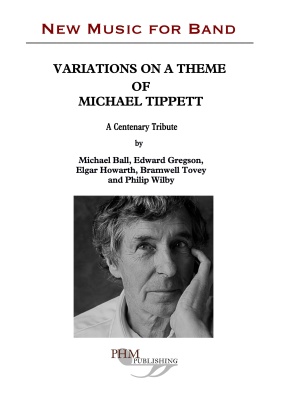
Variations on a Theme of Michael Tippett (Brass Band - Score and Parts)
A Centenary Tribute by Michael Ball, Edward Gregson, Elgar Howarth, Bramwell Tovey and Philip WilbyThis unique 'pice d'occasion' arose out of a telephone conversation in 2004 with Alan Wycherley, who was the soprano cornet player of the Foden's Richardson Band at the time. He indicated that the band would like to include an original birthday tribute for Edward Gregson (60) and Elgar Howarth (70) in its concert at the 2005 RNCM Festival of Brass in Manchester. I have been Artistic Director of Manchester's Festival of Brass since it was established in 1990 as a BBC Radio 3 series, As the centenary of the birth of Sir Michael Tippett fell on 5 January 2005, I devised this collective work as a way of embracing all three anniversaries in a novel way.The idea of joint compositions is not a new one in the classical music world. In the 1860s, Verdi was joined by a number of his contemporaries in a Requiem Mass for Rossini. In this country there have been a number of orchestral examples over the past fifty years, but never before for the brass band. Although Tippett composed only one work for brass band, Festal Brass with Blues, his orchestral works and operas are full of idiomatic brass writing. The theme I chose for this celebration is one of Tippet's most memorable miniatures featuring wind and brass. In the opera Midsummer Marriage it marks the entry of the Ancients. It is also included in the orchestral Suite in D (1948), for the Birthday of Prince Charles.I invited five of the leading contemporary voices in brass band music to add their own creative perspectives to the little Tippett theme, with it's characteristic rhythms, embellishments and modality - the Lydian mode. Each contribution was designed to fit into a tonal and formal template to give the whole work a flow and continuity. In Danse des Amis, Bramwell Tovey has composed a jazzy, humorous variation. Inspiration came from Tippett's love of jazz and, more personally, from the characteristically syncopated gait of the distinguished music critic John Amis, who Tovey once observed leaving a performance of Tippett's opera King Priam before the end. Incidentally, that performance was conducted by Elgar Howarth.We hear Edward Gregson in lyrical mode. His Midsummer Song is redolent of the sound world of Tippett's opera A Midsummer Marriage and it ends with a brief reference to a favourite of Gregson's, Tippett's Concerto for Orchestra. Michael Ball provides a brief moment of light, airy activity bringing to mind perhaps Tippett's love of Shakespearian fantasy, especially The Tempest. Elgar Howarth juxtaposes a slowed down version of the processional theme with distant recollections of fanfares from King Priam. Philip Wilby has rounded the tribute off with a spectacular fugue. During its inexorable progress Wilby ingeniously introduces the two other birthday references - the three-note musical signature that Elgar Howarth includes in much of his music and the characteristic theme which begins Edward Gregson's substantial work for brass an organ The Trumpets of the Angels. An elaborated reprise of Tippett's little theme is followed by a dynamic coda.- Paul HindmarshDuration: 13.00
Estimated dispatch 7-14 working days
-
£40.00
Variations on a Theme of Michael Tippett (Brass Band - Score only)
A Centenary Tribute by Michael Ball, Edward Gregson, Elgar Howarth, Bramwell Tovey and Philip WilbyThis unique 'pice d'occasion' arose out of a telephone conversation in 2004 with Alan Wycherley, who was the soprano cornet player of the Foden's Richardson Band at the time. He indicated that the band would like to include an original birthday tribute for Edward Gregson (60) and Elgar Howarth (70) in its concert at the 2005 RNCM Festival of Brass in Manchester. I have been Artistic Director of Manchester's Festival of Brass since it was established in 1990 as a BBC Radio 3 series, As the centenary of the birth of Sir Michael Tippett fell on 5 January 2005, I devised this collective work as a way of embracing all three anniversaries in a novel way.The idea of joint compositions is not a new one in the classical music world. In the 1860s, Verdi was joined by a number of his contemporaries in a Requiem Mass for Rossini. In this country there have been a number of orchestral examples over the past fifty years, but never before for the brass band. Although Tippett composed only one work for brass band, Festal Brass with Blues, his orchestral works and operas are full of idiomatic brass writing. The theme I chose for this celebration is one of Tippet's most memorable miniatures featuring wind and brass. In the opera Midsummer Marriage it marks the entry of the Ancients. It is also included in the orchestral Suite in D (1948), for the Birthday of Prince Charles.I invited five of the leading contemporary voices in brass band music to add their own creative perspectives to the little Tippett theme, with it's characteristic rhythms, embellishments and modality - the Lydian mode. Each contribution was designed to fit into a tonal and formal template to give the whole work a flow and continuity. In Danse des Amis, Bramwell Tovey has composed a jazzy, humorous variation. Inspiration came from Tippett's love of jazz and, more personally, from the characteristically syncopated gait of the distinguished music critic John Amis, who Tovey once observed leaving a performance of Tippett's opera King Priam before the end. Incidentally, that performance was conducted by Elgar Howarth.We hear Edward Gregson in lyrical mode. His Midsummer Song is redolent of the sound world of Tippett's opera A Midsummer Marriage and it ends with a brief reference to a favourite of Gregson's, Tippett's Concerto for Orchestra. Michael Ball provides a brief moment of light, airy activity bringing to mind perhaps Tippett's love of Shakespearian fantasy, especially The Tempest. Elgar Howarth juxtaposes a slowed down version of the processional theme with distant recollections of fanfares from King Priam. Philip Wilby has rounded the tribute off with a spectacular fugue. During its inexorable progress Wilby ingeniously introduces the two other birthday references - the three-note musical signature that Elgar Howarth includes in much of his music and the characteristic theme which begins Edward Gregson's substantial work for brass an organ The Trumpets of the Angels. An elaborated reprise of Tippett's little theme is followed by a dynamic coda.- Paul HindmarshDuration: 13.00
Estimated dispatch 7-14 working days
-
 £34.95
Island Whirl (Brass Band - Score and Parts)
Island Whirl was commissioned by Margaret Milligan who wanted a brand new piece of music composed as a present for Ian, her husband for his 70th birthday. Ian Milligan is a keen and dedicated musician and he is the musical director of Callendar Brass, based in Callendar near Stirling in Scotland.Margaret contacted me about the possibility of composing a short lively piece which had a Scottish theme that would be ideal for Callendar Brass Band and any other ensemble to get their teeth into. This piece takes its inspiration from the traditional Scottish folk song 'An Eriskay Love Lilt' which is a particular favourite of both Margaret and Ian.With thunderous Celtic drums the piece opens in a whirlwind of sound with fanfare brass and an off-stage soloist that can perform using either the cornet or trumpet. After the exciting opening, the brass and drums die away to allow the off-stage soloist to air the traditional tune 'An Eriskay Love Lilt'.The beautiful haunting melody, keeping its originality throughout undergoes a series of changes in the accompanying harmonic material before dying away to allow the Celtic drums to return. The percussion whip the band into a frenzy as the piece gets faster and faster. Just prior to the final notes the band diminuendo to allow one last closing statement from the Eriskay Love Lilt lead by the off-stage soloist before the ensemble charge to a dramatic close.When performing this piece I would recommend the off-stage soloist taking a position somewhere in the audience, so they can almost feel part of the performance. In addition, with the two tom-tom parts that represent the Celtic drums, bands should make the most of showcasing them by getting the two drummers out to the front of the band to perform. The ideal stage position would be with the players set up in stereo with one player in front of the soprano cornet and the other in front of the solo trombone.With the various choreographed movements from both the off-stage soloist and the percussionists. This piece is a great addition to any concert repertoire and is an ideal showcase for bands who want to try something a little different.I wish Ian at 70 years young, all the very best with his music making in the many years to come and I hope this piece, composed especially for him and Callender Brass brings them many years of musical enjoyment.Paul Lovatt-Cooper
Estimated dispatch 7-14 working days
-
 £42.95
Visions of Kolkhis (Brass Band - Score and Parts)
Visions of Kolkhis was commissioned by Jason Katsikaris and the Leyland Band as a finale for their appearance at the 2009 Brass in Concert Championship Inspired by Jason Katsikaris's Greek lineage, the subject of the work could be considered a metaphor for his impact on the British brass band scene, and the Leyland Band's commitment to striving for excellence.Written in thee continuous sections, the work paints a vivid picture of the island of Kolkhis, a place instrumental in so many tales in Greek mythology. The music represents three individual stories; Jason and the Argonauts, the Golden Fleece, and the liberation of Prometheus by Hercules. However, musical material is drawn from the Leyland Band's signature march, Harold Moss's The Royal Tiger, named after the bus made by Leyland Vehicles in the 1950's.
Estimated dispatch 7-14 working days
-
 £25.00
Cadishead - Concert March
ABOUT THIS PIECE: Introduce a spirited addition to your next programme with this new march - Cadishead. Written by Adam DJ Taylor in 2019, this vibrant march was composed for the Cadishead Public Band near Manchester as a tribute to the memory of James Roy Hesford. The piece embodies the classic elements of a brass band march, making it a versatile choice for concerts. ENSEMBLE: Standard British Brass Band WHEN YOU BUY THIS PRODUCT, YOU GET: High-quality printed score and parts LEVEL: 1 LISTEN: Click here DURATION: 3-minutes, 20 secondsEXAMPLE SCORE: Click here LEVEL GUIDE: Level 1- Accessible to all Level 2 - c. UK third section and higher Level 3 - c. UK second section and higher Level 4 - c. UK first section and higher Level 5 - c. UK championship section level
Estimated dispatch 5-7 working days
 View Music