
Results
-
 £105.20
Lei, milde ljos - Charles Henry Purday - Torstein Aagaard-Nilsen
Lead, Kindly Light is composed by the English composer Charles Henry Purday (1799-1885).This arrangement was originally written for Norwegian band Hjorungavag Brass.Purday was appointed conductor of psalmody at Crown Court ScotsChurch in Covent Garden, London, in the 1840's, during the ministry of Dr. John Cumming. Dr. Cumming's church was so popular that it was said traffic could not move in Bow Street and Drury Lane for the throng of carriages making their way toservices. Purday was a fine vocalist and had sung at the coronation of Queen Victoria. He became a music publisher, and was a pioneer in the movement for copyright law reform.
Estimated dispatch 5-14 working days
-
 £59.99
Old Hundredth - Louis Bourgeois - Philip Sparke
The tune Old Hundredth is one of the best-known melodies in all Christian musical traditions and first appeared in the 1551 psalter "Pseaumes Octante Trois de David", where it is used as a setting for a version of Psalm 134; it is usually attributed to the French composer Louis Bourgeois (c.1510 - c.1560). The melody was then used in 1561 by the Scots clergyman, William Kethe in Sternhold and Hopkins' Psalter for his paraphrase of Psalm 100 - All People that on Earth do Dwell, which is still the most familiar hymn sung to this noble tune. When Tate and Brady's "New Version of the Psalms" was published in 1696, the melody became know as the 'old' version - henceits current title. This arrangement presents three contrasting verses and is effective as a concert piece as well as an instrumental interlude as part of a church service or wedding.
Estimated dispatch 5-14 working days
-
 £89.99
Around a Village - Menno Haantjes
The idyllic village Beetsterzwaag, in the east of Friesland, and its surroundings are depicted in this suite. The first part describes the main street with its liveliness. The second part brings us to the nearby church of St. Hippolytus-Olterterp while the final section describes the children playing in the woods of Sparjebird. Het idyllisch in de Friese bossen gelegen dorp Beetsterzwaag en haar omgeving staat model in deze landelijke suite. Het eerste deel beschrijft de hoofdstraat met al haar levendigheid. Het tweede deel brengt ons in het naburige St. Hippolytus-kerkje van Olterterp terwijl het slotdeel de spelende kinderen beschrijft in het speelbosSparjebird.
Estimated dispatch 5-14 working days
-
 £104.99
Kefas - Rob Goorhuis
The composition Kefas was written for the brass band 'Apollo' from Grou (The Netherlands), by order of the Unisono Foundation, the organisation for wind music in The Netherlands.The assignment was given on account of earning the Champions Title during the Dutch Brass Band Championships in the year 2001 (4th division). The theme of the composition links the tradition of the village Grou, not to celebrate Sint Nicolaas but Sint Pieter.By this typical Dutch festivity (in December) the holy Nicolaas gives presents to the children. It is a popular custom where young and old participate. Grou is the only place where this is not done by Sint Nicolaas but by Sint Pieter.Apart from that, on the 22th of Februari, a lot of festivities that take place,resemble those of the Sinterklaas celebration. In the composition two Sint Pieter songs are processed, set through bible scenes, wherein in among others the visit of Christ to the house of Peter's Mother-in-law and the calling of Peter are depicted. The title refers to the pronouncement of Christ, where he named Peter the rock on which he shall build his church. The Hebrew word for rock is Kephas. Kefas was premiered in 2003.
Estimated dispatch 5-14 working days
-
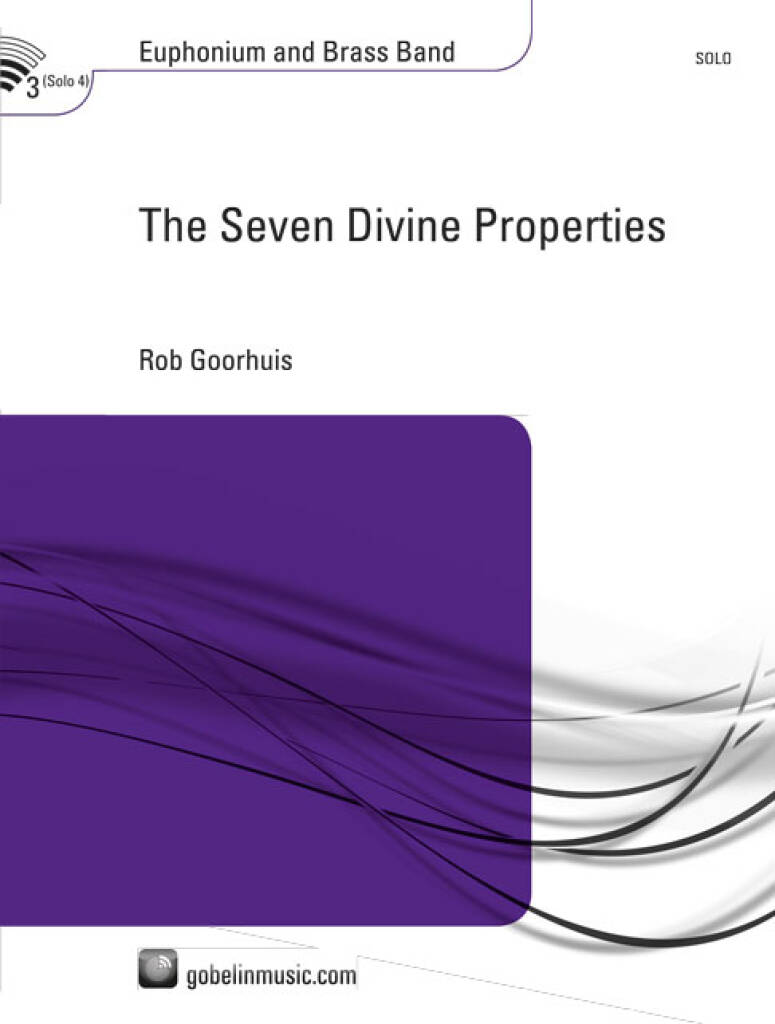 £94.99
The Seven Divine Properties - Rob Goorhuis
Rob Goorhuis wrote this challenging work for solo euphonium with its marvellous title The Seven Divine Properties at the request of Danny Oosterman and after an idea of Anteun Hoesen. In fact, this piece came about because the Andels Fanfare Corps was going to record a CD in early 2012 exclusively with pieces by Rob Goorhuis. Anteun Hoesen plays the solo part in this piece on the CD.The concept of divine properties features heavily in various ancient religions: these are properties to which man can aspire--through striving towards divine properties one can evolve spiritually and become a better person. Different divine properties feature in various religions. Inthe Christian church, the terms Faith, Hope and Love play an important role.This composition is primarily written from an Old Testament point of view. The chosen qualities are as follows: Simplicity, Strength, Truth, Perseverance and Passion. After a short introduction of the thematic material, the various properties are depicted in musical miniatures.
Estimated dispatch 5-14 working days
-
 £116.40
Decennium - Eric Swiggers
'Decennium' was composed in 2003 as a commission by the municipality of Berheze for its tenth anniversary. The composition describes the history of this town in the Province of Brabant, consisting of 6 different villages: Heesch, Heeswijk, Dinther, Nistelrode, Loosbroek and Vorstenbosch. The composition starts with a slow introduction, Adagio Misterioso, suggesting the atmosphere in long-ago days when the area consisted mainly of swamps, meres and low woods. (The word 'Bern' is a synonym of 'Born' meaning source or water, whereas 'Hese' is derived from 'Haisjo' meaning brushwood ). Above the dark sounds we hear far away trumpet signals announcing the Middle Ages. After a piercing crescendo, we hear the full sound of festive trumpets. A medieval dance, as was to be heard in the Heeswijk castle, follows. This dance gets a more and more stirring character and finally turns into a merry popular dance ending with a burst of laughter reproduced by descending scales with the muted trombones and trumpets. A slow transition with a quotation from a Gregorian plainsong (Domine Deus) and church bell ringing, referring to the Abbey of Berne, brings us to a romantic Larghetto. This part describes the quiet rural life in a beautiful natural surrounding. The last dying note contrasts with the threatening ostinato, referring to the rise of the industrialization, which provoked quite some resistance with the local people. Once more we hear the 'Domine Deus' but much more powerful this time. When the resistance calms down, the work concludes with an Alla Marcia. The first notes of the main theme could be heard all through the composition and now we hear the complete main theme again. The new town is born. A festive conclusion refers both to the tenth anniversary and the optimism and confidence as to the future.
Estimated dispatch 5-14 working days
-
 £68.60
Fanfare, Dance and Choral - Giovanni Giacomo Gastoldi - Henk van Belcum
Henk van Belcums used the festive and much loved song 'In Thee is Gladness', in this arrangement. Better known as 'Geest van hierboven' (Hymn 477) from the Songs for the Church (NL). A glorious fanfare opens the piece, which is then followed by a bright dance. The hymn is heard in the chorale section, in a fancy new setting, and the piece closes with a reprise of the opening fanfare.
Estimated dispatch 5-14 working days
-
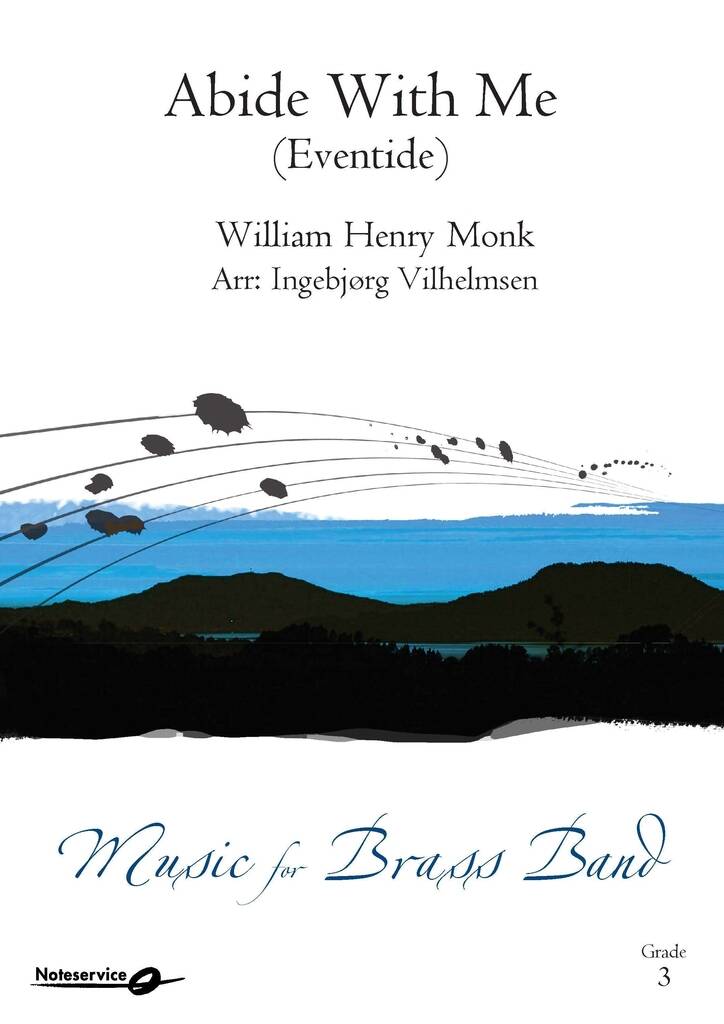 £127.30
Abide With Me - William Henry Monk - Ingebjørg Vilhelmsen
This arrangement of "Abide with me" slightly differs from the traditional representation of the hymn. The piece has a majestic introduction based on elements from and around the hymn. Furthermore, the theme is presented in a more familiar way, first in low brass and then tutti. The ending then reverts to the expression from the opening. This arrangement may fit in many concert programs, but is perhaps ideally suited for church concerts.
Estimated dispatch 5-14 working days
-
 £115.60
Generalstabens Honnormarsj - Oscar Borg - Svein H. Giske
This march was written in 1919 by Norways own March King Oscar Borg (1851-1930).He was born in the town of Halden in the southeast of Norway and received his education at the Royal Academy in Stockholm, Sweden.Upon his return to Halden he became a driving force in the towns musical life in several respects. He conducted choirs, amateur bands and played the organ in church.Borg was also the conductor of 1. Brigades Musikkorps (today The Norwegian Wind Ensemble) from 1881 to 1918.His significance for the Norwegian military bands and their repertoire is unquestionable.He wrote over 60 marches and he played several instruments; the violin, flute, cornet and the organ.This arrangement was written for Askoy Brass Band in 2021.Svein H. Giske
Estimated dispatch 5-14 working days
-
 £154.99
Spiriti - Thomas Doss
A Bach chorale stands at the centre of this work (Fur deinen Thron tret ich hiermit).Anton Bruckner was one of Johann Sebastian Bach's great admirers. His work is full of the spirit of that musical genius. For Thomas Doss, it was Bruckner's spirit that always seemed to be with him while working on Spiriti. Bruckner's spirit is captured in this composition by a quote from the chorale of his Fifth Symphony at the end of the piece.The introduction, written in the style of a funeral march, already displays the first fragments of the chorale. Like splinters they are strewn throughout the first Allegro, combining and recombining in turbulent, powerful tuttipassages. As the music becomes more rambunctious, the Bach-like fragments begin to swirl around each other, only to be scattered once more.The middle-section is of a more pensive nature. The Religioso character gives the audience time to reflect. The music is meditative and the quarter-note (or crotchet) elements mimic a soul that is yearning and crying out.The third part of the piece finally leads, by way of minimalist elements and the fragments mentioned earlier, to a magnificent presentation of the Bach chorale. As the church bells ring out, one can almost hear the great masters presiding at the organ.
Estimated dispatch 5-14 working days
 View Music