
Results
-
 £159.99
Rush Hour - Etienne Crausaz
Rush Hour was commissioned by the Swiss Brass Band Association (SBBV) on the occasion of the 38th Swiss National Brass Band Championships 2012 (Montreux SBBW) as the test piece in the Championship division.Structured in three parts without breaks, the work opens in a heavy, oppressive atmosphere, sometimes even noisy. After a short passage in a lighter mood a quick tempo takes over, the music becomes nervous and unrelenting, with constant twists and turns. The tension builds, leading to a slower movement in which various soloists are highlighted. A few humorous touches are heard in contrast to a majestic, powerful and dramatic chorale. The end of this part is brighter andmore peaceful. This atmosphere is soon replaced by a return of the thematic material heard in the first movement, developing into an oppressive moos. The piece concludes with a last ecstatic tutti, reusing the harmonies of the introduction in a kind of final flurry.Rush Hour attempts to express the range of feelings we may experience when caught in various stressful situations in the middle of the rush hour.
Estimated dispatch 5-14 working days
-
£76.99
Contrasten - Jan de Haan
The source of inspiration for the composer was the nuclear disaster in Chernobyl in Russia. The first movement Ostinato expresses desperation, helplessness, fear and anger. The themes from the first movement are further exposed in the second movement Fantasia which has a spectacular finale. In 1989 this composition was the test-piece for the finals in the fourth section of the National Brassband Championships of Great Britain.
Estimated dispatch 5-14 working days
-
 £104.99
Variations on a Chord - Jan de Haan
Variations on a Chord was composed on the occasion of the second lustrum of the Dutch Brass Band Championships celebrated in 1990. The piece is the immediate sequel to Contrasten a piece which was composed in 1986, and which is performed all over the world. Not only was the final chord of this previous work used as a starting point for the new composition, but Variations on a Chord is also the first concert piece for brass band composed by Jan de Haan since then. The several variations are based on a solemn theme. The so-called minor-major seventh chord is easily detectable. The structure of the piece is such that the lyrical theme is preceded by a majestic introduction, and isfollowed by eight variations each strongly contrasting in character. The piece finishes in a short but extremely spectacular coda.
Estimated dispatch 5-14 working days
-
 £104.99
Toccata Festiva - Jan Van der Roost
'Toccata Festiva' was commissioned in 1994 by the Dutch Brass Band Championships. The wind band version was made a year later by the composer himself. Historically speaking, the toccata is considered to be one of the first independent instrumental forms for keyboard instruments. Originally the toccata was typically more or less improvised, later this musical form was given a more regulated structure. Both elements are used in the 'Toccata Festiva': on the one hand the different themes are developed freely, on the other, the piece has an orderly structure. It is in a three part form (quick-slow-quick) and includes both strong rhythmical figures and broad melodic lines. Partof the composition is written in a more or less archaic tone idiom, referring to the period from which the toccata form originates (16th century).
Estimated dispatch 5-14 working days
-
 £60.99
Nordic Fanfare and Hymn - Jacob de Haan
As the title suggests, this opening work consists of a fanfare and a hymn. It was written for the opening ceremony of the FIS Nordic World Ski Championships in Oberstdorf (Allgau, Germany) and can be played in four different versions depending on your needs or the players available. You can use a complete version, a short fanfare played just by cornets, trombones and timpani, a double fanfare (extended with tutti-band) or a fanfare version followed by the hymn. Fanfare and Hymn is an extremely practical and versatile ceremonial opening piece.
Estimated dispatch 5-14 working days
-
 £69.99
Triumphal Brass - Jan de Haan
This exciting and energetic composition calls on all members of the band to try their best to make the audience jump out of their seats when they hear the fi rst notes. Jan de Haan's elaboration of two main themes lets the musicians present themselves as truly Triumphal Brass! The work was written as a test piece for the concert program in the Flemish Open Brass Band Championships 2010.
Estimated dispatch 5-14 working days
-
 £104.99
Parnassus - Jan Van der Roost
Since most of the bands competing in the 4th Section of the Dutch National Championships have many young players, this piece is stylistically youthful-- especially in the opening and closing sections. An arpeggio pattern appears numerous times in all registers and is the basic musical element of the main melody, alternating with a second theme that has a slightly different melodic character. The middle section is conceived like a chorale, introduced and developed stepwise: firstly with short patterns and gradually in increasingly long snippets, until it's played in its glorious entirety at measure 216. No real solo passages are included but rather small chambercombinations, thus offering the opportunity to various players to display their technical and performance skills. The finale recaptures musical material from the first section of the piece and provides a majestic conclusion.
Estimated dispatch 5-14 working days
-
 £104.99
Beecher Variations - Stephen Bulla
In this beautiful composition, melodic fragments of the hymn tune Beecher are morphed into a series of variations, showing the melody in various moods from expressive, then quiet and soft, to bright and triumphant in the end. Written as a testpiece in the 4th division for the Dutch Brass Band Championships in 2015, the music features challenging solo parts for cornet, soprano cornet, flugelhorn and euphonium. A great work for the concert stage!
Estimated dispatch 5-14 working days
-
£54.95
Northern Landscapes - Peter Graham
The four movements of Northern Landscapes provide musical mood pictures of various aspects of Northern working life. 1) Industry opens the suite with the bustle of factory machinery, followed attacca by 2) Seascapes which evokes the calmness of local waters during a fishing expedition. 3) Earth Dance references the mining industry where the blackness of the environment is mirrored by the darkness of the music while 4) Flight evokes the path of an aircraft on its maiden journey in this tribute to the aircraft industry. Northern Landscapes has its origins in music written for the Ulster Orchestra Brass Quintet. This revised and updated version for brass band was commissioned by the Boarshurst (Greenfield) Silver Band, with National Lottery funds, supported by the Arts Council of England. It was set as the 2003 National Brass Band Championships Area Third Section Test-Piece.
Estimated dispatch 5-14 working days
-
 £74.99
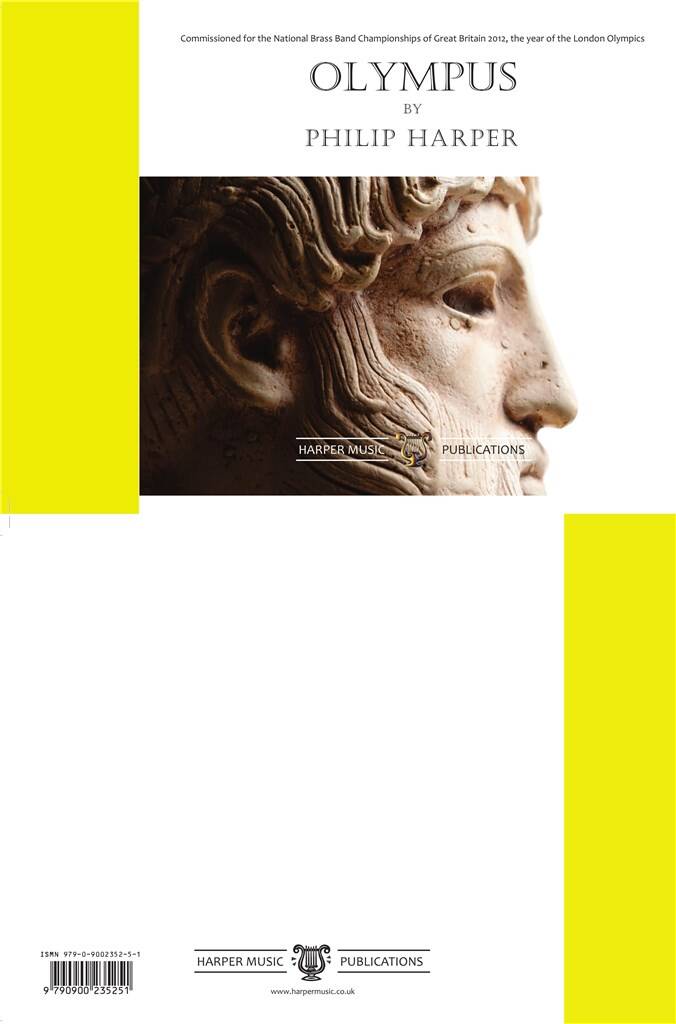
Olympus - Philip Harper
Selected as the test-piece for the 3rd Section Regional contests of the National Brass Band Championships 2012The music begins with a depiction of the exciting Opening Ceremony where noisy fanfares and sudden swells add to the cosmopolitan flag-waving clamour. Without a break the music leads to The Chariot Race, a fast compound-time gallop withthundering hooves in the basses and percussion, and a heroic melody introduced by the tenor horns. Chariot racing was the main equestrian event in the Ancient Greek Games, which were founded in memory of King Oenomaus. In the Greek legend he suffereddefeat in a chariot race to his son-in-law and Zeus' grandson, Pelops, but much of the music is bitter-sweet to symbolise the fact that Pelops had to cheat to win drawing parallels with some of the issues still facing modern-day athletics. A slow, mystical passage follows, describing The Temple of Zeus at Olympia. The statue of Zeus, who was honoured throughout the Ancient Games' history, was housed inside the temple and was one of the Seven Wonders of the Ancient World. Themusic depicts this period of the dawn of one of mankind's most ancient civilisations and there is a series of solo passages above a drone. The next section is called The Olympic Flame and a broad and lyrical anthem-like melody develops slowly in the euphoniums, which gradually ascends until the horns can take it over before passing upwards again to the cornets (Higher). The musicbursts into bright life at the lighting of the flame and the regular rhythmic pattern which has been established goes through an accelerando (Faster). The final section is called The Olympic Truce and aims to capture the cooperative spirit of the ancient practice of ending wars for the duration of the games. The anthem-like melody makes an affirmatory return (Stronger) and the work ends asit began with a blaze of colour and a real sense of optimism and global celebration. "Citius, Altius, Fortius" (Faster, Higher, Stonger)NOTES ON PERFORMANCEPercussion requirements: 1 to 3 players (3 Timpani, Snare Drum, Tenor Drum, Cymbals, Glockenspiel, Triangle)
Estimated dispatch 5-14 working days
 View Music