
Results
-
 £44.95
A CAROL FANTASY - Peter Graham
Written for the brilliant Welshbaritone Bryn Terfel's Christmas Television Spectacular, this arrangement can beplayed as a concert item or for audience and band. Includes Silent Night,Away in a Manger, O little Town, Joy to the World, O come all ye faithful
Estimated dispatch 3-7 working days
-
£40.00
Tubilation
A fantastic tuba feature with brass band backing. Driving semiquaver rhythms push this piece forwards whilst remaining away from the centre of attention which is undoubtedly the big old tuba! Full of semiquavers and scales rushing up to the top of the range of the instrument, there can be no doubt that the tuba is the star of the show. The solo part is carefully thought through with enough rests to make it approachable, while the syncopatino in the other parts give the music an energy that is maintained to the very final flourish, instigated by a demisemiquaver scale run on the tuba! Intermediate and above ensemble parts, but the solo tuba part needs a fairly skilled and confident player to get the most out of this piece.
-
 £34.95
Night Flight! - Jonathan Bates
'Night Flight' was composed for the Foden's Band's appearance at the 2021 Brass in Concert Championships held at The Sage, Gateshead. The band's theme encompassed a large range of monsters and creatures and this work depicts one of the most notorious monsters in folklore; Count Dracula. Throughout this short, virtuosic showpiece for Soprano Cornet and Euphonium, you can hear multiple strains of Mussorgsky's 'Night on a Bald Mountain' (with which Foden's Band opened their programme). . .
In Stock: Estimated dispatch 1-3 working days
-
 £29.95
Prayer to St Michael - Jonathan Bates
DURATION: 4'00". DIFFICULTY: Moderate. 'Prayer to Saint Michael' is a solo for Euphonium, composed for the Wantage Band and inspired by the life of a young Johann Sebastian Bach, who following the death of both parents by the age of only 10 moved to live with his older brother - Johann Christoph Bach - who was the church organist at St Michael's Church in Ohrdruf. It was in this church where Bach spent many hours studying and performing, being instructed by Johann Christoff on the clavichord. Within 6 years, the young Bach had been enrolled in the prestigious St Michael's School in Luneberg. . "St. Michael the Archangel, illustrious leader of the heavenly army, . defend us in the battle against principalities and powers, . against the rulers of the world of darkness and the spirit of wickedness in high places. Come to the rescue of mankind, . whom God has made in His own image and likeness, . and purchased from Satan's tyranny at so great a price. The Holy Church venerates you as her patron and guardian. The Lord has entrusted to you the task of leading the souls of the redeemed to heavenly blessedness. Entreat the Lord of peace to cast Satan down under our feet, . so as to keep him from further holding man captive and doing harm to the Church. Carry our prayers up to God's throne, . that the mercy of the Lord may quickly come and lay hold of the beast, . the serpent of old, Satan . and his demons, casting him in chains into the abyss, . so that he can no longer seduce the nations. Amen.". .
In Stock: Estimated dispatch 1-3 working days
-
 £89.95
Songs of Ascent - Jonathan Bates
DURATION: 14 minutes. DIFFICULTY: Championship. 'Songs of Ascent' was composed for the Royal Northern College of Music Brass Band, as part of their programme for the 2019 RNCM Festival of Brass. In my view, the festival itself is the leading showcase for original contemporary music for the medium (in a concert setting) in the world and therefore an ideal place to explore new ideas and sounds, which was a notion fundamental to the construction of this work. The piece is subtitled 'Out of the Depths, I cry to you, O Lord'; the opening line of Psalm 130 (which forms part of a set of 15 psalsm, 120-134 known as the Songs of Ascent") which forms the main inspiration for much of the musical material. Following an extended opening for four individual tuba lines, there are a number of solos for members of the band off stage, with bleak and deep accompaniment lines, reflecting the words of Psalm 130. Amongst these 'songs of ascents', the most common and strong themes are repentance and redemption; with the central core of this work emerging 'from the depths' to reveal one of very few calming and reflective passages of the work utilising the tune of 'Guide Me O Thy Great Redeemer' in a new setting, featuring the Solo Horn and Bass Trombone, before returning to the ethereal and dark timbres that form much of the music up to this point. In terms of compositional technique, this work is solely based on a set of 4 9-note scales in their various unique transpositions (below). Each of these scales provide a set of 2 whole tone scales, 6 minor triads, 6 major triads and is built on 9 augmented triads. Whilst most of the music in this work is based melodically on the set of notes (heard right at the outset in the motif in the tuba line), the central section delves into the harmonic capabilities of these 'modes', using a number of the 7 'keys' which can be derived from the minor & major chords derived in each scale. All 4 scales are used independantly to each other, with whole sections of the work focussing on each mode. 'Songs of Ascent' was selected as the set work for the Championship Section at the Butlin's Mineworker's Championships in 2020.
In Stock: Estimated dispatch 1-3 working days
-
 £34.95
Water Lilies - Jonathan Bates
DURATION: 5'00". DIFFICULTY: 1st Section+. 'Water Lilies' is a setting of a short poem by the American War poet Sara Teasdale from 1937. Teasdale's evocative writing is steadily becoming a renowned influence for composers - particularly in the choral scene, and this was where my first introduction to her work was founded in a work by Eriks Esenvalds entitled 'Stars'. . The percussion writing in this depicts a gentle ripple on a lake as water lilies float by at dusk, whilst the band writing explores a deep and personal interpretation of Teasdale's words which whilst on the face seem quite dark and brooding, yet really seem to express a feeling of longing and determination. . Water Lilies . If you have forgotten water lilies floating . On a dark lake among mountains in the afternoon shade, . If you have forgotten their wet, sleepy fragrance, . Then you can return and not be afraid. . But if you remember, then turn away forever . To the plains and the prairies where pools are far apart, . There you will not come at dusk on closing water lilies, . And the shadow of mountains will not fall on your heart. . Sara Teasdale (1937). .
In Stock: Estimated dispatch 1-3 working days
-
 £19.95
As The World Falls Apart... - Jonathan Bates
DURATION: 4 minutes. DIFFICULTY: Moderate. 'As The World Falls Apart' was composed for David Maxted as part of the programme for his BMus Final Recital at the RNCM in May 2017. The work was composed in a time of real political and social divide, with chaos only ever seeming minutes away, and the base of the piece is one of serenity and traniquility amongst the bedlam which is occurring around us all. Originally, the work was planned to be a totally free unaccompanied work for solo horn, however I wanted to make use of the vast space the RNCM concert hall can offer with the surround-sound speakers and decided to utilise a short sound effect track to enhance the feeling of chaos as the music reaches it's peak in dynamic and intensity. AUDIO FILE AVAILABLE FROM COMPOSER - [email protected]. . . .
In Stock: Estimated dispatch 1-3 working days
-
 £8.50
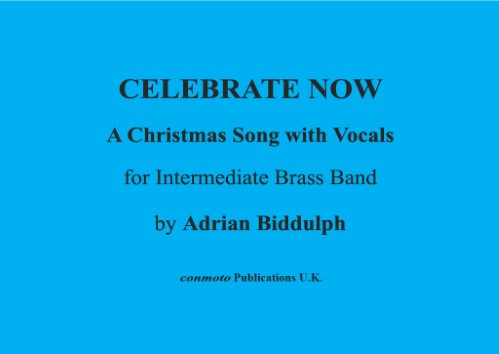
£8.50CELEBRATE NOW for Brass Band (score) - Biddulph, Adrian
Also contains a copy of the PVG & photocopiable word sheet (CMT3801) and can be performed with or without the vocal line. Parts included for Brass Band Brass, Orchestral Brass, Percussion & Flute. A Level 2 Wind Band (CMT3804) arrangement is also available.
In Stock: Estimated dispatch 1-3 working days
-
 £27.50
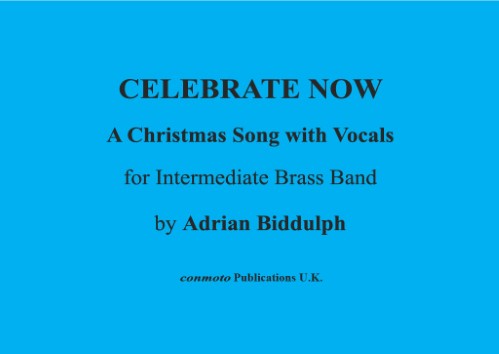
CELEBRATE NOW for Brass Band (score & parts) - Biddulph, Adrian
Also contains a copy of the PVG & photocopiable word sheet (CMT3801) and can be performed with or without the vocal line. Parts included for Brass Band Brass, Orchestral Brass, Percussion & Flute. A Level 2 Wind Band (CMT3804) arrangement is also available.
In Stock: Estimated dispatch 1-3 working days
-
 £33.91
Carnsmerry - Kevin Ackford
Score & Parts Carnsmerry was written as the set march in the year 2000 for the 1st section at the West of England Bandsmen's Festival contest held in the village of Bugle in Cornwall. Snippets of both the Floral Dance as well as the May Dance can be heard in this vibrant march, finishing with an obbligato for both the Soprano Cornet and Solo Horn this is a must for your concert programme.
Estimated dispatch 5-7 working days
 View Music