Results
-
£44.95James Bond Collection
Includes: The James Bond Theme; Gold Finger; The Spy Who Loved Me; On Her Majesty's Secret Service; From Russia With Love
Estimated dispatch 7-14 working days
-
£25.00
Brass Quartet Collection Volume 2 - Various Composers
Estimated dispatch 7-14 working days
-
£37.50
Brass Monkeys Jazz Workout - Paul H Traves
This huge release brings together a selection of music composed by Paul H Traves that introduces your learners to the different style of Jazz that is available. Naturally, the rhythmic work required to play such styles means that this publication will push your learners on and will challenge them at a new level. Syncopation and swing are at the heart of the music in this collection and it is the perfect way to get your learners playing in new styles not always covered by training band music. This title offers excellent value for money with seven titles included. This publication features:SNAKES & LADDERS - (teaching dynamics and expressive playing)CHROMATICS - (As the title suggest, ensuring every valve us used!)ROCKIN' GERONIMO - (featuring triplets and accidentals)TRUMPET DRIFT - (introducing crotchet triplets & syncopation)J.B.'s 12 BAR BLUES - (a well-known style that feature sharp key signatures)J.B.'s CALYPSO (unison playing and tight rhythmic playing required)ZIG-ZAG (getting players into a lazy swing style)
In Stock: Estimated dispatch 1-3 working days
-
£29.50The Deep - Andy Wareham
This stunning work took the title of 'Best Student Composition' at the UniBrass 2016 contest and features a collection of maritime hymn tunes in an unusual setting. Featuring an optional narration at over the opening sequence, the work is scored for quartet (Cornet, Horn, Euphonium & Bass) & band. 'Nearer My God To Thee', 'Melita' and 'Will Your Anchor Hold?' are all featured in this exciting new work as you won't have heard them before and is a great addition to any concert & contest repertoire.
In Stock: Estimated dispatch 1-3 working days
-
£75.00De Profundis - john wallace, Tony George
An original composition for massed brass bands and brass quintet devised by John Wallace, Tony George and Svend McEwan-Brown. A cross-genre production work, including scene setting, lighting and the spoken word reciting associated poems, De Profundis was given its world premiere at the East Neuk Festival on 1 July 2017 at The Bowhouse, performed by The Wallace Collection, Tullis Russell Mills Band and friends.If you would like to perform this work, The Wallace Collection are able to provide production consultancy and supply the brass quintet elements of the production - if you would like to discuss potential performances, please contact them direct on [email protected] NotesDe Profundis is a large scale brass band performance piece created by John Wallace and Tony George, based upon an original idea by Svend McEwan-Brown. It was developed in sessions with members of the Tullis Russell Mills Band, commissioned and premiered at East Neuk Festival 2017 at The Bowhouse, St Monans, on 1st July 2017.It was supported by Creative Scotland, Fife Council, Toby and Kate Anstruther, Shields and Carol Henderson, Donald and Louise MacDonald.This project remembers and celebrates the lives and music of miners. It is designed to give brass bands a performance piece that uses elements of improvisation and participation, to offer the players a stimulating and inspiring experience beyondthe normal run of brass band repertoire.All the music is drawn from two settings of the psalm 'Out of the Deep" (De Profundis).Look and Listen (courtesy of Tullis Russell Mills Band and The Wallace Collection at 2017 East Neuk Festival):More InformationMore details about the De Profundis project is available on a dedicated web-page on The Wallace Collection website.
In Stock: Estimated dispatch 3-5 working days
-
£52.37A Renaissance Christmas (Brass Band) Kevin Norbury
VIEW SCORE PDF This magnificent festive suite was written by Kevin Norbury for the Pierre Elliott Trudeau High School Wind Symphony and features several well known carols set in a Renaissance style. Here it has been set for brass band. Three contrasting movements comprise the work: i. Processional (Personent hodie - On this day earth shall ring) This is a short piece imagining a torchlight Yuletide procession (perhaps bearing the traditional roasted wild boar), using a well-known Christmas melody from the large collection of music compiled in the 16th century called Piae Cantiones (1582). The tune is presented twice with accompanying, related melodic material. ii. Pastorale (Quem pastores laudavere - Shepherds sang their praises o'er him) This is a 14th-century melody which was originally collected by Michael Praetorius at the end of the 16th-century. The treatment throughout is very lyrical without overly complex harmonies. The melody is heard three times with brief linking episodes and a short coda. iii. Celebration! (In dulci jubilo - In sweet celebration - Ding-dong merrily on high)) This magnificent 13th-century melody was also a part of Michael Praetorius's collection. It is traditional associated with the words 'Good Christian men, rejoice!' The opening is a straight transcription of the great chorale prelude for organ by J.S.Bach. After the grandeur of the opening, the tune is heard in more of a 'folky' style. A lot of related melodic material is then presented before the tune Ding-dong merrily on high is heard. After another episode of previously used music In dulci jubilo reappears in a joyful conclusion to the piece. Sheet music available from: UK - www.brassband.co.uk USA - www.solidbrassmusic.com Difficulty Level: 3rd Section + Instrumentation: Soprano Cornet Eb Solo Cornet Bb Repiano Cornet Bb 2nd Cornet Bb 3rd Cornet Bb Flugel Horn Bb Solo Horn Eb 1st Horn Eb 2nd Horn Eb 1st Baritone Bb 2nd Baritone Bb 1st Trombone Bb 2nd Trombone Bb Bass Trombone Euphonium Bb Bass Eb Bass Bb Percussion 1-4
In Stock: Estimated dispatch 1-3 working days
-
£34.95Mirror of the Heart - Jonathan Bates
DIFFICULTY: 4th+. DURATION: 4'30". Recorded on: Violet Volume 1 (Brass Band Willebroek). 'Mirror of the Heart' was composed for Belgian Cornet soloist Lode Violet for performances and recordings with the Wallberg Band (CH) and Brass Band Willebroek (B). The inspiration for the title of the work is taken from a collection of poems by the same name of late American poet Sara Teasdale (1884 - 1933); the centre of which are 54 deeply personal poems which - as a result - remained unpublished until after Teasdale's death. This work aims to reflect that particularly personal and reflective feel portrayed within the 'heart' of this collection.
In Stock: Estimated dispatch 1-3 working days
-
£59.95Bonnie Northumbria - Brass Band - LM786
COMPOSER: Laurie JohnstonProgramme NotesNorthumberland, or Northumbria as it is also known, is the most northern county in England and has magnificent and stunning landscapes just waiting to be explored. Filled with mystical castles, atmospheric ruins and historical sites and edged by spectacular coastal scenery, there is something wonderful to see at every turn. The Devils Causeway passes through Northumbria and reaches Berwick upon Tweed at the coast. Walkers and cyclists can also take the Coast and Castles Cycle Route or the North Sea Trail which journey through some of the most beautiful scenery along the way.The Blaydon Races is aGeordiefolk songwritten in the 19th century byGeordie Ridley, in a style deriving frommusic hall. It is regarded by many as the unofficialanthemofTynesideand is frequentlysungby supporters ofNewcastle United Football ClubandNewcastle Falconsrugby club.Blaydonis a small town inGateshead, situated about 4 miles (6.4km) fromNewcastle upon Tyne, inNorth East England. The race used to take place on the Stella Haugh 1 mile (1.6km) west of Blaydon.Stella South Power Station(demolished in 1995) was built on the site of the track in the early 1950s, after the races had stopped taking place in 1916.Water of Tyne (sometimes rendered as The Waters of Tyne) is a folk song (Roud number1364) from the north-east of England. The song is sung by a girl or woman lamenting the fact that her paramour is on the opposite bank of theRiver Tyne. Sleeve notes to Michael Hunt's recording of Tyneside songs states that "the ferry is believed to be that atHaughton Castleon theNorth Tyne". Alternatively the "rough river" in the last line may indicate a point further downstream, possiblyTynemouth.The song was collected byJohn Bellin 1810 and published two years later inRhymes of Northern Bards.The Keel Row is a traditional Tyneside folk song evoking the life and work of thekeelmenofNewcastle upon Tyne. A closely related song was first published in aScottishcollection of the 1770s, but may be considerably older, and it is unclear whether the tune is Scottish or English in origin.The opening lines of the song set it inSandgate, that part of the quayside overlooking the River Tyne to the east of the city centre where the keelmen lived and which is still overlooked by theKeelmen's Hospital.Versions of the song appear in both England and Scotland, with Scottish versions referring tothe Canongaterather than Sandgate. The earliest printing was in the 1770s inEdinburghin A Collection of Favourite Scots Tunes, edited by Charles Maclean, though the tune was also found in several late eighteenth-century English manuscript collections. As the term "keel" was used both sides of the border, it has not been determined which version was the original, althoughFrank Kidsonsurmised that like many other songs collected by Maclean it may originally have been aJacobiteair from the time of the1745 rebellion. Some versions of the song make reference to a "blue bonnet[...] with a snowy rose upon it", a clear attempt to evoke Jacobite symbolism, whether dating from 1745 or not.Kidson, however, also noted that he had found the tune of The Keel Row associated with an early dance called "The Yorkshire Lad" as early as 1748.By the 19th century the tune was well associated with the River Tyne; a few years before the 1850s the keelmen had met yearly to celebrate the founding of the Keelmen's Hospital, perambulating the town to the accompaniment of bands playing The Keel Row.Dance To Thy Daddyis a traditional Englishfolksong, originating inNorth East England. An early source for the lyrics, Joseph Robson's "Songs of the bards of the Tyne", published 1849, can be found on the Farne archive. In Farne's notes to the song, it is stated that these lyrics were written by William Watson around 1826.
In Stock: Estimated dispatch 3-5 working days
-
£25.00Canzona XIII
DescriptionCanzona XIII, also known as Canzon Septimi Octavi Toni a 12, was first published in 1597 as part of a collection entitled 'Symphoniae Sacrae' - this collection was a mixture of instrumental and choral pieces, and also included the famous Sonata Pian'e Forte, probably his best known work.Gabrieli was born in Venice sometime between 1554 and 1557 and studied with the renowned Dutch composer Orlando di Lassus. He also studied with his uncle, Andrea Gabrieli, and eventually succeeded him as the organist and composer at St Mark's Basilica in Venice. Already renowned as a musical centre, Venice became a magnet for composers wishing to study with Gabrieli after 'Symphoniae Sacrae' was published.Like many of his works, this Canzona was written to take advantage of the unique layout of St Mark's, which had galleries on three sides where the musicians could be placed to create novel spatial effects - utterly new and exciting for sixteenth century listeners. Canzona XIII has three different antiphonal 'choirs' and in this arrangement the band is split into three groups to reflect Gabrieli's innovative idea. Ideally the three groups should be clearly separated so the the antiphonal effect comes across clearly, although this will of course depend on the performance space. On no account should the band remain in its normal seated formation!As Gabrieli didn't have any percussionists (and percussion was widely thought inappropriate for music performed in church anyway) there are no percussion parts in this music.This arrangement was first performed by the Coppull and Standish Band conducted by Andrew Baker in 2009.You can follow a preview of the score while listening to an audio export of the music below!
Estimated dispatch 7-14 working days
-
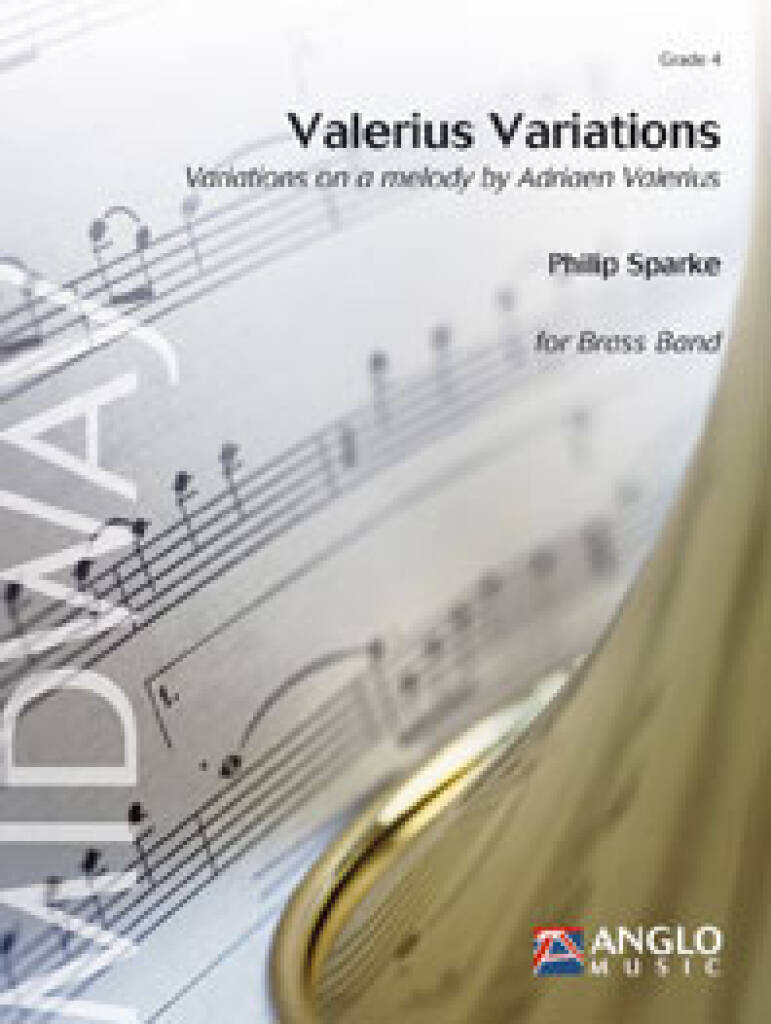
£79.99Valerius Variations - Philip Sparke
Dutch composer, artist and poet Adriaen Valerius is mostly remembered today for his collection of 79 songs for voice and lute or cittern, published posthumously in 1626. Philip Sparke has taken one melody from this collection that tells of the War of Independence with Spain. The beautiful slow melody is followed by a series of lively variations to form an extremely entertaining piece that will bring great joy to all who perform and listen to it.
Estimated dispatch 5-14 working days