
Results
-
 £54.20
Holiday for Trumpet (Cornet Solo with Brass Band - Score and Parts)
Your cornet player will love showing off their dexterity and tone in this upbeat number.
Estimated dispatch 7-14 working days
-
 £34.95
Dance of the Elves (Brass Band - Score and Parts)
An arrangement of David Popper's sparkling work, which was originally scored for cello and piano. Featuring the cornet section, this brisk number will show off your band's technique to the full.
Estimated dispatch 7-14 working days
-
 £74.95
Aspects of Adiemus (Brass Band - Score and Parts)
Aspects of Adiemus is a collection from one of the world's most popular composers, Karl Jenkins. Adiemus, literally translated, means 'we will draw near' and represents a musical language which can be heard on five award winning albums from the composer.Since Adiemus has risen in popularity around the world, it has become a growing entity meaning many different things to many different people. Vocally, the spread of influence grows wider all the time, taking in Arabic and African sounds as well as "Celtic" and ecclesiastical ones. The percussion too has expanded using Indian, Middle Eastern, Japanese, Chinese and even Australian instrumentation.The evolving nature of Adiemus has meant that it has been difficult to categorise. New age, classical crossover, world music, even pop. Karl sees this as a good sign: "To me, Adiemus transcends labels. The fact that it reaches people of different backgrounds, faiths and cultures gives it a universal appeal which is special. The compositions can be spiritual, religious, meditative - it's open to 'move' people in any away they choose to experience."Ironically, the Adiemus project 'got off the ground' initially due to a television commercial for an airline. Karl Jenkins explains, "I'd been toying with a new idea, completely separate to my work in advertising, but at this time, Jenkins Ratledge were commissioned to come up with the music for an airline commercial. We presented the client with a demonstration tape of one of my completed compositions and they loved it."That composition became known as Adiemus. The music for the airline commercial was aired and immediately drew interest from the public. Karl: "It's ironic that a piece of music not originally intended for a TV commercial should end up on a TV commercial, and that this music became the springboard for the success of the Adiemus project."Expertly arranged by Peter Graham, Aspects of Adiemus features the eponymous 'Adiemus', an uplifting and instantly recognisable opener. 'Chorale - Za Ma Ba' and 'Chorale - Vocalise' are songs of sanctuary, the latter featuring a chamber group from within the band. The vibrant 'Song of the Spirit' is a cornet feature, and the finale, 'Song of the Plains' combines intense rhythmic energy with tribal harmonies. Duration is variable depending on movement selection and optional cuts.Duration: 20.00
Estimated dispatch 7-14 working days
-
 £34.95
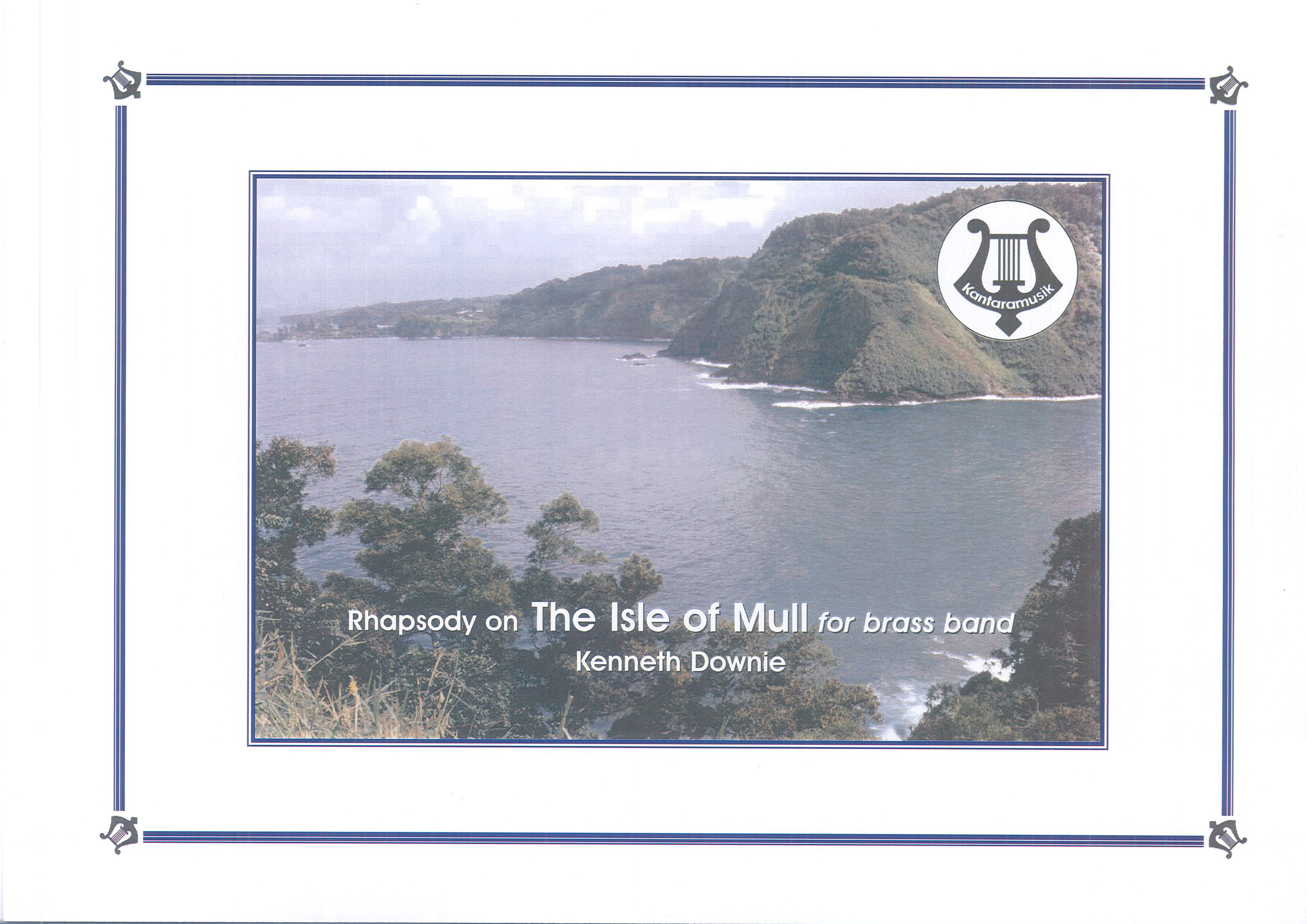
Rhapsody on the Isle of Mull (Brass Band - Score and Parts)
Mull is an island off the west coast of Scotland and it gives its name to the lovely tune which forms the basis of this music. It is very scenic, with some beautiful mountains and the composer has tried to suggest something of the atmosphere of grandeur in his score. The largely pentatonic nature of the tune heavily colours the musical texture.
Estimated dispatch 7-14 working days
-
 £34.95
Rondo Alla Turk (Xylophone Solo with Brass Band - Score and Parts)
Rondo Alla Turk has been a popular concert piece for many performers the world over. This is an arrangement I have done for solo xylophone that shows off the technical dexterity of both the piece and the instrument. Starting in a brisk tempo, the soloist performs the main themes of the piece with the major key fanfare-like interludes introducing each new section.The main melody from the opening returns with an even brighter tempo that takes the soloist into a flamboyant cadenza section. The cadenza section is scored out for the xylophone but the ad-lib marking allows the soloist in true Mozart fashion to improvise (if they wish) the cadenza section which leads into the finale.The finale brings back the major key motifs from the opening to a coda section that concludes in a breathless flurry from the soloist.Paul Lovatt-Cooper Suitable for 3rd section bands and above, soloist grade 8
Estimated dispatch 7-14 working days
-
 £44.99
Whirlegigg (Brass Band - Score and Parts)
Whirlegigg is the middle English word for a contraption that continuously spins. A great fascination with many inventors of the medieval period was to develop a perpetual motion machine constantly turning and giving off energy. This idea is particularly apt for this piece. A simple ternary structure gives ample opportunity for both boisterous and reflective material with gyrating accompaniment figures never far away. The machine almost stops near the end, but finally musters one last burst of excitement and energy to bring the work to its close. Suitable for 1st Section Bands and above. Duration: 5.00
Estimated dispatch 7-14 working days
-
 £119.95
Harrison's Dream (Brass Band - Score and Parts)
At 8.00pm on the 22nd of October 1707, the Association, flagship of the Royal Navy, struck rocks off the Scilly Isles with the loss of the entire crew. Throughout the rest of the evening the remaining three ships in the fleet suffered the same fate. Only 26 of the original 1,647 crew members survived. This disaster was a direct result of an inability to calculate longitude, the most pressing scientific problem of the time. It pushed the longitude question to the forefront of the national consciousness and precipitated the Longitude Act. Parliament funded a prize of �20,000 to anyone whose method or device would solve the dilemma. For carpenter and self-taught clockmaker John Harrison, this was the beginning of a 40 year obsession. To calculate longitude it is necessary to know the time aboard ship and at the home port or place of known longitude, at precisely the same moment. Harrison's dream was to build a clock so accurate that this calculation could be made, an audacious feat of engineering. This work reflects on aspects of this epic tale, brilliantly brought to life in Dava Sobel's book Longitude. Much of the music is mechanistic in tone and is constructed along precise mathematical and metrical lines. The heart of the work however is human - the attraction of the �20,000 prize is often cited as Harrison's motivation. However, the realisation that countless lives depended on a solution was one which haunted Harrison. The emotional core of the music reflects on this, and in particular the evening of 22ndOctober 1707. Peter GrahamCheshireJuly 2000
Estimated dispatch 7-14 working days
-
£37.95
Harrison's Dream (Brass Band - Score only)
At 8.00pm on the 22nd of October 1707, the Association, flagship of the Royal Navy, struck rocks off the Scilly Isles with the loss of the entire crew. Throughout the rest of the evening the remaining three ships in the fleet suffered the same fate. Only 26 of the original 1,647 crew members survived. This disaster was a direct result of an inability to calculate longitude, the most pressing scientific problem of the time. It pushed the longitude question to the forefront of the national consciousness and precipitated the Longitude Act. Parliament funded a prize of �20,000 to anyone whose method or device would solve the dilemma. For carpenter and self-taught clockmaker John Harrison, this was the beginning of a 40 year obsession. To calculate longitude it is necessary to know the time aboard ship and at the home port or place of known longitude, at precisely the same moment. Harrison's dream was to build a clock so accurate that this calculation could be made, an audacious feat of engineering. This work reflects on aspects of this epic tale, brilliantly brought to life in Dava Sobel's book Longitude. Much of the music is mechanistic in tone and is constructed along precise mathematical and metrical lines. The heart of the work however is human - the attraction of the �20,000 prize is often cited as Harrison's motivation. However, the realisation that countless lives depended on a solution was one which haunted Harrison. The emotional core of the music reflects on this, and in particular the evening of 22ndOctober 1707. Peter GrahamCheshireJuly 2000
Estimated dispatch 7-14 working days
-
 £15.99
'tis The Last Rose Brass Band - Traditional
It is often thought that this melody came from the Victorian era, when Irish songs were very popular, however this Air was first published in 1813 and has been adapted and arranged by many composers and arrangers over theyears. This arrangement, as a Flugel Horn solo, by Gary Westwood is a new treatment and shows off this tender and wistful love song.
Estimated dispatch 5-14 working days
-
Off Duty - John Dankworth - Len Jenkins
The late John Dankworth (1927-2010) made a string of recordings in the 1960s that have since come to be regarded as some of the finest British jazz of their time. Amongst these is his composition 'Off Duty' which was recorded in the 1960s when the influence of pop and rock on jazz was at its height and instruments such as the bass guitar were beginning to be incorporated into jazz's vocabulary. At this time and almost subconsciously, a Dankworth 'pop' style also evolved. This was a balanced marriage between jazz and pop which is here demonstrated in 'Off Duty' thanks to the ingenious and original orchestration by John Dankworth, and the faithful arrangement for Brass Band by one of his fans, Len Jenkins. The title is interesting as John loved to play with words. 'Off Duty' could mean relaxing away from work, but could also carry the implication of something not attracting taxation.... a sort of 'duty-free'. About the same time, the Dave Brubeck Quartet produced the seminal 'Take Five'... so could this be John's take on that title, suggesting a short break? Which meaning fits best for you? The piece would best suit the capabilities of a brass band playing at the standard of Third Section or above.