
Results
-
£107.95
Swift Severn's Flood (Score and Parts)
Swift Severn's Flood is in one movement and is both heroic and brooding in nature. The work requires great virtuosity with fast, furious running passages juxtaposed against extreme dynamic contrasts
Estimated dispatch 7-14 working days
-
£49.95
Swift Severn's Flood (Score Only)
Swift Severn's Flood is in one movement and is both heroic and brooding in nature. The work requires great virtuosity with fast, furious running passages juxtaposed against extreme dynamic contrasts
Estimated dispatch 7-14 working days
-
 £183.20
Folklore - Kjetil Djønne
"Folklore" is a work for brass band and percussion loosely based on the story of the Norwegian woman accused of witchcraft, Anne Pedersdotter. She was sentenced to be burned at the stake in Bergen in the spring of 1590 and has since been frequently highlighted as Norway's most famous and talked-about witch.The work begins with the movement "Lyderhorn," depicting the mountain outside Bergen where witches gathered to plan magical actions against the city. Here, we hear the quietness of nature and the wind blowing through the trees before a new theme appears, which will come to life in the next movement. In the distance, the witches have started their ceremony.In the next movement, "Walpurgis Night," the witches perform their rituals to afflict the city with fire, disease, and natural disasters. The ceremony becomes more and more chaotic, violent, and compelling until the darkness of the night envelops us, concluding the section.The third movement describes the women's inner struggle against the harassment they faced when the people of Bergen suspected them of being witches. Rumors often turned into formal accusations from the legal system, and many were sentenced to death after undergoing trial. "From life to death through the fire."The fourth and final movement, "The Pyre," depicts the actual death sentence. You can hear the pyre being ignited and the flames growing and intensifying. It all culminates in a chorale as a memorial to the lives that were taken.
Estimated dispatch 5-14 working days
-
 £72.99
Fanfare For A Friend - Bert Appermont
Fanfare for a Friend was originally composed as an introductory piece for the brass ensemble Musica Mosana and their conductor Mark Prils. The work begins with a brilliant brass fanfare that presents the main theme for the first time. This stately theme can be heard in counterpoints throughout the first 28 bars. This is followed by a contrasting and rapid part whereby a melodic theme can be heard against a more rhythmic accompaniment. A virtuoso and sweeping passage then leads to the grandioso in which both themes are played simultaneously in a grand finale.
Estimated dispatch 5-14 working days
-
 £80.00
St. Magnus - Kenneth Downie
Dedicated to Alastair Massey, an inspirational music teacher. Commissioned by the Scottish Brass Band Association for the 2004 European Brass Band Championships in Glasgow. This music is a set of variations on the tune known as St Magnus, which is attributed to Jeremiah Clarke. Most people will associate it with Thomas Kelly's hymn which begins: "The Head that once was crowned with thorns is crowned with glory now". The tune is very simple, consisting of just two, four-bar phrases. Neither is there much in the way of rhythmic variety, every note being a crotchet with the exception of two quavers, and the last note in each phrase. Within such a simple structure, however, lies considerable strength. THEME The listener is given the opportunity of hearing it twice, in full, at the beginning, starting with one player but soon taken up by the full ensemble. It returns in the middle of the music and is stated again near the end. This has been done quite deliberately in the hope that there will be an appreciation of what material is being developed, by the listener as well as by those with access to the score, who are able to see the visual connections. VARIATION 1 This takes the rhythm of the last part of the theme and also uses the shape of the opening as a recurring figure. The mood is whimsical and skittish, with short, teasing rhythmic figures tossed around the band, and quick interplay with percussion, at a fast tempo. An energetic flourish finishes this variation before the Andante espress. VARIATION 2 This commences with chords related to the opening of Variation 1. The cantabile on solo comets establishes a new, lyrical mood and there is scope for expressive playing in a series of short solo passages. The theme works its way unobtrusively into the texture before a reprise of the solo cornet melody and some more lyrical interchanges between Eb bass, euphonium, flugel horn and comets. The variation ends serenely with clear references to the last phrase of the theme. VARIATION 3 The first idea to dominate is clearly linked to the shape of the theme's first phrase. There is a frenetic feel to much of this variation, with considerable energy and instability created by extensive use of cross-rhythms. A thinning-out of the score marks a clear change to development of the start of the second phrase of the theme. This proves to be short-lived however, and the opening material returns leading to a restatement of the theme, "Maestoso," after which a euphonium cadenza links to Variation 4. VARIATION 4 Here we have some solos for euphonium, cornet, trombone and Eb bass set against a background of horns and baritones presenting a pensive statement of the theme's opening. VARIATION 5 This commences Allegro, with lively work for cornet and euphonium spreading to the whole band before attention focuses on the beginning of the second phrase of the theme which is initially presented in diminution, then in regular rhythm, then in inversion. An increase in tempo coupled with a decrease in volume, requires dexterity and control, with several metrical challenges thrown in for good measure. The same fragment of phrase becomes an ostinato which generates a frenzied climax, punctuated by short, dramatic silence, before the opening figure returns and the music gradually winds down. The tubular bells herald the final return of the theme, in augmentation, marking the start of the Finale. FINALE This features the running semiquavers of the previous variation sounding in counterpoint. A fast, furious coda speeds the work to a conclusion while references to the opening of the theme are still trying to break into the texture of the music. Kenneth Downie
Estimated dispatch 5-14 working days
-
 £69.00
Bella Ciao - Manu Pilas - Jan van Kraeydonck
Bella Ciao is an Italian battle song, which became popular in Italy during World War II among partisans resisting fascism and national socialism. The song became a global resistance song against oppressive powers. In 2018, the song became known again through the Spanish Netflix series La Casa de Papel, in which the song was used multiple times. Jan van Kraeydonck wrote a skillful arrangement for concert band, fanfare and brass band.
Estimated dispatch 5-14 working days
-
 £147.10
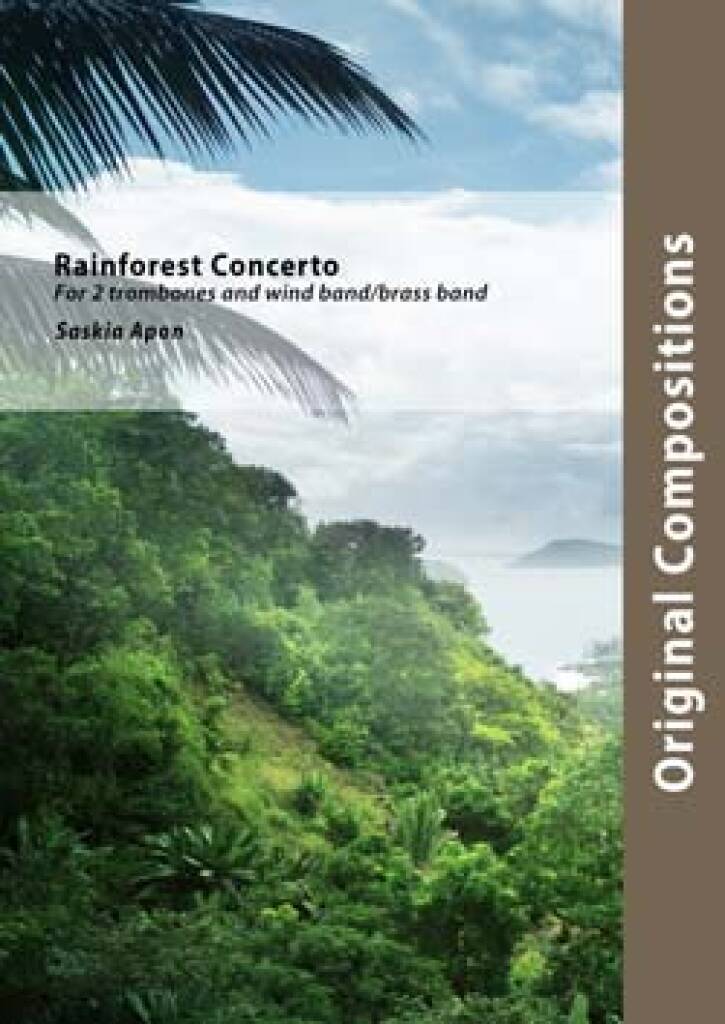
Rainforest Concerto - Saskia Apon
Rainforest Concerto has been commissioned by the Brass Band Rijnmond. This double concerto for two trombones and wind band consists of three parts with the cadenza in the slow niddle movement. Saskia Apon was inspired by the threat of the destruction of the rainforest. In the first part, Creation, we hear an accelerated reproduction of the birth of this impressive natural phenomenon. We hear the first birds, we see the growth of the mangrove trees and we witness the struggle for light and the force necessary to keep the realized equilibrium in a perpetual balance.The second part, Ode, is a tribute to the wonder and splendour of the rainforest. By means of subtle and extremely delicate sonorities we hear how nature adds an inestimable value to the rainforest. However it is also extremely fragile and this engenders a certain melancholy due to the awareness of man's impotence to respect this beautiful nature.In the last part, Contra Demolition, we hear the threatening decline, but also the revolt against this possible ruin. It is a heartfelt cry to leave nuture in peace and to work hard for the preservation of the beauty and the value of the rainforest.
Estimated dispatch 5-14 working days
-
£47.50
You'll Never Walk Alone - Richard Rodgers - Thijs Oud
This great football anthem, made famous worldwide when sung against the background of the Eiffel Tower to close the 1998 World Cup, can now be played and enjoyed by your brass band. An ideal piece to close any concert with.
Estimated dispatch 5-14 working days
-
 £59.99
Largo from Winter - Antonio Vivaldi - Philip Sparke
Antonio Vivaldi (1678-1741) stands, with Handel and J.S. Bach, as one of the titanic figures of late Baroque composition. Not only was he lauded as a composer of vocal and instrumental works both sacred and secular, he was without doubt, the most prolific composer of his age. In addition to hundreds of vocal works, including forty-nine operas, he composed five hundred concertos. The Four Seasons are probably the best known of his concerti with the second movement, Largo, portraying time spent by a roaring fire listening to the rain pounding against the window. This new arrangement for brass band retains all the warmth of the original.
Estimated dispatch 5-14 working days
-
 £30.00
Janacek's 'Taras Bulba' - Janacek
Comments from Tim Paton, the arranger of Janacek's 'Taras Bulba': "I will never forget the day in 1967 when I was introduced to the music of Leos Janacek, a Czech composer born in 1854, who died in 1928. Janacek was little known in Britain until the 1960's, when the conductor Charles Macherras introduced his unique music. I heard a recording of Macherras conducting the Pro Arte Orchestra in a performance of Janacek's "Sinfonietta".It was in 1969 that I first heard Janacek's Symphonic Rhapsody, "Taras Bulba".Janacek's music is exciting, powerful, emotive, impassioned and unpredictable.I have taken the first and third movements of this piece, and adapted them for Brass Band, which was at times extremely difficult, but rewarding. It sometimes took up to an hour to be satisfied that a mere several bars had been reproduced to convey the composer's intentions.The Death of AndriThe Cossaks, under the leadership of Taras Bulba, are fighting against the Poles in the 17th century. Taras's son Andri seeks to rescue his love, a Polish princess, from a city which is being besieged by the Cossaks. Having found her, he throws in his lot with the Poles, but is finally captured by his father, who executes him as a traitor before riding off again to battle.Prophesy and Death of Taras BulbaTaras himself is finally captured and condemned to be nailed to a tree and burned alive. As the flames creep around him, Taras has the satisfaction of seeing histroops escape, and as he dies, sees a vision of his country freed at last.This is incredibly descriptive music. The mood is constantly changing, creating feelings of love and anger, celebration and melancholy, despair and triumph.This Brass Band EditionThe duration of the original symphonic rhapsody, three movements, is approximately 23 minutes. I chose the first and third movements, so the Brass Band edition is approximately 14 minutes. The main reason is twofold: Being realistic about the demands this music would place on the stamina of the brass player; Keeping the piece less than 15 minutes, so that, if desired, it could be used on the contest platform.Two unique qualities of Janacek's music had to be taken into account when preparing this brass band version. His compositional technique was individual, at times not sticking to traditional expectations, in both form and orchestration. I imagined what the genius himself would have said looking at my work, and how to tackle a particular section to emulate his original intentions. This was particularly the case when dealing with high woodwind and violin parts, the use of tremolo in string parts, and the orchestral harp.Percussion: Janacek included timpani, side drum, cymbals, triangle and tubular bells. For reasons stated previously, I have also included xylophone and glockenspiel. I have also added the gong in a couple of places to enhance the dramatic effect of the music.
In Stock: Estimated dispatch 3-5 working days
 View Music