
Results
-
 £24.95
Tom Bowling - Trombone Solo (Brass Band - Score and Parts)
This wonderful song is invariably featured in the last night of the BBC Promenade Concert series as it is included in Henry Wood's Fantasia on British Sea Songs. It is played as a cello solo and always provides one of the most sensitive, melancholic moments of the evening. It the trombone soloist rises to the challenge, there will not be a dry eye in the concert hall!
Estimated dispatch 7-14 working days
-
 £27.00
Auld Lang Syne (Brass Band - Score and Parts)
It is a tradition in most English-speaking countries to sing this song at the stroke of midnight on New Year's Eve to usher in the New Year. The words are at least partially written by Robert Burns and the words "Auld Lang Syne" literally mean "old long ago" or "the good old days", providing a moment of reflection before moving forwards into the New Year.The tubular bells, although pitched, sound midnight when they enter at bar 10.This arrangement was prepared for Brass Band of the Western Reserve, musical director Keith M Wilkinson, to perform at First Night, Akron, Ohio, December 31st, 2007. The following choreography is suggested:Commence the performance with all the cornets scattered around the auditorium.At the end of bar 18 invite the audience to sing along with the band.At bar 27 the cornets move to stand in front of the other members of the band to lead to the stirring conclusion. Should auld acquaintance be forgot and never brought to mind?Should auld acquaintance be forgot and days of auld lang syne?For auld lang syne, my dear, for auld lang syne,We'll take a cup of kindness yet, for auld lang syne.
Estimated dispatch 7-14 working days
-
 £104.99
Manhattan (Cornet Solo with Brass Band - Score and Parts)
Cornet or Trumpet Solo with Brass BandManhattan was commissioned by the United States Army Band for their solo cornet player Woodrow English and first performed by them in Carnegie Hall, New York, in November 2003. The two-movement work demonstrates both the lyrical and technical abilities of this outstanding player. The 'theme' is a weekend in New York and the opening bluesy movement, Saturday Serenade, describes the city on a Saturday night. While writing Sunday Scherzo, the composer pictured an early morning jog in Central Park. This vivaciously rhythmic second movement ends with an even quicker coda bringing the work to a brilliant close. Each movement can also be played individually when a shorter solo is required.Duration: 9:30
Estimated dispatch 7-14 working days
-
 £29.95
First Light (Cornet Solo with Brass Band - Score and Parts)
First Light was written for Kirsty Abbotts and Carlton Main Frickley Colliery Band. A slow lilting melody is presented in the cornet solo and passed between the band and the soloist to create images of the tranquil night before the piece reaches a climactic moment which is meant to represent the beams of light emerging as the sun rises. The theme is then presented in a tutti forte section before arriving at a tranquil finish. First Light is featured on the Kirsty Abbotts and Carlton Main Frickley Colliery Bands CD, A Search for Peace.
Estimated dispatch 7-14 working days
-
 £54.99
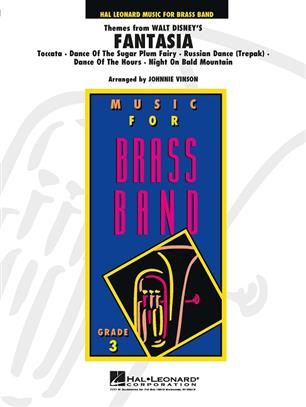
Themes from Fantasia (Brass Band - Score and Parts)
A very playable medley from the classic movie 'Fantasia' containing 'Toccata', 'Dance Of The Sugar Plum Fairy', 'Russian Dance (Trepak), 'Dance Of The Hours' and 'Night On Bald Mountain'. Ideal for young bands and very entertaining for your audience!
Estimated dispatch 7-14 working days
-
 £18.75
O Holy Night - Adam - John Iveson
Composed in 1847 by the French composer and critic Adolphe Adam, O Holy Night has achieved considerable popularity in recent years and is regularly featured in programmes of Christmas music. Thisarrangement for the Brass Band portrays the character of the music faithfully, with warm sonorities, making it a welcome addition to any band's Christmas Concert.
Estimated dispatch 5-14 working days
-
 £60.99
The Last Night of Fall - Etienne Crausaz
This beautiful chorale for Brass Band illustrates the winter solstice, the longest night of the year. Describing the end of nature's cycle, it has a rather melancholic character until the final chord which symbolises the new beginning.This contemplative work is ideal for creating a moment of tranquillity during a concert, and is also suitable as a warm-up piece.
Estimated dispatch 5-14 working days
-
 £84.99
Christmas Brass - Richard Peaslee
Christmas Brass is a fantasy on six carols, originally commissioned by Mark Freeh for the Manhattan Brass Choir. Duration: 16:30The well-known tune, O Come, O Come Emmanuel, a hymn originally based on a plainsong melody, is here set in 5/4 meter. Modal harmonies are combined with big band style as the piece gains momentum, greatly accentuating the mood of the words, "Rejoice! Rejoice! Emmanuel." The opening 5/4 statement of the theme returns, and the piece ends quietly.In Beautiful Savior (also known by the title Fairest Lord Jesus), a hushed beginning featuring horns, euphoniums, and a muted trumpet, leads through a key change to a satisfying, chorale-likeclosing passage.In Away in a Manger, Peaslee sets two tunes, Cradle Song and Away in a Manger. Following a straightforward presentation of each melody, Peaslee plays them against one another. The music swells to a full climax followed by a hushed ending.Peaslee employs a gentle hand in It Came Upon a Midnight Clear, using flugelhorn solos and duets in a jazz-waltz style.In Silent Night, the traditional carol gets an untraditional harmonization, propelled forward by give-and-take between the two groups of brass instruments in the brass choir: trumpets and trombones versus horns, euphoniums, and tuba.Hark! The Herald Angels Sing begins with a humorous blast of discordant harmonies as multiple carols are sounded at the same time. An up-tempo 4/4 announcement of the melody in the trombone is followed by a metrical modulation in 6/8-3/4 time. An additional metrical modulation bring the music back into 4/4, but at a slower tempo and in a pronounced jazz style. Tempo I returns, and the set of six pieces closes with a big ending.Instrumentation: 4 Trumpets, 2 Horns in F, 4 Trombones, 2 Euphoniums, Tuba, Guitar, Bass, Percussion
Estimated dispatch 5-14 working days
-
 £43.99
O Holy Night - Adolphe Charles Adam - Stephen Bulla
This terrific melody by the 19th century French composer Adolph Adam is one of the world's most famous Christmas solo melodies. It is unique due to the fact that it was the only Christmas song recorded by the legendary opera singer Enrico Caruso. This arrangement for soprano cornet and brass band will make a fantastic touching addition to any Christmas carol.
Estimated dispatch 5-14 working days
-
 £47.50
Silent Night - Franz Xaver Gruber - William Gordon
Austrian composer and organist Franz Xaver Gruber composed the original version of this Christmas work in 1818. It is probably one of the most famous of all Christmas carols and should not be missed from any Christmas concert. American composer William Gordon has produced this arrangement for brass band.
Estimated dispatch 5-14 working days
 View Music