
Results
-
 £17.50
The Covenanters (Brass Band - Score only) - Downie, Kenneth
In 1638, many members of the Presbyterian Church of Scotland signed a document called the National Covenant. By doing so, they were declaring that they acknowledged only Jesus Christ as the spiritual head of their church, and not any king or queen. This had become necessary because the Stuart kings believed in the Divine Right of Monarchs and saw themselves as head of the church. In the previous year, Charles I had forcibly introduced the Book of Common Prayer, invoking the wrath of the common people who faced the threat of torture, transportation or execution if they did not use the new liturgy and worship at their local church. The net result of this was that many met illegally in the countryside or in barns and large houses. These meetings became known as 'conventides' and many took place in the south-west of the country. Anyone caught attending was at risk of execution by the muskets of the dragoons who were employed in the area for that specific purpose. This music was written to honour the bravery and loyalty of these Christians to their faith, in the face of extreme danger, in the hope that it will inspire us also to be faithful. There are overtones of military threat, secrecy and solidarity. An old pentatonic tune is used, which the composer heard as a boy being sung to the words The Lord's My Shepherd.
Estimated dispatch 7-14 working days
-
 £57.99
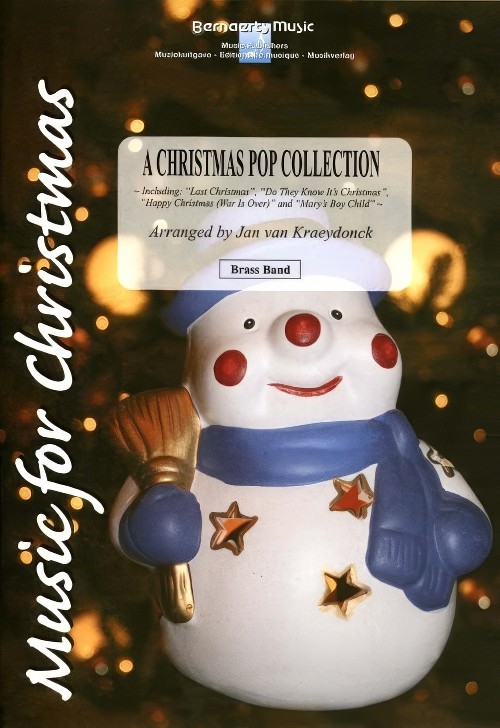
A Christmas Pop Collection (Brass Band - Score and Parts) - Kraeydonck, Jan van
Includes: Last Christmas; Do They Know It's Christmas; Happy Christmas (War Is Over); Mary's Boy Child. Duration: 5.30
Estimated dispatch 7-14 working days
-
£29.95
Christmas Calypso (Brass Band - Score and Parts) - Graham, Peter
An arrangement for brass band, in Caribbean style, of 'The virgin Mary had a baby boy'.
Estimated dispatch 7-14 working days
-
£14.95
Christmas Calypso (Brass Band - Score only) - Graham, Peter
An arrangement for brass band, in Caribbean style, of 'The virgin Mary had a baby boy'.
Estimated dispatch 7-14 working days
-
£44.95
Gaudete (Brass Band - Score and Parts) - Norbury, Kevin
A Christmas mini-overture featuring three medieval carols; 'Coventry Carol', 'Gaudete' and 'Unto us a boy is born'. A fun piece for player and listener alike.
Estimated dispatch 7-14 working days
-
£22.50
Gaudete (Brass Band - Score only) - Norbury, Kevin
A Christmas mini-overture featuring three medieval carols; 'Coventry Carol', 'Gaudete' and 'Unto us a boy is born'. A fun piece for player and listener alike.
Estimated dispatch 7-14 working days
-
 £60.99
Gold (Brass Band - Score and Parts) - Kemp, Gary - Oud, Thijs
At the beginning of the eighties trendy English boy band, Spandau Ballet, made it big with hits like True and Gold. Millions of records were sold worldwide, and the group became one of the most successful bands of the eighties. Why not bring a little 80's pop magic to any concert with the zesty disco tempo and jazzy chords of this arrangement.Duration: 4:30
Estimated dispatch 7-14 working days
-
 £44.95
Bravura (A Fantasy on British Folk Songs) (Euphonium Solo with Brass Band - Score and Parts) - Graham, Peter
Bravura is a companion piece to the composer's earlier euphonium display piece Brillante, utilising the same traditional 19th century "fantasy variation" structure, familiar to generations of brass soloists. Folk songs from the four corners of Great Britain are featured; Oranges and Lemons, (England), The Blue Bells of Scotland, The Minstrel Boy (Ireland) and the famous Welsh anthem Men of Harlech.The solo is a conflation of the original version, written for the 2002 Royal Albert Hall Gala Concert, which followed the National Brass Band Championships of Great Britain. On that occasion the combined talents of virtuosi David Childs, Derick Kane, Steven Mead and David Thornton (with guests Robert and Nicholas Childs) were on display, each personalising the cadenza section towards the end. This version incorporates a published cadenza, though soloists should feel free to improvise their own material at this point.
Estimated dispatch 7-14 working days
-
 £50.90
CAROL OF THE DRUM, The (Brass Band) - Fernie, Alan
The Little Drummer Boy. Grade: Easy.
Estimated dispatch 7-14 working days
-
 £30.00
O Mio Babbino Caro (from Gianni Schicchi) (Cornet Solo with Brass Band - Score and Parts) - Puccini, Giacomo - Littlemore, Phillip
O Mio Babbino Caro (Oh My Dear Papa) is taken from the opera Gianni Schicchi by Giacomo Puccini. It is sung by Lauretta after tensions between Schicchi and his prospective in-laws have reached a breaking point that threatens to separate her from Rinuccio, the boy she loves. It provides a contrasting interlude expressing lyrical simplicity and single-hearted love in the atmosphere of hypocrisy, jealousy, double-dealing and feuding in medieval Florence. The story of Gianni Schicchi concerns a rich old man who dies leaving all his possessions to the local monastery. His outraged relatives persuade Gianni Schicchi to impersonate the dead man and to dictate a new will. It is the second opera of Puccini's operatic triptych, which also includes?Il Tabarro?and?Suor Angelica. Duration: 2:00
Estimated dispatch 7-14 working days
 View Music