
Results
-
 £104.99
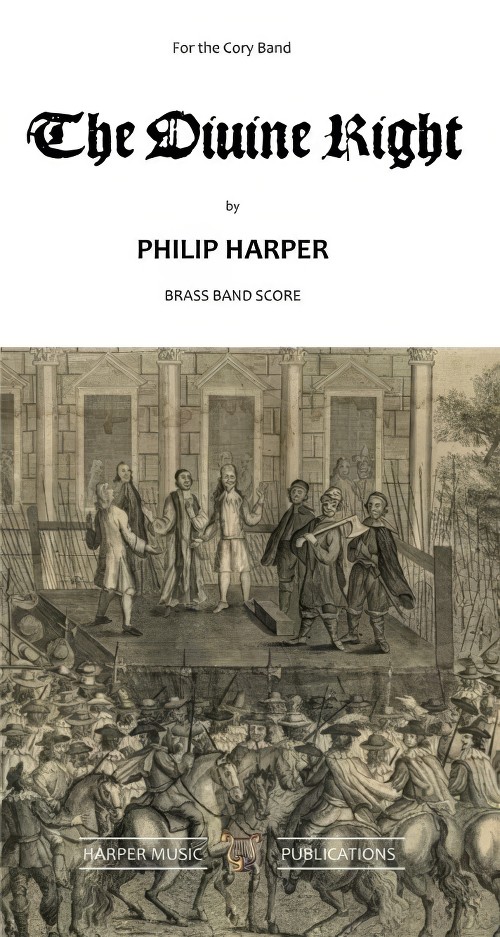
The Divine Right (Brass Band - Score and Parts) - Harper, Philip
At the time of composing this piece, the Arab Spring was sweeping through the Middle East. It seemed that almost every week a new country's people had risen up against the regimes and dictatorships which had prevailed for generations, leaving many nations at a defining crossroads in their history. There were so many possible ways ahead: so many hopes, yet so many uncertainties.This music is a depiction of these revolutionary times, and several musical themes are in turn presented, discussed, considered, fought over, altered, rejected or accepted.Most nations have had, or probably will have, their own Arab Spring, including the United Kingdom. Events of 17th Century Britain provide the context for this piece, particularly those following the execution of the tyrant King Charles I on 30 January 1649. The regicide was in part due to Charless steadfast belief in the Divine Right of Kings, and led to a tumultuous interregnum, where England stood at its own defining crossroads. The music begins turbulently, before King Charles appears and is led to the gallows outside Banqueting House in central London where he is brutally decapitated. From the assembled crowd rose, according to one observer,a moan as I never heard before and desire I may never hear again.The music descends to emptiness.The musical argument which follows is not strictly programmatic, but a number of musical themes are all thrown into the melting pot, representing ideas such as: religion; military force; reasoned Parliamentary debate; and the chattering, irrepressible voice of the people. Additionally, there are some quotations from the music of royalist composer Thomas Tomkins (1572-1656), who was often in tune with the feeling of the times.This defining episode in England's history was brought to a close with the Restoration of the monarchy in 1660, and as the exiled King Charles II rode back into London the diarist John Evelyn wrote:Never was so joyful a day seen in this nation. I stood in the Strand and beheld it, and blessed God.At the end of the piece the bells ring out, and the musical appearance of the King has transformed from turbulent to triumphant.Duration: 17.00
Estimated dispatch 7-14 working days
-
 £65.00
RISE OF THE PHOENIX (Brass Band - Score and Parts) - Barry, Darrol
As the title suggests, the phoenix was a fabulous mythical bird, who every morning at dawn, sang a song so enchanting that even the sun God, Apollo, would stop and listen. The bird would live for a hundred years, and at the end of its life, would build a pyre, set it on fire and be consumed by the flames. After three days, the phoenix would be reborn from the ashes, to sing once more.This work was commissioned by Clifton and Lightcliffe Band and reflects the difficulties and rebirth of the band to make music once more.Suitable for second section bands and above.
Estimated dispatch 7-14 working days
-
£27.50
RISE OF THE PHOENIX (Brass Band - Score only) - Barry, Darrol
As the title suggests, the phoenix was a fabulous mythical bird, who every morning at dawn, sang a song so enchanting that even the sun God, Apollo, would stop and listen. The bird would live for a hundred years, and at the end of its life, would build a pyre, set it on fire and be consumed by the flames. After three days, the phoenix would be reborn from the ashes, to sing once more.This work was commissioned by Clifton and Lightcliffe Band and reflects the difficulties and rebirth of the band to make music once more.Suitable for second section bands and above.
Estimated dispatch 7-14 working days
-
 £134.99
Sinfonietta: The Town Beneath the Cliff (Brass Band - Score and Parts) - Sparke, Philip
Sinfonietta: The Town Beneath the Cliff was commissioned by Holmestrand Ungdomskorps from Vestfold in Norway. The work is in four movements: a spectacular fanfare followed by a moto perpetuo-like toccata. The third movement Hymn is a beautiful piece of music allowing the band to show its musicality and sound. The last movement Scherzo Finale opens with a short phrase from Holmestrand's own town song, Holmestrandsangen, which comes again in full at the end of the piece, accompanied by a florid passage based on the opening theme.Duration: 13.45
Estimated dispatch 7-14 working days
-
 £59.95
The Long Cloud of Witnesses (Brass Band - Score and Parts) - Downie, Kenneth
This music was written for the Amsterdam Staff Band's 50th Anniversary. The idea for using this theme in appreciation of the pioneers of the band who had gone before came to me during the thanksgiving service for my own mother's life. She was a life-long Salvationist, and the large crowd that gathered for her thanksgiving in Winchester gave such an inspiring rendition of this hymn at the end of the service that it moved me to write the music. In the closing pages of the score I have tried to suggest that final parade when those who loved the Lord join the 'long cloud of witnesses' in procession to their eternal home. - Kenneth Downie
Estimated dispatch 7-14 working days
-
£29.95
The Long Cloud of Witnesses (Brass Band - Score only) - Downie, Kenneth
This music was written for the Amsterdam Staff Band's 50th Anniversary. The idea for using this theme in appreciation of the pioneers of the band who had gone before came to me during the thanksgiving service for my own mother's life. She was a life-long Salvationist, and the large crowd that gathered for her thanksgiving in Winchester gave such an inspiring rendition of this hymn at the end of the service that it moved me to write the music. In the closing pages of the score I have tried to suggest that final parade when those who loved the Lord join the 'long cloud of witnesses' in procession to their eternal home. - Kenneth Downie
Estimated dispatch 7-14 working days
-
 £174.99
The Turing Test (Brass Band - Score and Parts) - Dobson, Simon
Alan Turing is considered the father of modern computational science and much, if not all, of our modern computer technology and the connectivity that we now take for granted is born of the work of this one great, but troubled man. His famous test was designed to prove whether artificial intelligence (AI) could successfully imitate human thought. The single movement of The Turing Test is essentially non-programmatic, but it does seek to show something of the emotion and colour of Turing's life in its different sections. The composer employs bi-tonality and complex rhythms to show opposing worlds colliding. At the end of each test, we must decide: has true AI been born? Duration: 19.45
Estimated dispatch 7-14 working days
-
 £30.00
Feel
This duet for Eb tenor horn with brass band has been skillfully scored by Tim Paton, recreating this popular melody brought to fame by singer Robbie Williams.Tim comments:At the end of 2002, Robbie Williams presented us with the song "Feel". My wife, Julie, loves Robbie Williams, she also loves playing Tenor Horn with Flixton Band, so I took this sensitive and memorable music by Guy Chambers, and arranged it as a horn duet with brass band accompaniment for her birthday in 2003. Also available as a full brass band version.
In Stock: Estimated dispatch 3-5 working days
-
 £106.99
Evolution - Philip Sparke
Evolution was commissioned by Kunstfactor for the 4th section of the Dutch National Brass Band Championships (NBK) 2011. It is dedicated to Jappie Dijkstra and the Music Information Centre (MUI), Arnhem, Holland, in acknowledgement of their outstanding work in developing brass band repertoire. The composer writes:-The idea for the piece came when I was reading an article about a branch of Chinese philosophy which is abbreviated as Wu Xing, which has no exact translation but can mean, for example, five elements, five phases or five states of change. It is central to all elements of Chinese thought, including science, philosophy, medicine and astrology, and in simpleterms tries to create various cyclic relationships between five elements in all walks of life. An example is: Earth - Metal - Water - Wood - Fire - (Earth) etc. where (in one cycle) earth bears metal, metal changes to liquid (water) when heated, water helps trees grow, wood burns to create fire, fire produces ash (earth) and the cycle continues.I was particularly interested in the cycle of emotions: Meditation - Sorrow - Fear - Anger - Joy - (Meditation) etc. and thought this cyclic principle would provide an effective emotional journey for a piece of music. So Evolution has five equal sections which loosely characterise this emotional cycle. I have tried to make the music grow organically, with minimal repetition, and each movement evolves from the musical elements at the end of the previous one, with the opening material appearing, transformed, at the end of the piece to complete the cycle.
Estimated dispatch 5-14 working days
-
£60.99
Cowboy Suite - Alan Laken
In the tripartite 'Cowboy Suite' Alan Laken takes us to the Wild West, the domain of cowboys, indians, trappers and other fortune hunters. Around 1890 the west coast of America was reached, which in effect meant the end of the Wild West. Its stories, however, survived and have been a source of inspiration for many books, films, and, of course, music. Some characters, such as Jesse James, Billy the Kid, and Buffalo Bill are forever linked to these tales. In the 'Cowboy Suite' we first hear the 'Hoedown'. At the end of an exhausting workday the labourers used to lay down their tools, among others the 'hoes' and spontaneously began to play music on the instruments which they then possessed (guitars, fiddles, and banjos) and to dance. After being jolted on the 'Wagon Trail' we reach the third part, the 'Cowboy Roundup'. In this last part it becomes clear that as a cattle driver it is imperative to stay firmly seated in the saddle. As the cattle are rounded up, i.e. driven together, spectacular things happen.
Estimated dispatch 5-14 working days
 View Music