
Results
-
 £24.95
Sunset over the River Exe (Brass Band - Score and Parts)
From the little office in my garden where the composer does all his writing,there is a beautiful view looking westward, over the River Exe, in south Devon. It is a constant inspiration and makes me most grateful every time it is looked at. This little nocturne is the result of many musings and hopefully it will conjure up the atmosphere of the scene for all listeners.
Estimated dispatch 7-14 working days
-
 £24.95
The Great Parade (Brass Band - Score and Parts)
This piece is intended to be a bright, sparkling concert march and features the spiritual 'I got a robe'. The quick tempo is to encourage a performance of sparkle and wit and, at the same time, to reflect the mood of celebration in the spiritual. The song was sung by slaves to encourage them to remember that, although they might be deprived of even basic items like robes in their present plight, one day, when they get to heaven, 'all God's children got a robe'.
Estimated dispatch 7-14 working days
-
 £104.99
Cambridgeshire Impressions - Rieks van der Velde
In a four-part composition Rieks van der Velde takes us to the richly varied area surrounding the university city of Cambridge. The Dutch composer was especially inspired by the atmosphere of Cambridgeshire, the county which lies north ofLondon. 1. The Journey. Although on arrival the area looks peaceful and friendly, the ruggedness of its inhabitants and landscape have an unmistakable influence on the music. In the course of the tour, which starts with an Allegromovement, we are shown the vitality, energy and freshness of the Cambridgeshire countryside. Short themes, swift and sudden motifs and rhythmical patterns supported by the drive of percussion instruments give expression to this image. Thefirst part is concluded by two Calmo movements in which the music expresses how the cathedral in the city of Ely comes into sight and is gradually approached. 2. Visit to Ely Cathedral. The famous Norman cathedral church of Ely, whichwas built in 1109, has attracted tourists from all over the world apart from being a place of worship and heritage site. A cornet solo introduces the contemplative mood of the composition at this point. The mystical atmosphere of thecathedral runs through this lyrical part like a continuous thread. 3. The Pub. The thirst caused by this intensive journey makes a visit to the local pub a definite must. These "public houses", which may be open until the earlyhours of the morning, offer all kinds of entertainment. Drinks are served liberally and the atmosphere is lively. 4. The Journey Back. Time has flown: In other words, the moment of departure has come sooner than one would havewished. In a flashback which recaptures elements of the first part of the composition we say goodbye to Cambridgeshire in a fitting manner. Two scintillating final measures bring us abruptly back to the present.
Estimated dispatch 5-14 working days
-
 £60.99
Simply the Best - Mike Chapman - Ron Sebregts
Simply the Best was first performed by the little known Bonnie Tyler in 1988, but did not gain wide-spread popularity until Tina Turner recorded it barely one year later. The song has become one of Tina Turner's all time greatest hits and is a favourite around the world when something needs celebrating. Ron Sebregts' arrangement really rocks and will make sure your next concert is Simply the Best!
Estimated dispatch 5-14 working days
-
 £37.35
World War III (Brass Band) Joe Galuszka
This descriptive work for brass band by Joe Galuszka depicts the horrors of war. War is all around us. Every day, another life is lost. Myanmar, Sudan, Ethiopia, Ukraine, Colombia, Afghanistan, Somalia, Syria and Yemen. As time goes on, more and more countries are brought to the end of what is a diplomatic struggle - in where war seems to be the only option. 'War! Terror! Panic! captures the tumultuous and relentless nature of war. With driving rhythms, aggressive brass fanfares, and thundering percussion, the listener is immersed in the chaos of battle. Dissonance and clashing harmonies depict the discord that pervades war and takes us on a journey through the terror and panic that comes with the brutality of conflict. Remembrance (For Those That We Have Lost) provides a poignant and reflective interlude, allowing the audience to contemplate the human cost of war. Mournful melodies and expressive solos for trombone, euphonium and glockenspiel, convey the depth of sorrow and loss, serving as a powerful reminder of the toll war takes on individuals and communities. The final movement, Hymn for Peace and Hope is a testament to the enduring human spirit and the yearning for harmony - dissonance and conflict gradually give way to consonance and resolution. We celebrate the human capacity for unity and the triumph of peace over strife, as we imagine a world at piece. To listen to an audio demo of the work please visit https://on.soundcloud.com/Udt1AWRThgwuWnQv5 Duration: Approx. 5.00 mins Difficulty Level: 2nd Section + PDF download includes parts and score. Sheet music available from www.brassband.co.uk (UK) or https://satradecentral.org (USA) Instrumentation: Soprano Cornet Eb Solo Cornet Bb Repiano Cornet Bb 2nd Cornet Bb 3rd Cornet Bb Flugel Horn Bb Solo Horn Eb 1st Horn Eb 2nd Horn Eb 1st Baritone Bb 2nd Baritone Bb 1st Trombone Bb 2nd Trombone Bb Bass Trombone Euphonium Bb Bass Eb Bass Bb Timpani Percussion 1-3
In Stock: Estimated dispatch 1-3 working days
-
 £79.95
Lost Village of Imber, The - Christopher Bond
The village of Imber on Salisbury Plain had been inhabited for over one thousand years when it was evacuated in 1943 to make way for military training in the Second World War. At the time, with preparations for the Allied invasion of Europe underway, most villagers put up no resistance, despite being upset, with the belief that they'd return once the war had concluded. To this day, Imber and its surrounding land remain a military training ground. The villagers never returned, and just the shell of what was once a community remains. Structured in three movements, it is on this very real story that the work is based, setting out the series of events of 1943 in chronological order. The first movement, On Imber Downe, portrays a sense of jollity and cohesiveness - a community of individuals living and working together before news of the evacuation had broken. Sounds of the village are heard throughout, not least in a series of percussive effects - the anvil of the blacksmith; the cowbell of the cattle and the bells of the church. The second movement, The Church of St. Giles, begins mysteriously and this sonorous, atmospheric opening depicts Imber in its desolate state and the apprehension of residents as they learn they have to leave their homes. Amidst this is the Church, a symbol of hope for villagers who one day wish to return, portrayed with a sweeping melodic passage before the music returns to the apprehension of villagers facing eviction around their sadness at losing their rural way of life. In complete contrast, the third movement, Imemerie Aeternum, portrays the arrival of the military, complete with the sounds of the ammunition, firing and tanks - sounds which were all too familiar to those living in the surround areas. To close, the Church of St. Giles theme returns in a triumphant style, representing the idea that the church has always been, even to this day, a beacon of hope for the villagers and local community - both the centrepiece and pinnacle of a very real story. The work was commissioned by Bratton Silver Band in celebration of the band's 160th Anniversary, with funding from the Arts Council National Lottery Project Grants Fund and the Brass Bands England Norman Jones Trust Fund.
Estimated dispatch 10-14 working days
-
 £54.95
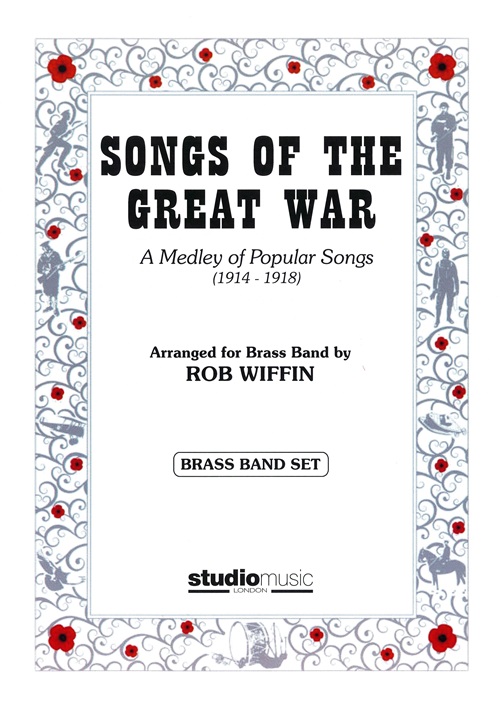
Songs of the Great War (Brass Band - Score and Parts) - Wiffin, Rob
A Medley of Popular Songs, 1914 - 1918Music of the Great War is a five year project to use music of the period to educate and engage schools, colleges, town bands, and the wider public across the UK and the world to learn in a positive way about the events, the experience of the troops involved from all sides, and how music played its part.This year, to commemorate the centenary of the Great War a specially arranged medley Songs of the Great War has been created. The medley has been arranged for bands to rehearse and eventually perform on the 11 November 2015. It brings together some of the most popular tunes played, sung and performed by the men and women of the time - in the trenches and on the various home fronts.With the support of many countries and organisations, on the 11 November the medley will be first played in New Zealand and Australia. It will ripple east across the world being performed in countries like India and Pakistan before hitting Europe and onwards to include performances in Canada and the Caribbean. This could become one of the most played pieces of music in a 24-hour period.In Britain, there will be performances across the country, including some at key events and sites involving a wide range of military and non-military personnel.The medley includes:It's a Long Way to TipperaryYour King and Country Want YouGood Bye-eeOh! It's a Lovely WarHello! Hello! Who's Your Lady FriendTake Me Back to Dear Old BlightyMademoiselle from ArmentieresThere's a Long, Long Trail A-windingIf You Were the Only Girl in the WorldPack Up Your Troubles (In Your Old Kit Bag)Old Soldiers Never Die/Last Post
Estimated dispatch 7-14 working days
-
 £55.00
Triumph Series Brass Band Journal, Numbers 1383 - 1386, March 2026
1383: Festival March - Lead On! (Andrew Wainwright)A dynamic march, commissioned by Majors Paul and Dawn McFarland during their appointment as Area Commanders of The Salvation Army's Dallas-Fort Worth Area, premiered at the 2023 Thanksgiving service at the Dallas Adult Rehabilitation Centre. Featuring the classic hymns Storm the forts of darkness (S.A.S.B. 980) and Lead on, O King eternal (S.A.S.B. 964), the piece captures the drive, hope, and mission at the heart of The Salvation Army's work in North Texas.1384: Confession (Kenneth Downie)This arrangement is based on the tune Lord of all (T.B. 440), one of the welcome additions to the 2015 Salvation Army tune book. Introduced to the arranger by Andrew Blyth, whose appreciation for the melody highlighted its gentle charm, the piece is dedicated to Andrew and the Peterborough Citadel Band, where he served as Bandmaster and continues to play.The music pairs the tune with the reflective words of We have not known thee as we ought (S.A.S.B. 630), a hymn often used in worship as a moment of confession and heart-searching before God. Its inclusion encourages both performers and listeners to approach worship with humility and sincerity.Although labelled simply as "German traditional," the tune's graceful simplicity is immediately evident. This arrangement preserves that character while introducing subtle harmonic colour and developing the tune's rising fourth motif as a unifying musical thread. The gentle nature of the melody remains central throughout, with a slightly heightened energy in the fifth phrase carefully drawn out without disrupting the overall serenity. The sharing of thematic material between Cornets and Horns calls for smooth, unobtrusive ensemble playing, allowing the tune's beauty to speak naturally.1385: God in good (Stephen Hull) This arrangement brings together two much'loved melodies: Goodness of God, a favourite from the final years of the arranger's service as Divisional Music Director in the Wisconsin/Upper Michigan Division, and the simple, enduring chorus God is so good. Heard often at summer camps, the song's message stayed with him, eventually inspiring this thoughtful musical pairing that highlights God's unwavering goodness throughout our lives.1386: A march in time (Martin Cordner)Written to celebrate the 130th anniversary of Thetford Corps (UKI Territory), this lively march pays tribute to a legacy of faithful witness, joyful service, and a community moving forward in God's light. Premiered by Cambridge Citadel Band during the anniversary weekend, the piece weaves together three cherished songs: Marching on in the light of God (S.A.S.B. 968), Jesus, precious Saviour (S.A.S.B. 501), and Light up the sunshine in your heart.
Estimated dispatch 7-14 working days
-
 £44.95
Glorified (Brass Band - Score and Parts)
Glorified was composed for the Canadian Staff Band's 50th Anniversary celebrations. This work is based on two tunes, Lord, be glorified (T.B. 738), a significant song at Canada's Territorial Music School over the years, and Great is thy faithfulness (T.B. 641). This song celebrates and signifies God's faithfulness to all associated with the Canadian Staff Band, and the commitment shown by its members through the years.The first half of the work harkens back to those members of the band who tragically perished in the early days on RMS Empress of Ireland, which was en route to England for the 1914 International Congress when it was struck by another vessel and sank. The rhythmic ostinatos heard represent the passing of time over the years. After the somewhat dark introduction, the music settles into a reflective rendition of In my life, Lord, be glorified (S.A.S.B. 593), before bursting into a rhythmic and jagged mixed-metre section. A yearning elegy pays tribute to those who lost their lives.The second half of the piece is celebratory in nature and commemorates the reformation of the band and the rich history which has ensued in the subsequent years. The rhythmic energy found in this section builds to a majestic presentation of the tune Lord, be glorified, which leads into the return of Great is thy faithfulness but in an optimistic fashion.
Estimated dispatch 7-14 working days
-
 £29.95
Keep in step! (Brass Band - Score and Parts)
The Salvation Army song Keep in step (S.A.S.B. 986) is given a tongue-in-cheek treatment, with the irony of a song that speaks of keeping in step at all times being used in a time signature that would be impossible to march to! This does make the music technically challenging and therefore careful preparation is needed to ensure everything remains within the correct bear, and that the rhythms sound convincing to the listener. There is also a touch of Broadway thrown in, with a recurring motif reminiscent of Gershwin's appropriately named Fascinating Rhythm.
Estimated dispatch 7-14 working days
 View Music