
Results
-
 £38.95
Unity Series Band Journal - Numbers 506 - 509, June 2022
506: Lord of all hopefulness (Gary Rose)The hymn Lord of all hopefulness, Lord of all Joy (S.A.S.B. 772) and its associate tune, Slane, creates a reflective work beautifully penned by Gary Rose507: Carol Arrangement - Glory in the highest (Sam Creamer)This Christmas favourite is given the classic Count Basie big band swing style - a perfect addition to your December concerts.508: Meditation - In Holiness (Dean Jones)Written for Merthyr Tydfil Corps band, this expressive work pieces together the tunes Hereford (T.B. 16) and Beethoven (T.B. 5).509: March - Ellan Vannie (Paul Sharman)The opening statement of this march reference the tune Ellan Vannin (T.B. 366) which gives rise to the title. 'Ellan Vannin' is Manx Gaelic for 'Isle of Man' and this music was written for a musician's weekend at Douglas Corps
Estimated dispatch 7-14 working days
-
 £39.95
On the Castle Green (Brass Band - Score and Parts)
I was contacted by conductor and friend Desmond Graham who wanted to have a traditional concert march composed to celebrate the Golden Jubilee of his band; The Third Carrickfergus Band.Immediately my mind started wandering as I thought about all the great marches that I have enjoyed playing and listening to over the years. So when I put pen to paper I had already planned out the structure of the march and which instruments to feature.The march itself is split into two halves, the first in a minor key the second in a major key. The opening section starting loudly in F minor features stereotypical passages one would come to recognise in a traditional concert march: a cornet solo, a melodic bridging section and a robust bass solo led by the basses and trombones.The second half of the march changes pace and mood as it lifts into a major key giving it a more lighter feel. We hear a second cornet solo which plays the second theme of the march. After a second bridge section the theme is played by the front row cornets to allow the soprano to play an obligato melody similar to that heard in marches like "Army of the Nile" and "Stars and Stripes Forever". It all builds to a grandioso ending where the tempo drops and the final theme is played with a quick accel to the end.As for the title? In Carrickfergus lies an old castle that faces the town which is situated on a small plot of luscious green grass - "On The Castle Green".Paul Lovatt-Cooper
Estimated dispatch 7-14 working days
-
£67.00
Vise ved vintersolkverv - Bruvoll/Stangnes - Haakon Esplo
The beautiful song "Song at Winter Solstice" has within short time been highly loved by listeners all around Norway. It's performed by folk-rock band "Hekla Stalstrenga" who released their first album "Hekla Stalstrenga" in 2008. This album was nominated for "Spellemansprisen" (the Norwegian equivalent to Grammy) in the folk music / traditional music category."Song at Winter Solstice" was released as single record in 2013.To the conductor:In this band arrangement you can choose whether to perform with or without repetition of the melody. If you want to use a song soloist, play the piece as is with all the verses that belong. As instrumental you can choose to go straight in the 2nd house to make the song shorter.
Estimated dispatch 7-14 working days
-
 £31.40
Hymn for Africa - Peter Meechan
Part of the Brass Band Aid SeriesBrass Band Aid is a Charitable Organisation formed by members of Stanhope Silver Band, based in the North of England. From an original aim to raise awareness of the Make Poverty History campaign in their local area, a brass band CD recording was planned. The initiative took on a whole new dimension when the collection of local bands performing on CD were then joined by, what is now known as, The Brass Band Aid Celebrity Band, made up of many of the top brass musicians in the country.Following the success of this initial project the Celebrity Band has come together again to record a new CD - "Into Africa". This is a compilation of pieces especially written for the recording by some of the most esteemed brass band writers of today. 'Hymn for Africa' is one such piece, generously contributed by Peter Meechan in support of the ongoing work of the charity."Hymn for Africa is inspired by the the release of Nelson Mandela in the early 1990's and the effect it had upon not only South Africa, but all over the continent of Africa, as well as the World as a whole. The fact that one man can achieve this with peace and great dignity will always be an inspiration, not only to me, but many, many millions of humans around the globe.sense of dignity and peace the composer . A simple 8 bar melody, first heard on an unaccompanied flugel horn at the beginning, is the basis of the composition. A drone is then added, before a chorale, and finally a rousing climax when the percussion and full band enter. The piece ends at it began, with a peaceful, unaccompanied, flugel solo." (Peter Meechan).All sets sold raise money for Brass Band Aid - a charity The Music Company has continued to actively support since 25.
In Stock: Estimated dispatch 3-5 working days
-
 £89.95
Revelation (Score and Parts)
Symphony for Double Brass on a theme of Purcell 1995 marked the tercentenary of Purcell's death, and my new score Revelation has been written as a tribute to his music and the ornate and confident spirit of his age. There are five major sections: 1 Prologue 2 Variations on a ground bass I 3 Fugue 4 Variations on a ground bass II 5 Epilogue and Resurrection The score uses many features of the Baroque Concerto Grosso, and arranges players in two equal groups from which soloists emerge to play in a variety ofvirtuoso ensembles. It quotes freely from Purcell's own piece Three Parts on a Ground in which he has composed a brilliant sequence of variations over a repeating six-note bass figure. This original motif can be heard most clearly beneath the duet for Cornet 5 and Soprano at the beginning of the 2nd section. There is, of course, a religious dimension to Revelation as the title suggests, and the score is prefaced by lines by the 17th century poet John Donne. His Holy Sonnet paraphrases the Book of Revelation in which the dead are raised at the sounds of the last trumpet. Donne's trumpets are themselves placed stereophonically ". . . At the round Earth's imagined corners" and it is this feature that today's players represent as they move around the performing area. Their final apocalyptic fanfares can be heard at the close of the score, as Purcell's music re-enters in a lasting tribute to England's first composer of genius. Philip Wilby September 1995 At the round Earth imagined corners, blow your trumpets, angels, and arise, arise from death, you numberless infinities Of souls, and to your scattered bodies go. All whom the flood did, and fire shall o 'erthrow All whom war, dearth, age, agues, tyrannies, Despair, law, chance hath slain, and you whose eyes Shall Behold God, and never taste death woe. John Donne after Revelation Ch. 11 v.15
Estimated dispatch 7-14 working days
-
 £44.95
Revelation (Score Only)
Symphony for Double Brass on a theme of Purcell 1995 marked the tercentenary of Purcell's death, and my new score Revelation has been written as a tribute to his music and the ornate and confident spirit of his age. There are five major sections: 1 Prologue 2 Variations on a ground bass I 3 Fugue 4 Variations on a ground bass II 5 Epilogue and Resurrection The score uses many features of the Baroque Concerto Grosso, and arranges players in two equal groups from which soloists emerge to play in a variety ofvirtuoso ensembles. It quotes freely from Purcell's own piece Three Parts on a Ground in which he has composed a brilliant sequence of variations over a repeating six-note bass figure. This original motif can be heard most clearly beneath the duet for Cornet 5 and Soprano at the beginning of the 2nd section. There is, of course, a religious dimension to Revelation as the title suggests, and the score is prefaced by lines by the 17th century poet John Donne. His Holy Sonnet paraphrases the Book of Revelation in which the dead are raised at the sounds of the last trumpet. Donne's trumpets are themselves placed stereophonically ". . . At the round Earth's imagined corners" and it is this feature that today's players represent as they move around the performing area. Their final apocalyptic fanfares can be heard at the close of the score, as Purcell's music re-enters in a lasting tribute to England's first composer of genius. Philip Wilby September 1995 At the round Earth imagined corners, blow your trumpets, angels, and arise, arise from death, you numberless infinities Of souls, and to your scattered bodies go. All whom the flood did, and fire shall o 'erthrow All whom war, dearth, age, agues, tyrannies, Despair, law, chance hath slain, and you whose eyes Shall Behold God, and never taste death woe. John Donne after Revelation Ch. 11 v.15
Estimated dispatch 7-14 working days
-
 £34.95
Goodbye Old Friend - Christopher Bond
Walt Disney was just twenty-five years old when he created Oswald the Lucky Rabbit, and the pair gained huge success, but that success was short-lived. In 1928, Disney travelled to New York City in hopes of negotiating a more profitable contract for the Oswald cartoons with his producer, Charles Mintz. Unknown to Disney, Mintz had been working behind his back to counter his own financial problems by stealing many of Disney's animators and staff. Walt Disney was devastated and decided to let Oswald go, and in doing so, lose all the rights to the rabbit he had created and nurtured so dearly. 'Goodbye Old Friend' is a beautiful slow-melody for euphonium and baritone, communicating the profound loss Disney felt in losing his producer, staff, and most of all, Oswald the Lucky Rabbit.
Estimated dispatch 10-14 working days
-
 £74.95
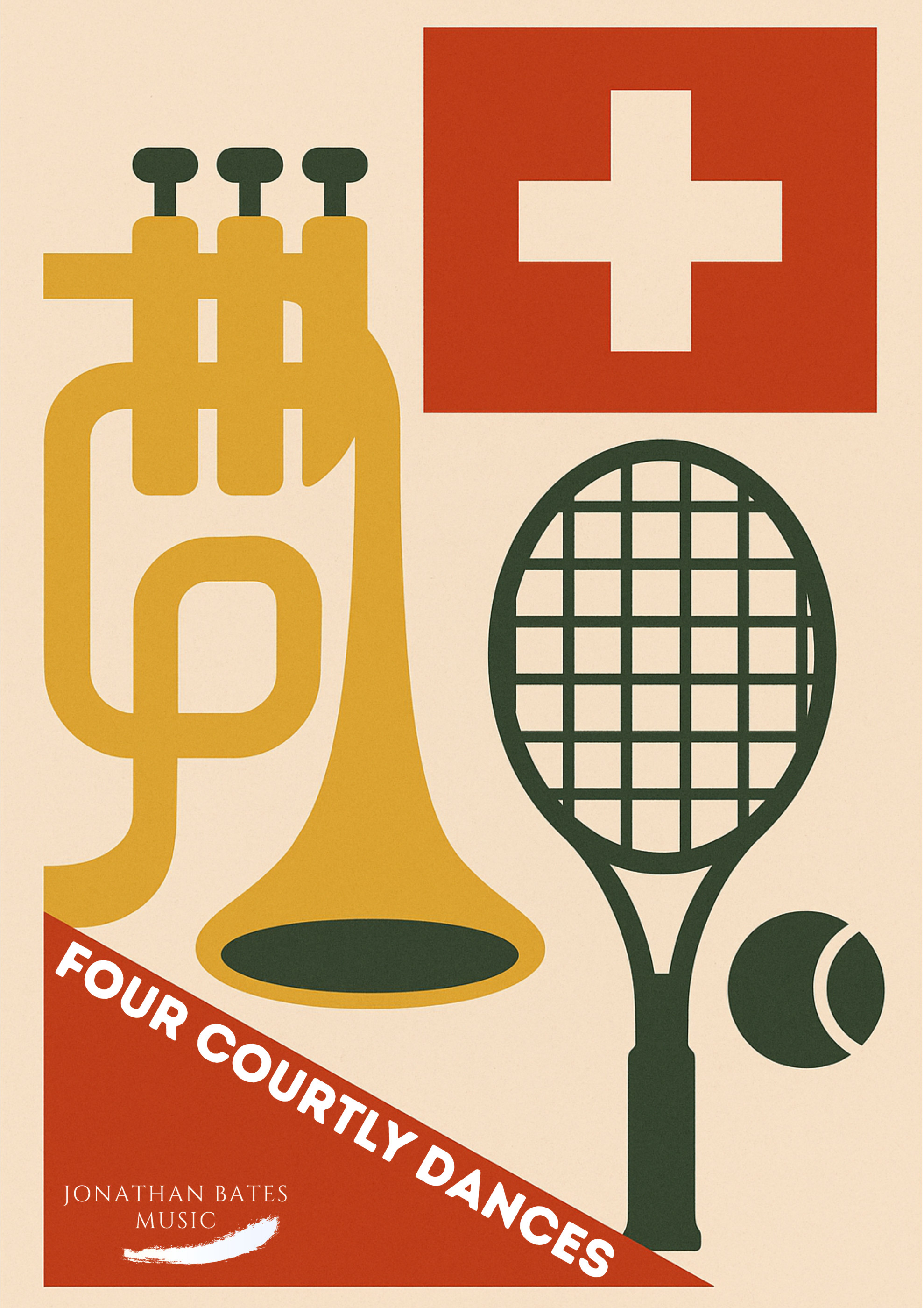
Four Courtly Dances - Jonathan Bates
DURATION: 12'00". DIFFICULTY: 1st+. 'Four Courtly Dances' was composed for Brass Band Burgermusik Luzern in 2025 for their Brass & Sport Gala Concert in the KKL Luzern. The work is a tribute to career of Swiss Tennis great Roger Federer with each movement giving a musical 'nod' to the story of his life and career. Each movement is inspired by a traditional 'courtly' (not in a tennis sense, but that was the idea!) dance:. 1. Inspiration (Almain) . The opening movement is subtitled 'Elegance on Court', backed by a deep-rooted sense of Swiss nationlism, featuring a prelude based upon the traditional Swiss song 'Guggisberglied'. . 2. Success & Failure (Galliard) . A movement centred around the trials and tribulations of an elite sportsperson, with antiphonal cornet & tambourine groups playing avirtuosic musical tennis match across the band. . 3. Rivalry (Sarabande & Canario) . An upbeat movement fused with Spanish and Balkan influences, inspired by Federer's long-running rivalries with Rafael Nadal and Novak Djokovic. . 4. Legacy (Pavane) . A final reflective and uplifting homage to the legacy leftby one of the greatest sportspeople of all time, culminating in a coda whichbrings together all the previous 'ingredients' which made Federer the icon he is. . .
In Stock: Estimated dispatch 1-3 working days
-
 £65.00
Music for Jock Tamson (Brass Band - Score and Parts)
Scottish Dances Set 2An original suite in three movements:Nyah Fearties!InchkeithWha's Like Us?This work was one of twelve works commissioned by the Scottish Brass Band Association and Funded by Creative Scotland Targeted Fund - 2021 to aid Covid Recovery and support composers in Scotland.Jock Tamson - a Scottish name explained... The phrase more often occurs in an extended form: We're a' Jock Tamson's bairns. This is interpreted in a metaphorical sense as a statement of egalitarian sentiments equivalent to "we're all the same under the skin" or "we are all God's children". i.e. This is music for everyone!
Estimated dispatch 7-14 working days
-
 £99.95
Carols for Band (Brass Band - Score and Parts)
Designed to be playable by any combination from quartet to full brass band, wind band or orchestra, the arrangements in this book with provide a practical solution to all your carolling needs. Parts are divided into Soprano, Alto, Tenor and Bass so that any suitable instrumentation will sound well, providing an equal balance of players per voice is maintained. The carols are printed in alphabetical order so they are easy to find, and comprehensively indexed under both first line and name of tune.Score, Timpani and Percussion parts are available separately.Instrumentation is as follows: Brass BandWind BandStringsSopranoEb Soprano CornetSolo Bb CornetBb Repiano & Flugel1st Flute & Piccolo2nd FluteOboe1st Bb Clarinet1st Bb Trumpet/Cornet1st ViolinAlto2nd & 3rd Bb CornetSolo Eb Horn1st Bb Trombone2nd & 3rd Bb ClarinetsEb Alto Saxophone2nd Bb Trumpet/Cornet1st F Horn2nd ViolinTenor1st & 2nd Eb Horns1st & 2nd Bb Baritones2nd Bb Trombone1st Bb EuphoniumEb Alto ClarinetBb Tenor Saxophone2nd F Horn1st & 2nd TrombonesViolaBassBass Trombone2nd Bb EuphoniumEb BassBb BassBassoonBb Bass ClarinetEb Baritone SaxophoneBass TromboneEuphoniumTubaCello/BassTitles included:Angels from the Realms of GloryAs with Gladness Men of OldAway in a MangerBrightest and BestChristians AwakeCoventry CarolDeck the HallsDing Dong, Merrily on HighFirst NowellGod Rest ye Merry, GentlemenGood King WenceslasHark the Glad SoundHark, the Herald Angels SingHolly and the IvyI Saw Three ShipsIn Dulci JubiloIn the Bleak Mid-WinterInfant HolyInfant KingIt Came Upon a Midnight ClearJingle BellsLo, He Comes with Clouds DescendingLove Came Down at ChristmasO Come, All ye FaithfulO Come, O Come, EmmanuelO Little Town of BethlehemOf the Father's Love BegottenOnce in Royal David's CitySans Day CarolSee Amid the Winter's SnowSilent NightSussex CarolThou Didst Leave Thy ThroneUnto Us is Born a SonWe Wish You a Merry ChristmasWhile Shepherds WatchedThe Brass Band Set consists of 25 Parts:1 x Eb Soprano Cornet4 x Solo Bb Cornet2 x Bb Repiano & Flugel4 x 2nd & 3rd Bb Cornet1 x Solo Eb Horn2 x 1st & 2nd Eb Horn2 x 1st & 2nd Bb Baritone1 x 1st Bb Trombone1 x 2nd Bb Trombone1 x Bass Trombone1 x 1st Bb Euphonium1 x 2nd Bb Euphonium2 x Eb Bass2 x Bb Bass
Estimated dispatch 7-14 working days