
Results
-
£40.00
Tubilation
A fantastic tuba feature with brass band backing. Driving semiquaver rhythms push this piece forwards whilst remaining away from the centre of attention which is undoubtedly the big old tuba! Full of semiquavers and scales rushing up to the top of the range of the instrument, there can be no doubt that the tuba is the star of the show. The solo part is carefully thought through with enough rests to make it approachable, while the syncopatino in the other parts give the music an energy that is maintained to the very final flourish, instigated by a demisemiquaver scale run on the tuba! Intermediate and above ensemble parts, but the solo tuba part needs a fairly skilled and confident player to get the most out of this piece.
-
 £25.95
Hymn for Africa - Peter Meechan
Part of the Brass Band Aid SeriesBrass Band Aid is a Charitable Organisation formed by members of Stanhope Silver Band, based in the North of England. From an original aim to raise awareness of the Make Poverty History campaign in their local area, a brass band CD recording was planned. The initiative took on a whole new dimension when the collection of local bands performing on CD were then joined by, what is now known as, The Brass Band Aid Celebrity Band, made up of many of the top brass musicians in the country.Following the success of this initial project the Celebrity Band has come together again to record a new CD - "Into Africa". This is a compilation of pieces especially written for the recording by some of the most esteemed brass band writers of today. 'Hymn for Africa' is one such piece, generously contributed by Peter Meechan in support of the ongoing work of the charity."Hymn for Africa is inspired by the the release of Nelson Mandela in the early 1990's and the effect it had upon not only South Africa, but all over the continent of Africa, as well as the World as a whole. The fact that one man can achieve this with peace and great dignity will always be an inspiration, not only to me, but many, many millions of humans around the globe.sense of dignity and peace the composer . A simple 8 bar melody, first heard on an unaccompanied flugel horn at the beginning, is the basis of the composition. A drone is then added, before a chorale, and finally a rousing climax when the percussion and full band enter. The piece ends at it began, with a peaceful, unaccompanied, flugel solo." (Peter Meechan).All sets sold raise money for Brass Band Aid - a charity The Music Company has continued to actively support since 25.
In Stock: Estimated dispatch 3-5 working days
-
 £15.00
Perseverance
DescriptionPerseverance was commissioned by Middleton Band to mark their 140th anniversary in 2016, supported using public funding by the National Lottery through Arts Council England, and featured on Middleton Band's CD of the same name.The title is taken from the original name of the 1876 band, the Middleton Perseverance Drum and Fife Band. According to the band's historical records, the Drum and Fife band was formed by six Middleton youngsters eager to learn music but short of funds. Following a whip round, they visited a music shop in Oldham where they purchased a 'one key flute' for six shillings and sixpence, and ('later on') a drum.This determination to make music despite the odds has been a characteristic of the band ever since; at the end of the second world war the band was again down to six players, who rebuilt the 'Middleton Borough Band' back to twenty-six players. After a period of some considerable success throughout the sixties and seventies culminating in winning the National Third Section title in 1983 the band hit hard times again in the late eighties and was down to only four members in 1987 before again being brought back to life. In recent decades the band has built a strong relationship with the East Lancashire Railway, another organisation which has battled sometimes mighty obstacles in its struggle to survive, and has maintained a thriving and successful youth band.The band's will to survive through adversity is reflected in the music, which builds from a sextet of four brass and two percussion players three times, only to fall back to the sextet twice. In the central slow movement the bass drum plays a 'heartbeat' rhythm as the remaining players remember those lost in the war. The relentless pace of the final section culminates in the band triumphing over the adversity which has curtailed the previous two sections. As a former member of Middleton Band (and one of the team that regained the National Third Section title in 2007) it is my pleasure to dedicate this work to the 'Pop and Ale Boys', Middleton Band.You can read more about the piece here.To view the accompanying video by Andy Marshall, designed to precede the piece, clickhereand find out more about the link between the video and the music here.Recording with Score VideoPerformance NotesIn performance the four brass members of the sextet (soprano, solo horn, solo trombone and solo euphonium) should stand at the sides of the band - soprano and horn behind the cornets, trombone and euphonium behind the trombones. Percussion may stand with them at the conductor's discretion, but only if the band has TWO snare drums and TWO concert bass drums available, as these are also needed at the back of the band in the tutti sections. In the second sextet snare drum should be muffled with a heavy cloth OR have the snares turned off (not both).Percussion and mutesPercussion required:snare drum (muffled with a heavy cloth at one point)concert bass drum, kit bass drum, hi-hat, suspended (crash) cymbal2 x tom-tomswood blockclash cymbals3 x timpanitam-tamglockenspielSoprano cornet, repiano and 2nd cornets, flugel and all trombones require metal straight mutes. Soprano, Solo Cornet 3/4, Repiano 2nd and 3rd cornets require cup mutes. Solo Cornet 1/2, Repiano, 2nd and 3rd cornets require harmon mutes.
Estimated dispatch 7-14 working days
-
 £30.00
Flanfayre - Stephen Deazley
I was asked by Music for Youth to write a flexibly scored fanfare for the school proms at the Royal Albert Hall and at their National Festival in Birmingham in 2013. At its first performance at the National Festival, over 200 young brass players performed Flanfayre in Birmingham Town Hall, directed by Roger Argente, members of Superbrass and myself. The score is a progressive romp through some increasingly dance-like grooves, borrowing some of its swing from South America, from marches and big band, moving from a really quite straight opening to a "let-go" moment at the end. It is more like a flan full of different flavours, than a fanfare, hence the title. I set myself a challenge to write 100 bars but ended up with 102, which, after the introduction, can be broken down into 10 easily discernible sections each with their own mini-musical narrative. If you have time feel free to teach the audience the clapping groove. I also modelled the slow moving melody of the final section on the following words; "nothing beats a nice big cheesy, nothing beats a nice big cheesy, nothing beats a nice big cheesy, nothing beats a cheesy flan". Feel free to incorporate these too, and perform only under the strict instruction that you have fun ! - Programme Note copyright of Stephen Deazley
-
 £40.00
Legends of Cyfarthfa - Matthew Hall
Legends of CyfarthfaCombining the music of Joseph Parry and the legendary Cyfarthfa Band, Legends of Cyfarthfa is a technically challenging but musically rewarding concert work. Robert Crawshay owned the Cyfarthfa Ironworks in South Wales creating a business empire second to none.Cyfarthfa Castle was built by Crawshay as the family home from the income made via the ironworks. He wanted his own private band to play under the name of the ironworks with the best players in the world, playing on the highest quality instruments at the time. Employing the band members under the guise of iron workers, the Cyfarthfa Band was made up of virtuoso players, performing for the pleasure of the Crawshay dynasty.This virtuosity can be heard in some of the more technically challenging sections of Legends of Cyfarthfa. Joseph Parry was born in Cyfarthfa.He composed the first piece of music specifically written for brass band called Tydfil Overture for the Cyfarthfa Band, alongside many other memorable works for other instrumentation.Legends of Cyfarthfa incorporates many of Parry's works including his opera Blodwen, hymn tune Aberystwyth, folk melody Myfanwy and the Tydfil Overture, alongside many other melodies from Wales. Sospanfach, Men of Harlech, Lisa Lan and Calon Lan are just a number of the melodies that are used in this composition.The premiere performance was given by Tredegar Town Band under the direction of Ian Porthouse at the 2010 Brass in Concert Championships where it was awarded the Cyril Beere Memorial Trophy for Best New Composition or Arrangement.https://matthew-hall.co.uk/wp-content/uploads/2014/08/05-Legends-Of-Cyfarthfa.mp3Legends of Cyfarthfa
Estimated dispatch 5-7 working days
-
Savoy Christmas Medley - Traditional - Len Jenkins based on an original arrangement by Debroy Somers
The Savoy Christmas Medley is a well-known and often played piece originally arranged from traditional music by Debroy Somers a big-band bandleader in the 1920's. William Henry (Debroy) Somers was an ex-army bandmaster who formed the Savoy Orpheans dance band, resident at the famous Savoy Hotel between 1923 and 1927. Whilst there are several editions of this music for full Brass Band, this latest arrangement has been tailored to suit a brass quintet with optional percussion. In many cases the availability of players around the festive season, or the space to accommodate a full band in some of the venues for Christmas engagements or for fundraising, means that a Quintet can be the preferred option. In order to achieve a good Quintet arrangement, it is necessary to achieve the same quality and diversity of sound as a full band but within a smaller group. A challenging objective which we believe has been achieved in this publication. In common with our developing practice, the arrangement is scored for both Brass Band and Concert Brass instruments.
-
 £34.95
Transformation (Brass Band - Score only) - Downie, Kenneth
I believe in transformation, God can change the hearts of men, And refine the evil nature, till it glows with grace again'. So wrote John Gowans in the second verse of his great hymn, 'I believe that God the Father, can be seen in God the Son', written specifically to affirm Salvationists' beliefs. It is sung to the tune Bethany and in seeking to explore this great subject at the heart of the Christian gospel in musical terms, the composer has used this fine tune as the basis. Although it never appears in its entirety, it is seldom out of the picture and much of the work is derived from it. The other main source of material is the lovely, simple chorus, 'Some day I shall be like him, changed to heavenly beauty, when his face I see'. This chorus is especially prominent in the middle section but there are important references to it throughout. There are also brief references to Charles Wesley's hymn, 'Love Divine' and, in particular, the telling lines, 'Changed from glory into glory, till in Heaven we take our place'. The work suggests that, at times, the process of being transformed is a struggle, portrayed with many passages of fraught and demanding music. Considerable reserves of stamina and technique are required while, in contrast, the chorus, 'Some day I shall be like him' provides the warm, gentle centre of the work. The premiere of the work was given by The International Staff Band of The Salvation Army in Cadogan Hall on Friday 3rd June 2011, as part of the band's 120th anniversary celebrations.
Estimated dispatch 7-14 working days
-
 £40.00
The Unfortunate Traveller (Brass Band - Score only) - Holst, Imogen - Hindmarsh, Paul
Imogen Holst (1907-1984) submitted The Unfortunate Traveller (1929) as her final work as a student portfolio at the Royal College of Music, where her composition teacher was Gordon Jacob. The title was taken from Thomas Nashe's famous 1594 picaresque novel of the same title. The Suite was first performed on 12 February 1933 at her Majesty's Theatre, Carlisle, by the St. Stephen's Band, with the composer conducting. Te concert was given in memory of Holst's uncle, Dr. H.A. Lediard. Holst had been impressed with the band's performance of his A Moorside Suite at the 1928 National Brass Band Championships (The Crystal Palace, South London) and was keen to work with them. Writing in Imogen Holst, a life in music, Christopher Grogan indicates that it was Gustav Holst's suggestion to include his daughter's work in the programme, quoting Imogen Holst's remarks made in interview to The Daily Mail as follows: "....it is the first time, so far as I know, that a woman has conducted a brass band at a public concert....It has been a delight to rehearse the St. Stephen's Band. It was their performance at the Crystal Palace Festival that inspired me to write this Suite, which I have dedicated to them."Imogen Holst accompanied her father to the Crystal Palace in 1928 to hear the performances of A Moorside Suite, and was so excited by the played and, audibly, by her father's music that she decided to write a brass band piece for her final examination. Te result was The Unfortunate Traveller (1929). However, it was not possible for her to present a brass band work for examination. She arranged it for string orchestra so that it could be played before she left the RCM in July 1930. Following the premiere of the original in 1933, the manuscripts did not resurface until 1969 Imogen found them among her late mother's effects. Although she requested score and parts be destroyed, they ended up in the possession of Manchester composer John Golland, who marked up the score presumably with the intention of creating a new performing edition. The original scoring reveals a lack of experience with what can be a tricky medium.With the agreement of the Holst Foundation, a revised edition, with additional percussion, was prepared in 2011 since when the work has been fortunate to travel round the world as a concert and contest piece. The original includes drums in the March only. The title was taken from Tomas Nashe's famous 1594 picaresque novel of the same title. Several Morris Dance tunes are introduced during the course of the four short movements, including Bonnie Green Garters, Shepherd's Hey, The Rose and The Wind Blaws Cauld. Quirky twists and turns of harmony and spirited rhythms that remind us how much Imogen Holst loved tradition English dance music.In September 2025, I made a performing edition of the composer's arrangement for string orchestra. The manuscript lacks the final movement, which I arranged in a similar style, ie. without extending the upper ranges. Making this edition raised some issues regarding the accuracy of my band version and some of the solutions I used to smooth out the voicing. I have used the composer's second thoughts to refine my performing edition and to correct a textual errors.- Paul HindmarshDuration: 10.00
Estimated dispatch 7-14 working days
-
£12.50
The Pilgrim's Prayer (Brass Band - Score only) - Rouse, Sydney - Ball, Eric
Introduction - This could hardly be more simple. Inexperienced players may have some little difficulty in intonation, especially as they are starting 'cold', but a useful lesson can be learned in this connection when rehearsing these two bars. Section A - The music is hymn tune-like in character, but it should not become stilted. Close intonation is still a point to study, especially in view of the chromatic nature of some of the harmony. Section B - Aim to secure just balance in the accompanying parts, especially in the second phrase, where the 1st comets may be inclined to treat their moving part as an independent melody rather than part of the 'colour' background. Section C -This is a reprise of the first theme, with a different arrangement. The same comments apply, however. Section D - Here the music becomes more song-like in style, and provides an interesting contrast. The scoring, too, is more varied, and there are a number of points that call for attention. Note that the 1st and 2nd comets and 2nd trombone work as a team throughout; see that the pulsating, syncopated background adds to the movement of the music without giving a jerky effect; the new entries in the fourth and twelfth bars are to be made quite smoothly; and do not allow the texture of the music, especially in the last eight bars of the section, to overshadow the simplicity of the main tune. Section E - Here the first subject appears again. In the arrangement the colour contrasts are quite clear-cut. In order to secure true balance in the fifth and sixth bars, it may be necessary to adjust the amount of tone given by the bass trombone, as this part is not doubled as are the other parts. Section F -This section forms a simple but expressive coda.
Estimated dispatch 7-14 working days
-
 £40.00
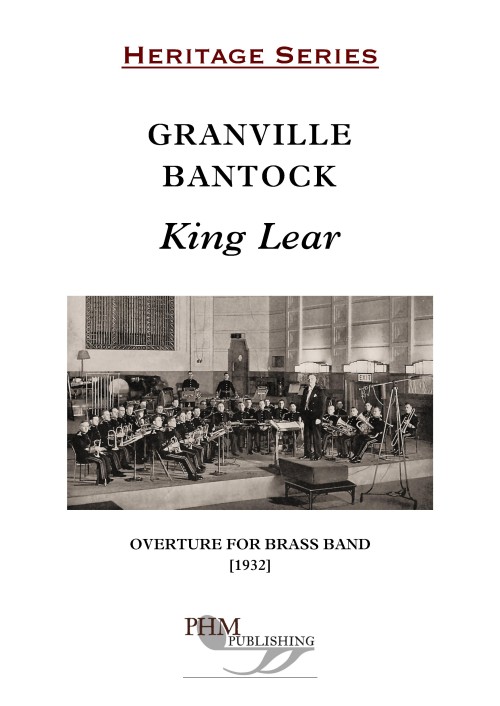
King Lear (Brass Band - Score only) - Bantock, Granville - Hindmarsh, Paul
Sir Granville Bantock (1868 - 1946) composed the second of his five major brass band work for Callender's Cableworks Band, completing the commission on 30 November 1932. Based in the Thames-side district of Belvedere near Erith, the band was active between 1898 and 1961. The works band of the Callender Cable & Construction Co. Ltd, it was at the peak of its popularity during the 1930s and was a frequent broadcaster on the radio. The band employed an in-house arranger and played saxophones in its lighter material. King Lear was one of the band's major commissions and was not published in Bantock's lifetime. The manuscript score and parts were thought to be lost for decades, but were found in the library of the Haydock Band (Lancashire), which had inherited part of Callender's library of manuscripts material and bespoke arrangements after it has been transferred to nearby Prescott Cables Band after Callender's Cable Works closed.King Lear is a substantial work, in essence a dramatic tone poem in the romantic Tchaikovskian manner, presenting a series of character portraits of the foolish old king and his three daughters, Goneril, Regan and Cordelia. The music is dramatic and lyrical by turns, with the most generous lyrical episode revealing perhaps the warm-hearted Cordelia. An expansive melody that flows from this is brought back towards the end as the main climax of the work.In 2001, Bantock's score was recorded by the University of Salford Brass Band, conducted by Dr. Roy Newsome. The original is serviceable, but in comparison with the orchestral version he made in 1936 (part of which was recorded on a Paxton 78 rpm) and later brass band scores, performing editions of which were prepared by others, it lacks colour and range typical of Bantock's orchestral work. Above all it lacks percussion, which can be heard on the recorded extract. With the kind permission of the Bantock Estate, I have prepared a performing edition for publication that incorporates percussion, derived from the orchestral recording and added editorially in similar manner elsewhere. I have revoiced some of the low- lying instrumental parts to present the material in more comfortable ranges. Editorial interventions more elaborate than revoicing the original text have been identified as cue notes.- Paul HindmarshDuration: 15.00
Estimated dispatch 7-14 working days
 View Music