
Results
-
 £19.95
Mythical Tales (Brass Quintet)
Mythical Tales (2012) is a ten minute work in three movements which represents three of the most popular folk stories or indeed in the case of the first movement, true stories, in Welsh culture.I. Owain GlyndwrOwain Glyn Dwr was born around the 1350s into an Anglo-Welsh gentry family. His estates provided him with a modest power base in north-east Wales. After a number of disputes, he proclaimed himself prince of Wales in September 1400.Glyn Dwr led several battles with the English, although he was never captured. Over the next few years punitive measures were enacted to keep control of Wales, but these were matched by many acts of Welsh rebellion - among them the capture of Conwy Castle in April 1401. In June 1402, at the Battle of Pilleth on Bryn Glas Hill, Glyn Dwr led his troops to victory over an English army. By now Glyn Dwr was leading a national revolt. In 1404, he led a march towards Wocester, but failed, with the English capturing parts of Wales. He died defending his country.II. MyfanwyMyfanwy was the most beautiful woman in Powys, but she was vain and liked nothing better than to be told how beautiful she was. Many handsome men would court her, but she would not show interest because they couldn't sing and play to her, reflecting her true beauty.Luckily, a penniless bard, Hywel ap Einion was in love with Myfanwy, and one day plucked up the courage to climb up the hill to the castle with his harp, to sing and play to her. He's allowed in to play for her, and while he's playing and complimenting her on her beauty she can neither listen nor look at any other man. Because of this Hywel believes that she has fallen in love with him. But his hopes are dashed when a richer, more handsome and more eloquent lover comes along. The music of the second movement portrays the despair and upset that Hywel must have felt.III. Battle of the DragonsMany centuries ago when dragons roamed the land, a white ice dragon descended on a small village and decided to live there, not knowing that a red fire dragon was already living nearby.Six months later the red dragon awoke to find a huge white dragon wrapped around his village that he cared for. He could tell that his people were ill from the cold. The Land was bare; nothing was able to grow not even the pesky dandelions. The people were starving. The people longed for the red dragon to free them from the icy misery, so that their life and land could return to the sunny and warm climate that it was once before.The red fire dragon challenged the white ice dragon to a single combat fight at the top of the cliff the next day. The people of the village watched in terror awaiting their fate. The red dragon beat the white dragon, and the crowd cheered with joy as the red dragon roared with triumph. The mayor of the village declared that the land should always fly a flag with the symbol of a Red dragon on it. The flag's background should be half green and half white; the green to represent the lush green grass of the land and the white to represent the ice. This way no one would ever forget what happened.
Estimated dispatch 7-14 working days
-
 £30.00
Bandamonium 2024 (Neil Lock) - Brass Band Sheet Music Full Score & Parts - LM541
COMPOSER: Neil LockThis march was submitted to the march composers' competition for "Bandamonium 3"in Hatherleigh, Devon in July 2024. The winning march was played by massed bands at the conclusion of the celebrations on Saturday 27th July 2024. Unfortunately, this march took second place in the competition, behind the march of Paul Pennicotte-Henrie, conductor of Okehampton Silver Band.The march can be played with or without the singing. (Even at the Whit Friday marches, begad!) I suggest that it should be introduced by 3-beat rolls.When played with singing, the "Bandamonium" lyrics (bars 10-13 and 56-57) are to be sung by all players, keeping to their own parts, with appropriate octave adjustment for their individual singing voices. Conductor and percussionists should sing with the main theme (Db and C at bars 10-13, F at 56-57). Listen to the 3rd cornet players!There is an additional part for Singers, in which the trio melody (bars 58 onwards) can be sung by Soprano and Tenor singers at a moderate choir standard. An octave-down option is also provided in the higher bars. This part can be given to "spare" singers within the band, or to singers external to the band if opportunity permits. The lyrics are:We are in Devon,We're in Hatherleigh,Whit Friday heaven,But we're marching free!Now it's past seven,Time to party,At BandamoniumIn Hatherleigh!LM541 - ISMN : 9790570005413
In Stock: Estimated dispatch 3-5 working days
-
 £15.00
Jerusalem - Parry
Programme Notes from Andrew Duncan:This is one of the more difficult arrangements in the Flexi-Collection Popular Classics Series, and as such will be best attempted after the easier ones have been mastered.The arrangement can be played all the way through as a solo piece or with a number of players playing the 1st Cornet/Trumpet part.The percussion part is very minimal in this arrangement (only 3 notes forthe suspended cymbal) and is an optional part.The Flexi-Collection ApproachFlexible scoring tailored to your needs - A perfect solution for expanding the repertoire of training and junior brass bands. The Flexi-Collection currently offers two series - Popular Classics and World Tour. Based on four-part harmony, these collections provide groups with the advantage of complete flexibility when they may not be balanced. If players or instruments are missing, the show can still go on!The Flexi-Collection - Popular Classics Series, encapsulates all that is great about the wonderful range of musical styles produced by Holst, Elgar, Handel, Verdi, Tchaikovsky, Grieg, Bizet and Parry.The thoughtful scoring and arranging by Andrew Duncan now means that groups of all abilities have access to a truly flexible set of music for their needs. With world parts, rudimentary theory, terminology translations and large format typesetting, The Flexi-Collection ticks all the boxes when it comes to bringing interesting music to the training and junior band/brass group environment.Available individually or as part of the money-saving Flexi-Collection Popular ClassicsAlbum.Scored for Brass Band and supplied with additional Easy Bb, Easy Eb and world parts - The Flexi-Collection offers flexibility in every sense of the word.
In Stock: Estimated dispatch 3-5 working days
-
 £40.00
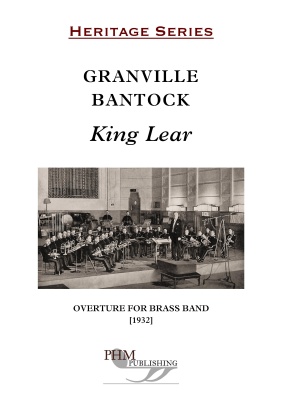
King Lear (Brass Band - Score only)
Sir Granville Bantock (1868 - 1946) composed the second of his five major brass band work for Callender's Cableworks Band, completing the commission on 30 November 1932. Based in the Thames-side district of Belvedere near Erith, the band was active between 1898 and 1961. The works band of the Callender Cable & Construction Co. Ltd, it was at the peak of its popularity during the 1930s and was a frequent broadcaster on the radio. The band employed an in-house arranger and played saxophones in its lighter material. King Lear was one of the band's major commissions and was not published in Bantock's lifetime. The manuscript score and parts were thought to be lost for decades, but were found in the library of the Haydock Band (Lancashire), which had inherited part of Callender's library of manuscripts material and bespoke arrangements after it has been transferred to nearby Prescott Cables Band after Callender's Cable Works closed.King Lear is a substantial work, in essence a dramatic tone poem in the romantic Tchaikovskian manner, presenting a series of character portraits of the foolish old king and his three daughters, Goneril, Regan and Cordelia. The music is dramatic and lyrical by turns, with the most generous lyrical episode revealing perhaps the warm-hearted Cordelia. An expansive melody that flows from this is brought back towards the end as the main climax of the work.In 2001, Bantock's score was recorded by the University of Salford Brass Band, conducted by Dr. Roy Newsome. The original is serviceable, but in comparison with the orchestral version he made in 1936 (part of which was recorded on a Paxton 78 rpm) and later brass band scores, performing editions of which were prepared by others, it lacks colour and range typical of Bantock's orchestral work. Above all it lacks percussion, which can be heard on the recorded extract. With the kind permission of the Bantock Estate, I have prepared a performing edition for publication that incorporates percussion, derived from the orchestral recording and added editorially in similar manner elsewhere. I have revoiced some of the low- lying instrumental parts to present the material in more comfortable ranges. Editorial interventions more elaborate than revoicing the original text have been identified as cue notes.- Paul HindmarshDuration: 15.00
Estimated dispatch 7-14 working days
-
 £44.95
Revelation (Score Only)
Symphony for Double Brass on a theme of Purcell 1995 marked the tercentenary of Purcell's death, and my new score Revelation has been written as a tribute to his music and the ornate and confident spirit of his age. There are five major sections: 1 Prologue 2 Variations on a ground bass I 3 Fugue 4 Variations on a ground bass II 5 Epilogue and Resurrection The score uses many features of the Baroque Concerto Grosso, and arranges players in two equal groups from which soloists emerge to play in a variety ofvirtuoso ensembles. It quotes freely from Purcell's own piece Three Parts on a Ground in which he has composed a brilliant sequence of variations over a repeating six-note bass figure. This original motif can be heard most clearly beneath the duet for Cornet 5 and Soprano at the beginning of the 2nd section. There is, of course, a religious dimension to Revelation as the title suggests, and the score is prefaced by lines by the 17th century poet John Donne. His Holy Sonnet paraphrases the Book of Revelation in which the dead are raised at the sounds of the last trumpet. Donne's trumpets are themselves placed stereophonically ". . . At the round Earth's imagined corners" and it is this feature that today's players represent as they move around the performing area. Their final apocalyptic fanfares can be heard at the close of the score, as Purcell's music re-enters in a lasting tribute to England's first composer of genius. Philip Wilby September 1995 At the round Earth imagined corners, blow your trumpets, angels, and arise, arise from death, you numberless infinities Of souls, and to your scattered bodies go. All whom the flood did, and fire shall o 'erthrow All whom war, dearth, age, agues, tyrannies, Despair, law, chance hath slain, and you whose eyes Shall Behold God, and never taste death woe. John Donne after Revelation Ch. 11 v.15
Estimated dispatch 7-14 working days
-
 £10.00
Kopanitsa
DescriptionKopanitsa was commissioned by Gavin Pritchard, who is also the work's dedicatee and gave the first performance with the Tongwynlais Temperance Band conducted by Gareth Pritchard at the Butlins Mineworkers Championship on 20 January 2008, winning the prize for best soloist as a result. He has recorded it on the CD "Enter the Galaxies" accompanied by the Cory Band conducted by Robert Childs.Gavin had requested a virtuoso showpiece featuring as many instruments as possible. The solo part is therefore written for vibraphone (bowed and struck), 10 x tuned tom toms, 5 x suspended cymbals plus hi-hat and a xylophone. The soloist's 'choreography' therefore forms an integral part of the performance. This can be seen to great effect in Gavin's performance of the work at the 2013 Brass in Concert Championship with Tredegar Band, available on the DVD of the event from World of Brass. A 'kopanitsa' is a Bulgarian folk dance that traditionally features two slow beats and two quick beats, reflected in the central 10/8 section. The music is deliberately Balkan in character, using the characteristic modes of Greek and Bulgarian folk music, and accelerates regularly to finish at breakneck speed. The tom-tom section marked 'ad lib.' after [D] can be improvised if the soloist wishes.You can follow the score in the preview video below!
Estimated dispatch 7-14 working days
-
 £38.95
Unity Series Band Journal - Numbers 518 - 521, June 2023
518: March - A Christmas cavalcade (Morgan Juel Stavik)This march contains several Christmas carols and songs. Some are easy to recognise and are identified in the score, while other references are more subtle.519: Christmas bossa nova (Kevin Larsson)Using Jingle Bells, The First Nowell, It came upon the midnight clear and Ding dong! merrily on high, here is a great bossa nova to liven up your Christmas concert.520 (1): In te Domine speravi (Des Prez trs. Zachary Docter)This piece is a transcription of an early 16th century choral work by the Renaissance composer Josquin des Prez. Josquin was a well-known and highly regarded composer in his day. Like many composer of this period, Josquin wrote linearly, valuing independent free-flowing lines over vertical harmonies. As a result, the interlocking counterpoint in this work can be quite complex and the tied rhythms challenging.520 (2): Excerpt from 'Vespers' (Rachmaninoff trs. Andrew Poirier)Sergei Rachmaninoff's setting of the All-Night Vigil (Vespers) Op.37, of which this excerpt is taken, was composed in January and February 1915. The outbreak of World War I in August 1914 took many people by surprise, and to Rachmaninoff it was a severe shock. This compelled him to write a piece that reminded him of his childhood and the importance of the Russian Orthodox Church within the national identity of Russia. The excerpt transcribed here has a quality and enigmatic charm that never fails to move the souls of those that listen to it.521: March - Walk of faith (Stanley Makau)This march introduces Stanley Makau to the band journals. Stanley is currently the Deputy and Youth Bandmaster at Quarry Road Citadel Corps in Nairobi, Kenya. His inspiration for the march primarily came from Psalm 91: 11-12, and the march is in keeping with the traditional style that has been a staple for Salvation Army music-making.
Estimated dispatch 7-14 working days
-
 £36.89
A Fugal Overture (Brass Band) Gustav Holst arr. Rob Bushnell
A Fugal Overture was written in 1922 by Gustav Holst. It was first performed at the Royal Opera House, Covent Garden on 14 May 1923 and was used as an opening work to Holst's one-act opera The Perfect Fool. It received its concert premiere on 11 October 1923 at one of Henry Wood's Queen's Hall Promenade Concerts. It is an early example of neoclassicism and was influenced by the counterpoint of J. S. Bach, despite its unconventional use of the fugal process. Holst began writing the piece in the summer of 1922, having hoped to develop it into a ballet. It is divided into three sections, the fugal subject with its distinct 3+3+2 pattern, a slower section with solos at the end, and a third section where the subject returns. Although reviews of the piece were mixed at the time of its premiere, the likes of Adrian Boult have said it was "an invigorating work that could effectively start any [...] concert". In more recent years, it has been compared to John Adam's A Short Ride in a Fast Machine. This arrangement is for the British-style brass band, with alternative parts for horns in F and bass-clef lower brass. A recording of the original composition can be found here: www.youtube.com/watch?v=a8xfwJyFq2E. Duration: Approx. 5.40 minutes Difficulty Level: 1st Section + PDF download includes parts and score. Sheet music available from www.brassband.co.uk Instrumentation: Soprano Cornet Eb Solo Cornet Bb Repiano Cornet Bb 2nd Cornet Bb 3rd Cornet Bb Flugel Horn Bb Solo Horn Eb 1st Horn Eb 2nd Horn Eb 1st Baritone Bb 2nd Baritone Bb 1st Trombone Bb 2nd Trombone Bb Bass Trombone Euphonium Bb Bass Eb Bass BbTimpani Percussion 1-2
In Stock: Estimated dispatch 1-3 working days
-
 £15.00
Toreador's March from Carmen - Bizet
Performance Notes from Andrew Duncan:The main feature of this arrangement is perhaps the wide range of dynamics used. Every dynamic from p through to ffis written and if played will, greatly enhance a performance of the piece.The distinctive style of the piece is also an important element for the players to embrace. Although the original rhythm has been simplified to facilitate ability, it has retained the intended 'feel' of the bravado style and offers a useful development of the players' musical awareness.The Flexi-Collection ApproachFlexible scoring tailored to your needs - A perfect solution for expanding the repertoire of training and junior brass bands. The Flexi-Collection currently offers two series - Popular Classics and World Tour. Based on four-part harmony, these collections provide groups with the advantage of complete flexibility when they may not be balanced. If players or instruments are missing, the show can still go on!The Flexi-Collection - Popular Classics Series, encapsulates all that is great about the wonderful range of musical styles produced by Holst, Elgar, Handel, Verdi, Tchaikovsky, Grieg, Bizet and Parry.The thoughtful scoring and arranging by Andrew Duncan now means that groups of all abilities have access to a truly flexible set of music for their needs. With world parts, rudimentary theory, terminology translations and large format typesetting, The Flexi-Collection ticks all the boxes when it comes to bringing interesting music to the training and junior band/brass group environment.Available individually or as part of the money-saving Flexi-Collection Popular ClassicsAlbum.Scored for Brass Band and supplied with additional Easy Bb, Easy Eb and world parts - The Flexi-Collection offers flexibility in every sense of the word.
In Stock: Estimated dispatch 3-5 working days
-
A Lazy Afternoon - Len Jenkins - Len Jenkins
'A Lazy Afternoon' brings to mind a lazy hot day in summer, possibly starting with a short drive out to somewhere pleasant for an afternoon's picnic. It is accepted that a drive out is now something many would choose to avoid, especially at busy weekends, but one can perhaps dream of open un-cluttered roads with no rush to get there. As such, this piece is ideal for the local summer fete. It has a gentle style that so befits an English village fete, recalling an era when things did not need to be so immediate and may thereby help to give a perfect respite from the everyday 'rush and tear'. As with many of Wobbleco's pieces, this is aimed at the average town and village band, and is within the reasonable playing capabilities of its members.
