Searching for Wind Band Music? Visit the Wind Band Music Shop
We've found 83 matches for your search. Order by

Results

  • £65.00

    Royal Fireworks, Music from the (Brass Band - Score and Parts) - Handel, George Frideric - Blakeson, Don

    Handel's Music For The Royal Fireworks was composed in 1749 to celebrate the signing of the Treaty of Aix-la-Chapelle and the end of the War of the Austrian Succession. The site chosen was the fashionable upper part of St. James Park, which was becoming known at that time as Green Park. The Green Park 'Machine', which housed the pyrotechnics was an elaborate affair adorned with "statues and other figures, festoons of flowers, and other lustres". It was announced that there would be some 10,000 rockets and other devices to be let off, all culminating in a grand, burning sun with 'Vivat Rex' at its centre. There were also rumours that the event was to be accompanied by an impressively large band of military music and mention was made of "40 trumpets, 20 french horns, 16 hautboys (oboes), 16 bassoons, 8 pairs of kettle drums, 12 side drums, a proper number of flutes and fifes; with 100 cannon to go off singly at intervals". It is unlikely that Handel had ever conceived such forces and it was merely the promoter's hyberbole, not least because it was unlikely that there were sufficient numbers of extra military musicians available that could read music, as most played from memory. It is also likely that Handel, and his publisher, were conscious that future performances would be hindered by such forces. The autographed score lists the instrumentation as 9 trumpets, 9 french horns, 24 hautboys, 12 bassoons, 3 pairs of kettle drums and up to 4 side drums. The work is in five movements, although Handel's original score did not indicate in which order they should be played. However, in this score they are arranged to be played as follows: Overture; Bour?e; La Paix; Minuets; La R?jouissance. Duration: 19:00

    Estimated dispatch 7-14 working days

     PDF View Music

  • £14.95

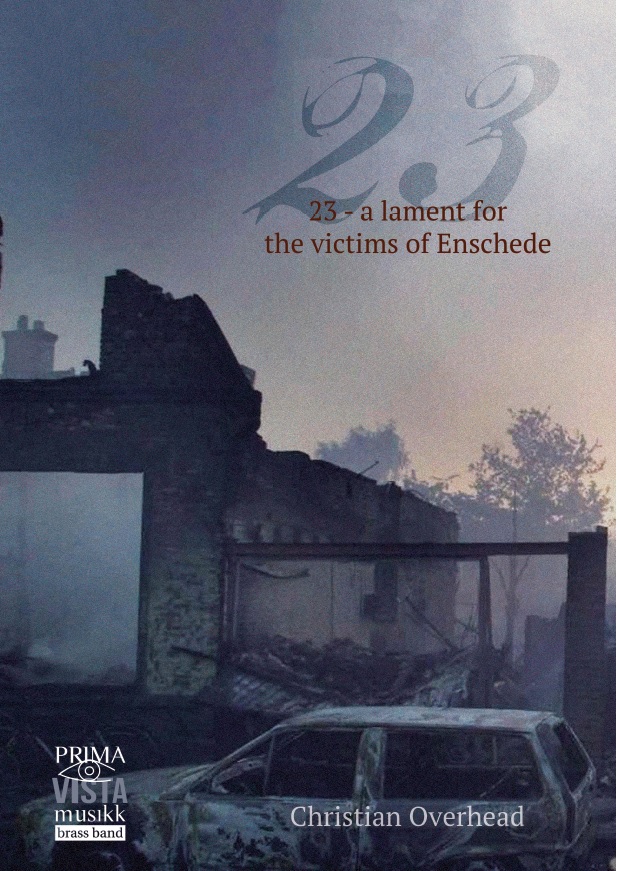
    23 - A Lament for the Victims of Enschede (Score Only)

    23 was composed for Brass Band Schoonhoven, and used as part of their programme for Brass in Concert in November 2016.On the 13 th May 2000, the Netherlands was shocked by an explosion in Roombeek - a district of Enschede, near the German border - after a fire broke out at a local fireworks depot. 23 people lost their lives in the tragic events. This piece pays tribute to their memory.The numbers 2 and 3 form the basis of the piece. The use of 5/4 allows the music to flow, alternating between 2 + 3 and 3 + 2; there are frequent passages where triplet quavers clash with straight quavers; and the tuned percussion make use of a scale composed of alternating intervals of 2 and 3 semitones.

    Estimated dispatch 7-14 working days
  • £44.50

    The Covid Collection - Gavin Somerset

    This exciting new 22-minute concert suite for Brass Sextet has been composed during the months of lockdown charting the feelings of a nation, with seven movements playable by 6 (or more) players. The music was composed with the intention for players to perform either together live in a small group, in isolation by way of a virtual performance (downloadable backing tracks are available to play along to) and ultimately, to give players something to enjoy as we all miss our brass band families. This concert suite is the perfect addition to all bands' libraries at a time when rehearsals are limited. Several of the movements are already in preparation for a full band edition to be released at a later date: (also available as a digital download worldwide - purchase now & print to play). Bands purchasing this sextet edition will be eligible for a discount on the upcoming full brass band edition of the concert suite. ------------------------------------------------------------------------------------- Movement 1: FANFARE: The Call of the Band - CLICK HERE TO DOWNLOAD PLAYBACK TRACK This opening fanfare gives way to a full of life and energy. With catchy melodies and harmonies, it is an effective opening to any concert programme and the perfect way to begin the Suite. Movement 2: March of the Antibodies - CLICK HERE TO DOWNLOAD PLAYBACK TRACK A cheeky little number that keeps on fighting though. Whilst not a March in the traditional brass band sense, players should aim to give a 'happy' performance of this movement ensuring smiles all around for both performers and the audience.Movement 3: Solidarity - CLICK HERE TO DOWNLOAD PLAYBACK TRACK The first slow movement of the concert suite aims to reflect on the isolation many of us felt during the time of lockdown. However, during these times, walks out with loved ones allowed many to connect and enjoy downtime, not often afforded to many. Movement 4: Lazy Days - CLICK HERE TO DOWNLOAD PLAYBACK TRACK A movement whose title really does say it all. A laid back swing number that should be played in an as relaxed manner, as possible!Movement 5: Hymn for Carers (Dedicated to the NHS & Care Workers) - CLICK HERE TO DOWNLOAD PLAYBACK TRACK Dedicated to the NHS & Care Workers, this hymn tune is filled with emotional highs and lows, felt by many of the hospital and care staff who worked tirelessly to keep our people safe, with a timely nod at the end to Vera Lynn & our missed VE day commemorations. Movement 6: Army of the Keyworkers - CLICK HERE TO DOWNLOAD PLAYBACK TRACK A stirring work in 12/8 which rightfully, depicts our heroes who kept the country moving through the most difficult of times. An heroic number for players to enjoy.Movement 7: CELEBRATION: Return of the Band - CLICK HERE TO DOWNLOAD PLAYBACK TRACK Little needs to be said about this movement, as at this time of release, we cannot yet celebrate the return of all players to the band rooms across the country. However, when that time comes, this movement is to be played with the joy of normality we shall all feel. CLICK HERE TO DOWNLOAD THE FULL SUITE BACKING TRACK ------------------------------------------------------------------------------------- Each movement can be performed as a standalone item, or form part of the full 22-minute concert suite. Sextet scored for: x1 Cornet I in Bbx1 Cornet 2 in Bb1x Flugelhorn1x Tenor Horn in Eb1x Euphonium/Baritone in Bb1x Eb Bass*extra parts included are, Cornet parts in Eb & C, Horn in F, Euphonium/Baritone in BC, Trombone (TC and BC), BBb Bass in TC & Tuba in BC.

    In Stock: Estimated dispatch 1-3 working days

     PDF View Music

  • £116.40

    The Phoenix - Paul Hertel

    This nice composition, commissioned by the Swiss Army Brass Band was arranged for symphonic band at Johann Mosenbichler's request. The legendary bird called 'Phoenix' rises from its ashes as a symbol of optimism and vitality. From a choral with Southeastern European characteristics develops an impressive middle part resulting in a stretto with a compelling finale. Because of its splendid brilliant sounds, this composition is appreciated by musicians of all ages.

    Estimated dispatch 5-14 working days

     PDF View Music

  • £188.50

    Fansa da Matasa - Reid Gilje

    "Fansa da Matasa" was written for Norwegian Brass Band Felleskorpset Askoy, today named Ravnanger Brass.The piece is divided into six main parts where the last one includes the hymn "Colne";Part 1 starts slowly, but rhythmically where the intensity grows towards a virtuosic Part 2.Part 2 feature a demaning solo for xylophone (bars 55 to 63). A simplified version of this solo is included in the part.Part 3 starts with some declamatory cadences and continue with several solos before it closed with a larger tutti-part.Part 4 has to be played well firmly and rhythmically. The melody is more of a cantabile style.Part 5 is a beautiful and quiet one with a touch of melancholy. (Small notes in Baritone to played if necessary).Part 6 has to be played with a rhythmic drive and intensity. The hymn "Colne" starts at bar 248 and should be played with a sostenuto-style.

    Estimated dispatch 5-14 working days
  • £60.00

    Lock Horns/Rage On - Simon Dobson

    Simon Dobson's dynamic and unusual concert march Lock Horns/Rage On was commissioned by the Leyland Band and their conductor Jason Katsikaris, and formed part of their programme for the Brass in ConcertChampionships, held at The Sage, Gateshead on 15th November 2009. Brass Band Grade 4/5: Premier Youth and 2nd Section Duration: 4 minutes

    Estimated dispatch 5-14 working days
  • £80.00

    St. Magnus - Kenneth Downie

    Dedicated to Alastair Massey, an inspirational music teacher. Commissioned by the Scottish Brass Band Association for the 2004 European Brass Band Championships in Glasgow. This music is a set of variations on the tune known as St Magnus, which is attributed to Jeremiah Clarke. Most people will associate it with Thomas Kelly's hymn which begins: "The Head that once was crowned with thorns is crowned with glory now". The tune is very simple, consisting of just two, four-bar phrases. Neither is there much in the way of rhythmic variety, every note being a crotchet with the exception of two quavers, and the last note in each phrase. Within such a simple structure, however, lies considerable strength. THEME The listener is given the opportunity of hearing it twice, in full, at the beginning, starting with one player but soon taken up by the full ensemble. It returns in the middle of the music and is stated again near the end. This has been done quite deliberately in the hope that there will be an appreciation of what material is being developed, by the listener as well as by those with access to the score, who are able to see the visual connections. VARIATION 1 This takes the rhythm of the last part of the theme and also uses the shape of the opening as a recurring figure. The mood is whimsical and skittish, with short, teasing rhythmic figures tossed around the band, and quick interplay with percussion, at a fast tempo. An energetic flourish finishes this variation before the Andante espress. VARIATION 2 This commences with chords related to the opening of Variation 1. The cantabile on solo comets establishes a new, lyrical mood and there is scope for expressive playing in a series of short solo passages. The theme works its way unobtrusively into the texture before a reprise of the solo cornet melody and some more lyrical interchanges between Eb bass, euphonium, flugel horn and comets. The variation ends serenely with clear references to the last phrase of the theme. VARIATION 3 The first idea to dominate is clearly linked to the shape of the theme's first phrase. There is a frenetic feel to much of this variation, with considerable energy and instability created by extensive use of cross-rhythms. A thinning-out of the score marks a clear change to development of the start of the second phrase of the theme. This proves to be short-lived however, and the opening material returns leading to a restatement of the theme, "Maestoso," after which a euphonium cadenza links to Variation 4. VARIATION 4 Here we have some solos for euphonium, cornet, trombone and Eb bass set against a background of horns and baritones presenting a pensive statement of the theme's opening. VARIATION 5 This commences Allegro, with lively work for cornet and euphonium spreading to the whole band before attention focuses on the beginning of the second phrase of the theme which is initially presented in diminution, then in regular rhythm, then in inversion. An increase in tempo coupled with a decrease in volume, requires dexterity and control, with several metrical challenges thrown in for good measure. The same fragment of phrase becomes an ostinato which generates a frenzied climax, punctuated by short, dramatic silence, before the opening figure returns and the music gradually winds down. The tubular bells herald the final return of the theme, in augmentation, marking the start of the Finale. FINALE This features the running semiquavers of the previous variation sounding in counterpoint. A fast, furious coda speeds the work to a conclusion while references to the opening of the theme are still trying to break into the texture of the music. Kenneth Downie

    Estimated dispatch 5-14 working days
  • £55.00

    New York. - Nigel Hess

    'New York'... or to be more precise, Manhattan. For anyone who is familiar with this bizarre and wonderful city, this piece needs no explanation. This brass band transcription has been made by Phillip Littlemore and provides adriving and punchy 4 minute work for brass band. 'New York' is the third movement of 'East Coast Pictures', originally written for wind band, commissioned in 1985 by the British Youth Wind Orchestra with funds from NationalWestminster Bank plc. These three short 'pictures' were inspired by several visits by the composer to a small part of the USA's East Coast, an area that provides great extremes in the geography and thepeople.This work has recently been recorded on the CD 'East Coast Pictures' by the Leyland Band, conducted by Michael Fowles, and is available from this site (catalogue number: 0-571-52109-6).

    Estimated dispatch 5-14 working days
  • £55.00

    The Dreaded Groove and Hook - Simon Dobson

    The Dreaded Groove and Hook is an up-tempo acid-jazz number that draws inspiration from bands like Jamiroquai and The Youngblood Brass Band. The groove in question is the main tune that is shared round theband, whilst the hook, in 'pop' terms, is the catchy bit of the song. The whole band joins in to play a huge 'riff' that acts as a chorus to the jazz-like verses. The piece was commissioned by JasonKatsikaris and The Leyland Band, who gave the first performance as part of their programme for the Brass In Concert Championships, held at The Sage, Gateshead on the 16th November 2008. It has now been recorded by the same bandandconductor on the CD entitled Penlee.Brass Band Grade 5: 1st SectionDuration: 4 minutes

    Estimated dispatch 5-14 working days
  • £102.60

    Cherubic Hymn of Ukraine - Yakiv Yatsynevych - John Philip Hannevik

    Ukraine was invaded on February 24, 2022, and the world again became spectators to a conflict between unequal opponents. Once again we saw lies, injustice and brutality up close.I must admit that a feeling of powerlessness arose when experiencing this, an empty feeling of not being able to do anything useful.One early Monday morning, a few weeks into the conflict, I sat down to listen to Ukrainian music.I hardly knew any Ukrainian music, but I was familiar with the composer Mykola Leontovych, the man who composed "Carol of the Bells". He was a member of the Ukrainian liberation movement, and he was assassinated by a Soviet agent in 1921.One of his contemporary colleagues was the composer, teacher and conductor Yakiv Yatsynevych (1869-1945). He wrote church music and choral music, and I became very taken by his Hymn to the Cherubim, a part of the Orthodox Mass.I could not find any sheet music for this. But I have listened to numerous choral recordings, and I have tried to notate the music as I believe the composer himself has done originally.I chose to do the arrangement for a solo group of 4 players. These players can be placed at a distance from the ensemble, maybe on a gallery or at the back of your concert hall.The arrangement was made for Brottum Brass for their participation in the Oslo Brass Festival in April 2022.The performance in the church this particular night was met with a long-lasting silence after the last note. The warm respect, the moving response and love we felt from the audience is a memory I will carry with me for a long time.In the lyrics to this psalm, one finds the phrase:Let us now lay aside all earthly cares- John Philip Hannevik -

    Estimated dispatch 5-14 working days

     PDF View Music