
Results
-
 £228.70
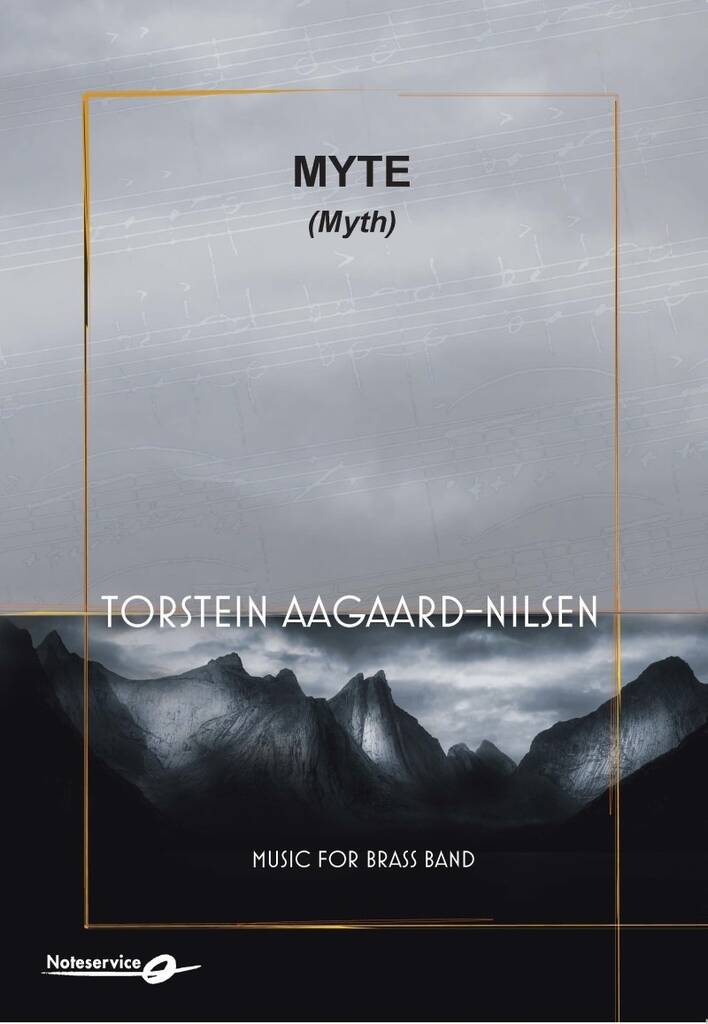
Myte - Myth - Torstein Aagaard-Nilsen
Commissioned by Radoy Brass for their 20 years anniversary.This version was first performed by Manger Skulemusikklag in 2005.The Work is devided into Five Scenes:1. Sverdet (The Sword) 3:452. Advarsel - fra en vis mann (Warning - from a Wise Man) 2:303. Dragen (The Dragon) 3:004. Advarsel II - fra syngende fugler (Warning II - from singing birds) 1:355. Gull - forbannelsen (Gold - The Curse) 2:50Total durata 13:30This work is based on five scenes from the tale about "Sigurd Favnesbane" (Sigurd the dragonslayer). Moods and atmospheres in the piece represent my way of retelling the old myth.1. The SwordThe dwarf blacksmith Regin is hammering and sharpening the edges of the magical sword Gram. After three attempts the sword is finally sharp enough to kill a dragon. 2. Warning - from a Wise manRichard Wagners opera Sigfried is based on the same story. In the opera the hero get warned by a wise man. He tells the secret of how to survive an attack of the dragon by hiding in a hole in the pathway and then kill the dragon with the sword as thedragon passes on its way to the river to drink water.3. DragonThe Dragon (Favne) guards a fantastic treasure, but he is also the brother of the blacksmith Regin. Favne get killed and his blood flows slowly while he laments (trombone/bass trombone).4. Warning II - from singing birdsWhile frying the heart, Sigurd burns his thumb and put it into his mouth to cool it down. Then he swallow a drop of fresh magic dragon blood which transfers the ability to understand the birdlanguage. The birds sing warnings to Sigurd telling himthat Regin will betray him and later kill him. Sigurd then kills Regin instead.5. Gold - the CurseSigurd takes the gold treasure and escapes on the horseback of Grane. But his robbery of the gold lead him into trouble: The gold is banned and a curse will hit everyone whotakes it...Myth is a programmatic work where the story is quite clearly illustrated throughout the piece:In the first movement you can hear the blacksmith working with hammer on ambolt while the heat is intense from the glows. The dwarf has got his own theme i lower brass (bar 4-5). The hero Sigurd has his own identifying chord (2 bars before F). Thechord is also a symbol of the sword.In the second movement the warning from the wise man is expressed in the lyric bass line.The airblow in instruments illustrate the dragon Favne on his way out of his cave, and later the blood flows slowly. The dragon takes his last deep breath after a painful duet in trombones. The birds sing their motifs (lightly, but not cheerfulthough), until Sigurd cuts the head off Regin and it hits the ground.The last movement describes the atmosphere andstate of mind as the curse infects the obsessed thief.
Estimated dispatch 5-14 working days
-
 £60.99
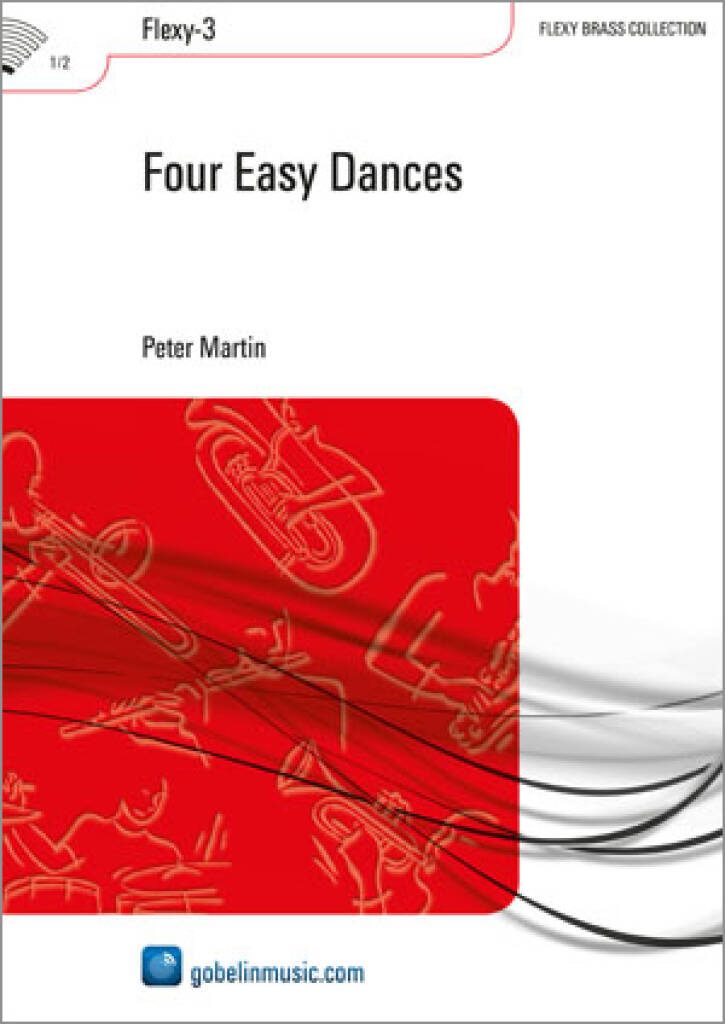
Four Easy Dances - Peter Martin
'Four Easy Dances' is a four-part suite from Gobelin's 'Flexy Band Collection'. This series is meant for starter ensembles, i.e. youth orchestras which may not have the full range of instruments available yet. Therefore, it is possible to combine various instruments. 'Four Easy Dances' comes from the 'Flexy 3 Series' and can in principle be played by only three instruments, completed with three percussion instruments. 'Four Easy Dances' consists of: 1. Hop, Skip and Jump, 2. Little Polka, 3. Spanish Dance (castanets are obligatory) and finally 4. Tango.
Estimated dispatch 5-14 working days
-
 £80.00
St. Magnus - Kenneth Downie
Dedicated to Alastair Massey, an inspirational music teacher. Commissioned by the Scottish Brass Band Association for the 2004 European Brass Band Championships in Glasgow. This music is a set of variations on the tune known as St Magnus, which is attributed to Jeremiah Clarke. Most people will associate it with Thomas Kelly's hymn which begins: "The Head that once was crowned with thorns is crowned with glory now". The tune is very simple, consisting of just two, four-bar phrases. Neither is there much in the way of rhythmic variety, every note being a crotchet with the exception of two quavers, and the last note in each phrase. Within such a simple structure, however, lies considerable strength. THEME The listener is given the opportunity of hearing it twice, in full, at the beginning, starting with one player but soon taken up by the full ensemble. It returns in the middle of the music and is stated again near the end. This has been done quite deliberately in the hope that there will be an appreciation of what material is being developed, by the listener as well as by those with access to the score, who are able to see the visual connections. VARIATION 1 This takes the rhythm of the last part of the theme and also uses the shape of the opening as a recurring figure. The mood is whimsical and skittish, with short, teasing rhythmic figures tossed around the band, and quick interplay with percussion, at a fast tempo. An energetic flourish finishes this variation before the Andante espress. VARIATION 2 This commences with chords related to the opening of Variation 1. The cantabile on solo comets establishes a new, lyrical mood and there is scope for expressive playing in a series of short solo passages. The theme works its way unobtrusively into the texture before a reprise of the solo cornet melody and some more lyrical interchanges between Eb bass, euphonium, flugel horn and comets. The variation ends serenely with clear references to the last phrase of the theme. VARIATION 3 The first idea to dominate is clearly linked to the shape of the theme's first phrase. There is a frenetic feel to much of this variation, with considerable energy and instability created by extensive use of cross-rhythms. A thinning-out of the score marks a clear change to development of the start of the second phrase of the theme. This proves to be short-lived however, and the opening material returns leading to a restatement of the theme, "Maestoso," after which a euphonium cadenza links to Variation 4. VARIATION 4 Here we have some solos for euphonium, cornet, trombone and Eb bass set against a background of horns and baritones presenting a pensive statement of the theme's opening. VARIATION 5 This commences Allegro, with lively work for cornet and euphonium spreading to the whole band before attention focuses on the beginning of the second phrase of the theme which is initially presented in diminution, then in regular rhythm, then in inversion. An increase in tempo coupled with a decrease in volume, requires dexterity and control, with several metrical challenges thrown in for good measure. The same fragment of phrase becomes an ostinato which generates a frenzied climax, punctuated by short, dramatic silence, before the opening figure returns and the music gradually winds down. The tubular bells herald the final return of the theme, in augmentation, marking the start of the Finale. FINALE This features the running semiquavers of the previous variation sounding in counterpoint. A fast, furious coda speeds the work to a conclusion while references to the opening of the theme are still trying to break into the texture of the music. Kenneth Downie
Estimated dispatch 5-14 working days
-
 £72.99
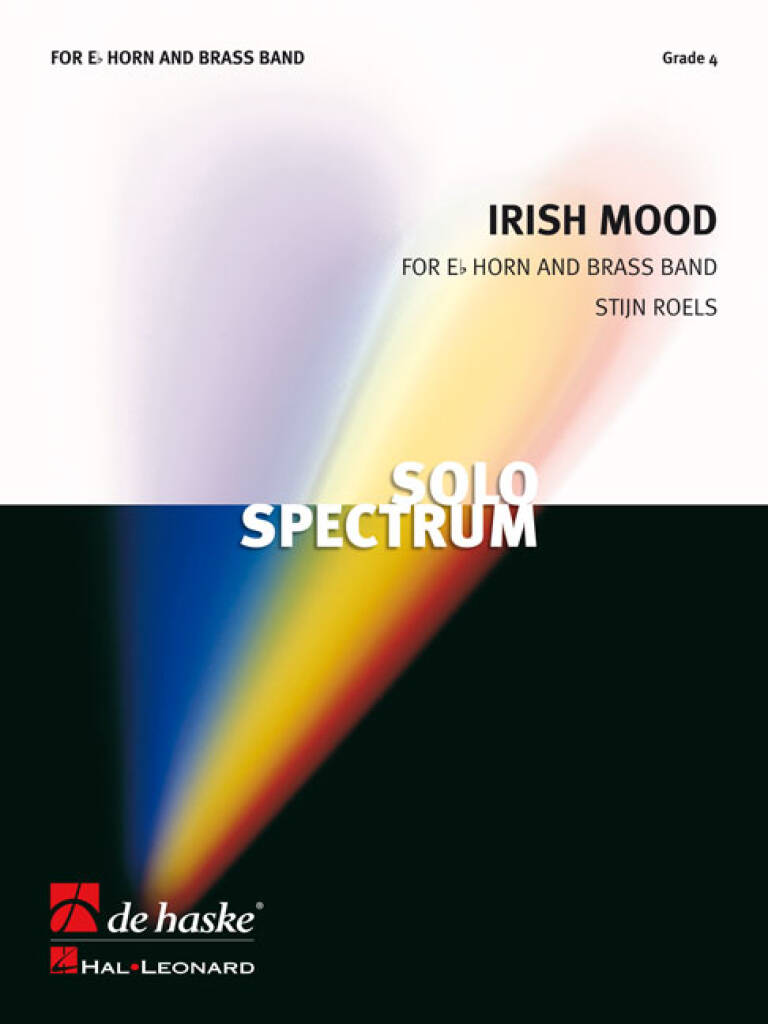
Irish Mood - Stijn Roels
Irish Mood was written in a classic 'theme and variations' construction, opening with an Irish-inspired melodic theme, which is then followed by four variations of divergent character. After the introduction of the theme by the soloist, the cornets and trombones play the main melody in Variation 1, while the soloist provides a flowing counter melody. Next comes the highly extrovert and lively Variation 2, contrasted by an introverted Variation 3 in a minor key. A masterful tutti (Variation 4) then leads the piece toward a brilliant ending.
Estimated dispatch 5-14 working days
-
 £84.99
Christmas Miniatures - Patrick Millstone
10 famous Christmas songs in different styles. Including: 1. Intrada - Bohemian traditional 2. Quem Pastores Laudavere 3. Once in Royal David's City 4. Song - French traditional 5. Er is een Kindeke geboren op aard' - Dutch traditional 6. Coventry Carol 7. Deck the Halls 8. O, Kindeke klein 9. Good King Wenceslas 10. Traditional from Poland
Estimated dispatch 5-14 working days
-
 £76.99
Bread and Games - William Vean
'Panem et Circenses', Bread and Games were essential for keeping the citizens of ancient Rome in check. While the bread was meant for the poorest among the Romans, the Games were Popular Pastime Number One for everybody.There were different kinds of games, such as chariot races (especially popular with female spectators), or wild-beast fights, where lions, tigers, bulls or bears were set on one another or even on human beings. Most popular, however, were the Gladiator fights. In 'Bread and Games' William Vean depicts one of the many fights in the antique Colosseum. 1. Entrance of the Gladiators: By powerful bugle-calls the attention of the peoplewas asked for, after which the Gladiators entered the Arena at the sound of heroic marching-music.2.Swordfight: We can hear that the fights were not mere child's play in this part.On the contrary, they were a matter of life and death and were fought accordingly.3.Mercy of the Emperor: Sometimes a wounded gladiator could be fortunate, depending on the mercy of the audience. Waving one's handkerchief meant mercy, a turned-down thumb meant no pardon. The Emperor had the right to take the final decision, but he usually complied with the wish of the majority of the public. 4.Lap of Honour: Gladiators were mainly selected among slaves, convicted criminals, or prisoners of war. Consequently, winning was very important, as it would mean fame, honour and sometimes even wealth. A lap of honour, therefore, was the winner's due reward.
Estimated dispatch 5-14 working days
-
£84.99
Creamy and Crispy - Marc Cunningham
This composition of Marc Cunningham has four parts, and takes place on a sunny day in a picturesque town. 1. Promenade Many people walk through the city. The band passes through the streets. People are strolling along the avenues and amorous couples are sitting on a park bench. 2. Lovey Dovey One of these couples is knee-deep in love. 3. Crispy and Creamy Here the contrasts between a crisp staccato section in two-four time signature and a smooth legato section in three-four time signature are depicted. Is Crispy the boy and Creamy the girl? 4. Farewell In the last particle the couple says goodbye. We still think back tothe walk through the city. It sounds a little less happy now. Not everyone is good at saying goodbye, sometimes a tear flows.
Estimated dispatch 5-14 working days
-
 £104.99
4Evers - Harm Evers
Bundle of 4 Marches written by the 'King of Marches' Harm Evers. 1. In Festive Mood 2. Parade of Sails 3.Times Square4. Pioneers March
Estimated dispatch 5-14 working days
-
£104.99
Theme Park Fun! - Wilco Moerman
In Theme Park Fun! your orchestra pays a visit to an amusement park. During your visit, you will experience some spectacular rides and attractions this theme park offers. The uniqueness of Theme Park Fun! is the interplay between music and(moving) images. Animations and illustrations support the visual composition (downloadable after ordering a set, on www.gobelinmusic.com).Part 1: The Entrance & Parade [with animation]The opening of the park is a fact. A day fullof fun and pleasure awaits! You and the other visitors will be confronted with all the rides, attractions and adventures the theme park has to offer. Which ride shall we do first?! There is so much to do and experience on this day in the park! Aparade of colorful floats and park figures is passing by.Let the fun begin!Part 2: The Haunted House [with animation]The only ride in the park that is not related to fun, is the Haunted House. Here visitors will be challengedto visit a house full of ghosts, creepy figures and other ominous things. The clock strikes twelve, there is no turning back. Ghosts are whispering, yelling, screaming... Fortunately it is almost one oclock, so we can leave this creepy placequickly.Part 3: The Swinging Galleon [with illustrations]What a huge pirate ship! Each time you swing back and forth, you will feel that weird feeling in your stomach. When you are thrown completely into the top you will have afantastic view over the park, but you can not enjoy it for long. Before you know the ship swings back the other way.Part 4: The Fairy Tale Ride [with illustrations]After all those exciting and spectacular rides and attractions,it is time for a peaceful tour in The Fairy Tale Ride. Surrounded by a fairytale setting, you will discover fable figures, talking animals and colorful designs. Such a beauty and tranquility. Having had this experience, we are ready again for thebig rides in the park!Part 5: The Bumper Cars [with illustrations]Now its time to crawl behind the wheel of the Bumper Cars! Shall we all chase the conductor?! Before you know you are hit by another visitor or you will bumpagainst someone else. In this tough ride you can prove yourself as a real driver, or perhaps as a really bad one.Part 6: The Roller Coaster [with illustrations]The largest, fastest and scariest ride in the park ... we shoulddefinitely do the Roller Coaster! All together in the train, the over-the-shoulder restraints are lowering... be ready to ride. The train leaves the station and is heading for the big lift hill. It will be very scary when the train reaches the topand the train will be plunged down the first drop! Loops, corkscrews and other spectacular coaster elements will follow... Before you know it, the ride of your life is over. Shall we ride it again?!Part 7: Leaving the Park [withanimation]Unfortunately everything comes to an end. This day in the theme park is over, but we have a lot new experiences to talk about! The memories of all the funny and spectacular rides will come up when we walk through the park to theexit. Just one look over the shoulder, the amusement park figures are waving at us. Hopefully we will come back again soon!
Estimated dispatch 5-14 working days
-
£188.50
Fansa da Matasa - Reid Gilje
"Fansa da Matasa" was written for Norwegian Brass Band Felleskorpset Askoy, today named Ravnanger Brass.The piece is divided into six main parts where the last one includes the hymn "Colne";Part 1 starts slowly, but rhythmically where the intensity grows towards a virtuosic Part 2.Part 2 feature a demaning solo for xylophone (bars 55 to 63). A simplified version of this solo is included in the part.Part 3 starts with some declamatory cadences and continue with several solos before it closed with a larger tutti-part.Part 4 has to be played well firmly and rhythmically. The melody is more of a cantabile style.Part 5 is a beautiful and quiet one with a touch of melancholy. (Small notes in Baritone to played if necessary).Part 6 has to be played with a rhythmic drive and intensity. The hymn "Colne" starts at bar 248 and should be played with a sostenuto-style.
Estimated dispatch 5-14 working days
 View Music