
Results
-
 £30.00
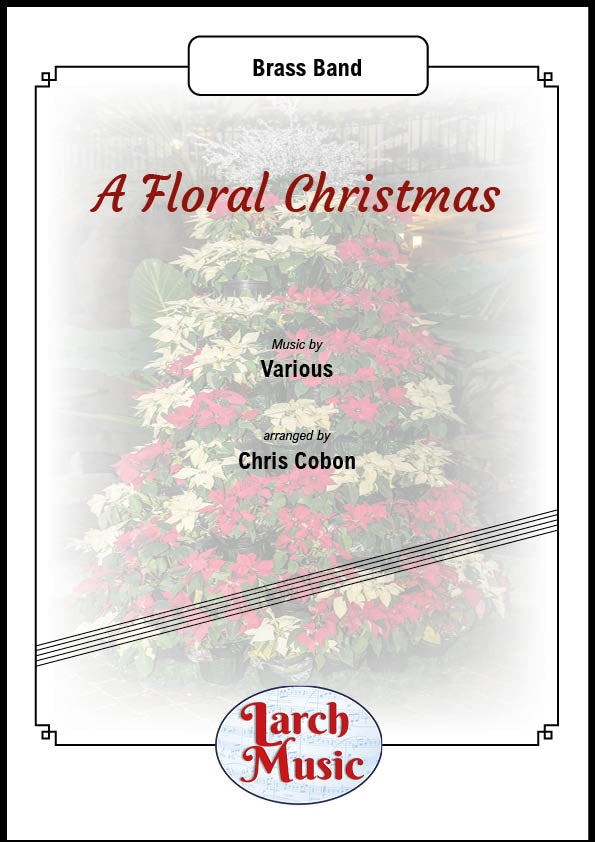
A Floral Christmas - Brass Band Sheet Music Full Score & Parts - LM264
COMPOSER: VariousARRANGER: Chris CobonISMN : 9790570002641A superb new collection of Christmas carols carefully crafted into a medley, with a hint of the Katy Moss classic "Floral Dance", ready for your Christmas concerts.Christmas Carols include :The Holly & The IvyJingle BellsHark!, The Herald Angels SingThe Twelve Days of ChristmasIt Came Upon A Midnight ClearDeck The HallsCarol of The BellsAway In A MangerSilent NightFloral DanceO Holy NightO Come, O Come EmmanuelThe Twelve Days of ChristmasJoy To The WorldO Come, All Ye FaithfulThe Twelve Days of ChristmasLM264 - ISMN : 9790570002641
In Stock: Estimated dispatch 3-5 working days
-
 £30.00
Barking Mad - Jock McKenzie
The New Orleans Brass Band sound is now something that is heard and seen throughout the world. Originally repertoire was played to serve civic & church duties and was often spiritual in content mixed with more than a hint of jazz. These days, almost 'anything goes' with music arranged and composed for the idiom. Despite this, many 'staple' musical characteristics prevail - a hint of the blues in melody & harmony and a funky, swinging rhythmic drive for both dancing and marching. Barking Mad uses these ingredients to present a brassy, shackles off, in-yer-face musical number.
-
 £30.00
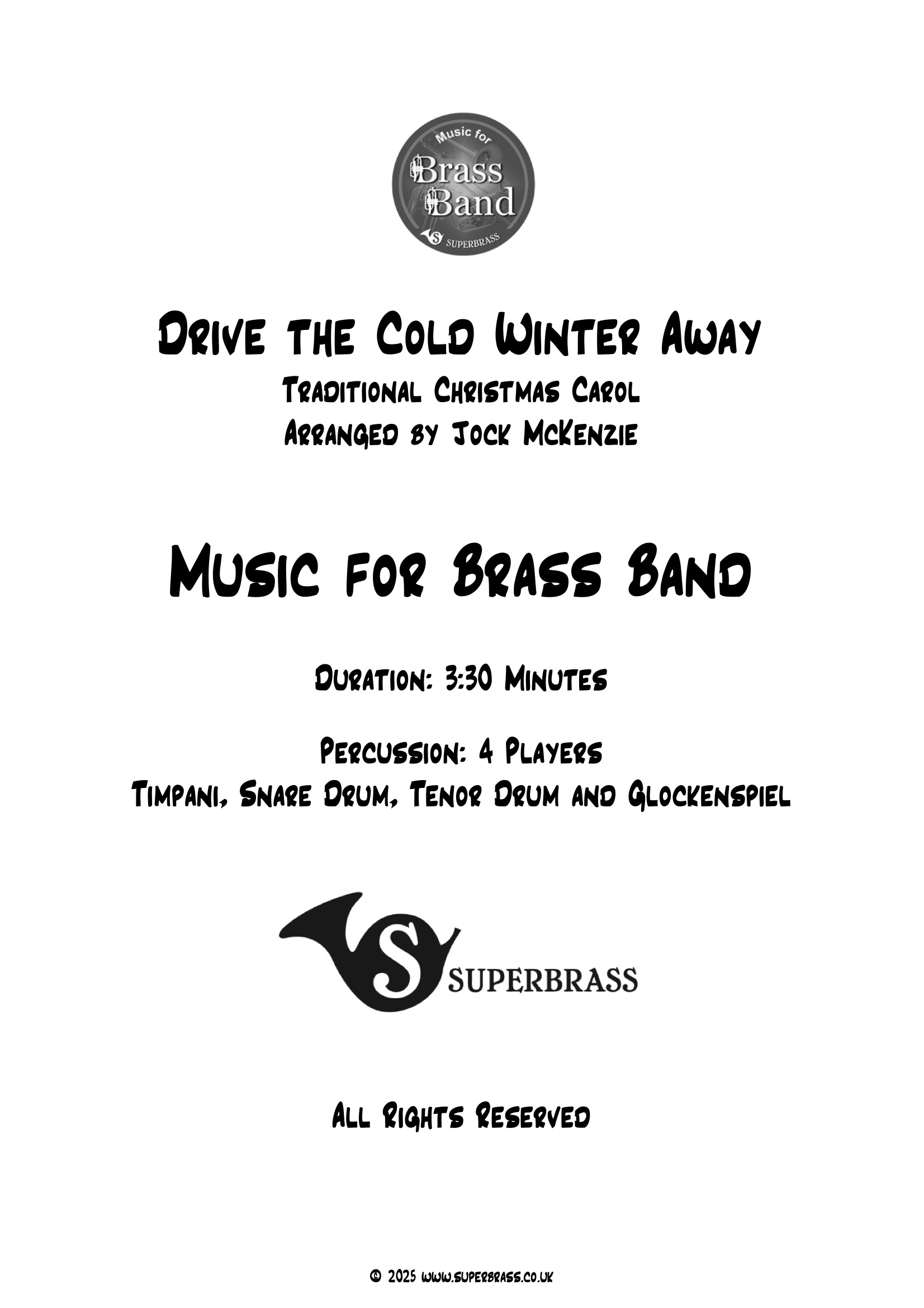
Drive the Cold Winter Away - Traditional
This carol first appeared in print in the early seventeenth century, being found in various notable collections; Playford's "The English Dancing Master", the "Samuel Pepys Collection" and the "Roxburghe Collection". Whilst the music is thought to have come from an earlier era the dance tune ("When Phoebus Did Rest"), the words were first printed as a broadside c.1625. As a carol, the lyrics discuss various seasonal festivities during 'Christmastide'. Alternative titles for the same carol include "In Praise of Christmas" and "All Hail to the Days".
-
 £30.00
Inchcolm - Terry Johns
The island of Inchcolm was visited by St Columba in 567 and is mentioned in Shakespeare's Macbeth. It lies on the stretch of water beyond my balcony, known locally as "Mortimer's deep", and on short winter days, the ruins of Columba's abbey are shrouded in the mists of the estuary and bring a flavour of mystery and legend to my morning coffee. Music comes easily here amidst the crying of the seabirds, and the horn has given its distinctive voice to history, myth and folklore for centuries. Its sound was born in the wide-open spaces and can paint a broad seascape with ease.
-
 £30.00
Buffoon . . . - Lucy Pankhurst
We all need a little buffoonery at times, and this enjoyable creation from Lucy Pankhurst completely hits the mark with its melody being so 'buffoon-like' in its movement and harmonies.Reminiscent of circus-style music, the piece is thinly scored to start and then gradually develops gentle variations of the melody. These are shared throughout the band until a peak of harmonies and tempo leads to a settled return to a more reflective ending.An imaginative development of a simple tune which makes for a versatile light concert item ... it's also likely that the main melody will stay in your mind days after hearing it!
In Stock: Estimated dispatch 3-5 working days
-
 £30.00
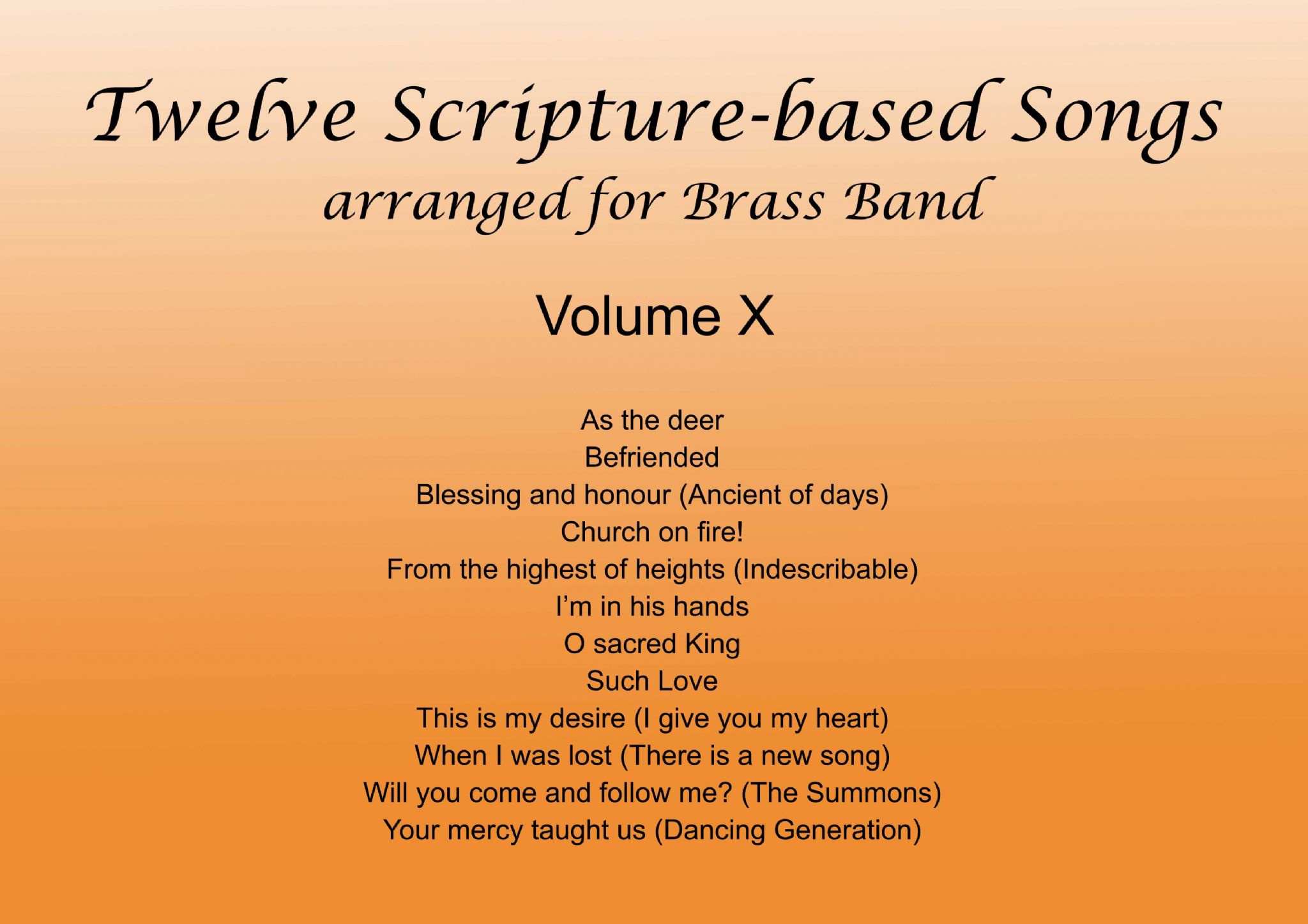
Twelve Scripture-Based Songs Volume X
Twelve scripture-Based Songs arranged for Brass Band (Volume X) are packaged and marketed in complete sets which include a full score and a set of master parts. It is intended that these parts be used as 'masters', for the purpose of photocopying a quantity of parts to accommodate the precise instrumentation needs of the band for which this has been purchased.As the deerBefriendedBlessing and honour (Ancient of days)Church on fire!From the highest of heights (Indescribable)I'm in his handsO sacred KingSuch LoveThis is my desire (I give you my heart)When I was lost (There is a new song)Will you come and follow me? (The Summons)Your mercy taught us (Dancing Generation)
Estimated dispatch 7-14 working days
-
 £30.00
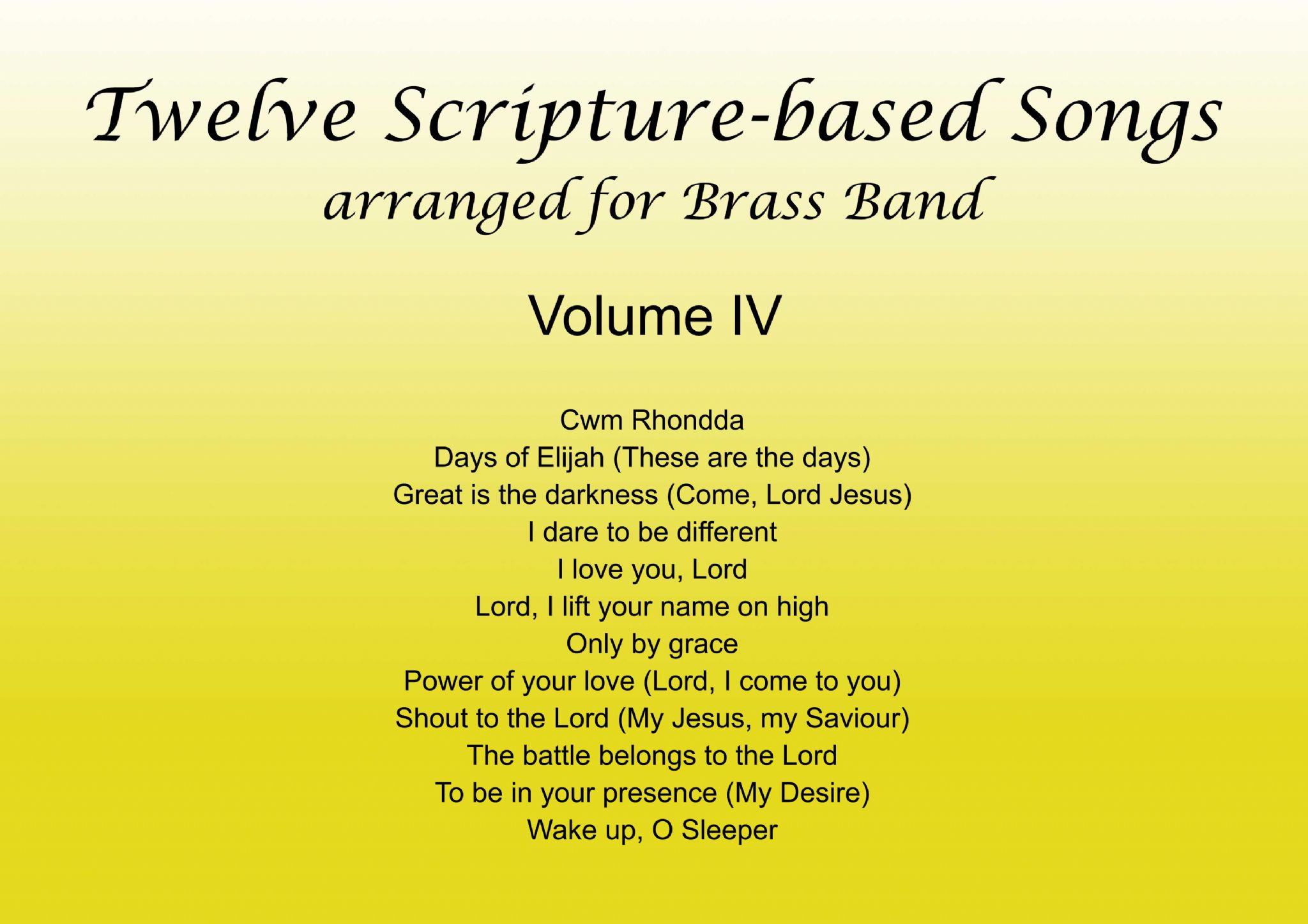
Twelve Scripture-Based Songs Volume IV
Twelve scripture-Based Songs arranged for Brass Band (Volume IV) are packaged and marketed in complete sets which include a full score and a set of master parts. It is intended that these parts be used as 'masters', for the purpose of photocopying a quantity of parts to accommodate the precise instrumentation needs of the band for which this has been purchased.Cwm RhonddaDays of Elijah (These are the days)Great is the darkness (Come, Lord Jesus)I dare to be differentI love you, LordLord, I lift your name on highOnly by gracePower of your love (Lord, I come to you)Shout to the Lord (My Jesus, my Saviour)The battle belongs to the LordTo be in your presence (My Desire)Wake up, O Sleeper
Estimated dispatch 7-14 working days
-
 £10.00
Endurance
DescriptionMen wanted for hazardous journey. Small wages, bitter cold, long months of complete darkness, constant danger, safe return doubtful. Honour and recognition in case of success. - Ernest Shackleton, 4 Burlington StreetEndurance takes its title from the ship used by Sir Ernest Shackleton's Imperial Trans-Antarctic Expedition in 1914-15. After many months of fundraising (and reputedly running the above advert in The Times) the Endurance set sail from Plymouth on 6 August 1914. Whilst at sea news of the outbreak of war led Shackleton to put his ship and crew at the disposal of the Admiralty, but their services were not required and they were encouraged to continue. On October 26 1914 they left Grytviken on South Georgia for the Antarctic continent, hoping to find the pack ice shrinking in the Antarctic spring. Two days later, however, they encountered unseasonable ice which slowed their progress considerably. On 15 January 1915, when Endurance was only 200 miles from her intended landfall at Vahsel Bay, the ship became beset by ice which had been compressed against the land to the south by gale force winds. Trapped in the ice of the Weddell Sea, the ship spent the Antarctic winter driven by the weather further from her intended destination until, on 21 November 1915 Endurance broke up forcing the crew to abandon ship and set up camp on the ice at a site they named "Patience Camp".The crew spent several weeks on the ice. As the southern spring started to reduce the extent of the ice shelf they took to their three lifeboats, sailing across the open ocean to reach the desolate and uninhabited Elephant Island. There they used two of the boats to build a makeshift shelter while Shackleton and five others took the largest boat, an open lifeboat named the 'James Caird' and sailed it for 800 terrifyingly dangerous miles across the vast and lonely Southern Atlantic to South Georgia - a journey now widely regarded as one of the greatest and most heroic small-boat journeys ever undertaken. After landing on the wrong side of the island and having to climb over a mountain range in the dark with no map, Shackleton and his companions finally stumbled back into the Grytviken whaling station on 19 May 1916.After resting very briefly to recover his strength, Shackleton then began a relentless campaign to beg or borrow a ship to rescue the rest of his crew from Elephant Island; whaling ships were not strong enough to enter polar ice, but on 30 August 1916, over two years after their departure from Plymouth, Shackleton finally returned to Elephant Island aboard a steam tug borrowed from the Chilean government. Although some were in poor health, every member of the Endurance crew was rescued and returned home alive.Endurance is dedicated to the memory of my mum, who passed away in September 2017.Listen to a computer generated preview and follow the score below:
Estimated dispatch 7-14 working days
-
 £94.99
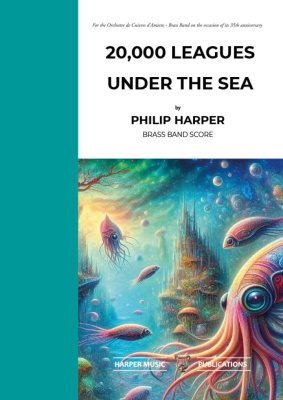
20,000 Leagues Under the Sea (Brass Band - Score and Parts)
Frenchman Jules Verne was a pioneer in science fiction during the late 19th Century, penning some classic stories such as Journey to the Centre of the Earth and Around the World in 80 Days - both of which have already been the subject of brass band test-pieces. It was therefore natural for me to choose Verne's 1869 watery magnum opus as the subject for this piece to which there are five sections, as well as an introduction and a finale.THE NAUTILUS. After a mysterious introduction we are introduced to The Nautilus - a fantastical submarine.THE CORAL KINGDOM. We visit awe-inspiring underwater coral formations.SQUID ATTACK. The Nautilus is attacked by a school of giant squid, or 'devilfish'.CAPTAIN NEMO. Captain Nemo is a loner and an eccentric. Some say he is a madman. Soloists of the band help to uncover the character of this enigmatic but powerful figure.MAELSTROM. The Nautilus is dragged into the ocean's deadliest whirlpool but Captain Nemo lives to fight another day.Duration: 12.30
Estimated dispatch 7-14 working days
-
£43.99
20,000 Leagues Under the Sea (Brass Band - Score only)
Frenchman Jules Verne was a pioneer in science fiction during the late 19th Century, penning some classic stories such as Journey to the Centre of the Earth and Around the World in 80 Days - both of which have already been the subject of brass band test-pieces. It was therefore natural for me to choose Verne's 1869 watery magnum opus as the subject for this piece to which there are five sections, as well as an introduction and a finale.THE NAUTILUS. After a mysterious introduction we are introduced to The Nautilus - a fantastical submarine.THE CORAL KINGDOM. We visit awe-inspiring underwater coral formations.SQUID ATTACK. The Nautilus is attacked by a school of giant squid, or 'devilfish'.CAPTAIN NEMO. Captain Nemo is a loner and an eccentric. Some say he is a madman. Soloists of the band help to uncover the character of this enigmatic but powerful figure.MAELSTROM. The Nautilus is dragged into the ocean's deadliest whirlpool but Captain Nemo lives to fight another day.Duration: 12.30
Estimated dispatch 7-14 working days
