
Results
-
 £34.22
Je te veux (Brass Band) Satie arr. Rob Bushnell
Je te veux, or I Want You, is a valse chantee (sung waltz) by the French composer Erik Satie, with lyrics by Henry Pacory. It was written for Paulette Darty, who first sang it in 1903 at La Scala, Paris, with Satie accompanying. There are various versions that Satie produced, the original for piano and voice, a version for brass 'orchestra', for full orchestra (where a trio section was added), and a version for solo piano (but including the new trio section).This arrangement is for the UK-style brass band, with alternative parts for horns in F and bass-clef lower brass, and is of the longer version (with the trio section). As a result, it lends itself to being performed in a various of ways, with the ensemble has the option of selecting the part of it compound ternary form to play: (A-B-A)(C-D-C)(A-B-A).A recording of the original composition can be found here: www.youtube.com/watch?v=FA3JJdmwJU8Difficulty Level: 4th Section +Duration: 4 or 5 minutes (depending on tempo and without any cuts)PDF download includes parts and score.Sheet music available at www.brassband.co.uk (UK) or https://satradecentral.org (USA)Instrumentation:Soprano Cornet EbSolo Cornet BbRepiano Cornet Bb2nd Cornet Bb3rd Cornet BbFlugel Horn BbSolo Horn Eb1st Horn Eb2nd Horn Eb1st Baritone Bb2nd Baritone Bb1st Trombone Bb2nd Trombone BbBass TromboneEuphonium BbBass EbBass BbTimpaniDrum KitAuxiliary Percussion (Glockenspiel, Cymbal & Triangle)
In Stock: Estimated dispatch 1-3 working days
-
 £68.45
Metamorphosis on 'Finlandia' (Brass Band) Andrew Wainwright
This major work was commissioned by Five Lakes Silver Band and its Musical Director Christopher Ward in February 2024, and is featured on the band's CD Resurget Cineribus. The music is based on the hymn tune by Katharina von Schlegel, Be Still, My Soul, found in Sibelius' famous tone poem Finlandia (Op. 26). While the only source material used in Metamorphosis on 'Finlandia' is the hymn itself as opposed to any of the developmental music found in the tone poem, it does also seek to depict the strife of the Finnish people against the censorship of the Russian Empire. It is therefore both rousing and turbulent at various times.Metamorphosis on 'Finlandia' commences with a quartet playing a full statement of the hymn in its simplest form, featuring a solo flugel. This leads into a sprightly 6/8 section where a fanfare-like figure proclaims the theme. The music in this section is at times unstable and off-kilter as references to the hymn come and go, often in a very chromatic or dissonant form - a reflection of the struggles that the Finnish people went through. Despite this, there is still a sense of optimism.A somewhat reflective slower section follows, featuring another full rendition of the hymn, with a number of solo voices taking up the tune. This is followed by several cadenzas - for cornet, trombone, E bass, and B bass, which represent different voices speaking out against the oppression of the Finnish people. This leads into an energetic final movement before a resounding proclamation of the hymn in its full glory. A return to the fanfare heard earlier in the work brings the piece to a glorious conclusion.To listen to a recording of Five Lakes Silver Band performing the work please visit www.youtube.com/watch?v=GeJJF6asD2kDuration: Approx. 13.15 minutesDifficulty Level: 1st Section +PDF download includes parts and score.Sheet music available here (UK) or https://satradecentral.org (USA)Instrumentation:Soprano Cornet EbSolo Cornet BbRepiano Cornet Bb2nd Cornet Bb3rd Cornet BbFlugel Horn BbSolo Horn Eb1st Horn Eb2nd Horn Eb1st Baritone Bb2nd Baritone Bb1st Trombone Bb2nd Trombone BbBass TromboneEuphonium BbBass EbBass BbTimpaniPercussion 1-3
In Stock: Estimated dispatch 1-3 working days
-
 £76.06
Gothique Fantasy - On a theme by Boellmann (Brass Band) Andrew Wainwright
This magnificent work was commissioned by The Illinois Brass Band for the 2024 North American Brass Band Championships. It is also the title track of the 2026 CD by Black Dyke Band, featuring the music of Andrew Wainwright.Based on Leon Boellmann's epic organ work Suite Gothique, the 3rd movement of which is entitled Priere a Notre-Dame (A Prayer for Notre Dame), it pays tribute to the nearly 700-year-old Notre-Dame de Paris after the fire which did so much damage to this iconic building.Notre-Dame stands out for its three pipe organs (one historic) and its immense church bells, which are referenced at various times in Gothique Fantasy. Two of the other movements from Boellmann's work also provide inspiration for the piece, firstly the Introduction - Choral, and the famous Toccata, snippets of which appear at various times in the piece.Gothique Fantasy opens with the Choral, a solo offstage cornet sounding the opening statement. A quintet, stood to the side of the stage, takes up the Choral, while the rest of the band enters on held muted notes, creating a sustained effect evoking the harmonies spreading across the vast cathedral. Colossal organ-like sounds announce themselves as the full band takes on the theme.A lively Animato follows. Here there are continued references to the Choral, while the famous Toccata motif starts to appear.A Misterioso section ensues, which leads into a poignant Prayer for Notre Dame featuring a euphonium duet, where the music reflects upon the devasting fire and centuries of history and artefacts that were lost. A lone euphonium the sounds, representing the remaining remnants of the cathedral.A chaotic and rhythmic Presto, based on the Toccata, then follows and tests the technique of the band from top to bottom, whilst moving through various time signatures, the pulse lacking any sense of stability. A return to the Choral theme leads into a further reflective section, this time featuring the secondary theme from the Toccata with a flugel and solo horn duet.Next the music arrives at an aleatory section (Senza Misura), which depicts the remnants of the fire, followed by the grand cathedral emerging out of the ashes. Various motifs from earlier in the piece are heard across the band. At this point, various parts enter at different times on the conductor's signal, before building towards a 6/8 Presto. Here the music gathers momentum as it leads to a Grandioso finale featuring the Choral in all its glory. However, to conclude the work, the final strains of the Toccata sound, bringing the work to a glorious conclusion as Notre-Dame rises again!To view a video of The Illinois Brass Band performing the work please visit www.youtube.com/watch?v=xG3JB6Ye5aUDuration: 15.00 minutes approx.Difficulty Level: Championship SectionThis PDF download includes parts and score.Sheet music available from www.brassband.co.ukInstrumentation:Soprano Cornet EbSolo Cornet BbRepiano Cornet Bb2nd Cornet Bb3rd Cornet BbFlugel Horn BbSolo Horn Eb1st Horn Eb2nd Horn Eb1st Baritone Bb2nd Baritone Bb1st Trombone Bb2nd Trombone BbBass TromboneEuphonium BbBass EbBass BbPercussion 1-4
In Stock: Estimated dispatch 1-3 working days
-
 £38.03
Fallen Souls (Brass Band) Andrew Wainwright
Fallen Souls was the winner of Grimethorpe Colliery Band's 1st Annual Composition Competition in 2023. This depictive and impactful work explores the theme of human fallibility. The piece begins with a slow, yearnful introduction that depicts a fall from grace, represented by a horn solo that reflects the innate goodness of humanity. However, the music soon becomes more agitated and dissonant as it represents the temptations that can lead us astray. The opening reaches a climax of chaos and despair, as we are shown the devastating consequences of our choices.The following section depicts the temptations of humanity. The music is chaotic and seductive in this section, with regular time changes and rhythmic instability, representing the many temptations that surround us. The section ends with a sense of uncertainty, as we are left wondering whether we will succumb to these temptations.There is a reprise of the opening horn solo, and a return to the notion of human fallibility, but this time in extended form. Again there is a build toward chaos, and the music becomes more complex and textured, reflecting the complexity of the human journey. The work ends somewhat abruptly with a blaze, leaving the listener with a sense of both hope and uncertainty.To view a rolling score video featuring Grimethorpe Colliery Band please visit www.youtube.com/watch?v=rM-p8CjnYo0Duration: 5.00 minutes approx.Difficulty Level: 1st Section +PDF download includes parts and score.Sheet music available from www.brassband.co.uk/sheet-music/fallen-souls-brass-band-andrew-wainwright-brookwrightInstrumentation:Soprano Cornet EbSolo Cornet BbRepiano Cornet Bb2nd Cornet Bb3rd Cornet BbFlugel Horn BbSolo Horn Eb1st Horn Eb2nd Horn Eb1st Baritone Bb2nd Baritone Bb1st Trombone Bb2nd Trombone BbBass TromboneEuphonium BbBass EbBass BbTimpaniPercussion 1-3
In Stock: Estimated dispatch 1-3 working days
-
 £41.83
A Carol Rhapsody (Brass Band) Geoffrey Nobes
Capture the mystery, wonder, and joy of the festive season with A Carol Rhapsody (Geoffrey Nobes). This dynamic and brilliantly orchestrated medley weaves together a selection of much-loved Christmas carols, balancing timeless audience favorites with beautiful, lesser-known melodies. Perfect as a centerpiece or finale for your festive concert, this rhapsody provides an engaging musical journey that highlights the full tonal palette of your band.Thoughtfully scored with accessible range demands, standard time signatures, and comfortable keys, A Carol Rhapsody is exceptionally approachable. It serves as an ideal performance piece for 4th Section bands and above, as well as Youth and Training Bands looking for a rich, full-sounding festive work. Higher-section bands will also appreciate its quick rehearsal turn-around during a busy Christmas season.The Musical JourneyAtmospheric Opening: The piece begins with an evocative introduction, featuring subtle echoes of Coventry Carol and Hark, the Herald Angels Sing.Rhythmic & Bright: The tempo shifts into a lively rendition of the old French folk carol O Leave Your Sheep, cleverly interwoven with motifs from Joy to the World and the sweeping refrain of Angels from the Realms of Glory.A Lush, Lyrical Heart: The centerpiece of the work is an extended, beautifully textured setting of another French folk carol, Whence Is That Goodly Fragrance. This section serves as a wonderful showcase, passing the melody throughout various sections of the ensemble in turn.Triumphant Finale: The pacing accelerates into a joyful romp through the traditional English carol I Saw Three Ships Come Sailing in. Excitement builds through a series of key changes, weaving several themes together before culminating in a triumphant Glory to the New-born King - complete with the ringing bells of Ding, Dong! Merrily on High echoing across the band.To view a rolling score video of this piece please visit www.youtube.com/watch?v=hYehd0CGaA8Duration: approx. 6.30 minutesDifficulty Level: 4th Section +This PDF download includes the full score and parts.Sheet music available at www.brassband.co.uk (UK) or https://satradecentral.org (USA)Instrumentation:Soprano Cornet EbSolo Cornet Bb1st Cornet Bb2nd Cornet BbFlugel Horn BbSolo Horn Eb1st Horn Eb2nd Horn Eb1st Baritone Bb2nd Baritone Bb1st Trombone Bb2nd Trombone BbBass TromboneEuphonium BbBass EbBass BbPercussion 1-3
In Stock: Estimated dispatch 1-3 working days
-
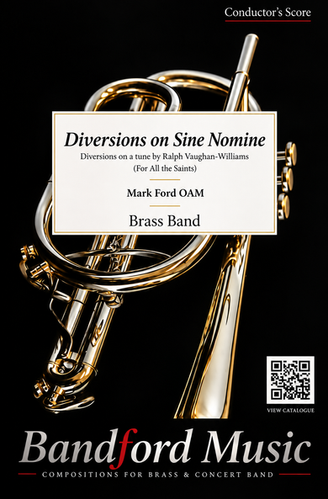 £60.85
Diversions on Sine Nomine (Brass Band) Vaughan Williams arr. Mark Ford
Diversions on Sine Nomine is a substantial concert work for brass band, derived entirely from Ralph Vaughan Williams' celebrated hymn tune For All the Saints. Rather than a conventional set of variations, the work unfolds as a sequence of contrasting diversions, each reimagining aspects of the melody's character, harmony, and rhythmic potential.The opening establishes the noble and timeless quality of Sine Nomine before leading into episodes that explore a wide expressive range - from reflective and lyrical writing to passages of rhythmic energy and grandeur. Fragments of the hymn are continually transformed and re-contextualised, allowing the music to progress with clarity and purpose while maintaining a strong sense of structural coherence.Scored specifically with 3rd and 4th Section bands in mind, the work combines musical substance with practical playability. Idiomatic brass writing, transparent textures, and effective use of traditional band colours ensure musical impact without excessive technical demand. The final section brings the work to a broad and affirmative conclusion, reaffirming the dignity and enduring strength of Vaughan Williams' original melody.To view a rolling score video of the work please visit www.youtube.com/watch?v=Sth69ate-CsDuration: 11.00 minutesDifficulty Level: 4th Section +This PDF download includes the full score and parts.Sheet music available at www.brassband.co.uk (UK) or https://satradecentral.org(USA)Instrumentation:Soprano Cornet EbSolo Cornet 1&2 BbSolo Cornet 3&4 BbRepiano Cornet Bb2nd Cornet Bb3rd Cornet BbFlugel Horn BbSolo Horn Eb1st Horn Eb2nd Horn Eb1st Baritone Bb2nd Baritone Bb1st Trombone Bb2nd Trombone BbBass TromboneEuphonium BbBass EbBass BbTimpaniPercussion 1-2Tuned Percussion
In Stock: Estimated dispatch 1-3 working days
-
 £38.03
A Fugal Overture (Brass Band) Gustav Holst arr. Rob Bushnell
A Fugal Overture was written in 1922 by Gustav Holst. It was first performed at the Royal Opera House, Covent Garden on 14 May 1923 and was used as an opening work to Holst's one-act opera The Perfect Fool. It received its concert premiere on 11 October 1923 at one of Henry Wood's Queen's Hall Promenade Concerts. It is an early example of neoclassicism and was influenced by the counterpoint of J. S. Bach, despite its unconventional use of the fugal process.Holst began writing the piece in the summer of 1922, having hoped to develop it into a ballet. It is divided into three sections, the fugal subject with its distinct 3+3+2 pattern, a slower section with solos at the end, and a third section where the subject returns.Although reviews of the piece were mixed at the time of its premiere, the likes of Adrian Boult have said it was "an invigorating work that could effectively start any [...] concert". In more recent years, it has been compared to John Adam's A Short Ride in a Fast Machine.This arrangement is for the British-style brass band, with alternative parts for horns in F and bass-clef lower brass. A recording of the original composition can be found here: www.youtube.com/watch?v=a8xfwJyFq2E.Duration: Approx. 5.40 minutesDifficulty Level: 1st Section +PDF download includes parts and score.Sheet music available from www.brassband.co.ukInstrumentation:Soprano Cornet EbSolo Cornet BbRepiano Cornet Bb2nd Cornet Bb3rd Cornet BbFlugel Horn BbSolo Horn Eb1st Horn Eb2nd Horn Eb1st Baritone Bb2nd Baritone Bb1st Trombone Bb2nd Trombone BbBass TromboneEuphonium BbBass EbBass BbTimpaniPercussion 1-2
In Stock: Estimated dispatch 1-3 working days
-
 £38.03
Capriccio for Brass Band (Robbert Vos)
Capriccio for Brass Band (Robbert Vos) was the winner of both the overall prize decided by the judges and Public Commendation prize for the 2020 International Brass Band Composer Competition, a contest that included some 92 entries from around the world.The composer writes: 'My Capriccio for Brass Band is a lively, intense and virtuosic piece based on several thematic, rhythmical and harmonic ideas which are developed during the piece. It is non-programmatic and not based on a storyline. The middle section, in contrary, is in more of a minimalistic style, where there is room to create a mysterious and open atmosphere. Rhythmical elements are quoted from the opening movement, whilst clashing chords are used to build up tension. The last movement builds to a big climax, where several of the compositorial ideas used before come together for the finale.'PDF download includes score and full set of parts.Sheet music available from:UK - www.brassband.co.ukUSA - www.solidbrassmusic.comDifficulty Level: Championship SectionInstrumentation:Soprano Cornet EbSolo Cornet BbRepiano Cornet Bb2nd Cornet Bb3rd Cornet BbFlugel Horn BbSolo Horn Eb1st Horn Eb2nd Horn Eb1st Baritone Bb2nd Baritone Bb1st Trombone Bb2nd Trombone BbBass Trombone1st Euphonium Bb2nd Euphonium BbBass EbBass BbTimpaniPercussion 1-3
In Stock: Estimated dispatch 1-3 working days
-
 £29.95
The Strong Tower (Brass Band - Score and Parts)
Following the popularity of Turris Fortissima, I decided, albeit many years later, to revisit some of the material it contains and create a shorter piece, expanding on some of the ideas and motifs, allowing myself to follow those in different directions altogether. The result is this piece which I hope will also excite players and listeners alike.The music is marked at a quick tempo from the start, but despite several changes in meter, the tempo doesn't change until the small accelerando leads us into the presto section. In order to maintain the excitement and drama, it's important to set the pace and keep it consistent throughout.Section A introduces a few of the motifs that will be developed during the piece, including the main Turris Fortissima theme from bar 13 to 18.At section B, ensure the quavers are tight across the whole band with a strong attack, making an obvious difference in dynamic when fff is marked, in bars 23, 25 and 27. A more lyrical approach will be effective from the Horns in section C, with vigorous interruptions from the rest of the band breaking up their melody.Section D features long notes from muted 1st and 2nd Cornets and Trombones, with crescendos each time. These should be significant and sound as though they emerge from nowhere, completely cutting through the overall texture.Section D features long notes from muted 1st and 2nd Cornets and Trombones, with crescendos each time. These should be significant and sound as though they emerge from nowhere, completely cutting through the overall texture.Sections E and F are both passages of building intensity. Various contrasting motifs are layered, including a subtle reference to the hymn tune Ein' feste Burg (A mighty fortress is our God) from the Euphonium. The music becomes more busy and muddled, before reaching its climax at section G where the lyrical melody is heard again, this time from the Solo Cornets and Euphonium.In bars 141 to 145, there is a reference to Dean Goffin's My strength, my tower in the Basses, as used in Turris Fortissima. Allow this motif to dominate, keeping the notes full and grand-sounding. In bars 149 to 151 there is further use of the line from Ein' feste Burg in the Baritones, Trombones, Euphoniums and Basses leading into the final section.- Steven Ponsford
Estimated dispatch 7-14 working days
-
 £30.42
Kyrie from 'Petite Messe Solennelle' (Brass Band) Rossini arr. David Robb
Gioachino Rossini's Kyrie, the opening movement of his final major composition, Petite Messe Solennelle, is presented here in an atmospheric arrangement for brass band.The piece opens with an enigmatic melody in the bass section, creating a dark and distinctive opening before the music gradually develops into a lighter, more sacred sound world. Echoes of the opening motif return towards the conclusion, bringing the arrangement to a satisfying close.With its contrast between mysterious opening passages and lyrical, devotional writing, Rossini's Kyrie provides an evocative addition to the brass band repertoire.To view a rolling score video of this piece please visit www.youtube.com/watch?v=_x8FBbdcQaEDuration: 2.45 minutesDifficulty Level: 4th Section +This PDF download includes the full score and parts.Sheet music available at www.brassband.co.uk (UK) or https://satradecentral.org (USA)Instrumentation:Soprano Cornet EbSolo Cornet BbRepiano Cornet Bb2nd Cornet Bb3rd Cornet BbFlugel Horn BbSolo Horn Eb1st Horn Eb2nd Horn Eb1st Baritone Bb2nd Baritone Bb1st Trombone Bb2nd Trombone BbBass TromboneEuphonium BbBass EbBass BbTimpaniSuspended Cymbal
In Stock: Estimated dispatch 1-3 working days
 Watch video