Results
-
 £33.37
Cofio Aberfan (Brass Band) Alex Scaife McGee
Cofio Aberfan (Remembering Aberfan) is a deeply moving musical work composed to mark the 60th anniversary of the 1966 Aberfan disaster. On that tragic day, a collapsing coal tip devastated a close-knit Welsh village, claiming 144 lives - including 116 children attending their final day of term at Pant Glas Primary School. Designed for commemorative programs, civic events, and concert performances, this piece serves as both a solemn homage to those who perished and an inspiring tribute to the survivors. Moving fluidly between deep reflection and powerful affirmation, the composition captures the poignant sense of a childhood cut short while honoring the extraordinary tenacity of a community that refused to let tragedy define its destiny. Duration: 4.30 minutes Difficulty Level: 4th Section + To view a rolling score video of this piece please visit https://www.youtube.com/watch?v=X4XB5HCV6RY This PDF download includes the full score and parts. Sheet music available at www.brassband.co.uk (UK) or https://satradecentral.org (USA) Instrumentation: Soprano Cornet Eb Solo Cornet Bb Repiano Cornet Bb 2nd Cornet Bb 3rd Cornet Bb Flugel Horn Bb Solo Horn Eb 1st Horn Eb 2nd Horn Eb 1st Baritone Bb 2nd Baritone Bb 1st Trombone Bb 2nd Trombone Bb Bass Trombone Euphonium Bb Bass Eb Bass Bb Timpani Percussion 1-2
In Stock: Estimated dispatch 1-3 working days
-
 £44.49
Illuminate - Brass Band (Andrew Wainwright)
Written for the Chicago Staff Band's tour of England in 2015, this exhilaratingwork was premiered at The Salvation Army's Boundless International Congress at London's O2 Arena to an audience of 20,000 people. The piece is structured as a through-composed triptych, weaving together the popularcontemporary worship songs Shine on Us (Michael W. Smith) and Speak, O Lord (Keith and Kristin Getty) with the historic Salvationist anthem The World for God (Evangeline Booth) to explore themes of light, guidance, and mission. The work opens with energy and rhythmic drive, centering on Shine on Us. A stark contrast follows in the meditative middle section. Here, the music explores the contemplative depths of Speak, O Lord, featuring the solo horn. The final section introduces a nostalgic and stirring reference to General Evangeline Booth's classic hymn, The World for God. The finale juxtaposes all three themes. As the disparate melodies intertwine and layer upon one another, the music builds to a triumphant climax - a representation of 'illumination' that celebrates a shared faith across generations. To view The International Staff Band performing the piece, please visit: www.youtube.com/watch?v=T5gVsBrdvio Duration: approx. 7 minutes Includes score and full set of parts. Sheet music available exclusively from World of Brass - www.worldofbrass.com Difficulty Level: 2nd Section + Instrumentation: Soprano Cornet Eb Solo Cornet Bb 1st Cornet Bb 2nd Cornet Bb Flugel Horn Bb Solo Horn Eb 1st Horn Eb 2nd Horn Eb 1st Baritone Bb 2nd Baritone Bb 1st Trombone Bb 2nd Trombone Bb Bass Trombone Euphonium Bb Bass Eb Bass Bb Timpani Percussion 1-2
In Stock: Estimated dispatch 1-3 working days
-
£85.00
The Drop: Remixed (Score & Parts) - Simon Dobson
Originally commissioned as the set test piece for Section B of the 2007 European Brass Band Championships, The Drop was re-worked and extended as The Drop: Remixed for Leyland Band to perform at the 2008 RNCM Festival of Brass in Manchester. Ideal as a First Section brass band test piece, The Drop: Remixed contains much tuneful and dance-based music and finishes with a massive drum 'n 'bass-inspired ending.Brass Band Grade 5: 1st SectionDuration: 12 minutesThe work has subsequently been recorded by the Leyland Band, conducted by Jason Katsikaris, an is on the CD entitled Penlee.
In Stock: Estimated dispatch 1-3 working days
-
 £42.00
Volcano (Score only) - Robert Simpson
One of the composer's most enduring works, Volcano was written for the National Brass Band Championships of Great Britain in 1979. The composer writes: "While it is, of course, possible to listen to this piece with the erruption of a volcano in mind, it is also possible to interpret the title in a figurative sense - that is to say, as one might refer to a 'volcanic temperament'. Alternatively, some may prefer to listen to is simply as a piece of music. I would recommend the latter." Duration: 12:00
Estimated dispatch 7-9 working days
-
 £52.00
Volcano (Parts only) - Robert SImpson
One of the composer's most enduring works, Volcano was written for the National Brass Band Championships of Great Britain in 1979. The composer writes: "While it is, of course, possible to listen to this piece with the erruption of a volcano in mind, it is also possible to interpret the title in a figurative sense - that is to say, as one might refer to a 'volcanic temperament'. Alternatively, some may prefer to listen to is simply as a piece of music. I would recommend the latter." Duration: 12:00
Estimated dispatch 7-9 working days
-
 £100.99
Frontier Vision (Brass Band - Score and Parts)
Frontier Vision is a concert or contest piece based on three elements: the commemoration of the 500th anniversary of Reformation Day, the Martin Luther melody, A Mighty Fortress Is Our God (Ein Feste Burg ist unser Gott) on which this composition is based, and thirdly the spreading of the evangelical movement in the late 19th century, of which the analogous storyline forms the structural basis of this work. Multi-cultural ethnic influences, along with the driving rhythms that reflect the perseverance and hard work of those mission-minded pioneers, are both important components that make Frontier Vision an outstanding choice for your concert or contest. Frontier Vision was the test piece for the second division in the Dutch National Brass Band Championships 2017. Duration: 12.00
Estimated dispatch 7-14 working days
-
 £79.99
The Drop: Remixed (Brass Band - Score and Parts)
Originally commissioned as the set test piece for Section B of the 2007 European Brass Band Championships, The Drop was re-worked and extended as The Drop: Remixed for Leyland Band to perform at the 2008 RNCM Festival of Brass in Manchester. Ideal as a First Section brass band test piece, The Drop: Remixed contains much tuneful and dance-based music and finishes with a massive drum 'n 'bass-inspired ending.Suitable for 1st Section Bands and aboveDuration: 12.00
Estimated dispatch 7-14 working days
-
 £80.00
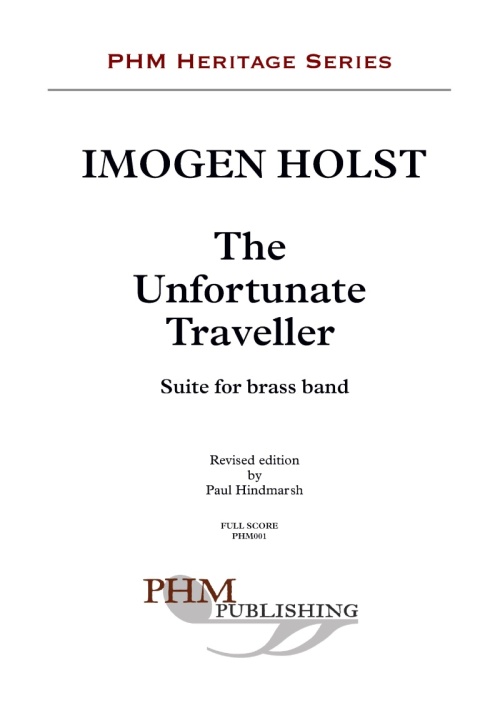
The Unfortunate Traveller (Brass Band - Score and Parts)
Imogen Holst (1907-1984) submitted The Unfortunate Traveller (1929) as her final work as a student portfolio at the Royal College of Music, where her composition teacher was Gordon Jacob. The title was taken from Thomas Nashe's famous 1594 picaresque novel of the same title. The Suite was first performed on 12 February 1933 at her Majesty's Theatre, Carlisle, by the St. Stephen's Band, with the composer conducting. Te concert was given in memory of Holst's uncle, Dr. H.A. Lediard. Holst had been impressed with the band's performance of his A Moorside Suite at the 1928 National Brass Band Championships (The Crystal Palace, South London) and was keen to work with them. Writing in Imogen Holst, a life in music, Christopher Grogan indicates that it was Gustav Holst's suggestion to include his daughter's work in the programme, quoting Imogen Holst's remarks made in interview to The Daily Mail as follows: "....it is the first time, so far as I know, that a woman has conducted a brass band at a public concert....It has been a delight to rehearse the St. Stephen's Band. It was their performance at the Crystal Palace Festival that inspired me to write this Suite, which I have dedicated to them."Imogen Holst accompanied her father to the Crystal Palace in 1928 to hear the performances of A Moorside Suite, and was so excited by the played and, audibly, by her father's music that she decided to write a brass band piece for her final examination. Te result was The Unfortunate Traveller (1929). However, it was not possible for her to present a brass band work for examination. She arranged it for string orchestra so that it could be played before she left the RCM in July 1930. Following the premiere of the original in 1933, the manuscripts did not resurface until 1969 Imogen found them among her late mother's effects. Although she requested score and parts be destroyed, they ended up in the possession of Manchester composer John Golland, who marked up the score presumably with the intention of creating a new performing edition. The original scoring reveals a lack of experience with what can be a tricky medium.With the agreement of the Holst Foundation, a revised edition, with additional percussion, was prepared in 2011 since when the work has been fortunate to travel round the world as a concert and contest piece. The original includes drums in the March only. The title was taken from Tomas Nashe's famous 1594 picaresque novel of the same title. Several Morris Dance tunes are introduced during the course of the four short movements, including Bonnie Green Garters, Shepherd's Hey, The Rose and The Wind Blaws Cauld. Quirky twists and turns of harmony and spirited rhythms that remind us how much Imogen Holst loved tradition English dance music.In September 2025, I made a performing edition of the composer's arrangement for string orchestra. The manuscript lacks the final movement, which I arranged in a similar style, ie. without extending the upper ranges. Making this edition raised some issues regarding the accuracy of my band version and some of the solutions I used to smooth out the voicing. I have used the composer's second thoughts to refine my performing edition and to correct a textual errors.- Paul HindmarshDuration: 10.00
Estimated dispatch 7-14 working days
-
£40.00
The Unfortunate Traveller (Brass Band - Score only)
Imogen Holst (1907-1984) submitted The Unfortunate Traveller (1929) as her final work as a student portfolio at the Royal College of Music, where her composition teacher was Gordon Jacob. The title was taken from Thomas Nashe's famous 1594 picaresque novel of the same title. The Suite was first performed on 12 February 1933 at her Majesty's Theatre, Carlisle, by the St. Stephen's Band, with the composer conducting. Te concert was given in memory of Holst's uncle, Dr. H.A. Lediard. Holst had been impressed with the band's performance of his A Moorside Suite at the 1928 National Brass Band Championships (The Crystal Palace, South London) and was keen to work with them. Writing in Imogen Holst, a life in music, Christopher Grogan indicates that it was Gustav Holst's suggestion to include his daughter's work in the programme, quoting Imogen Holst's remarks made in interview to The Daily Mail as follows: "....it is the first time, so far as I know, that a woman has conducted a brass band at a public concert....It has been a delight to rehearse the St. Stephen's Band. It was their performance at the Crystal Palace Festival that inspired me to write this Suite, which I have dedicated to them."Imogen Holst accompanied her father to the Crystal Palace in 1928 to hear the performances of A Moorside Suite, and was so excited by the played and, audibly, by her father's music that she decided to write a brass band piece for her final examination. Te result was The Unfortunate Traveller (1929). However, it was not possible for her to present a brass band work for examination. She arranged it for string orchestra so that it could be played before she left the RCM in July 1930. Following the premiere of the original in 1933, the manuscripts did not resurface until 1969 Imogen found them among her late mother's effects. Although she requested score and parts be destroyed, they ended up in the possession of Manchester composer John Golland, who marked up the score presumably with the intention of creating a new performing edition. The original scoring reveals a lack of experience with what can be a tricky medium.With the agreement of the Holst Foundation, a revised edition, with additional percussion, was prepared in 2011 since when the work has been fortunate to travel round the world as a concert and contest piece. The original includes drums in the March only. The title was taken from Tomas Nashe's famous 1594 picaresque novel of the same title. Several Morris Dance tunes are introduced during the course of the four short movements, including Bonnie Green Garters, Shepherd's Hey, The Rose and The Wind Blaws Cauld. Quirky twists and turns of harmony and spirited rhythms that remind us how much Imogen Holst loved tradition English dance music.In September 2025, I made a performing edition of the composer's arrangement for string orchestra. The manuscript lacks the final movement, which I arranged in a similar style, ie. without extending the upper ranges. Making this edition raised some issues regarding the accuracy of my band version and some of the solutions I used to smooth out the voicing. I have used the composer's second thoughts to refine my performing edition and to correct a textual errors.- Paul HindmarshDuration: 10.00
Estimated dispatch 7-14 working days
-
 £37.08
A Friend I Have (Brass Band) Fendall Hill
The composer writes: 'This work is a personal interpretation of the well known hymn What a Friend We Have in Jesus. This piece is autobiographical in that it reflects the friendship I have with Jesus, and some of the moods, nature and outcomes of many of those conversations. For example, the Blues section is representative of times where I present my 'blues' to him, and he turns them around. It's very personal and hard to describe the full nature of my relationship, but this music provides a good window. He is certainly my Lord, my Saviour, and my most precious friend.' PDF download includes score and full set of parts. Sheet music available from: UK - www.brassband.co.uk USA - www.solidbrassmusic.com To view a performance video of the work please visit: https://www.youtube.com/watch?v=cN-zYhdwaxM Difficulty Level: 1st Section + Instrumentation: Soprano Cornet Eb Solo Cornet Bb 1st Cornet Bb 2nd Cornet Bb Flugel Horn Bb Solo Horn Eb 1st Horn Eb 2nd Horn Eb 1st Baritone Bb 2nd Baritone Bb 1st Trombone Bb 2nd Trombone Bb Bass Trombone Euphonium 1-2 Bb Bass Eb Bass Bb Drum Kit Temple Blocks Timbales
In Stock: Estimated dispatch 1-3 working days