
Results
-
Galloping Home (The theme from TV's Black Beauty) - Dennis King - Len Jenkins
"The Adventures of Black Beauty" was a British children's television drama series produced by London Weekend Television and shown by ITV in the United Kingdom between 1972 and 1974. The theme tune, "Galloping Home", written by Denis King and performed by the London String Chorale, was released as a single and peaked at number 31 in the UK charts in the week of 2 February 1974. It was later used at the climax of the first series of Absolutely Fabulous, with Edina Monsoon dreaming of running through a field as Black Beauty does in the series' title sequence. The piece has been arranged for both Full Brass Band and Brass Ensemble, in this case a Quintet with optional percussion. Both arrangements are well within the capabilities of most bands.
-
 £42.00
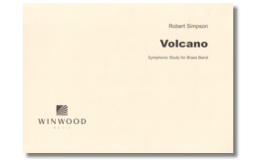
Volcano (Score only) - Robert Simpson
One of the composer's most enduring works, Volcano was written for the National Brass Band Championships of Great Britain in 1979. The composer writes: "While it is, of course, possible to listen to this piece with the erruption of a volcano in mind, it is also possible to interpret the title in a figurative sense - that is to say, as one might refer to a 'volcanic temperament'. Alternatively, some may prefer to listen to is simply as a piece of music. I would recommend the latter." Duration: 12:00
Estimated dispatch 7-9 working days
-
 £52.00
Volcano (Parts only) - Robert SImpson
One of the composer's most enduring works, Volcano was written for the National Brass Band Championships of Great Britain in 1979. The composer writes: "While it is, of course, possible to listen to this piece with the erruption of a volcano in mind, it is also possible to interpret the title in a figurative sense - that is to say, as one might refer to a 'volcanic temperament'. Alternatively, some may prefer to listen to is simply as a piece of music. I would recommend the latter." Duration: 12:00
Estimated dispatch 7-9 working days
-
 £59.95
Aftershock (Brass Band - Score and Parts)
In this piece, the term "aftershock" serves as a metaphor for the Christian Church: commissioned by Jesus to carry forward the impact of his ministry and message. The Church is the spiritual aftershock of Christ's life, death, and resurrection - reverberating through history and into the present.Musically, the piece is constructed in three movements and built around motifs that pulse, echo, and resonate, symbolising the ongoing influence of Christ through his Church. Several well-known Christian songs are woven into its fabric, each contributing to the narrative of mission and worship. Build your Kingdom here (Rend Collective) affirms the Church's identity as "the hope on earth," while Major Leonard Ballantine's And you will be my witnesses (M.S. 1992-10) recalls Jesus' call to spread the gospel.The reflective central section features Matt Redman's I will offer up my life in spirit and truth, expressing personal devotion of a believer seeking to serive within the global Church.The finale draws on a traditional Salvation Army song by William Drake Pennick (S.A.S.B. 937), urging believers to proclaim the gospel far and wide: Tell the world, O tell the world!Make salvation's story heard;In the highways, in the byways,And in lands beyond the sea,do some witnessing for JesusWheresoever you may be.
Estimated dispatch 7-14 working days
-
 £44.95
Love-Lifted-Me (Brass Band - Score and Parts)
The composer describes this piece as a waltz fantasy - it embodies many characteristics of the dance, and has a few flights of fancy as well! The source of inspiration for the work is the much loved hymn Love lifted me with words by James Rowe (S.A.S.B. 583) and music by Howard E. Smith (T.B. 744).This high-spirited celebration in music will make a wonderful addition to your library.
Estimated dispatch 7-14 working days
-
 £29.95
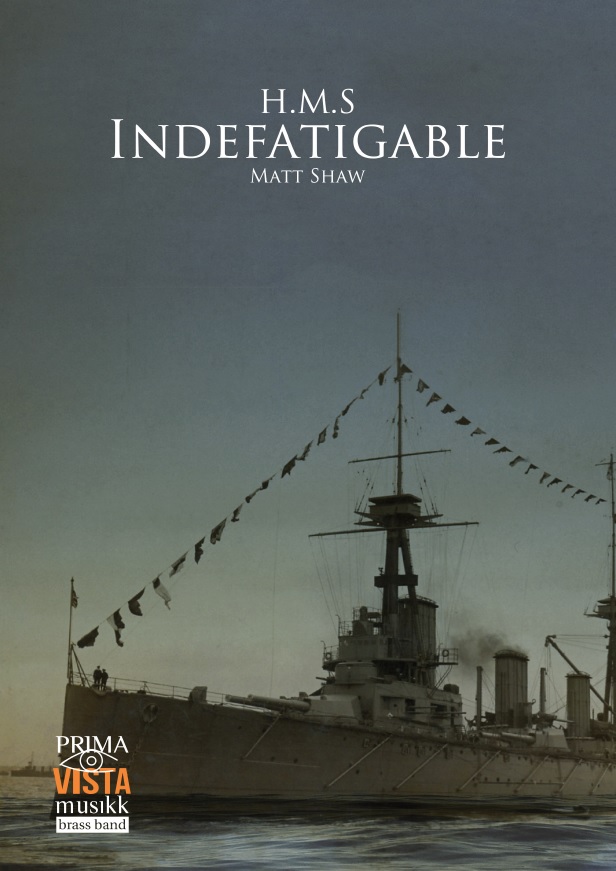
HMS Indefatigable (Brass Band - Score and Parts)
HMS Indefatigable is a contest march, composed for the Virtuosi GUS Band, under the direction of Adam Cooke, and used as part of their programme for Brass in Concert in November 2016.The march is named after the battlecruiser HMS Indefatigable; an ill-fated ship of the British fleet that fell victim to German Bombardment in the Battle of Jutland, in 1916. During the initial 30 minutes of the battle, the Indefatigable sustained heavy fire from the German battleship SMS Von der Tann, which struck Indefatigable's armoury and caused the ship to suffer a catastrophic explosion, resulting in the ship sinking, with all but two lives lost. 1,017 souls perished.This piece aims to capture the might and power of the great ship at sea, incorporating a touch of menace, hinting at the unfortunate end awaiting the HMS Indefatigable, whilst serving as a fitting tribute to the ship and her crew.
Estimated dispatch 7-14 working days
-
 £14.95
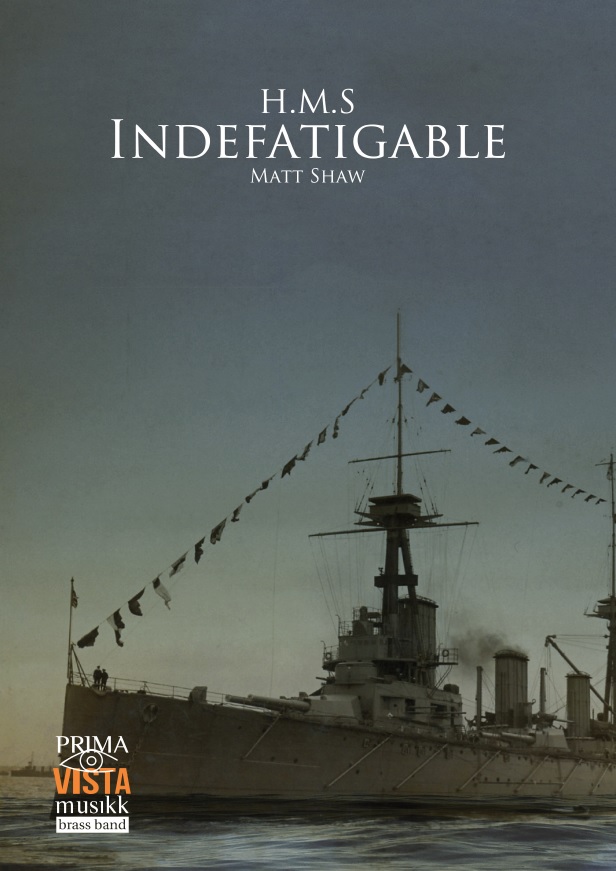
HMS Indefatigable (Score Only)
HMS Indefatigable is a contest march, composed for the Virtuosi GUS Band, under the direction of Adam Cooke, and used as part of their programme for Brass in Concert in November 2016.The march is named after the battlecruiser HMS Indefatigable; an ill-fated ship of the British fleet that fell victim to German Bombardment in the Battle of Jutland, in 1916. During the initial 30 minutes of the battle, the Indefatigable sustained heavy fire from the German battleship SMS Von der Tann, which struck Indefatigable's armoury and caused the ship to suffer a catastrophic explosion, resulting in the ship sinking, with all but two lives lost. 1,017 souls perished.This piece aims to capture the might and power of the great ship at sea, incorporating a touch of menace, hinting at the unfortunate end awaiting the HMS Indefatigable, whilst serving as a fitting tribute to the ship and her crew.
Estimated dispatch 7-14 working days
-
 £45.00
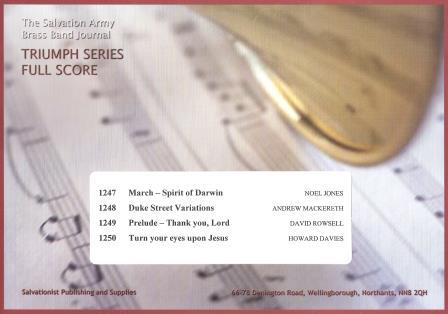
Triumph Series Band Journal March 2014 Numbers 1247-1250
No.1247 March - Spirit of Darwin (Noel Jones)This march was written as a tribute to Majors Hilton and Wilga Morris for the wonderful ministry they provided as reginal officers. It includes two well-known Salvation Army songs; 'Ever is the War Cry, Victory, Victory!' and'O My Heart is Full of Music and of Gladness'.No. 1248 Duke Street Variations (Andrew Mackereth)A set of variations on the well-known tune 'Duke Street', written at the request of Young People's Bandleader Andrew Laird for the centenary weekend of the Clydebank YP Band in 2012. No.1249 Prelude - Thank you, Lord (David Rowsell)A prelude based on the chorus 'Thank you , Lord for saving my soul'.No. 1250 Turn Your Eyes Upon Jesus (Howard Davies)A setting of the well-loved melody 'Turn your eyes upon nJesus', which also incorporates the tune 'Open our eyes, Lord'.
Estimated dispatch 7-14 working days
-
 £44.83
Boreas: The North Wind (Brass Band) Derek Jenkins
Boreas was an ancient Greek deity personifying the north wind. He was a winged god of ruthless disposition, which was rivaled only by the harsh wintry winds at his command. Boreas fell in love with Orithyia, the King's daughter. Contrary to his genuine nature, he attempted to woo her with sweet words of devotion. His efforts were in vain, and Orithyia failed to yield to his advances. With this rejection, Boreas's temper flared and he, once again, was overcome by his icy and merciless nature. Like Boreas, this work begins with slow, lyrical lines that quickly fade into an unrelenting fury of anger. Moments reminiscent of Boreas's words of affection appear, but they are quickly washed away as the piece escalates. This arrangement was written for Joseph Parisi and the Fountain City Brass Band as a small token of thanks. The original version for wind ensemble was commissioned by and written for Timothy Shade and the Bethel College Wind Ensemble. To view a video of Diamond Brass Band performing the work please visit: www.youtube.com/watch?v=Co4oreV7Hm4 Sheet music available from: UK - www.brassband.co.uk USA - www.solidbrassmusic.com Difficulty Level: 2nd Section + Instrumentation: 1 Soprano Cornet (Eb) 9 Cornets (Bb) 1 Flugelhorn 3 Tenor Horns (Eb) 2 Baritones (Bb) 2 Trombones (Bb) 1 Bass Trombone 2 Euphoniums (Bb) 2 Basses (Eb) 2 Basses (Bb) 4 Percussion
In Stock: Estimated dispatch 1-3 working days
-
 £33.62
You're Always There (Brass Band) Lee Fisher arr. Andrew Wainwright
One of BrookWright's most popular titles, this piece is based on an original song by Lee Fisher which was written for Britain's Got Talent star Charlie Green. Originally arranged as a tenor horn solo with brass band, it is now available here as a standalone work for band. To view a follow-the-score video please visit www.youtube.com/watch?v=suzzgdxU_xU PDF download includes score and parts. Sheet music available from: UK - www.brassband.co.uk USA - https://satradecentral.org Difficulty Level: 4th Section + Length: 3.45 minutes Instrumentation: Soprano Cornet Eb Solo Cornet Bb Repiano Cornet Bb 2nd Cornet Bb 3rd Cornet Bb Flugel Horn Bb Solo Horn Eb 1st Horn Eb 2nd Horn Eb 1st Baritone Bb 2nd Baritone Bb 1st Trombone Bb 2nd Trombone Bb Bass Trombone Euphonium Bb Bass Eb Bass Bb Timpani Percussion 1-2
In Stock: Estimated dispatch 1-3 working days