
Results
-
 £54.99
Sgt. Pepper's Lonely Hearts Club Band - John Lennon - Philip Harper
Sgt. Pepper's Lonely Hearts Club Band is the most famous album by The Beatles, and perhaps of all time. When it came out in 1967 it was remarkable not only for its many great songs, but also because of the innovative recording techniques that were used on the record for the very first time, setting a new standard for many decades to come. Conductor, arranger and composer Philip Harper is a huge Beatles fan himself and had a great time creating this grade 4 arrangement!
Estimated dispatch 5-14 working days
-
 £133.40
Concertino Olympique (Trombone Solo) - Roy Newsome
Estimated dispatch 5-14 working days
-
 £115.00
The Princess and The Frog - Randy Newman - Bertrand Moren
Estimated dispatch 5-14 working days
-
 £60.99
Bandstand Boogie - C. Albertine - Peter Wain
Charles Albertine played Tenor Saxophone with the Sammy Kaye band in the late 1940s, and was the lead arranger for the new Las Elgart band. He arranged most of the Three Suns later music. Most of his later career was spent in television. 'Bandstand Boogie' was adopted by Dick Clark as the theme song for his long-running series, 'American Bandstand.'
Estimated dispatch 5-14 working days
-
 £60.99
Fanfare La Perie - Paul Dukas - Peter Wain
In 1911 the Russian impresario Diaghilev commisioned Paul Dukas to compose music for the famous ballet fairy-tale 'La Perie'by Jean Coralli.Fokine was to make a new choreography, so that the Russian ballet company 'Ballet Russes' would be able to perform the piece in Paris that same year. Due to a quarrel between Diaghilev and Dukas about who should dance the title-part, however, the ballet was not performed by the 'Ballet Russes'but by another company in 1912.The ballet 'La Perie' is Dukas' last symphonic work. In 1911 gaf de Russische impresario Diaghilev Paul Dukas opdracht om muziek te componeren voor het beroemde ballet sprookje 'La Perie' van Jean Coralli. Fokine was gevraagd om een nieuwe choreografie te maken, zodat het Russische balletgezelschap 'Ballet Russes' in staat zou zijn om het stuk in Parijs op te voeren in datzelfde jaar. Door een ruzie tussen Diaghilev en Dukas over de vraag wie de hoofdrol mocht dansen, werd het ballet in 1912 echter niet uitgevoerd door het 'Ballet Russes' maar door een ander gezelschap. Het ballet 'La Perie' is het laatste symfonische werk van Dukas.
Estimated dispatch 5-14 working days
-
 £54.99
They are Coming - John Emerson Blackstone
There are people who are capable of planning well. They live their lives in a well-structured manner and know exactly what they have to do. On the other hand, there are also people who are the exact opposite: they want to do too many things at once and are often somewhat absent-minded, which occasionally results in frantic situations. The outcome of one such situation is 'They are coming'. John Emerson Blackstone had been working on a new composition for some time when he received a telephone call from his editor, who told him that the deadline was approaching rapidly, even worse, that it would expire at the end of that same day and that he would drop by in person to fetch thecomposition! Blackstone set to work in a frenzy and completed the last details. When his editor arrived, the piece was finished ..... and got its definitive title: 'They are coming'.
Estimated dispatch 5-14 working days
-
 £69.99
Auld Lang Syne - Menno Haantjes
Whereas 'Auld Lang Syne' may be considered the best-known Scottish song ever, yet at the same time it is an obscure one, for there are but few people who know the complete text by heart. After the familiar 'Should auld acquaintance be forgot .....' many people take their refuge to lyrics like 'rum tee dum ta dee ..... lah, lah, lah ........... for auld lang syne'. Even in Scotland only a handful of persons know the entire text and are able to give a correct rendering of it. The current lyrics have been attributed to the Scottish poet Robert Burns. Burns, however, he did not write the whole poem : after he had heard an old man sing the centuries-old Scotchballad, he wrote it down and added a number of stanzas (1788). Historical research teaches us that the ballad served many purposes, both political and religious. Nowadays, 'Auld Lang Syne' is sung as a Christmas Carol and it is also sung on New Year's Eve at the turning of the year. Apart from that, though, the song is also sung on many other occasions sometimes with different lyrics, which usually have Love, Friendship and/or Parting as their themes, as these go well with the fascinating melody. In this arrangement a low-sounding solo instrument is central. The harmonization in the accompaniment fits in perfectly with the sentiments this song will evoke. Should auld acquaintance be forgot And never brought to mind? Should auld acquintance be forgot. And days of auld lang syne? For auld lang syne, my dear, For auld lang syne, We'll take a cup of kindness yet, For auld lang syne.
Estimated dispatch 5-14 working days
-
 £109.99
Columbus - Rob Goorhuis
Christopher Columbus was born in Genoa in 1451. His father was a wool merchant. Originally he seemed destined to follow in his father's footsteps, and thus sailed the oceans to countries as far apart as Iceland and Guinea. In 1476 his ship was sunk during a battle off the coast of Portugal. Columbus saved his own life by swimming to shore. In 1484 he conceived the idea of sailing to the Indies via a westward sea route, but it was only in 1492 that he was able to realize this plan. On this first voyage he was in command of three ships: the flag-ship, called the Santa Maria, the Pinta, and the Ni?a. From Spain Columbus sailed via the Canary Islands to the Bahamas, whichhe sighted on October 12th 1492. Without being aware of it Columbus discovered the 'New World' he thought he had landed in the eastern part of Asia. The motif from Dvooak's 9th Symphony 'Aus der neuen Welt' forms a little counterfeit history at this point in the composition. After this first voyage Columbus was to undertake another three long voyages to America. These voyages were certainly not entirely devoid of misfortune. More than once he was faced with shipwreck, mutiny and the destruction of settlements he had founded. After Columbus had left for Spain from Rio Belen in 1503, he beached his ships on the coast of Jamaica. The crew were marooned there and it was only after a year that Columbus succeeded in saving his men and sailing back to Spain with them. In the music the misunderstanding about which continent Columbus discovered in his lifetime resounds, for does this part in the composition not contain Asiatic motifs? Poor Columbus! In 1506 the famous explorer died in Valladolid.
Estimated dispatch 5-14 working days
-
 £154.99
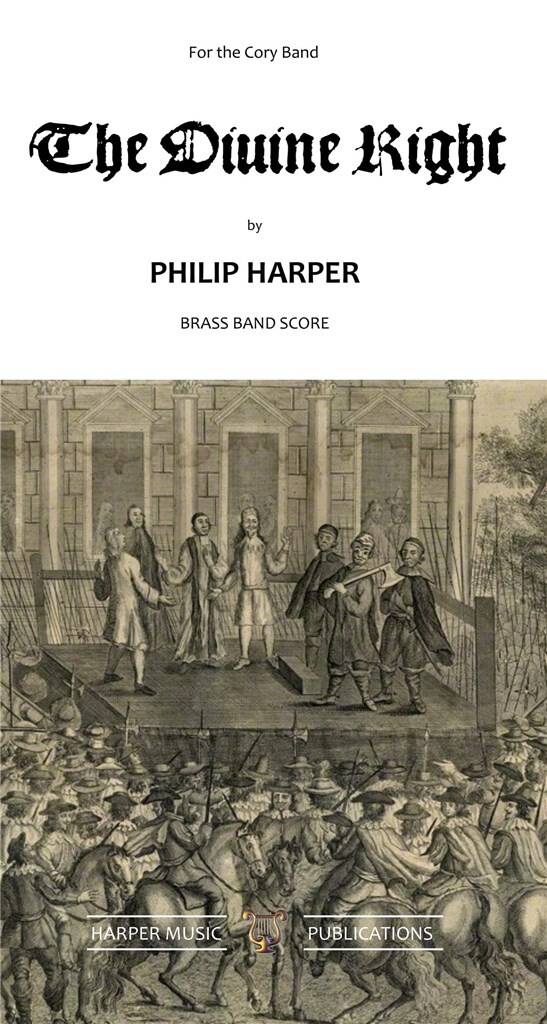
The Divine Right - Philip Harper
At the time of composing this piece, the Arab Spring was sweeping through the Middle East. It seemed that almost every week a new countrys people had risen up against the regimes and dictatorships which had prevailed for generations, leaving manynations at a defining crossroads in their history. There were so many possible ways ahead: so many hopes, yet so many uncertainties.My music is a depiction of these revolutionary times, and several musical themes are in turn presented, discussed, considered, fought over, altered, rejected or accepted. Most nations have had, or probably will have, their own Arab Spring, including my own, the United Kingdom. Events of 17th Century Britain provide the context for this piece, particularly those following the execution of the tyrant King Charles I on30 January 1649. The regicide was in part due to Charless steadfast belief in the Divine Right of Kings, and led to a tumultuous interregnum, where England stood at its own defining crossroads.The music begins turbulently, before King Charles appears and is led to the gallows outside Banqueting House in central London where he is brutally decapitated. From the assembled crowd rose, according to one observer, a moan as I never heard before and desire I may never hear again.The music descends to emptiness. The musical argument which follows is not strictly programmatic, but a number of musical themes are all thrown into the melting pot, representing ideas such as: religion; military force; reasoned Parliamentary debate; and the chattering,irrepressible voice of the people. Additionally, there are some quotations from the music of royalist composer Thomas Tomkins (1572-1656), who was often in tune with the feeling of the times. This defining episode in Englands history was brought to a close with the Restoration of the monarchy in 1660, and as the exiled King Charles II rode back into London the diarist John Evelyn wrote: Never was so joyful a day seen in this nation. I stood in the Strand and beheld it, and blessed God.At the end of the piece the bells ring out, and the musical appearance of the King has transformed from turbulent to triumphant. Philip Harper, 2013
Estimated dispatch 5-14 working days
-
£67.50
Alice in Wonderland - Danny Elfman - Michael Brown
Lewis Carroll's novel Alice in Wonderland served as the basis for the new Walt Disney film. From Danny Elfman's soundtrack, Michael Brown used the titles Alice Returns, Alice's Theme and Bandersnatched for his enchanting medley that has been adapted for brass band by Klaas van der Woude.
Estimated dispatch 5-14 working days
 View Music