
Results
-
£60.99
Triumphant Intrada - Bertrand Moren
This new composition for brass band makes an ideal concert opener. Majestic chords and energetic rhythms hold the listener spellbound and all the instruments in the band are given the opportunity to display their range of beautiful sound colours.
Estimated dispatch 5-14 working days
-
£54.99
On My Way - Phil Collins - Peter Kleine Schaars
The English musician Phil Collins has written six new songs for the animated Walt Disney film Brother Bear. His catchy pop rock is well known and popular with a worldwide audience. In Brother Bear, the young Kenai kills a grizzly bear to avenge his brother's death. Then he is magically transformed into a bear himself and he makes friends with the bear cub Koda. Together, they undertake a long, exciting journey in search of the mountain where Kenai can become human again. Meanwhile Kenai's remaining brother hunts them in order to avenge his family. Thus, the main themes of Brother Bear are brotherhood and friendship. On My Way gives voice to the courage and the determinationthat characterise Brother Bear. Peter Kleine Schaars has produced an excellent arrangement for band, which reflects the original film music very well.
Estimated dispatch 5-14 working days
-
 £76.99
Funky Brass - Otto M. Schwarz
In addition to his many 'serious'works Otto M. Schwarz has had much success with several lighter works such as Band Fever, Funk Attack and Groovin' Around. His new seriously funky piece Funky Brass makes a perfect addition to the light brass band repertoire.
Estimated dispatch 5-14 working days
-
 £104.99
Lake of the Moon - Kevin Houben
The travels of the Aztec people as they headed south through North America looking for a new home, acted as the inspiration for Lake of the Moon.The composition contains small fragments of Oriental music and South American rhythms and occasionally, Russian Cossacks seem to raise their heads. The journey from North to South is not without danger, which is represented by threatening sounds within the music.In the Adagio divotothe composer takes us along to the Texcoco Lake, which the Aztecs called the lake of the moon. Bring a little bit of South American history to your concert with Lake of the Moon.
Estimated dispatch 5-14 working days
-
 £54.99
The Logical Song - André Waignein
The Logical Song was written by the lead singer of the famous British pop band Supertramp - a song about a happy, carefree child growing up to become a cynical adult. It was one of the group's biggest worldwide hits. Andre Waignein's brass band arrangement will be a big hit with all Supertramp fans and may well attract many new fans!
Estimated dispatch 5-14 working days
-
 £60.99
High School Musical - Robert Longfield
Ask any child what their favourite film has been over the past few years and a large number will say High School Musical. The music is full of energy and emotion and has been an essential part of the films success. This fun-filled medley features three songs from the original film: Start Of Something New, Breaking Free and We're All In This Together.
Estimated dispatch 5-14 working days
-
 £89.99
Broken Sword - Kevin Houben
The Broken Sword is one of the five ceremonial swords kept in the Tower of London and is used during the coronation of a new king or queen. Legend has it that an angel broke off the tip of the sword in an effort to prevent an unjust killing. Composer Kevin Houben lets his music retell this intriguing legend. Broken Sword resembles a film score in many ways and will paint vivid images as the band plays its way through the legend. Many different moods create a contrast-rich work that makes for an exciting listening and playing experience every time!
Estimated dispatch 5-14 working days
-
 £118.99
Abaddon - Kevin Houben
Abaddon was commissioned by the NLBB (Noord-Limburgse Brassband North Limburg Brass Band) from Belgium. Abaddon is the demon reigning over the underworld. In the New Testament in the Book of Revelation by John (9:11) he is calledthe angel of the bottomless pit. The work Abaddon lives up to its name. Technically and physically, it holds an enormous challenge for every band in the champions division. The composition has a traditional form structure (fast slow fast), and it consists of ornamentationsaround the letters IVAN, after Ivan Meylemans, the conductor who since 2001 has obtained great successes with the NLBB, and who in this case has also been essential in taming the demon in Abaddon.
Estimated dispatch 5-14 working days
-
 £129.99
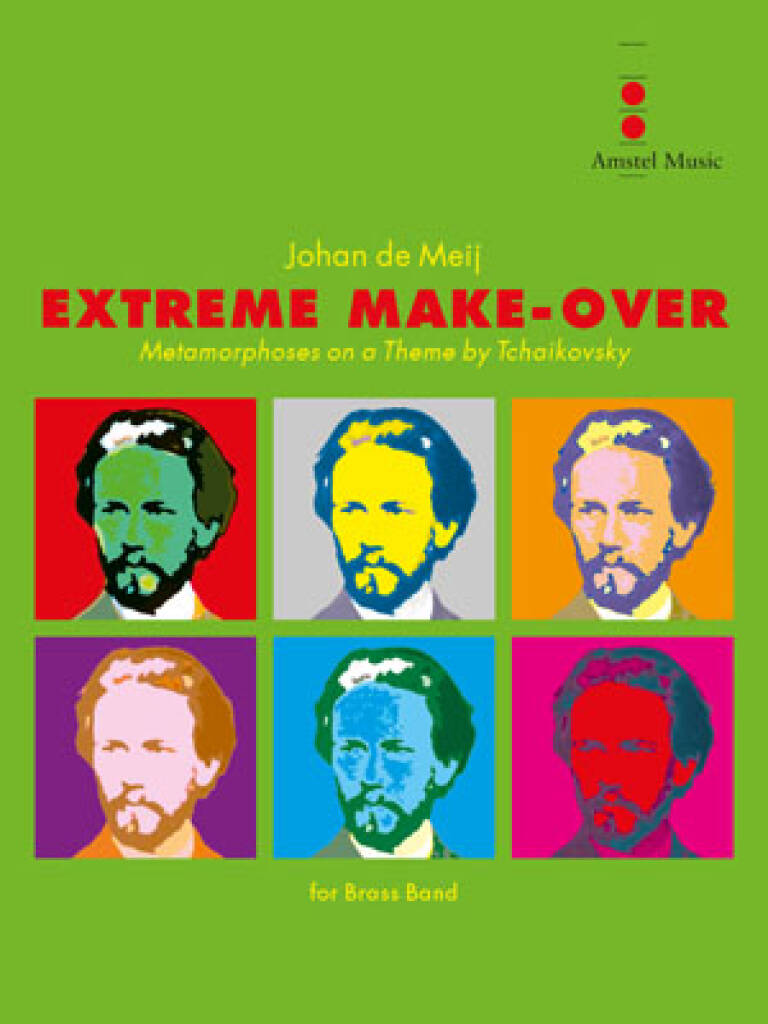
Extreme Make-Over - Johan de Meij
The work, set as the test-piece for the 2005 European Brass Band Championships was inspired by a theme from the second movement of Tchaikovsky's String Quartet No.1 (Andante Cantabile). It consists of a number of musical metamorphoses on the theme and includes several excerpts from Tchaikovsky's Fourth and Sixth Symphonies and Romeo and Juliet. The most unconventional element of the work is instrumentation for ten tuned bottles to be played by members of the Cornet section. This gives the piece an Indonesian Gamelan effect. Why not give your players something to get their teeth into with this impressive major new work.
Estimated dispatch 5-14 working days
-
 £152.99
Between the Two Rivers - Philip Sparke
Between the Two Rivers was commissioned by Fanfare 'Prins Hendrik', from Aalst in the Netherlands. The title derives from the fact that the town of Aalst lies between two tributaries of the River Dommel. The community is a highly religious one, so the famous Luther chorale, Ein' Feste Burg, was an obvious choice for Philip Sparke to use as the theme for this new work. It takes the form of a theme with four contrasting variations. Variation 1 is a moto perpetuo, variation 2 has a slower march like feel, variation 3 is a sinister slow movement and the final variation is in the form of a lyrical fugue. Between The Two Rivers is sure to become a major work inmodern brass band repertoire.
Estimated dispatch 5-14 working days
 View Music