
Results
-
 £59.99
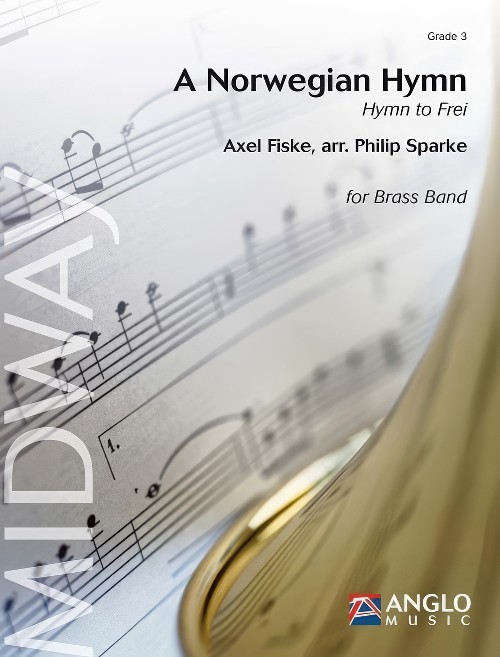
A Norwegian Hymn (Brass Band - Score and Parts) - Fiske, Axel - Sparke, Philip
British composer Philip Sparke was asked to write this arrangement of Hymn to Frei for the Norwegian Brass Band Frei Hornmusikk . Sparke had already used part of this hymn by a composer well-known in the home region of the band in The Saga of Haakon the Good. In A Norwegian Hymn, three verses of the tune can be heard: the first is performed by various soloists, followed by a quieter second verse, before the third verse brings the piece to a triumphal close. A beautiful piece, which is also excellent to use to work on musicality with bands in lower divisions.Duration: 4.00
Estimated dispatch 7-14 working days
-
 £38.00
Leviathan (Brass Band - Score and Parts) - Denegri, Paul - Barton, Tom
"Leviathan" began its evolution as a workshop work inspired by the poem written by Heathcote Williams entitled; "Whale Nation". At the time of this workshop the tentet brass repertoire existed of extremely well written original or arranged works of a lighter nature but there was a shortage of works with a greater emotional depth and edge, hence Leviathan's early conception as an atmospheric and emotive work. The workshop piece explored whale sound and song and was a 25 minute work in two parts. After many years of the workshop sketches sitting dormant the new work Leviathan is a much shorter and concise work. It contains only one of the original melodic themes of the workshop work. Leviathan is driven and underpinned by melodic and rhythmic elements. It is a programmed work following the awe inspiring majestic might and beauty of whales through to a hunt scene, the chase, and the ultimate demise of earth's largest mammal. Originally commissioned by Superbrass for brass ensemble, this arrangement is by Tom Barton. Duration: 6.30. Suitable for 1st Section Bands and above.
Estimated dispatch 7-14 working days
-
 £88.00
Fanfares, Marches, Hymns and Finale (Brass Band - Score and Parts) - Broughton, Bruce
"Fanfares, Marches, Hymns and Finale" is a series of self-referential movements, each composed around an attitude expressed in the title rather than for any actual utilitarian use. Hence, it would be difficult to march to most of "Marches", although it is composed of martial rhythms and associative figures. One could, however, sing the pentatonic (five note) main theme from "Hymns", which is composed in an American folk-hymn style and set in an Atmosphere evocative of meditation and reflection, although there is no text associated with the themes. "Fanfares" is based upon an opening six-note motif first heard in unison. It precedes and announces the following three movements. As the plural aspect of the title indicates, "fanfares" open and close the movement itself. Needless to say, the spirited "Finale" brings the piece to a close. Duration: 11.00. Suitable for Championship Section Bands.
Estimated dispatch 7-14 working days
-
 £73.00
Bass Trombone Concerto (Bass Trombone Solo with Brass Band - Score and Parts) - Wood, Gareth
Written in 2006 for Roger Argente, Gareth Wood brings his considerable experience of writing for brass, and brass bands in particular, to an instrument not often blessed with opportunities for solo exposure. It is scored for soloist accompanied by traditional brass band line-up, including timpani and two percussion, and follows the standard three-movement pattern. In the first movement, the soloist launches straight into the musical argument with a low-lying repeated quaver figure punctuated by the band. A lyrical second subject in the high register is also entrusted to the soloist, and the movement comes to a thrilling conclusion. The slow movement opens softly with the percussion, and a mournful bass line sets the mood for a thoughtful long melody. It reaches a powerful climax, which subsides to a return of the opening mood. In the march-like finale, the soloist is pitted against a number of solo instruments from the band and a driving ostinato carries the momentum through to the blazing ending. Duration: 13.00. Suitable for 1st Section Bands and above.
Estimated dispatch 7-14 working days
-
 £48.00
Tientos y Danzas (Brass Band - Score and Parts) - Wood, Gareth
Tientos y Danzas is a suite in four movements and was written especially for Superbrass. It is not literally descriptive, but conjures up a breezy, festive atmosphere. The title "Tientos" stems from the fact that a lot of the brass writing is reminiscent of virtuosic Renaissance keyboard finger-work (a "Tiento" is the Spanish equivalent of a toccata). Only later did we discover that the word is also the name of a style of flamenco dancing, which links nicely with Danzas (dances). The first movement is an extended fanfare, with military rhythms on the tenor drums and dramatic cornet and horn calls. Next comes a witty waltz featuring the horn. The music builds in complexity; the main horn theme returns before a playful coda. The following Andante makes effective use of the mutes, both in the haunting opening "pyramid" chords, and in the elaborate, recurrent cornet duets; the two cornets have the last word. After a couple of false starts, the finale sets off at a cracking pace, with dislocated accents creating an irregular rhythmic pulse. There are opportunities for every instrument to shine (metaphorically) and the music gets even faster for a thrilling conclusion. Duration: 10.30. Suitable for 1st Section Bands and above.
Estimated dispatch 7-14 working days
-
 £60.99
A Christmas Night (Brass Band - Score and Parts) - Jeanbourquin, Marc
In a Christmas Night, Marc Jeanbourquin revisits four great Christmas Eve classics in a fresh style. From the majestic chorale Adeste Fideles to the famous Joy to the World and a jazz version of the equally well-known Jingle Bells followed by We Wish You a Merry Christmas as a fitting conclusion, this medley expresses in music a traditional Christmastime to your audience.Duration: 4:15
Estimated dispatch 7-14 working days
-
 £87.99
Second to None (Brass Band - Score and Parts) - Sparke, Philip
Second to None is a perfectly suitable title for this work, though it actually refers to "Nulli Secundus", the motto of the British Corps of Army Music, who gave the commission to Philip Sparke. The piece opens with a fanfare, followed by two short quotes from two of the Corp's own marches and a festive Vivace. A more legato central section creates a nice contrast before the work closes with the opening fanfare. A perfect affair!Duration: 6:15
Estimated dispatch 7-14 working days
-
 £89.95
Trombone Concerto (Trombone Solo with Brass Band - Score and Parts) - Gregson, Edward
The Gregson Trombone Concerto was originally written in 1979 to a commission from Bedfordshire Education Service, for a new work for Michael Hext, winner of the first BBC Young Musician of the Year competition. This version for brass band was commissioned by Nicholas Childs, Music Director of the Black Dyke Band, specially for Brett Baker, the then principal trombone of the band. He has recorded it on the Doyen label with the Black Dyke Band.The work falls into three main sections, played without a break, but conforming to the traditional pattern of concerto structure. After a slow introduction, containing most of the motivic and rhythmic ideas used in the work, there follows the main fast section which is itself divided into three parts and concludes with a fierce climax (timpani and gong). The slow and rather intense middle section is linked to a cadenza for the soloist, at first unaccompanied but leading to accompanied references to earlier material. The final section is a scherzo which ends dramatically with a re-statement of the opening slow introduction. A brisk coda concludes the work. The interval of a fourth (and its augmented form) provides melodic and harmonic unity for the work, whilst the tonal juxtaposition between E minor and B flat major throughout the concerto is an important element of the structure.The writing for trombone is virtuosic, encompassing the whole range of the instrument, but it also exploits the rather beautiful lyrical sound of which this instrument is capable.
Estimated dispatch 7-14 working days
-
 £44.95
Trombone Concerto (Trombone Solo with Brass Band - Score only) - Gregson, Edward
The Gregson Trombone Concerto was originally written in 1979 to a commission from Bedfordshire Education Service, for a new work for Michael Hext, winner of the first BBC Young Musician of the Year competition. This version for brass band was commissioned by Nicholas Childs, Music Director of the Black Dyke Band, specially for Brett Baker, the then principal trombone of the band. He has recorded it on the Doyen label with the Black Dyke Band.The work falls into three main sections, played without a break, but conforming to the traditional pattern of concerto structure. After a slow introduction, containing most of the motivic and rhythmic ideas used in the work, there follows the main fast section which is itself divided into three parts and concludes with a fierce climax (timpani and gong). The slow and rather intense middle section is linked to a cadenza for the soloist, at first unaccompanied but leading to accompanied references to earlier material. The final section is a scherzo which ends dramatically with a re-statement of the opening slow introduction. A brisk coda concludes the work. The interval of a fourth (and its augmented form) provides melodic and harmonic unity for the work, whilst the tonal juxtaposition between E minor and B flat major throughout the concerto is an important element of the structure.The writing for trombone is virtuosic, encompassing the whole range of the instrument, but it also exploits the rather beautiful lyrical sound of which this instrument is capable.Duration: 16.00
Estimated dispatch 7-14 working days
-
 £34.95
Rhapsody for Euphonium (Euphonium Solo with Brass Band - Score and Parts) - Sharman, Paul
Following a lively opening in which the band echoes statements by?the soloist, the central section features the melody 'He Leadeth Me'?before returning to the pyrotechnics of the first section.
Estimated dispatch 7-14 working days
 View Music