
Results
-
 £15.00
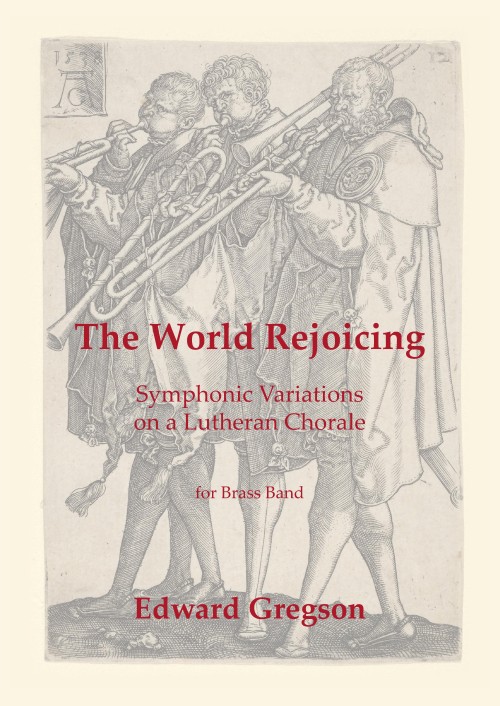
The World Rejoicing (Brass Band - Study Score) - Gregson, Edward
The World Rejoicing was commissioned by the National Brass Band Associations of Belgium, Netherlands, Norway, Switzerland, and the British Open, as the test piece for their competitions in 2020/21. Although the work was completed in 2019, the pandemic of 2020 meant that these competitions were postponed until 2021/22. The premiere took place in September 2021 at Symphony Hall, Birmingham, UK.In searching for a common link between the brass band traditions of the various European countries that commissioned this work, I considered the fact that hymns have always played an important role in the relationship that brass bands have with their particular communities; and thus I turned to a well- known Lutheran chorale, Nun danket alle Gott (Now thank we all our God), written around 1636 by Martin Rinkart, with the melody attributed to Johann Cruger. A number of composers have incorporated this chorale into their music, most famously J.S. Bach in his Cantatas no. 79 and 192, and Mendelssohn in the Lobsegang movement of his 2nd Symphony (the harmonisation of which is usually used when this hymn is sung).It seemed fitting therefore for me to return to a compositional form I have used many times before (Variations) and to write a work based on this hymn. I have used it in a similar way to that which I employed in my Variations on Laudate Dominum of 1976 - that is, rather than writing a set of variations using elaborations of the complete tune, I have taken various phrases from the chorale and used them within the context of other musical material, applying an overall symphonic process of continuous variation and development. The structure, or sub-divisions of the work, which is through composed and plays without a break, is as follows:Prelude, Capriccio, La Danza 1, Processional, La Danza 2, Arias and Duets, Fuga Burlesca, Chorale, and Postlude.The work, which is around 16 minutes in length, is also partly autobiographical - in the manner say of Strauss's Ein Heldenleben - in that I have incorporated into the score brief quotations from many of my other major works for brass band. In that respect, The World Rejoicing sums up a particular facet of my life as a composer, and reflects the admiration I have always had for what is surely one of the great amateur music-making traditions in the world.Duration: 16.00
Estimated dispatch 7-14 working days
-
 £89.95
Four Etudes (Brass Band - Score and Parts) - Gregson, Edward
This work was written during August and September 2016. In it, I wanted primarily to explore the elements of timbre, rhythm, texture and colour. The first three tudes (or studies) are based on a set of piano pieces I composed in 1982, whilst the last, the longest of the set, was composed specially. My reference point was the Four tudes for orchestra of 1928 by Stravinsky, a work I have always admired, and of which the first three also happen to be based on a set of earlier pieces, in his case for string quartet, with the last being a re-arrangement of a work for pianola. I have also borrowed the titles he gave to the individual studies as they seemed to fit the mood of my pieces.However, the exception is the final study, where instead of the exuberant mood of his colourful portrayal of Madrid, mine was influenced by the terrible human tragedy that was unfolding in Aleppo at the time I was writing it, and thus reflects the violence and barbarism of those events; yet towards the end it does offer a glimmer of hope for humanity with a return to the Canticle (Song) of the first study, and concludes quietly with the chords and bells that began the work. The titles of the tudes are Canticle, Dance, Excentrique, and Aleppo. Like Stravinsky's, the set is relatively short, lasting around 8 minutes.The Four tudes were commissioned by Black Dyke Band and were written specially for the recording marking the conclusion of my year as Composer-in-Residence. The concert premiere will be given by Black Dyke Band, conducted by the composer, at the RNCM Festival of Brass in January 2017.- Edward GregsonDuration: 8.00
Estimated dispatch 7-14 working days
-
 £37.95
Four Etudes (Brass Band - Score only) - Gregson, Edward
This work was written during August and September 2016. In it, I wanted primarily to explore the elements of timbre, rhythm, texture and colour. The first three tudes (or studies) are based on a set of piano pieces I composed in 1982, whilst the last, the longest of the set, was composed specially. My reference point was the Four tudes for orchestra of 1928 by Stravinsky, a work I have always admired, and of which the first three also happen to be based on a set of earlier pieces, in his case for string quartet, with the last being a re-arrangement of a work for pianola. I have also borrowed the titles he gave to the individual studies as they seemed to fit the mood of my pieces.However, the exception is the final study, where instead of the exuberant mood of his colourful portrayal of Madrid, mine was influenced by the terrible human tragedy that was unfolding in Aleppo at the time I was writing it, and thus reflects the violence and barbarism of those events; yet towards the end it does offer a glimmer of hope for humanity with a return to the Canticle (Song) of the first study, and concludes quietly with the chords and bells that began the work. The titles of the tudes are Canticle, Dance, Excentrique, and Aleppo. Like Stravinsky's, the set is relatively short, lasting around 8 minutes.The Four tudes were commissioned by Black Dyke Band and were written specially for the recording marking the conclusion of my year as Composer-in-Residence. The concert premiere will be given by Black Dyke Band, conducted by the composer, at the RNCM Festival of Brass in January 2017.- Edward GregsonDuration: 8.00
Estimated dispatch 7-14 working days
-
 £44.95
Symphonic Rhapsody for Euphonium (Brass Band - Score and Parts) - Gregson, Edward
The Symphonic Rhapsody was published in 1976, although the genesis of the piece dates back to the early '60s when I was a teenager and played the euphonium in a Salvation Army band. The work incorporates an old gospel song - 'So we'll roll the old chariot along' - into a symphonically structured form. Motifs from the gospel song permeate the rest of the musical material so that the work hopefully has a unified whole. The 'variations' are less actual variations on the tune itself, but more a comment on certain melodic aspects.Although the writing is naturally virtuosic in a way which is obvious for such a solo instrument within the brass band, it never the less unfolds many more lyrical aspects of the instrument's capabilities. Towards the end of the piece the tune is heard once again in its full version, leading to a coda where the euphonium takes centre stage in a bravura manner.- Edward GregsonDuration: 10.00
Estimated dispatch 7-14 working days
-
 £89.95
Diversions, Op.97 (Brass Band - Score and Parts) - Bourgeois, Derek
This work was commissioned in1985 by Skellerup, Christchurch, New ZealandMovements:Allegro VivaceAndante Con Moto Molto ExpressivoAllegro VivaceDerek Bourgeois wrote Diversions in the summer of 1985 to a commissioned from the Skellerup Brass Band.Bourgeois previous test piece, Blitz, was aggressive and forceful, therefore the composer decided to write a work of a completely different character, which although technically very demanding, is light-hearted in style, and easy on the ear, as the title suggests.The first and third movements share the same tempo, but are rather different in character. The first movement is a sonata allegro contrasting two main themes. The first is bold and jaunty and is heavily scored, the second announced by the solo horn is more lyrical in character. The development section and recapitulation are merged into a continuous interplay of the two themes.The second movement is an expressive andante in free rondo form. It is lightly scored for the most part with a lot of solo passages that make demands on the musicianship of the players and conductor alike. The very simplicity of its textures and the breadth of its melodic writing demand firm control of vibrato, phrasing and rubato.The brief finale is nothing short of a romp. Its ternary structure is highly rhythmic in character and only rarely do the performers enjoy the luxury of two consecutive bars in the same time signature!Duration: 11.00
Estimated dispatch 7-14 working days
-
£44.95
Diversions, Op.97 (Brass Band - Score only) - Bourgeois, Derek
This work was commissioned in1985 by Skellerup, Christchurch, New ZealandMovements:Allegro VivaceAndante Con Moto Molto ExpressivoAllegro VivaceDerek Bourgeois wrote Diversions in the summer of 1985 to a commissioned from the Skellerup Brass Band.Bourgeois previous test piece, Blitz, was aggressive and forceful, therefore the composer decided to write a work of a completely different character, which although technically very demanding, is light-hearted in style, and easy on the ear, as the title suggests.The first and third movements share the same tempo, but are rather different in character. The first movement is a sonata allegro contrasting two main themes. The first is bold and jaunty and is heavily scored, the second announced by the solo horn is more lyrical in character. The development section and recapitulation are merged into a continuous interplay of the two themes.The second movement is an expressive andante in free rondo form. It is lightly scored for the most part with a lot of solo passages that make demands on the musicianship of the players and conductor alike. The very simplicity of its textures and the breadth of its melodic writing demand firm control of vibrato, phrasing and rubato.The brief finale is nothing short of a romp. Its ternary structure is highly rhythmic in character and only rarely do the performers enjoy the luxury of two consecutive bars in the same time signature!Duration: 11.00
Estimated dispatch 7-14 working days
-
 £23.95
The Red Kite (Euphonium Solo with Brass Band - Score and Parts) - Wiffin, Rob
At one time the Red Kite was close to national extinction in the UK but now it is possible to admire this distinctive bird of prey with its red colouring and forked tail. I love watching it soaring so gracefully through the sky. I attempted to catch that feeling in this solo composed for Martin Smith. In writing it I had in mind making the euphonium glide solitary and effortlessly, occasionally swooping down then reclaiming its high altitude.To create the desired atmosphere, I avoided too many root position chords and enhanced the feeling of floating by adding notes to a lot of the harmony, giving it subtle colour. The harmonic rhythm is slow but the movement switches in the way that the Red Kite can make slight changes of direction by minor adjustments of its tail. On top of this accompaniment the soloist is left to sing with a sense of grace and freedom.- Rob WiffinDuration: 3.45
Estimated dispatch 7-14 working days
-
 £44.95
Flashback (Brass Band - Score and Parts) - Graham, Peter
Flashback was written for Lee Rigg and the Wardle Academy Youth Band and opened their winning programme at the 2022 European Youth Championships (Development Section) in Birmingham England.Prior to his transition to the conductors podium Lee was a long serving member of the Black Dyke Band and considered by many (including myself) to be perhaps the world's greatest repiano cornet player!In many respects our careers have run in parallel and a number of my works over the years have included solos with Lee in mind. In its short span Flashback makes references to some of these plus my first forays into band writing Dimensions and Prisms, both of which have featured on occasion at the European competition.- Peter GrahamDuration: 2.30
Estimated dispatch 7-14 working days
-
 £44.95
Trombone Concerto (Trombone Solo with Brass Band - Score only) - Wiffin, Rob
My Trombone Concerto was commissioned by Brett Baker following an earlier piece I had written for him called Shout! It was composed in Spain in the summer of 2010. Once I started writing I realised that this concerto was inevitably going to draw on my own experiences as a trombone player. The first movement was really a matter of getting the right thematic ideas and balancing the tutti and solo passages so, for formal structure, I studied the Gordon Jacob Trombone Concerto. There is a lyrical section preceding the first Allegro that owes much in spirit (but not in the actual music) to The Eternal Quest, Ray Steadman-Allen's Salvation Army solo. The slow movement seemed determined to come out in the vein of a Richard Strauss song. I wanted to write something ineluctably 'cantabile' as we trombone players rarely get a chance to play the melody. There is a brief allusion to that wonderful moment when the trombone gets to sing above the orchestra in Sibelius' seventh symphony. Arthur Wilson, that great exponent of the singing style in trombone-playing and my teacher at college died in the summer of 2010 so it seemed appropriate to dedicate this movement to him. The last movement is the lightest of the three in style and is slightly jazz-inflected, hopefully providing some fun for the soloist. While wanting to test the instrument I did not set out with the intention of making the concerto difficult but there are undoubtedly challenges of technique, range and style to be met by the soloist.- Rob Wiffin
Estimated dispatch 7-14 working days
-
£87.95
Trombone Concerto (Trombone Solo with Brass Band - Score and Parts) - Wiffin, Rob
My Trombone Concerto was commissioned by Brett Baker following an earlier piece I had written for him called Shout! It was composed in Spain in the summer of 2010. Once I started writing I realised that this concerto was inevitably going to draw on my own experiences as a trombone player.The first movement was really a matter of getting the right thematic ideas and balancing the tutti and solo passages so, for formal structure, I studied the Gordon Jacob Trombone Concerto. There is a lyrical section preceding the first Allegro that owes much in spirit (but not in the actual music) to The Eternal Quest, Ray Steadman-Allen's Salvation Army solo.The slow movement seemed determined to come out in the vein of a Richard Strauss song. I wanted to write something ineluctably 'cantabile' as we trombone players rarely get a chance to play the melody. There is a brief allusion to that wonderful moment when the trombone gets to sing above the orchestra in Sibelius' seventh symphony. Arthur Wilson, that great exponent of the singing style in trombone-playing and my teacher at college died in the summer of 2010 so it seemed appropriate to dedicate this movement to him.The last movement is the lightest of the three in style and is slightly jazz-inflected, hopefully providing some fun for the soloist.While wanting to test the instrument I did not set out with the intention of making the concerto difficult but there are undoubtedly challenges of technique, range and style to be met by the soloist.- Rob Wiffin
Estimated dispatch 7-14 working days
 View Music