
Results
-
I Believe - Drake, Graham, Shirl & Stillman - Len Jenkins
"I Believe" is a popular song written by Ervin Drake, Irvin Graham, Jimmy Shirl and Al Stillman in 1953. It was commissioned with the intent of offering people hope and faith against the backdrop of the Korean War that followed so soon after World War 2. The number has been recorded by many artists and the edition by The Bachelors is perhaps the best well-known in Britain. This arrangement, which is very suitable for fetes and concerts, features the Flugel and Tenor Horns in a duet, with band accompaniment. It is dedicated to the twins Hazel and Heather who play these instruments in the Woburn Sands Band. Graham Cooper
-
Codebreakers : Bletchley Park - Len Jenkins - Len Jenkins
Bletchley Park was the centre for Allied codebreaking in World War 2, responsible for decoding secret military codes used by enemy forces, in particular those related to the use of the 'Enigma' and other encoding machines. In the course of its endeavours it developed what was effectively the first electronic computer and brought to prominence the genius of Alan Turing when its wartime work was declassified and made public. The composer, Len Jenkins, still lives near Bletchley Park, went to school nearby, and attended training courses there when, after the war, it was used as a telecommunications training centre. This march is dedicated to the memory of all those who worked at Bletchley Park.
-
 £41.14
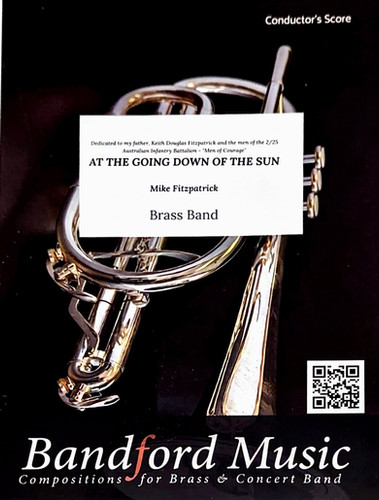
At the Going Down of the Sun (Brass Band) Mike Fitzpatrick
At The Going Down Of The Sun is a deeply moving musical tribute dedicated to the courage, resilience, and ultimate sacrifice of those who have defended the nation of Australia. Inspired by the heroic legacy of the 2/25th Battalion and their storied defense of the Kokoda Track during World War II, this composition serves as a solemn reminder of the immense gratitude owed to its fallen heroes. This piece is born from a legacy of service. It was composed in honor of Keith Fitzpatrick, who enlisted in the AIF on November 28, 1941. Keith served two tours in New Guinea, spending 359 days on the treacherous Kokoda Track. Keith Fitzpatrick lived to celebrate his 100th birthday in 2023, leaving behind a profound legacy through his wife of 67 years, Valda, and three generations of descendants. At The Going Down Of The Sun captures this spirit of endurance and devotion. It is an ideal addition to any program focused on: Anzac Day & Remembrance Day services Military Commemorations Historical Tributes To view a rolling score video of the work please visit www.youtube.com/watch?v=ydO9PKOKTpk Duration: 7.00 minutes Difficulty Level: 3rd Section + This PDF download includes the full score and parts. Sheet music available at www.brassband.co.uk (UK) or satradecentral.org (USA) Instrumentation: Soprano Cornet Eb Solo Cornet 1&2 Bb Solo Cornet 3&4 Bb Repiano Cornet Bb 2nd Cornet Bb 3rd Cornet Bb Flugel Horn Bb Solo Horn Eb 1st Horn Eb 2nd Horn Eb 1st Baritone Bb 2nd Baritone Bb 1st Trombone Bb 2nd Trombone Bb Bass Trombone Euphonium Bb Bass Eb Bass Bb Percussion Tubular Bells
In Stock: Estimated dispatch 1-3 working days
-
 £48.62
Perspectives from Gallipoli (Brass Band) Fendall Hill
This powerful and evocative work by Australian-New Zealand composer Fendall Hill pays tribute to the ANZAC soldiers who passed through Weymouth, Dorset during World War I. Inspired by first-hand accounts, the piece follows the emotional journey of a young soldier - from eager enlistment, through the harrowing Gallipoli campaign, to recovery and reflection in Weymouth. Structured in four movements, the music captures anticipation, fear, fierce resistance, and eventual healing, culminating in a moment of remembrance. The hymn tune Wareham -written by Dorset composer William Knapp - features prominently as a thematic thread, honouring the region's historical connection to the ANZAC legacy. A deeply moving addition to the brass band repertoire, this work is both a musical narrative and a heartfelt gesture of gratitude to the people of Dorset for their care and ongoing commemoration of the ANZACs. To view a performance of the work featuring ANZAC Brass please visit www.youtube.com/watch?v=diz9TRz7rwE Duration: approx. 8.00 minutes Difficulty Level: 1st Section + PDF download includes parts and score. Sheet music available at www.brassband.co.uk (UK) or www.cimarronmusic.com (USA) Instrumentation: Soprano Cornet Eb Solo Cornet Bb Repiano Cornet Bb 2nd Cornet Bb 3rd Cornet Bb Flugel Horn Bb Solo Horn Eb 1st Horn Eb 2nd Horn Eb 1st Baritone Bb 2nd Baritone Bb 1st Trombone Bb 2nd Trombone Bb Bass Trombone Euphonium Bb Bass Eb Bass Bb Timpani Percussion 1-3
In Stock: Estimated dispatch 1-3 working days
-
 £33.66
Menuet (Brass Band) Ravel arr. Rob Bushnell
Le Tombeau de Couperin (The Grave of Couperin) was written by Maurice Ravel between 1914 and 1917, originally a suite of piece for solo piano. Based on what was considered a traditional Baroque suite, Ravel wanted to pay homage to Baroque French keyboard music, whilst retaining his 20th-century chromaticism, making the work neoclassicist. Each movement is dedicated to the memory of a friend of the composer who died fighting in World War I. Ravel produced an orchestral version in 1919, omitting two of the original six movements. The Menuet was written in memory of Jean Dreyfus; Ravel had recuperated at his home. This arrangement is for the British-style brass band, with alternative parts for horns in F and bass-clef lower brass. A recording of the original composition can be found here: www.youtube.com/watch?v=jnNwEcBTSmk. Duration: Approx. 4 minutes Difficulty Level: 2nd Section + Duration: 4 minutes (depending on tempo and without any cuts) PDF download includes parts and score. Sheet music available at www.brassband.co.uk (UK) or www.cimarronmusic.com (USA) Instrumentation: Soprano Cornet Eb Solo Cornet Bb Repiano Cornet Bb 2nd Cornet Bb 3rd Cornet Bb Flugel Horn Bb Solo Horn Eb 1st Horn Eb 2nd Horn Eb 1st Baritone Bb 2nd Baritone Bb 1st Trombone Bb 2nd Trombone Bb Bass Trombone Euphonium Bb Bass Eb Bass Bb Timpani Percussion - Vibraphone & Glockenspiel
In Stock: Estimated dispatch 1-3 working days
-
 £35.00
A Manchester Tale. Andrew Duncan
Recommended - Championship & 1st Section A Manchester Tale depicts life in Manchester from the industrial revolution through to the 2nd World War and the rebuilding afterwards. Includes score & parts
-
 £29.95
When It Is Peace - Jonathan Bates
DURATION: 5 minutes. DIFFICULTY: 4th+. When it Is Peace was commissioned by Cold Ash Brass as a sombre, reflective featured work for their concet marking the centenary of the end of World War 1. The work was originally composed alongside choir, using text from local poets to the Thatcham area, and this version was later reworked as a stand-alone work for band.
In Stock: Estimated dispatch 1-3 working days
-
 £34.95
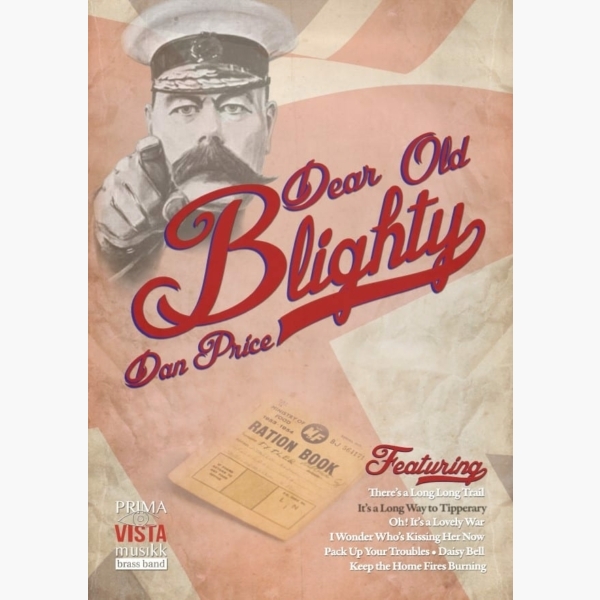
Dear Old Blighty - Dan Price
Commissioned in 2014 by the Flowers Band and premiered at the Cheltenham Music Festival in the same year, Dear Old Blighty is a creative arrangement of songs popular in 1914 and of those released during the World War I period....
Estimated dispatch 5-7 working days
-
£29.95
HEROES OF THE COMBAT (Brass Band Set) - Bramwell Coles
Published two years after the end of World War Two, the title of this march projects a dual symbolism of which the composer was so fond, earlier examples being The Flag of Freedom and Victors Acclaimed. The introduction of this march is more extended and subsequent strains demonstrate a trait loved by both Coles and Marshall; the shifting between triple and duple subdivisions of the beat within attractive melodies and accompaniments.
Estimated dispatch 7-14 working days
-
£29.95
VICTORS ACCLAIMED (Brass Band Set) - Bramwell Coles
Bramwell Coles became known as the Salvation Army 'march king' a label he began to earn with his first march written in 1906! This march, written in 1945 to mark the end of World War Two, saluted his seven children all of whom returned unscathed from service in the armed forces.
Estimated dispatch 7-14 working days