
Results
-
£94.95
The Maunsell Forts (Score and Parts)
The Maunsell Sea Forts are military defence structures from the Second World War, designed and built under the supervision of Guy Maunsell. There were three in Liverpool Bay, not far from Hilbre Island and now no longer extant, and five in the Thames E
Estimated dispatch 7-14 working days
-
£49.95
The Maunsell Forts (Score Only)
The Maunsell Sea Forts are military defence structures from the Second World War, designed and built under the supervision of Guy Maunsell. There were three in Liverpool Bay, not far from Hilbre Island and now no longer extant, and five in the Thames E
Estimated dispatch 7-14 working days
-
 £54.20
The Planets (War and Peace)
This series is for Brass Bands with a reduced number of playersThis series is without Repiano, 2nd Horn in Eb and 2nd TromboneParts included for:1 Eb Soprano Cornet5 Solo Bb Cornet3 2nd Bb Cornet2 3rd Bb Cornet1 Bb Flugel Horn1 Solo Eb Horn2 1st Eb Horn1 1st Bb Baritone2 2nd Bb Baritone (2nd Bb Trombone)1 1st Bb Trombone1 Bass Trombone2 Bb Euphonium2 Eb Bass2 Bb Bass1 Timpani2 Percussion/Drum SetOptional parts also included for:1 1st Trombone BC1 2nd Trombone BC1 Bass Trombone TC
Estimated dispatch 7-14 working days
-
 £59.95
Judd: The Holy War
Inspired by John Bunyan's allegory of the same name, the composer paints a sound picture of spiritual warfare between the forces of good and evil. Martin Luther's Reformation chorale Ein feste Burg (A Mighty Fortress is our God) serves as the rallying point for 'good' forces led by Mansoul. This brilliant score, A Salvation Army epic, serves as an example of marvellous invention, colourful scoring and compact formal symmetry.
Estimated dispatch 7-14 working days
-
 £54.95
Songs of the Great War (Brass Band - Score and Parts) - Wiffin, Rob
A Medley of Popular Songs, 1914 - 1918Music of the Great War is a five year project to use music of the period to educate and engage schools, colleges, town bands, and the wider public across the UK and the world to learn in a positive way about the events, the experience of the troops involved from all sides, and how music played its part.This year, to commemorate the centenary of the Great War a specially arranged medley Songs of the Great War has been created. The medley has been arranged for bands to rehearse and eventually perform on the 11 November 2015. It brings together some of the most popular tunes played, sung and performed by the men and women of the time - in the trenches and on the various home fronts.With the support of many countries and organisations, on the 11 November the medley will be first played in New Zealand and Australia. It will ripple east across the world being performed in countries like India and Pakistan before hitting Europe and onwards to include performances in Canada and the Caribbean. This could become one of the most played pieces of music in a 24-hour period.In Britain, there will be performances across the country, including some at key events and sites involving a wide range of military and non-military personnel.The medley includes:It's a Long Way to TipperaryYour King and Country Want YouGood Bye-eeOh! It's a Lovely WarHello! Hello! Who's Your Lady FriendTake Me Back to Dear Old BlightyMademoiselle from ArmentieresThere's a Long, Long Trail A-windingIf You Were the Only Girl in the WorldPack Up Your Troubles (In Your Old Kit Bag)Old Soldiers Never Die/Last Post
Estimated dispatch 7-14 working days
-
 £54.20
EVE OF WAR, The (Brass Band) - Wayne, Jeff - Jenkins, Christian
From War of the World. Grade: medium
Estimated dispatch 7-14 working days
-
 £76.99
Free World Fantasy (Brass Band - Score and Parts) - De Haan, Jacob
This piece was commissioned by the Dutch province of Groningen for the celebrations commemorating the liberation festivities in 1987. In the composition, the dream of a world without war is symbolized. It is the first composition in a series in which Jacob de Haan combines concert music with pop music in a style, which reminds one of film music. Later compositions in which he has reaped much success with the same formula in style are Oregon, La Storia and Utopia.Duration: 8.00
Estimated dispatch 7-14 working days
-
£60.99
The Longest Day - Paul Anka - Steven Verhaert
This classic 1962 war film about the landing of the Allied troops at the end of the Second World War is a historic link to the recent D-Day memorial. This upbeat march is a kind of cynical reference to the horror and madness of World War II at the time of the fall of the Third Reich.
Estimated dispatch 5-14 working days
-
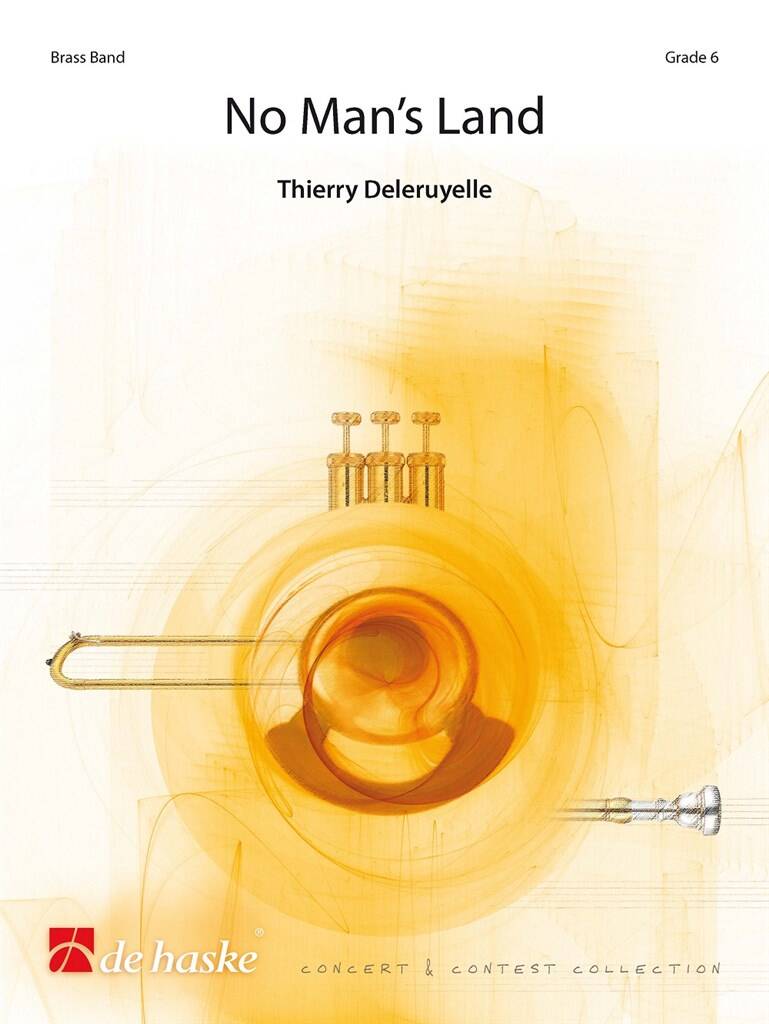 £144.99
No Man's Land - Thierry Deleruyelle
No Man's Land was commissioned by the 'Noordlimburgse Brass Band'. Thierry Deleruyelle has written this work in 2018, 100 years after the end of World War 1. This work is related to his first work written for brass band, Fraternity, which tells the story about the mining accident in Courieres, France. Countries such as Belgium and Germany helped France. Eight years later World War 1 broke out. Instead of helping each other, no man's land arose.
Estimated dispatch 5-14 working days
-
£60.99
Eventide (Song of Liberation) - Jacob de Haan
A composition with the liberation from the Second World War as its theme. After a solemn introduction one hears the melody of the hymn Abide with you, which was sung a lot during the war. Following there are variations on the theme, finally leading to the magisterial conclusion that represents the ultimate liberation.The work may be interpreted as popular music (with the part for drumset), but a more serious version without drums is possible and, indeed, preferable.
Estimated dispatch 5-14 working days
 View Music