
Results
-
 £44.95
Metropolis 1927 (Brass Band - B4 Score only)
Fritz Lang's 1927 science fiction epic Metropolis is considered to be a masterpiece of cinematic vision and a high point of German Expressionist filmmaking. Set in a future dystopian world the film introduces the viewer to two contrasting communities living in the vast city of Metropolis. Those above ground live a life of privilege and pleasure serviced by the underground-dwelling drone workers whose role is to maintain and operate the banks of machines which provide the city's power.Lang's film, which can be considered a type of 20th century morality play, draws upon a range of themes and influences from Marxist ideals and social satire to overt religious symbolism.The music does not attempt to precis the plot, such as it is, but simply reflects my musical responses to Lang's noirish visual style and set designs - the brooding machine rooms, the decadent nightclubs, the gothic cathedral and so on - paradoxically a world of terrifying beauty.Metropolis 1927 was commissioned by Bramwell Tovey and The National Youth Brass Band of Great Britain with funds provided by The Arts Council of England. The first performances took place in the Winter Gardens, Weston-super-Mare on Saturday 19th April and in the Cheltenham Town Hall on Sunday 20th April 2014.This revised version was premiered by The Black Dyke Band, conductor Nicholas Childs, at the 38th European Brass Band Championships in the Konzerthaus Freiburg, Germany, on Saturday 2 May 2015.Peter Graham
Estimated dispatch 7-14 working days
-
 £124.95
Metropolis 1927 (Brass Band - Score and Parts)
Fritz Lang's 1927 science fiction epic Metropolis is considered to be a masterpiece of cinematic vision and a high point of German Expressionist filmmaking. Set in a future dystopian world the film introduces the viewer to two contrasting communities living in the vast city of Metropolis. Those above ground live a life of privilege and pleasure serviced by the underground-dwelling drone workers whose role is to maintain and operate the banks of machines which provide the city's power.Lang's film, which can be considered a type of 20th century morality play, draws upon a range of themes and influences from Marxist ideals and social satire to overt religious symbolism.The music does not attempt to precis the plot, such as it is, but simply reflects my musical responses to Lang's noirish visual style and set designs - the brooding machine rooms, the decadent nightclubs, the gothic cathedral and so on - paradoxically a world of terrifying beauty.Metropolis 1927 was commissioned by Bramwell Tovey and The National Youth Brass Band of Great Britain with funds provided by The Arts Council of England. The first performances took place in the Winter Gardens, Weston-super-Mare on Saturday 19th April and in the Cheltenham Town Hall on Sunday 20th April 2014.This revised version was premiered by The Black Dyke Band, conductor Nicholas Childs, at the 38th European Brass Band Championships in the Konzerthaus Freiburg, Germany, on Saturday 2 May 2015.Peter Graham
Estimated dispatch 7-14 working days
-
 £45.00
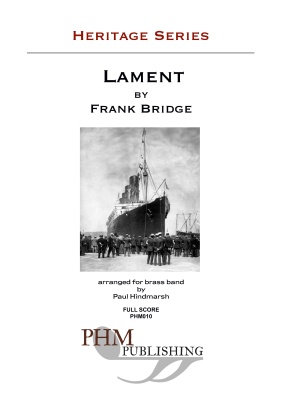
Lament (Brass Band - Score and Parts)
The English composer Frank Bridge (1879 - 1941) did not take an active part in the First World War. However, he was devastated by the slaughter on the western and the eastern fronts, especially the loss of so many of his musicians friends and colleagues. Writing in 1963, his former pupil Benjamin Britten confessed that 'a lot of my feelings about the First World War which people seemed to see in the War Requiem came from Bridge. He had written a piano sonata in memory of a friend killed in France and though he didn't encourage me to take a stand for the sake of a stand, he did make me argue and argue and argue. His own pacifism was not aggressive, but typically gentle'.Bridge composed this Lament for string orchestra on 14 June 1915, in memory of Catherine Crompton, who drowned when the Cunard liner Lusitania was torpedoed by a German submarine on 7 May, 1915. According to figures researched by Liverpool historian Kevin Roach (www.lusitania.net), 1201 men, women and children lost their lives out of the 1962 people aboard. Ninety-four children died, including Catherine, her twin brother Paul and four other siblings. Paul Crompton, Snr. (44), a British businessman working in Philadelphia, his wife Gladys (40) and the family nanny were also drowned. How Bridge's dedication came about is uncertain. The music critic Edwin Evans, who knew Bridge well, has written that the Catherine was a young friend. It is also possible that he came across the family photograph which was published in many newspapers in the wake of the tragedy. By that time, Bridge was greatly distressed by the war as a whole. It seems perfectly in keeping with his pacifist leanings and the strength of his reaction, that this poignant and deeply touching 'war memorial' should mourn a child who he did not know, rather than one of the thousands of young men who fell in battle.Through the musical tears of this melancholy lullaby, Bridge may have regarded the death of young Catherine Crompton as symbolic of the loss of so many innocent lives in wartime. His response to this personal tragedy was characteristically spontaneous and utterly sincere. It is one of his most effective miniatures, poignant yet restrained in its lyrical beauty, with a compelling directness and simplicity of construction.This brass band transcription is pitched one tone lower than the original for string orchestra.- Paul HindmarshDuration: 5.00
Estimated dispatch 7-14 working days
-
 £34.95
Escape Velocity (Brass Band - Score and Parts)
Escape Velocity is the scientific term for the speed at which a body overcomes the gravitational pull of another body. Thematically, the music seeks to capture the busyness and 'gravitational pull' of the fallen world and the struggle of the believer to overcome and escape into the restful presence of God. Eventually, the believer breaks free from the world, the work culminating in a presentation of the popular Hillsong anthem, 'I will run to you'.
Estimated dispatch 7-14 working days
-
 £50.00
Judd: Beulah Land
Wilfred Heaton began to assemble material for 'Beulah Land' in the early 1990s following a request from the Amsterdam Staff Band for a new work. Despite reminding himself on the manuscript that he should either complete or destroy the work before his death, ultimately he did not manage either. This edition was subsequently realised in 2003 for the tour of the USA Western States by the Amsterdam Staff Band. 'Beulah Land' is Heaton's vision of the joy that awaits the Christian in Heaven and, according to his family, is reminiscent of the kind of music he often improvised at the piano. The three movements are as follows; 1. Better World; a waltz sequence on the tune 'Zealley' to which the words 'There is a better world, they say' are sung.2. Heavenly Home; an elegiac cortege using the tunes 'My home is in Heaven', 'I have a home that is fairer than day' and 'The home over there'.3. Happy Land; Beginning in waltz rhythm this soon gives way to a sequence of free variations on the song 'There is a happy land, Far, far away'.
Estimated dispatch 7-14 working days
-
£35.00
Darkwood (Score Only)
Born in the Vale of Evesham, Worcestershire, Dan took a keen interest in music from an early age playing tuba and trombone with his local brass band. After leaving school he embarked on a 10 year career as a hotelier integrating it with a developing career as a freelance musician playing double bass, sousaphone and bass saxophone with big bands including the internationally Pasadena Roof Orchestra.In 2003, he enrolled in the Band Musicianship course at Salford University where he studied composition and arranging with Prof. Peter Graham. Dan's first test-piece An Elgar Portrait was selected as the 4th Section set work at the Swiss National Brass Band Championships in 2007 and again at the Pontins Championships the following year. He then went on to write the test-piece New World Sketches which was set as the 2nd Section test-piece for the British Regional Contests in 2009.In 2009, Dan became Composer in Association with the Cory Band, helping them with their winning programmes at several Brass in Concert Championships. In 2012 he became the Arranger in Association with Black Dyke Band and has been involved with many of the band's exciting projects including his arrangement of Recycled for the ground breaking multimedia campaign - Danger Global Warming Project and the band's collaboration with British composer Tolga Kashif in 2012 for his Olympic Anthem Let Your Light Shine.In 2015, Dan had a number of major works performed at International contests which included Realms of Asgard: Yggdrassil - a new test-work commissioned by Jaren Hornmusikkforening to be used as their choice work at the Norwegian Brass Band Championships, Ocean of Storms - an exciting new work for Grimethorpe Colliery Band's Brass in Concert programme and his test-piece Visions which was used as a 4th Section National Finals test-piece.Dan is currently working full time at the University of Salford, lecturing in Composition and Arranging. He continues to work as a freelance composer working with a number of leading soloists, brass and wind bands around the world.
Estimated dispatch 7-14 working days
-
 £74.95
Eden (Score and Parts)
This work was commissioned by the Brass Band Heritage Trust as the test piece for the final of the 2005 Besson National Brass Band Championship, held at the Royal Albert Hall, London.The score is prefaced by the final lines from Milton's epic poem Paradise Lost (completed in 1663), in which Adam and Eve, expelled from Paradise, make their uncertain way into the outside world:"...The world was all before them, where to chooseTheir place of rest, and providence their guide:They hand in hand with wandering steps and slow,Through Eden took their solitary way."My work is in three linked sections. In the first, the characters of Adam, Eve and the serpent guarding the Tree of Knowledge are respectively represented by solo euphonium, cornet and trombone. The music opens in an idyllic and tranquil mood and leads into a duet between euphonium and cornet. Throughout this passage the prevailing mood darkens, though the soloists seem to remain oblivious to the increasingly fraught atmosphere. A whip-crack announces the malevolent appearance of the solo trombone who proceeds to engage the solo cornet in a sinister dialogue.The second section interprets the Eden story as a modern metaphor for the havoc mankind has inflicted upon the world, exploiting and abusing its resources in the pursuit of wealth. Though certainly intended here as a comment on the present-day, it is by no means a new idea: Milton himself had an almost prescient awareness of it in Book I of his poem, where men, led on by Mammon:"...Ransacked the centre and with impious handsRifled the bowels of their mother earthFor treasures better hid. Soon had his crewOpened into the hill a spacious woundAnd digged out ribs of gold."So this section is fast and violent, at times almost manic in its destructive energy. At length a furious climax subsides and a tolling bell ushers in the third and final section.This final part is slow, beginning with an intense lament featuring solos for tenor-horn, flgel-horn and repiano cornet and joined later by solo baritone, soprano cornet, Eb-bass and Bb-bass.At one stage in the planning of the work it seemed likely that the music would end here - in despair. Then, mid-way through writing it, I visited the extraordinary Eden Project in Cornwall. Here, in a disused quarry - a huge man-made wound in the earth - immense biomes, containing an abundance of plant species from every region of the globe, together with an inspirational education programme, perhaps offer a small ray of hope for the future. This is the image behind the work's conclusion and the optimism it aims to express is real enough, though it is hard-won and challenged to the last.John Pickard 2005
Estimated dispatch 7-14 working days
-
 £29.50
Eden (Score Only)
This work was commissioned by the Brass Band Heritage Trust as the test piece for the final of the 2005 Besson National Brass Band Championship, held at the Royal Albert Hall, London.The score is prefaced by the final lines from Milton's epic poem Paradise Lost (completed in 1663), in which Adam and Eve, expelled from Paradise, make their uncertain way into the outside world:"...The world was all before them, where to chooseTheir place of rest, and providence their guide:They hand in hand with wandering steps and slow,Through Eden took their solitary way."My work is in three linked sections. In the first, the characters of Adam, Eve and the serpent guarding the Tree of Knowledge are respectively represented by solo euphonium, cornet and trombone. The music opens in an idyllic and tranquil mood and leads into a duet between euphonium and cornet. Throughout this passage the prevailing mood darkens, though the soloists seem to remain oblivious to the increasingly fraught atmosphere. A whip-crack announces the malevolent appearance of the solo trombone who proceeds to engage the solo cornet in a sinister dialogue.The second section interprets the Eden story as a modern metaphor for the havoc mankind has inflicted upon the world, exploiting and abusing its resources in the pursuit of wealth. Though certainly intended here as a comment on the present-day, it is by no means a new idea: Milton himself had an almost prescient awareness of it in Book I of his poem, where men, led on by Mammon:"...Ransacked the centre and with impious handsRifled the bowels of their mother earthFor treasures better hid. Soon had his crewOpened into the hill a spacious woundAnd digged out ribs of gold."So this section is fast and violent, at times almost manic in its destructive energy. At length a furious climax subsides and a tolling bell ushers in the third and final section.This final part is slow, beginning with an intense lament featuring solos for tenor-horn, flgel-horn and repiano cornet and joined later by solo baritone, soprano cornet, Eb-bass and Bb-bass.At one stage in the planning of the work it seemed likely that the music would end here - in despair. Then, mid-way through writing it, I visited the extraordinary Eden Project in Cornwall. Here, in a disused quarry - a huge man-made wound in the earth - immense biomes, containing an abundance of plant species from every region of the globe, together with an inspirational education programme, perhaps offer a small ray of hope for the future. This is the image behind the work's conclusion and the optimism it aims to express is real enough, though it is hard-won and challenged to the last.John Pickard 2005
Estimated dispatch 7-14 working days
-
 £45.00
Blue Thunder
Commissioned in 2013 by the National Children's Band of Great Britain for their 10th Anniversary, Blue Thunder takes inspiration from the fast and noisy world of steam locomotives. The Mallard 4468 is a LNER Pacific steam locomotive and was famous for setting the world land speed record (126mph). Blue Thunder (a reference to the train's colour and lightning speed) also marks the 75th anniversary of this world record. The music imitates the sounds and excitement of a steam train on its journey, with added choreography to add some visual excitement. Listen: Duration: 00:04:45 Grade 3.5
Estimated dispatch 5-7 working days
-
 £15.00
Capriccio Italiane - Tchaikovsky
Programme Notes by Andrew Duncan:This arrangement is fairly simple and the strong melodic and rhythmic lines should help introduce inexperienced players to the concept of playing in 3 time. The triplets in the 3rd cornet/trumpet part and the 1st Baritone/Euphonium/Trombone part (and in the tambourine part) are played in unison and will greatly help to move the rhythm forward.The tune is in the 1st cornet/trumpet part up until letter B when it is played by the horns (in unison) and in harmony by the 1st Baritone/Euphonium/Trombone part, so there is plenty for all to play throughout the piece.The Percussion part is written for a Tambourine, and although it is optional, it would add colour to a performance of the arrangement.The Flexi-Collection ApproachFlexible scoring tailored to your needs - A perfect solution for expanding the repertoire of training and junior brass bands. The Flexi-Collection currently offers two series - Popular Classics and World Tour. Based on four-part harmony, these collections provide groups with the advantage of complete flexibility when they may not be balanced. If players or instruments are missing, the show can still go on!The Flexi-Collection - Popular Classics Series, encapsulates all that is great about the wonderful range of musical styles produced by Holst, Elgar, Handel, Verdi, Tchaikovsky, Grieg, Bizet and Parry.The thoughtful scoring and arranging by Andrew Duncan now means that groups of all abilities have access to a truly flexible set of music for their needs. With world parts, rudimentary theory, terminology translations and large format typesetting, The Flexi-Collection ticks all the boxes when it comes to bringing interesting music to the training and junior band/brass group environment.Available individually or as part of the money-saving Flexi-Collection Popular Classics Album. Scored for Brass Band and supplied with additional Easy Bb, Easy Eb and world parts - The Flexi-Collection offers flexibility in every sense of the word.
In Stock: Estimated dispatch 3-5 working days