
Results
-
 £68.90
Jodrell Bank - P. Yorke - J.B. Ham
The title refers to the big radio telescope at Jodrell Bank in England. This composition is not exactly a symphonic poem, although it tries to give a musical portrait of eternity and infinity. 'Jodrell Bank' is a real classic of the brass band repertoire with its romantic style, its impressive climaxes alternating with quiet pauses and its sparkling finale. Peter York was above all a composer of film and theatre music and was very active in the world of entertainment and light music. Yet he had one musical hobby: composing for brass band even if he had no links at all with the brass band world. At first, he signed his brass band compositions with the pen name Ivor Gould but later used his own name. Among his most important compositions are The Shipbuilders Suite, Gallions Reach and Jodrell Bank.
Estimated dispatch 5-14 working days
-
£76.99
Durkle Bandrydge Suite - Bruce Fraser
Durkle Bandrydge is the name of the composers imaginary world, but it could very well be anyones invisible dream world with a different name. In this very versatile suite by Bruce Fraser, 8 characters are featured, each with its ownpeculiarities, making Durkle Bandrydge such a colourful place. Do these characters differ that much from us? That is for you to find out! In the last part, all characters come together in a special way.Durkle Bandrydge exists at the end ofyour street. It is invisible to humans, but Durkle Bandrygators can watch us with great interest. The music will introduce you to some of the characters who live in this unusual place. The parts: Somnanbulyss, who is a giant trollguarding the entrance to Durkle Bandryde. At least, he is supposed to, but he tends to sleep most of the time. His music is therefore very slow moving and sleepy. Long Gwysteen is a tall, mysterious, and somehow sophisticated character,who walls around with a shell on his back. His music glides along rather gracefully. Squelfitch is a rather unpleasant and smelly character who lives in a bog, which is why his music sounds rather slimy and a bit like trying to walkthrough quicksand. Perfydlia is a meddling old woman, who gossips about everybody and squeals with sudden delight at the small exciting bits of tittletattle about others in the village. In the music you can hear her sudden little squealsof delight. Maryann Lovely is a beautiful young lady, graceful, gorgeous, absolutely devine, and her music is obviously just the same. Thistledoo Nicely is a lively character who spends and spends and spends with her credit card,buying the latest fashion and never worries about having to pay the bills. Her music reflects her excitement when shopping and het 'happy go lucky' approach to life. Marsyn Edginton is the Lord of the manor, the richest man in town, the'big cheese', the man with all the power and, of course, the biggest house. He is very grand and his music like he could be a king. Jimmy McScotsmyn is a red haired scotsman wearing tartan cap. He misses his home country terribly and eatslots of shortbread, oatcakes, scotch eggs, porridge and drinks an enormous amount of Scotch Wisky, which helps him to have fond memories of the kind of music he would like to dance to when he was a younger man. His favourite dance is a Jig andthis is the music he remembers. Grand March of the Durkle Bandrydgators. We hope that you have enjoyed meeting these characters from Drukle Bandrydge and would invite you to listen to all the villagers now march along in a grand parade -it is a pity that you can not see them, what is a wonderful sight. If you listen carefully, you will hear the melodies which belong to the characters as they march past. Oh what a grand spectacle!
Estimated dispatch 5-14 working days
-
 £60.99
Brass Fire - Thomas Doss
This sparkling composition by Thomas Doss, full of energy and playfulness, was commissioned by the National Youth Brass Band of Switzerland. Bursting with enthusiasm and freshness, it's exactly what you'd expect from a band brimming with young talent.With its infectious rhythms, brilliant tonal colors, and vibrant dynamics, this composition is ideal as a festive concert opener. It also makes the perfect whirlwind encore, allowing both musicians and the audience to end the concert on a high note.A composition that celebrates the strength, vitality, and future of the brass band world - enjoy listening!
Estimated dispatch 5-14 working days
-
 £87.99
Black Gold - Thierry Deleruyelle
Black Gold was commissioned by Musikverein 1891 "Harmonie" Saarwellingen e.V. (Germany) to mark its 130th anniversary. This composition pictures the history of the mining industry in the town of Saarwellingen and its surrounding region, where the life of the miners as well as their families revolved around coal, or black gold, for centuries on end. The piece is based on motifs from the famous song "Gluck auf, Gluck auf, der Steiger kommt..." ("Good luck, good luck, the mining foreman comes"), a veritable anthem for miners the world over.
Estimated dispatch 5-14 working days
-
 £49.99
Journey To The Past - Stephen Flaherty - Christopher Bond
Step into an enchanting world of nostalgia with the compelling sounds of Journey To The Past, a wonderful little gem by Stephen Flaherty, magically arranged for brass band by Christopher Bond. This song, originally composed for the popular animated film Anastasia, tells a story of hope, discovery and finding one's true self. The warm brass band sounds add a new dimension, infusing each note with emotion and passion.
Estimated dispatch 5-14 working days
-
 £134.99
Crazy Twenties - Thierry Deleruyelle
Crazy Twenties takes place in the 1920s, a decade otherwise known as the "Roaring Twenties". This work retraces an exceptional period in social, cultural and artistic terms, when a new generation dreamt of a new world. The work opens with a bright and lively movement, followed by a nostalgic interlude. A gracious slow movement accompanies the Parisian district of Montparnasse. Written in the style of an unstable blues, the next movement evokes characters sipping their Bloody Marys in a cafe. The final movement is a fugue with the main motif as the subject.
Estimated dispatch 5-14 working days
-
 £94.99
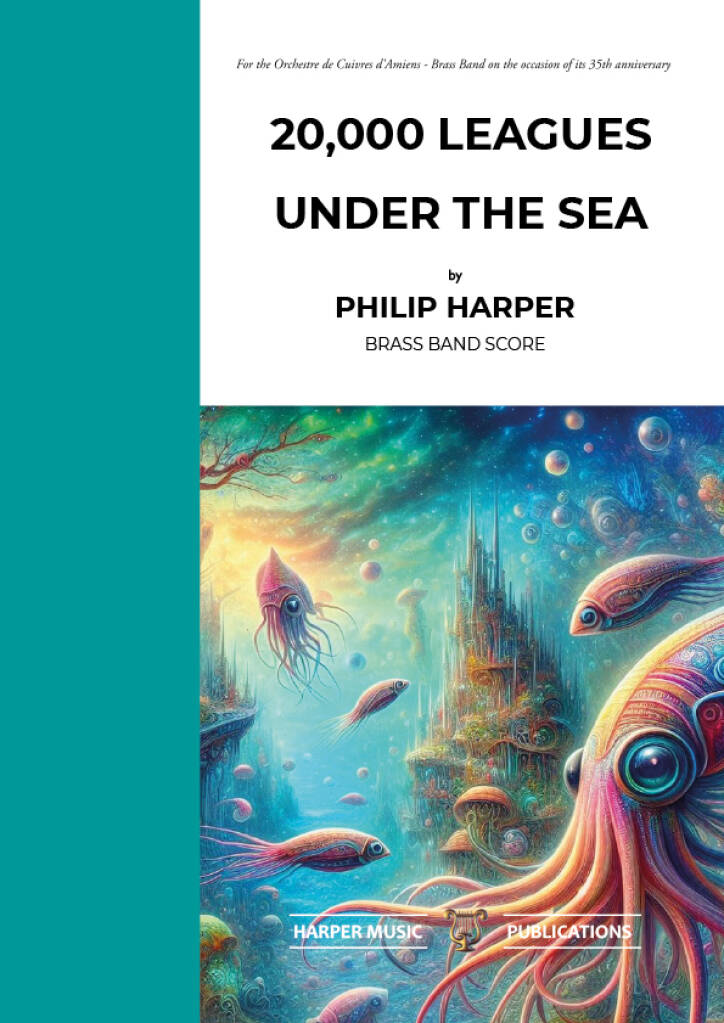
20,000 Leagues under the Sea - Philip Harper
Frenchman Jules Verne was a pioneer in science fiction during the late 19th Century, penning some classic stories such as Journey to the Centre of the Earth and Around the World in 80 Days - both of which have already been the subject of brass band test-pieces. It was therefore natural for me to choose Verne's 1869 watery magnum opus as the subject for this piece to which there are five sections, as well as an introduction and a finale.I. THE NAUTILUS. After a mysterious introduction we are introduced to The Nautilus - a fantastical submarine.II. THE CORAL KINGDOM. We visit awe-inspiring underwater coral formations.III. SQUID ATTACK. The Nautilus is attacked by a school of giant squid, or 'devilfish'.IV. CAPTAIN NEMO. Captain Nemo is a loner and an eccentric. Some say he is a madman. Soloists of the band help to uncover the character of this enigmatic but powerful figure.V. MAELSTROM. The Nautilus is dragged into the ocean's deadliest whirlpool but Captain Nemo lives to fight another day.
Estimated dispatch 5-14 working days
-
 £69.00
Bella Ciao - Manu Pilas - Jan van Kraeydonck
Bella Ciao is an Italian battle song, which became popular in Italy during World War II among partisans resisting fascism and national socialism. The song became a global resistance song against oppressive powers. In 2018, the song became known again through the Spanish Netflix series La Casa de Papel, in which the song was used multiple times. Jan van Kraeydonck wrote a skillful arrangement for concert band, fanfare and brass band.
Estimated dispatch 5-14 working days
-
 £94.99
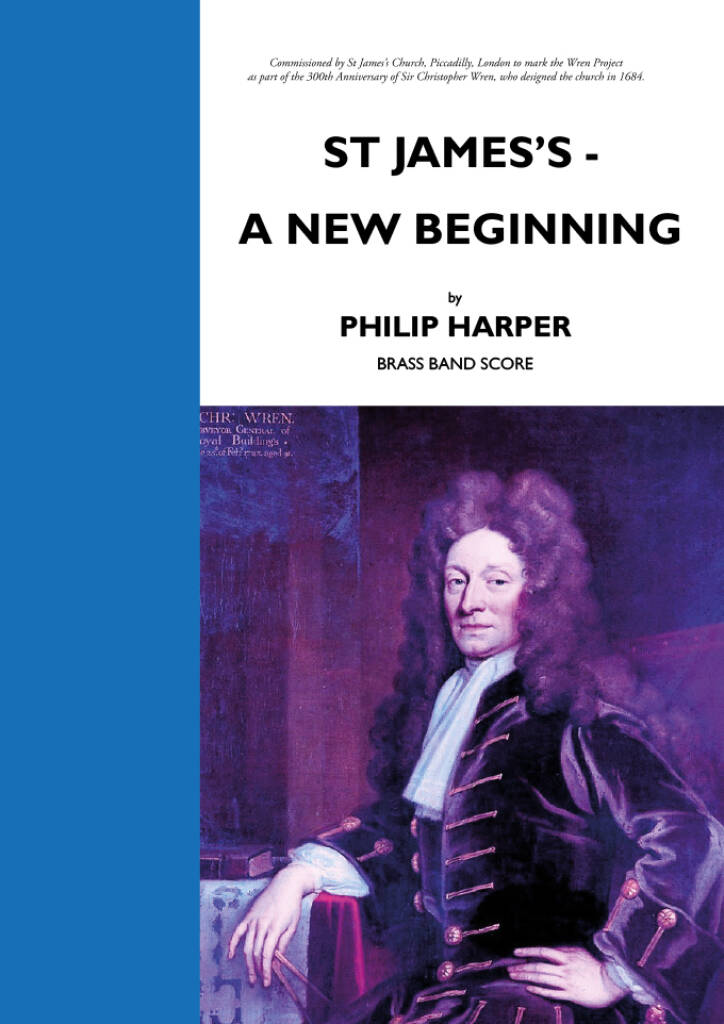
St James's - A New Beginning - Philip Harper
St James's - A New Beginning commemorates 300 years since the death of English architect Sir Christopher Wren who redesigned and rebuilt London after the Great Fire in 1666. It was used as the test-piece for the National Brass Band Championships of Great Britain (1st Section) in 2023.The piece is in four parts:I. THE GREAT FIREII. AFTERMATHIII. VISIONIV. RENAISSANCEThe bells ring the alarm and, as the capital city is engulfed by flames, panic and desperation spread. As the fire burns out, we are left to contemplate the aftermath of the inferno. Enter Sir Christopher Wren. His vision and courage were some of the most influential forces in the rebuilding of London which rose to reclaim its place as one of the great cities of the world.
Estimated dispatch 5-14 working days
-
 £91.99
Hermitage - Jan de Haan
Jan de Haan drew inspiration for this work from five paintings exhibited in The Hermitage in Saint Petersburg, one of the largest and most versatile museums in the world. He used the melodious Andante cantabile from the String Quartet Op. 11 by the Russian composer Pyotr Ilyich Tchaikovsky as its starting point. Thus, he created his own musical painting, which is just as varied as the underlying canvases - from Cheerful Company by Dirck Hals to Dance II by Henri Matisse. A true work of art!
Estimated dispatch 5-14 working days
 View Music