
Results
-
 £95.00
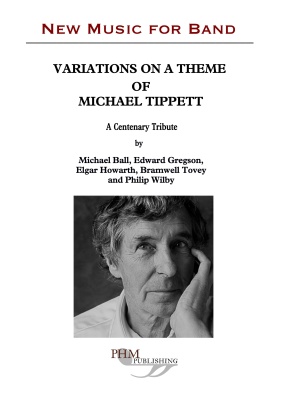
Variations on a Theme of Michael Tippett (Brass Band - Score and Parts)
A Centenary Tribute by Michael Ball, Edward Gregson, Elgar Howarth, Bramwell Tovey and Philip WilbyThis unique 'pice d'occasion' arose out of a telephone conversation in 2004 with Alan Wycherley, who was the soprano cornet player of the Foden's Richardson Band at the time. He indicated that the band would like to include an original birthday tribute for Edward Gregson (60) and Elgar Howarth (70) in its concert at the 2005 RNCM Festival of Brass in Manchester. I have been Artistic Director of Manchester's Festival of Brass since it was established in 1990 as a BBC Radio 3 series, As the centenary of the birth of Sir Michael Tippett fell on 5 January 2005, I devised this collective work as a way of embracing all three anniversaries in a novel way.The idea of joint compositions is not a new one in the classical music world. In the 1860s, Verdi was joined by a number of his contemporaries in a Requiem Mass for Rossini. In this country there have been a number of orchestral examples over the past fifty years, but never before for the brass band. Although Tippett composed only one work for brass band, Festal Brass with Blues, his orchestral works and operas are full of idiomatic brass writing. The theme I chose for this celebration is one of Tippet's most memorable miniatures featuring wind and brass. In the opera Midsummer Marriage it marks the entry of the Ancients. It is also included in the orchestral Suite in D (1948), for the Birthday of Prince Charles.I invited five of the leading contemporary voices in brass band music to add their own creative perspectives to the little Tippett theme, with it's characteristic rhythms, embellishments and modality - the Lydian mode. Each contribution was designed to fit into a tonal and formal template to give the whole work a flow and continuity. In Danse des Amis, Bramwell Tovey has composed a jazzy, humorous variation. Inspiration came from Tippett's love of jazz and, more personally, from the characteristically syncopated gait of the distinguished music critic John Amis, who Tovey once observed leaving a performance of Tippett's opera King Priam before the end. Incidentally, that performance was conducted by Elgar Howarth.We hear Edward Gregson in lyrical mode. His Midsummer Song is redolent of the sound world of Tippett's opera A Midsummer Marriage and it ends with a brief reference to a favourite of Gregson's, Tippett's Concerto for Orchestra. Michael Ball provides a brief moment of light, airy activity bringing to mind perhaps Tippett's love of Shakespearian fantasy, especially The Tempest. Elgar Howarth juxtaposes a slowed down version of the processional theme with distant recollections of fanfares from King Priam. Philip Wilby has rounded the tribute off with a spectacular fugue. During its inexorable progress Wilby ingeniously introduces the two other birthday references - the three-note musical signature that Elgar Howarth includes in much of his music and the characteristic theme which begins Edward Gregson's substantial work for brass an organ The Trumpets of the Angels. An elaborated reprise of Tippett's little theme is followed by a dynamic coda.- Paul HindmarshDuration: 13.00
Estimated dispatch 7-14 working days
-
£40.00
Variations on a Theme of Michael Tippett (Brass Band - Score only)
A Centenary Tribute by Michael Ball, Edward Gregson, Elgar Howarth, Bramwell Tovey and Philip WilbyThis unique 'pice d'occasion' arose out of a telephone conversation in 2004 with Alan Wycherley, who was the soprano cornet player of the Foden's Richardson Band at the time. He indicated that the band would like to include an original birthday tribute for Edward Gregson (60) and Elgar Howarth (70) in its concert at the 2005 RNCM Festival of Brass in Manchester. I have been Artistic Director of Manchester's Festival of Brass since it was established in 1990 as a BBC Radio 3 series, As the centenary of the birth of Sir Michael Tippett fell on 5 January 2005, I devised this collective work as a way of embracing all three anniversaries in a novel way.The idea of joint compositions is not a new one in the classical music world. In the 1860s, Verdi was joined by a number of his contemporaries in a Requiem Mass for Rossini. In this country there have been a number of orchestral examples over the past fifty years, but never before for the brass band. Although Tippett composed only one work for brass band, Festal Brass with Blues, his orchestral works and operas are full of idiomatic brass writing. The theme I chose for this celebration is one of Tippet's most memorable miniatures featuring wind and brass. In the opera Midsummer Marriage it marks the entry of the Ancients. It is also included in the orchestral Suite in D (1948), for the Birthday of Prince Charles.I invited five of the leading contemporary voices in brass band music to add their own creative perspectives to the little Tippett theme, with it's characteristic rhythms, embellishments and modality - the Lydian mode. Each contribution was designed to fit into a tonal and formal template to give the whole work a flow and continuity. In Danse des Amis, Bramwell Tovey has composed a jazzy, humorous variation. Inspiration came from Tippett's love of jazz and, more personally, from the characteristically syncopated gait of the distinguished music critic John Amis, who Tovey once observed leaving a performance of Tippett's opera King Priam before the end. Incidentally, that performance was conducted by Elgar Howarth.We hear Edward Gregson in lyrical mode. His Midsummer Song is redolent of the sound world of Tippett's opera A Midsummer Marriage and it ends with a brief reference to a favourite of Gregson's, Tippett's Concerto for Orchestra. Michael Ball provides a brief moment of light, airy activity bringing to mind perhaps Tippett's love of Shakespearian fantasy, especially The Tempest. Elgar Howarth juxtaposes a slowed down version of the processional theme with distant recollections of fanfares from King Priam. Philip Wilby has rounded the tribute off with a spectacular fugue. During its inexorable progress Wilby ingeniously introduces the two other birthday references - the three-note musical signature that Elgar Howarth includes in much of his music and the characteristic theme which begins Edward Gregson's substantial work for brass an organ The Trumpets of the Angels. An elaborated reprise of Tippett's little theme is followed by a dynamic coda.- Paul HindmarshDuration: 13.00
Estimated dispatch 7-14 working days
-
 £70.00
Bella Ciao - Traditional/Henk Ummels
The origin of Bella ciao is uncertain. Possibly it is derived from an older song on the same melody, also called Bella ciao, about the abuses in the rice harvest in northern Italy in the 19th century, where lower-class women performed poorly paid seasonal work under barbaric conditions. In 2018 the song became known again by the television series La casa de papel, in which the song was used multiple times. It was sung among others by the characters El Profesor and Berlin.
Estimated dispatch 10-14 working days
-
 £38.95
Unity Series Band Journal - Numbers 474 - 477, February 2019
474: Prelude - Tell me the old, old story (Munashe Chikwezvero)Arabella Hankey's verses (S.A.S.B. 150) were originally written in 1866 while the author was recovering from a serious illness. The music was then added by William Howard Doane in 1868. This prelude comes to us from a Salvationist composer from the Hunyani Corps in the Zimbabwe Territory.475: My Redeemer lives (Marcus Venables)This lively arrangement of My Redeemer lives (S.A.S.B. 223) was written for the North York Temple Junior Band. The music is designed to emulate the more challenging Salvation Army band pieces to which younger musicians might aspire, as well as being a joyful announcement of our Redeemer's resurrection.476: Filte (Roger Trigg)Filte (FAHL-cheh) is the Irish word for welcome. This music was written to commemorate the start of The Salvation Army's work in Ireland. It features the tune The Eden Above (T.B. 503) which is purported to be the first song performed by a Salvation Army delegation on Irish soil. The next hymn presented is King of kings, majesty (S.A.S.B. 376) which has been a significant song in the life of Belfast Citadel Corps in its more recent past. The piece closes with the confident music of the song I believe we shall win (S.A.S.B. 990).477: Chorus Arrangement - Follow, I will follow thee (Morgan Juel Stavik)This is a gentle setting of H.L. Brown's melody Follow, I will follow thee.
Estimated dispatch 7-14 working days
-
 £38.95
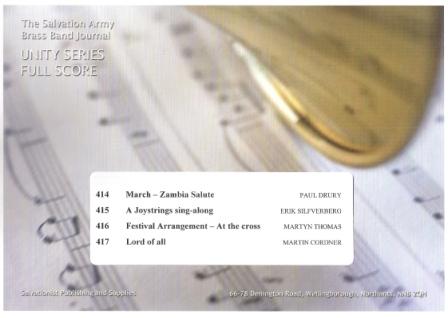
Unity Series Band Journal February 2014 Numbers 414-417
No.414 March - Zambia Salute (Paul Drury)In April 2009, a group from Chelmsford Citadel Corps visited Zambia. The purpose of the visit was to assist in the leadership of the Zambian Territorial Music School, held at Chikankata. This march was written to commemorate the event and received its premiere performance at the final festival. The melody featured is the chorus of the song, I know not why Dod's wondrous grace (S.A.S.B. 730).No.415 A Joystrings sing-along (Erik Silfverberg O.F.)This piece represents the first published work since the sudden Promotion to Glory of Bandmaster Erik Silfverberg O.F. The Joystrings made Salvation Army history about fifty years ago, introducing rock music on the Christian music scene. Many of their songs have become classics and have been used as thematic material in our brass music. Here is a selection of three of their songs, to be used either as a band piece or as accompaniment to a sing-along. The three songs are:- 'I want to sing it', 'It's an open secret' and 'Have faith in God'.No.416 Festival Arrangement - At the cross (Martyn Thomas)The well-known song, 'At the cross' (T.B. 580), is given a lively new setting by Martyn Thomas. The rock and swing treatment of this old melody should appeal to many!No.417 Lord of all (Martin Cordner)This piece was written for the 120th Anniversary of Balham corps (London Central Division) in 2011. In terms of a theme, the anniversary occasion prompted the primary thought that the piece should first be a praise-offering to God, acknowledging him for who he is. Therefore songs referenced in the piece are praide songs: 'Lord, reign in me', 'He is Lord', 'All hail the Lamb', along with a song of testimony, 'I'm a soldier bound for Glory' (T.B. 382),which speaks of the Christian hope in Heaven and challenges Salvationists to influence others by living out that hope. There is also a brief reference to the National Anthem of the Democratic Republic of Congo (4 bars before D)- man acknowledgement to the faithfulness of corps soldiers who in recent years have arrived from that country.
Estimated dispatch 7-14 working days
-
 £59.95
Judd: Caelum Corona - Stephen Bulla
Stephen Bulla's 'Caelum Corona' ('Crown of Heaven') portrays, in sound, a Christian's walk in faith, intended metaphorically via a musical narrative reminiscent of the early church pilgrims, their struggles and triumphs. The composer initially evokes the atmosphere of Rome at the time of St. Paul and other martyrs, thus the Latin title. Bulla marks his imaginative tone poem with dark, brooding music in the first two of three parts, in each of which he has embedded an appropriate hymn or song reference as thematic material. The first of these sounds in a minor key following a symphonic exposition made up primarily of fanfare-like motives, the music at times quite harsh and abrasive. The song is Paul's statement of exuberant faith (2 Timothy 1:12) in the midst of prison and persecution: 'For I know whom I have believed, and am persuaded that he is able to keep that which I've committed unto him against that day.' More challenging, aggressive music returns until a further point of reflection on Christ's sacrifice is reached. The music graphically evokes the barren landscape of Golgatha, the horror of the crucifixion, including stark wind sounds, a loss of stability via eerie, dissonant chord clusters, and even the nails being driven into Christ's body. The Baritones and then Flugel Horn softly play 'He died of a broken heart.' Yet the Christian life, despite its perils - both at the time of Paul and now - is a victorious life, and the composer resolves the tensions of the work in a scintillating finale, a brilliant setting of the old song about spiritual warfare and the ultimate triumph of Christ the King: 'Victory for me!' (T.B. 841). The chorus of that tune proclaims: 'No retreating, hell defeating, shoulder to shoulder we stand; God look down, with glory crown our conq'ring band.' That crowning is the same one sought and claimed by St. Paul (2 Timothy 4:8): 'Now there is in store for me a crown of righteousness, which the Lord, the righteous judge, will award me on that day, but also to all who have longed for his appearing.' Believers look forward to participating in the final coronation of their Saviour - King of Kings and Lord of Lords - while humbly desiring their own 'crown of heaven.'
Estimated dispatch 7-14 working days
-
 £39.95
Snow White Selection
Includes: Some Day My Prince Will Come; Whistle While You Work; I'm Wishing; Heigh-Ho; With a Smile and a Song; Silly Song; One Song.
Estimated dispatch 7-14 working days
-
£70.00
Milestone - Peter Meechan
Milestone is a concerto commissioned by Mark Wilkinson (with funds provided by the Arts Council England) to celebrate 21 years as Principal Cornet with Fodens Band. In three movements, the work is intended to not only demonstrate the soloistas virtuosic skills, but also his ability to communicate to the audience.The first movement, titled Milestone, combines sections of driving rhythms (intended to represent Markas years of continuing hard work), in the accompaniment with long legato phrases from the soloist interspersed with dexterous, virtuosic, passages.The second movement, Song, features a simple chord sequence, over which the soloist asingsa a melody, each time varying and each time becoming more expressive, leading to an emotional climax.The final movement, Twenty One, is a quasi-celebratory dance. Opening with the band clapping, the soloist weaves their way through the various textures in the band. Occasionally making both a musical and metaphorical nod to the industrious nature of the first movement, the chord sequence of the second movement also re-appears, before a brief coda takes us to the conclusion of the work.
Estimated dispatch 12-14 working days
-
Diamonds - Jerry Lordan - Len Jenkins
In November 1962, ex-Shadows members Jet Harris and Tony Meehan decided to work as a duo and went to No 1 with a Jerry Lordan composition, "Diamonds". Harris, a bass player, took an ordinary Fender guitar and detuned every string a whole tone to enable him to hit notes which were lower than an ordinary guitar. However, it was apparently difficult to work with on stage since once the strings were slackened they would go out of tune very easily. The duo went on to have a second Top 10 hit with "Scarlett O'Hara" which is also available from Wobbleco Music in an arrangement for brass band. Both arrangements seek to capture the characteristic style of 60's rock music and retain the signature drum solos for which they are rightly remembered. But in addition, both pieces also appeal to a younger generation who may not have heard the originals. Our young kit drummer in Woburn Sands 'A' Band commented "...the (drum) part has the slightest shuffle feel to it, which improves the groove of the song, and to replicate the vintage snare-drum sound, I have heard that you can place a towel or a cloth over the head of the drum. I think it would work well...(otherwise) the drum part stays relatively simple and repetitive"...Chance to re-create the sound of the 60's.....Go for it!
-
 £33.66
Love Eternal (Cornet/Flugel Solo with Brass Band) Jarrod Cooper arr. Lamplough
Love Eternal was written by Gavin Lamplough for Neil Blessett, who at the time of writing was the Principal Horn player of both Birmingham (UK) Citadel Band and the International Staff Band of The Salvation Army. After popular demand, it was set as a cornet or flugel horn solo, both with piano accompaniment and this version with brass band. The arranger uses Jarod Cooper's popular contemporary worship song King of Kings, Majesty as the basis for the work and the piece seeks to provide a vehicle for the rich timbres of the tenor horn to be enjoyed by the listener. The music reflects the Christian musician's desire to offer their talents to God to be used by Him, and the lyrics of the song are ones of contrast as the musical journey of this piece seeks to emulate the juxtaposition through contrasting moods. To view a video of Helen Williams performing the solo (version with piano accompaniment) please visit www.youtube.com/watch?v=ww3B06TBKMM PDF download includes score and parts. Sheet music available from: UK - www.brassband.co.uk USA - www.cimarronmusic.com Difficulty Level: 4th Section + Length: 5.00 minutes Instrumentation: Cornet/Flugel Horn Soloist Bb Soprano Cornet Eb 1st Cornet Bb 2nd Cornet Bb Flugel Horn Bb 1st Horn Eb 2nd Horn Eb 1st Baritone Bb 2nd Baritone Bb 1st Trombone Bb 2nd Trombone Bb Bass Trombone Euphonium Bb Bass Eb Bass Bb Percussion 1-3
In Stock: Estimated dispatch 1-3 working days
 Listen to MP3
 View Music