
Results
-
Bernie's Song - Miller/Leiber/Stoller ver.Mulligan, arr.John Dankworth - Len Jenkins
Bernie's Tune is a 1953 jazz standard with music written by Bernie Miller and lyrics by Jerry Leiber and Mike Stoller. It was popularised through a recording by the quartet of the American saxophonist and composer Gerry Mulligan, and the tune was a popular choice for musicians jamming at the time. Information about the composer is scarce. All that people really know of him is that he was a piano player from Washington DC. Gerry Mulligan's version was subsequently arranged by the late, legendary John Dankworth and this arrangement for brass band has been faithfully based on it to evoke the atmosphere of that golden era.
-
 £45.00
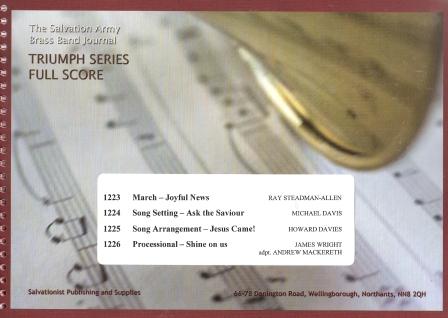
Triumph Series Band Journal March 2012 Numbers 1223-1226
No.1223 March - Joyful News (Ray Steadman-Allen)the composer freeli admits that it was probably 'doodling' on the piano that prompted this march! The title is linked to one of the incorporated tunes, 'My bonnie lies over the ocean' which, in The Salvation Army, is linked to the words, 'God's love is as high as the heavens'. In style, the march has a light swing feel.No.1224 Song Setting - Ask the Saviour (Michael Davis)A setting of the well-known melody, 'Yield not to temptation'.No.1225 Song Arrangement - Jesus Came! (Howard Davis)An arrangement of an old Salvation Army song, 'Jesus came with peace to me, His strong arm was stretched to me, Then my burden took from me - My Saviour'.No.1226 Processional - Shine on us (James Wright adapted by Andrew Mackereth)This bolero-style setting of Michael W Smith's anthem was originally made for s wedding at Sheffield Citadel. It was subsequently adapted for use at the Belfast Temple Music School when players entered the arena in groups, through several entrances, playing from memory.
Estimated dispatch 7-14 working days
-
 £40.00
A Song for Bram (Brass Band - Score and Parts) - Gregson, Edward
A Song for Bram is a short work, originally composed piano and brass band, and is dedicated to the memory of Bramwell Tovey, a close friend and colleague of the composer, and a conductor, composer, pianist and musician of huge talent, who sadly passed away before his time in the summer of 2022. In this short piece the composer has tried to imagine what kind of tune Bram would have improvised at the piano, something he frequently engaged in. No doubt it would have been a mixture of bluesy jazz, hymn tune, and love song, and this is how the solo piano takes off. In the middle section of a what is a simple tertiary structure, introduced are quotes from two hymn tunes Bram particularly loved, never having forgotten his Salvation Army roots. Bram's 'Song' returns, this time on a plaintive flugelhorn horn, and which reaches a climax with the full band before receding, literally, into the distance.....(to a new life beyond?).Duration: 6.00
Estimated dispatch 7-14 working days
-
£14.00
A Song for Bram (Brass Band - Score only) - Gregson, Edward
A Song for Bram is a short work, originally composed piano and brass band, and is dedicated to the memory of Bramwell Tovey, a close friend and colleague of the composer, and a conductor, composer, pianist and musician of huge talent, who sadly passed away before his time in the summer of 2022. In this short piece the composer has tried to imagine what kind of tune Bram would have improvised at the piano, something he frequently engaged in. No doubt it would have been a mixture of bluesy jazz, hymn tune, and love song, and this is how the solo piano takes off. In the middle section of a what is a simple tertiary structure, introduced are quotes from two hymn tunes Bram particularly loved, never having forgotten his Salvation Army roots. Bram's 'Song' returns, this time on a plaintive flugelhorn horn, and which reaches a climax with the full band before receding, literally, into the distance.....(to a new life beyond?).Duration: 6.00
Estimated dispatch 7-14 working days
-
 £15.00
Symphony in Two Movements (Brass Band - Study Score) - Gregson, Edward
Selected as the Championship Section test piece for the National Brass Band Championships of Great Britain 2025This work was jointly commissioned by the National Youth Brass Band of Great Britain (NYBBGB) and the National Youth Brass Band of Wales (NYBBW), the latter with funding from T Cerdd (Music Centre Wales), to celebrate their 60th and 30th anniversaries respectively. The first performances were given at Cadogan Hall, London, in April 2012, by the NYBBGB, conducted by Bramwell Tovey; and at the Great Hall, Aberystwyth University, in July 2012, by the NYBBW, conducted by Nicholas Childs.When I was approached about a joint commission to write a new work to celebrate the anniversaries of these two outstanding youth bands I was delighted to accept, and decided to respond by writing a work apposite for the magnitude of these special occasions, namely a 'symphony for brass'.Through a long journey of writing music for brass band, which commenced with Connotations (1977), and continued with Dances and Arias (1984), Of Men and Mountains (1991), The Trumpets of the Angels (2000) and Rococo Variations (2008), I arrived at what I regard as the most important work of the cycle to date, combining as it does serious musical intent with considerable technical demands. It is perhaps my most abstract work for brass band, avoiding any programmatic content.The symphony lasts for some 19 minutes and is structured in two linked movements. The form is based on that used by Beethoven in his final piano sonata (Op.111), which is in two movements only: a compact sonata-form allegro, followed by a more expansive theme and four variations. Prokofiev also adopted this model in his 2nd Symphony of 1925.The opening Toccata of this Symphony is highly dramatic but compact, whilst still retaining the 'traditional' structural elements of exposition, development and recapitulation; indeed, it also has the 'traditional' element of a contrasting second subject - a gentle, lyrical modal melody first heard on solo cornets.In contrast, the longer and more substantial second movement Variations is built around a theme and four variations. The slowly unfolding chorale-like theme accumulates both added note harmony and increasing instrumentation, whilst the four variations which follow are by turn mercurial (fast, starting with all the instruments muted), march-like (menacing, with short rhythmic articulations underpinning an extended atonal melody), serene (a series of 'romances' for solo instruments alongside echoes of the chorale) with an emerging theme eventually bursting into a climax of passionate intent; whilst the final variation is a dynamic scherzo (concertante-like in its series of rapid-fire solos, duets, trios and quartets) with the music gradually incorporating elements of the main ideas from the first movement, thus acting as a recapitulation for the whole work. It reaches its peroration with a return to the very opening of the symphony, now in the 'home' tonality of F, and thus creating a truly symphonic dimension to the music.Most of the melodic material of the symphony is derived from the opening eleven-note 'row', which contains various intervallic sets, and although the work is not serially conceived it does use some typical quasi-serial procedures, such as canons, inversions, and retrogrades. The symphony uses somewhat limited percussion, in line with a 'classical' approach to the sound world of the brass band, alongside a use of multi-divisi instrumentation, whereby each player has an individual part rather than the traditional doubling within certain sections of the band.- Edward GregsonDuration: 19.00
Estimated dispatch 7-14 working days
-
 £107.95
Symphony in Two Movements (Brass Band - Score and Parts) - Gregson, Edward
Selected as the Championship Section test piece for the National Brass Band Championships of Great Britain 2025This work was jointly commissioned by the National Youth Brass Band of Great Britain (NYBBGB) and the National Youth Brass Band of Wales (NYBBW), the latter with funding from T Cerdd (Music Centre Wales), to celebrate their 60th and 30th anniversaries respectively. The first performances were given at Cadogan Hall, London, in April 2012, by the NYBBGB, conducted by Bramwell Tovey; and at the Great Hall, Aberystwyth University, in July 2012, by the NYBBW, conducted by Nicholas Childs.When I was approached about a joint commission to write a new work to celebrate the anniversaries of these two outstanding youth bands I was delighted to accept, and decided to respond by writing a work apposite for the magnitude of these special occasions, namely a 'symphony for brass'.Through a long journey of writing music for brass band, which commenced with Connotations (1977), and continued with Dances and Arias (1984), Of Men and Mountains (1991), The Trumpets of the Angels (2000) and Rococo Variations (2008), I arrived at what I regard as the most important work of the cycle to date, combining as it does serious musical intent with considerable technical demands. It is perhaps my most abstract work for brass band, avoiding any programmatic content.The symphony lasts for some 19 minutes and is structured in two linked movements. The form is based on that used by Beethoven in his final piano sonata (Op.111), which is in two movements only: a compact sonata-form allegro, followed by a more expansive theme and four variations. Prokofiev also adopted this model in his 2nd Symphony of 1925.The opening Toccata of this Symphony is highly dramatic but compact, whilst still retaining the 'traditional' structural elements of exposition, development and recapitulation; indeed, it also has the 'traditional' element of a contrasting second subject - a gentle, lyrical modal melody first heard on solo cornets.In contrast, the longer and more substantial second movement Variations is built around a theme and four variations. The slowly unfolding chorale-like theme accumulates both added note harmony and increasing instrumentation, whilst the four variations which follow are by turn mercurial (fast, starting with all the instruments muted), march-like (menacing, with short rhythmic articulations underpinning an extended atonal melody), serene (a series of 'romances' for solo instruments alongside echoes of the chorale) with an emerging theme eventually bursting into a climax of passionate intent; whilst the final variation is a dynamic scherzo (concertante-like in its series of rapid-fire solos, duets, trios and quartets) with the music gradually incorporating elements of the main ideas from the first movement, thus acting as a recapitulation for the whole work. It reaches its peroration with a return to the very opening of the symphony, now in the 'home' tonality of F, and thus creating a truly symphonic dimension to the music.Most of the melodic material of the symphony is derived from the opening eleven-note 'row', which contains various intervallic sets, and although the work is not serially conceived it does use some typical quasi-serial procedures, such as canons, inversions, and retrogrades. The symphony uses somewhat limited percussion, in line with a 'classical' approach to the sound world of the brass band, alongside a use of multi-divisi instrumentation, whereby each player has an individual part rather than the traditional doubling within certain sections of the band.- Edward GregsonDuration: 19.00
Estimated dispatch 7-14 working days
-
 £57.95
Symphony in Two Movements (Brass Band - Score only) - Gregson, Edward
Selected as the Championship Section test piece for the National Brass Band Championships of Great Britain 2025This work was jointly commissioned by the National Youth Brass Band of Great Britain (NYBBGB) and the National Youth Brass Band of Wales (NYBBW), the latter with funding from T Cerdd (Music Centre Wales), to celebrate their 60th and 30th anniversaries respectively. The first performances were given at Cadogan Hall, London, in April 2012, by the NYBBGB, conducted by Bramwell Tovey; and at the Great Hall, Aberystwyth University, in July 2012, by the NYBBW, conducted by Nicholas Childs.When I was approached about a joint commission to write a new work to celebrate the anniversaries of these two outstanding youth bands I was delighted to accept, and decided to respond by writing a work apposite for the magnitude of these special occasions, namely a 'symphony for brass'.Through a long journey of writing music for brass band, which commenced with Connotations (1977), and continued with Dances and Arias (1984), Of Men and Mountains (1991), The Trumpets of the Angels (2000) and Rococo Variations (2008), I arrived at what I regard as the most important work of the cycle to date, combining as it does serious musical intent with considerable technical demands. It is perhaps my most abstract work for brass band, avoiding any programmatic content.The symphony lasts for some 19 minutes and is structured in two linked movements. The form is based on that used by Beethoven in his final piano sonata (Op.111), which is in two movements only: a compact sonata-form allegro, followed by a more expansive theme and four variations. Prokofiev also adopted this model in his 2nd Symphony of 1925.The opening Toccata of this Symphony is highly dramatic but compact, whilst still retaining the 'traditional' structural elements of exposition, development and recapitulation; indeed, it also has the 'traditional' element of a contrasting second subject - a gentle, lyrical modal melody first heard on solo cornets.In contrast, the longer and more substantial second movement Variations is built around a theme and four variations. The slowly unfolding chorale-like theme accumulates both added note harmony and increasing instrumentation, whilst the four variations which follow are by turn mercurial (fast, starting with all the instruments muted), march-like (menacing, with short rhythmic articulations underpinning an extended atonal melody), serene (a series of 'romances' for solo instruments alongside echoes of the chorale) with an emerging theme eventually bursting into a climax of passionate intent; whilst the final variation is a dynamic scherzo (concertante-like in its series of rapid-fire solos, duets, trios and quartets) with the music gradually incorporating elements of the main ideas from the first movement, thus acting as a recapitulation for the whole work. It reaches its peroration with a return to the very opening of the symphony, now in the 'home' tonality of F, and thus creating a truly symphonic dimension to the music.Most of the melodic material of the symphony is derived from the opening eleven-note 'row', which contains various intervallic sets, and although the work is not serially conceived it does use some typical quasi-serial procedures, such as canons, inversions, and retrogrades. The symphony uses somewhat limited percussion, in line with a 'classical' approach to the sound world of the brass band, alongside a use of multi-divisi instrumentation, whereby each player has an individual part rather than the traditional doubling within certain sections of the band.- Edward GregsonDuration: 19.00
Estimated dispatch 7-14 working days
-
 £40.00
Great Gate of Kiev, The (from Pictures at an Exhibition) (Brass Band - Score and Parts) - Mussorgsky, Modest - Littlemore, Phillip
Modest Mussorgsky was a close friend of the young artist and architect Victor Hartmann, and his death in 1873 plunged Mossorgsky into a deep depression. The following year a memorial exhibition in St. Petersburg displayed Hartmann's paintings, costumes, architectural designs and sketches. Mussorgsky's visit to it, combined with his desire to write a piece in his friend's memory, inspired him to compose his?Pictures At An Exhibition?for piano. A suite of ten movements, with a recurring Promenade theme, it is one of the composer's most famous works and regarded as a showpiece for virtuoso pianists. It is perhaps the orchestral transcription made by Maurice Ravel in 1922 that is now the most famous version of it. This arrangement opens with a brief excerpt from?The Hut on Fowl's Legs, which was based on a painting of an elaborately carved clock depicting Baba Yaga, a horrible tiny witch that feasts on human bones. The tenth, and final picture in Mussorgsky's masterpiece is commonly referred to as?The Great Gate of Kiev, although it's literal translation is The Bogatyr Gates -- a Bogatyr being a hero figure in medieval East Slavic legend. It features a grand main theme that is interspersed with a more solemn hymn-like secondary theme. The work closes with a grand final rendition of the Promenade theme that almost grinds to a halt at what must be the foot of what were to be magnificent ceremonial gates (although they were never actually built!). Duration: 6:00
Estimated dispatch 7-14 working days
-
 £89.95
Four Etudes (Brass Band - Score and Parts) - Gregson, Edward
This work was written during August and September 2016. In it, I wanted primarily to explore the elements of timbre, rhythm, texture and colour. The first three tudes (or studies) are based on a set of piano pieces I composed in 1982, whilst the last, the longest of the set, was composed specially. My reference point was the Four tudes for orchestra of 1928 by Stravinsky, a work I have always admired, and of which the first three also happen to be based on a set of earlier pieces, in his case for string quartet, with the last being a re-arrangement of a work for pianola. I have also borrowed the titles he gave to the individual studies as they seemed to fit the mood of my pieces.However, the exception is the final study, where instead of the exuberant mood of his colourful portrayal of Madrid, mine was influenced by the terrible human tragedy that was unfolding in Aleppo at the time I was writing it, and thus reflects the violence and barbarism of those events; yet towards the end it does offer a glimmer of hope for humanity with a return to the Canticle (Song) of the first study, and concludes quietly with the chords and bells that began the work. The titles of the tudes are Canticle, Dance, Excentrique, and Aleppo. Like Stravinsky's, the set is relatively short, lasting around 8 minutes.The Four tudes were commissioned by Black Dyke Band and were written specially for the recording marking the conclusion of my year as Composer-in-Residence. The concert premiere will be given by Black Dyke Band, conducted by the composer, at the RNCM Festival of Brass in January 2017.- Edward GregsonDuration: 8.00
Estimated dispatch 7-14 working days
-
 £37.95
Four Etudes (Brass Band - Score only) - Gregson, Edward
This work was written during August and September 2016. In it, I wanted primarily to explore the elements of timbre, rhythm, texture and colour. The first three tudes (or studies) are based on a set of piano pieces I composed in 1982, whilst the last, the longest of the set, was composed specially. My reference point was the Four tudes for orchestra of 1928 by Stravinsky, a work I have always admired, and of which the first three also happen to be based on a set of earlier pieces, in his case for string quartet, with the last being a re-arrangement of a work for pianola. I have also borrowed the titles he gave to the individual studies as they seemed to fit the mood of my pieces.However, the exception is the final study, where instead of the exuberant mood of his colourful portrayal of Madrid, mine was influenced by the terrible human tragedy that was unfolding in Aleppo at the time I was writing it, and thus reflects the violence and barbarism of those events; yet towards the end it does offer a glimmer of hope for humanity with a return to the Canticle (Song) of the first study, and concludes quietly with the chords and bells that began the work. The titles of the tudes are Canticle, Dance, Excentrique, and Aleppo. Like Stravinsky's, the set is relatively short, lasting around 8 minutes.The Four tudes were commissioned by Black Dyke Band and were written specially for the recording marking the conclusion of my year as Composer-in-Residence. The concert premiere will be given by Black Dyke Band, conducted by the composer, at the RNCM Festival of Brass in January 2017.- Edward GregsonDuration: 8.00
Estimated dispatch 7-14 working days
 View Music