Searching for Wind Band Music? Visit the Wind Band Music Shop
We've found 908 matches for your search. Order by

Results

  • £29.95

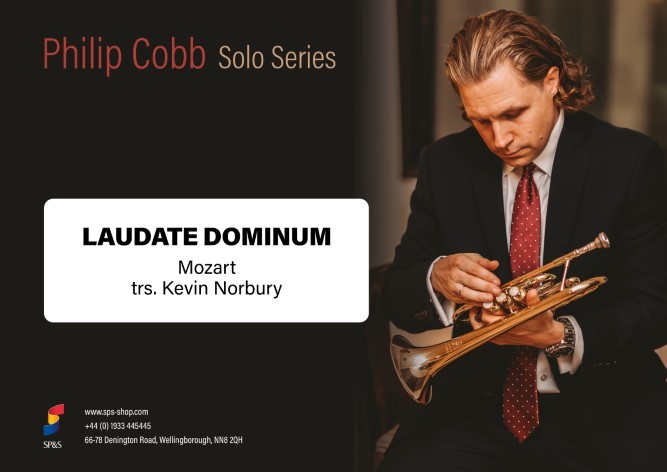
    Laudate Dominum (Cornet Solo with Brass Band - Score and Parts)

    Originally composed by Mozart in 1780 from the Vesperae ples de Confessore, this setting of the shortest of the psalms, Psalm 117, has an ethereal quality. It seems to express something of the beauty of God and of his love in creation. This work has been beautifully transcribed for brass and soloist by Kevin Norbury.Duration: 5.00

    Estimated dispatch 7-14 working days
  • £29.95

    Ochills (Cornet Solo with Brass Band - Score and Parts)

    Ochills was inspired by the composer during a stay in Alloa, Scotland. His room looked out on the Ochills and one morning, taking a sheet of manuscript paper, he traced the shape of the hills across the stave, and then added the notes in a rhythmic pattern.Duration: 2.45

    Estimated dispatch 7-14 working days
  • £29.95

    Prayer of Childhood (Cornet Solo with Brass Band - Score and Parts)

    Leslie Condon made a huge impact on the lives of many he encountered. His compositions ranged from extended brass works to simple choral songs. Prayer of Childhood, originally composed for children to sing, is based on the verses which commence 'Gentle Jesus, meek and mild'. The simplicity of the melodic line is its strength and compliments the text so beautifully.Duration: 2.30

    Estimated dispatch 7-14 working days
  • £55.00

    Teens At The Junkyard - Brass Band Full Score & Parts - LM995

    COMPOSER: Chris AllenProgramme NotesWriting about beautiful rural scenes and seascapes seems to be a very British thing to do. The themes of the English Pastoral School seem especially alive and well in the brass band musical repertoire, featuring in popular works such as John McCabe's Cloudcatcher Fells and Ray Steadman-Allen's Seascapes among many others. McCabe's engrossing depictions of place in Cloudcatcher, Maunsell Forts and Scenes in America Deserta conviced me that music really can transport the listener to a different environment, but rather than describing a landmark or a pastoral scene, I decided to give some attention to an ugly, neglected place.In Square Enix's Life is Strange, an episodic adventure game released in 2015, two teens use the local junkyard as a place of escape from the drama of their lives, unbeknowst to the fact that their friend, recently missing, was murdered and buried in that very place. Inspired by these dark images, I sought to write music that reflected the strewn broken glass, the piles of trash, the stories left behind in the waste of the junkyard. In keeping with this theme of buried history, I unearthed a musical relic from the brass band repertoire, cannibalising themes from Eric Ball's Journey into Freedom. In fragmenting and distorting such a treasured work I hope to make the listener feel a process of wasting away of precious memories.The first movement should be spiky, clinical and bleak, with a similar character to that of Harrison Birtwistle's Grimethorpe Aria, and the second, an intense, reminiscing, lyrical slow section. The final movement is in a similar vein to Elgar Howarth's Songs for B.L., ending with a blazing finish as if standing upon the tallest pile of trash in the junkyard and looking down upon the chaos below.Chris Allen (2021)About the Composer:Chris Allen, 22, studied Music at the University of Birmingham, graduating with a 1st in his Bachelor's degree in 2020 and achieving a Distinction in his Master's in Composition in 2021. Chris won the University of Birmingham Music Society's Composition Competition in 2019 with his piece for brass band, The Sirens, and was published for the first time by Modrana Music after winning the Durham University Brass Band's inaugural composition competition with his suite, Three Images of North-East England. Both pieces have been performed in concert and recorded recently and Chris continues to write new, original works for brass band.Chris started playing the tenor horn at the age of 7 under the tutelage of Don Blakeson, first joining the Melton Band and then moving onto Hathern Band,conducted by David Newman. Upon moving to university in Birmingham,Chris studied performance on the tenor horn with Owen Farr for a year,started playing with the University of Birmingham Brass Band, under thebaton of Stuart Birnie, and began writing and occasionally conducting his ownworks for brass band. However, his work is not confined to this ensemble,and as part of his studies, he has written for the Ligeti Quartet and theBirmingham Contemporary Music Group.

    In Stock: Estimated dispatch 3-5 working days
  • £29.95

    Rhapsody in Brass (Score Only)

    Rhapsody in Brass is in three movements and was written for the British Open Championships in 1949, held at Belle Vue in Manchester. The contest winners were Fairey Aviation Works Band under the baton of Harry Mortimer. Eric Ball came second with Ransome & Marles and Stanley Boddington 3rd with Munn and Felton Band. Rhapsody in Brass had the unusual distinction of being written as a test piece by a Salvation Army composer. Eric Ball's Resurgam was the only other piece to achieve that dual personality in that era.Dean Goffin was born in 1916 in Wellington, New Zealand, son of Henry Goffin, a Salvation Army officer and composer. At 19 he was appointed Bandmaster of the Wellington South Band and when World War II started, he enlisted in the New Zealand Armed Forces where he became Bandmaster of the 20th Infantry Battalion and later the 4th Brigade Band. During the time he served with them in the Middle East and Europe, he composed and arranged numerous pieces among which Rhapsody in Brass and the march Bel Hamid, later adapted for Salvation Army use and renamed Anthem of the Free.After the war, Dean kept on composing and his work was featured by the Wellington South Band. Later he transferred to Timaru for another job and became Bandmaster there. He was studying music at the time and as he wanted to take part in a competition for devotional selections for Salvation Army use, he sent some of his compositions to the International Headquarters. When Rhapsody for Brass was chosen as the test-piece for the British Open Championships, people at the Salvation Army started asking questions about the lack of publications of his work. It was discovered that the pieces submitted for the competition didn't meet the exact criteria. Among these pieces was one of his most appealing works The Light of the World which was published a year later, in 1950, the same year as he completed his Bachelor of Music studies at Otagu University.After entering the Salvation Army Training College in Wellington with his wife, Marjorie, Dean was in 1956 appointed National Bandmaster in the British Territory. Later he became National Secretary for Bands and Songster Brigades and in this period he organised the yearly festival in the Royal Albert Hall and was responsible for the national music schools in the UK. Dean returned to his home country in 1966 and to mark the centenary of the Salvation Army in New Zealand he was knighted by the Queen in 1983. Sir Dean Goffin died on 23 January 1984.

    Estimated dispatch 7-14 working days
  • £35.00

    Darkwood (Score Only)

    Born in the Vale of Evesham, Worcestershire, Dan took a keen interest in music from an early age playing tuba and trombone with his local brass band. After leaving school he embarked on a 10 year career as a hotelier integrating it with a developing career as a freelance musician playing double bass, sousaphone and bass saxophone with big bands including the internationally Pasadena Roof Orchestra.In 2003, he enrolled in the Band Musicianship course at Salford University where he studied composition and arranging with Prof. Peter Graham. Dan's first test-piece An Elgar Portrait was selected as the 4th Section set work at the Swiss National Brass Band Championships in 2007 and again at the Pontins Championships the following year. He then went on to write the test-piece New World Sketches which was set as the 2nd Section test-piece for the British Regional Contests in 2009.In 2009, Dan became Composer in Association with the Cory Band, helping them with their winning programmes at several Brass in Concert Championships. In 2012 he became the Arranger in Association with Black Dyke Band and has been involved with many of the band's exciting projects including his arrangement of Recycled for the ground breaking multimedia campaign - Danger Global Warming Project and the band's collaboration with British composer Tolga Kashif in 2012 for his Olympic Anthem Let Your Light Shine.In 2015, Dan had a number of major works performed at International contests which included Realms of Asgard: Yggdrassil - a new test-work commissioned by Jaren Hornmusikkforening to be used as their choice work at the Norwegian Brass Band Championships, Ocean of Storms - an exciting new work for Grimethorpe Colliery Band's Brass in Concert programme and his test-piece Visions which was used as a 4th Section National Finals test-piece.Dan is currently working full time at the University of Salford, lecturing in Composition and Arranging. He continues to work as a freelance composer working with a number of leading soloists, brass and wind bands around the world.

    Estimated dispatch 7-14 working days
  • £40.84

    Verklarte Nacht (Brass Band) Arnold Schoenberg arr. Rob Bushnell

    Composed in just three weeks in 1899, Verklarte Nacht (Transfigured Night) is a string sextet in one movement by Arnold Schoenberg. Whilst known better for tone rows, his dodecaphonic music and the Second Viennese School, Schoenberg was a master of harmony (writing a number of books on the subject) and, in his early life, was inspired by the music of Brahms and Wagner. This is his best-known tonal work. Its description as a tone poem is not surprising given it takes its inspiration from Richard Dehmel's poem of the same name, as well as Schoenberg's strong feelings towards his future wife, Mathilde Zemlinsky, sister of his teacher, Alexander von Zemlinsky. The work is said to have five sections, one for each of the stanzas in the poem. The poem, from 1896, describes a man and woman walking through a dark forest on a moonlit night. The woman shares a secret with him, that she is pregnant but not with his child. The man reflects upon this before warmly accepting (and forgiving) the news. The work premiered on 18 March 1902 in the Vienna Musikverein by the Rose Quartet. As was normal at the time, Schoenberg produced a string orchestra version that was premiered on 29 November 1916 in Prague, conducted by Zemlinsky, which was later revised in 1943 to better support the soloists, also adding more articulation and tempo markings. Whilst the piece was controversial at the time, both musically and due to the poem's "inappropriate" subject matter, Richard Dehmel himself was impressed, writing "I had intended to follow the motives of my text in your composition, but soon forgot to do so, I was so enthralled by the music." This arrangement is for the British-style brass band, with alternative parts for horns in F and bass-clef lower brass. To view a recording of the original composition please visit www.youtube.com/watch?v=vqODySSxYpc. Difficulty Level: 2nd Section + Duration: approx. 6.40 minutes Sheet music available from www.brassband.co.uk Instrumentation: Soprano Cornet Eb Solo Cornet Bb Repiano Cornet Bb 2nd Cornet Bb 3rd Cornet Bb Flugel Horn Bb Solo Horn Eb 1st Horn Eb 2nd Horn Eb 1st Baritone Bb 2nd Baritone Bb 1st Trombone Bb 2nd Trombone Bb Bass Trombone Euphonium Bb Bass Eb Bass BbTimpani Percussion 1-3

    In Stock: Estimated dispatch 1-3 working days
  • £64.95

    A Day in the Life of a Knight (Brass Band - Score and Parts) - Lawrence, Phil

    Here we have a most descriptive piece of writing - a story through music. A fantastic 1st section test piece and championship concert work:The opening scene would depict standing on the battlements of a castle hearing the thundering hoofs of our brave Knight's horse miles in the distance. His arrival is expected, and his reputation is known across many lands. Today, he is to joust amongst mere mortal knights and compete for the hand of the fair (and local) Princess.He vanquishes all competitors and wins the day. The scene moves to evening and court where reception and dance is to be held for our winning knight. Both Knight and Princess become centre of attention during the dance. Their eyes only for each other.At last, the Knight has a chance to be a lone with his Princess as they steal away from the celebrations to a star lit rampart above the castle gardens, where the Knight declares his ever-lasting love and pledges his life and of honour to her. He asks her hand, meanwhile monks pray in the below chapel hoping for union. She say's yes. It is announced in court, then blown from the battlements.Day breaks; he is brought word of evil doings back in his own land. He leaves word to the Princess that he will be back soon to take her hand. The trouble back home was a rouse to get him away from the Princes so one of the vanquished, a dark knight in yesterdays joust, has summoned a dragon to kidnap the princess for his own.As the truth of the deception reaches our Knight he quickly returns to face the varlet that has taken his Lady. This time tis no joust, but a fight to the death with the dark knight and dragon. Our champion proves his best once again and wins the day and the hand of his Princess forever!- Phil LawrenceSuitable for 1st Section Bands and aboveDuration: 11.15

    Estimated dispatch 7-14 working days
  • £25.00 £25.00
    Buy from Wobbleco Music

    Laughter In The Rain - Sedaka & Cody - Len Jenkins

    In America, this was Neil Sedaka's comeback single. Whilst he had 11 Top-40 hits from 1960-1963, he could not score a hit after the British Invasion of the 60's. His fortunes were such in America that this song was at first released only in England, where it went to No. 15. However, whilst recording with 10cc in London, Sedaka reconnected with his friend Elton John who offered to put out a Sedaka single in America under his own record label, Rocket Records. Since "Laughter In The Rain" was already a hit in the UK, that was the choice, and anything with Elton John's name on it was sure to get some spins. So, later in 1974, "Laughter" was released on Rocket Records with liner notes and endorsements by Elton, and the song took off, becoming his second million-seller 12 years after his first, which was "Breaking Up Is Hard To Do."

  • £45.00

    Lament (Brass Band - Score and Parts) - Bridge, Frank - Hindmarsh, Paul

    The English composer Frank Bridge (1879 - 1941) did not take an active part in the First World War. However, he was devastated by the slaughter on the western and the eastern fronts, especially the loss of so many of his musicians friends and colleagues. Writing in 1963, his former pupil Benjamin Britten confessed that 'a lot of my feelings about the First World War which people seemed to see in the War Requiem came from Bridge. He had written a piano sonata in memory of a friend killed in France and though he didn't encourage me to take a stand for the sake of a stand, he did make me argue and argue and argue. His own pacifism was not aggressive, but typically gentle'.Bridge composed this Lament for string orchestra on 14 June 1915, in memory of Catherine Crompton, who drowned when the Cunard liner Lusitania was torpedoed by a German submarine on 7 May, 1915. According to figures researched by Liverpool historian Kevin Roach (www.lusitania.net), 1201 men, women and children lost their lives out of the 1962 people aboard. Ninety-four children died, including Catherine, her twin brother Paul and four other siblings. Paul Crompton, Snr. (44), a British businessman working in Philadelphia, his wife Gladys (40) and the family nanny were also drowned. How Bridge's dedication came about is uncertain. The music critic Edwin Evans, who knew Bridge well, has written that the Catherine was a young friend. It is also possible that he came across the family photograph which was published in many newspapers in the wake of the tragedy. By that time, Bridge was greatly distressed by the war as a whole. It seems perfectly in keeping with his pacifist leanings and the strength of his reaction, that this poignant and deeply touching 'war memorial' should mourn a child who he did not know, rather than one of the thousands of young men who fell in battle.Through the musical tears of this melancholy lullaby, Bridge may have regarded the death of young Catherine Crompton as symbolic of the loss of so many innocent lives in wartime. His response to this personal tragedy was characteristically spontaneous and utterly sincere. It is one of his most effective miniatures, poignant yet restrained in its lyrical beauty, with a compelling directness and simplicity of construction.This brass band transcription is pitched one tone lower than the original for string orchestra.- Paul HindmarshDuration: 5.00

    Estimated dispatch 7-14 working days

     PDF View Music