
Results
-
 £42.95
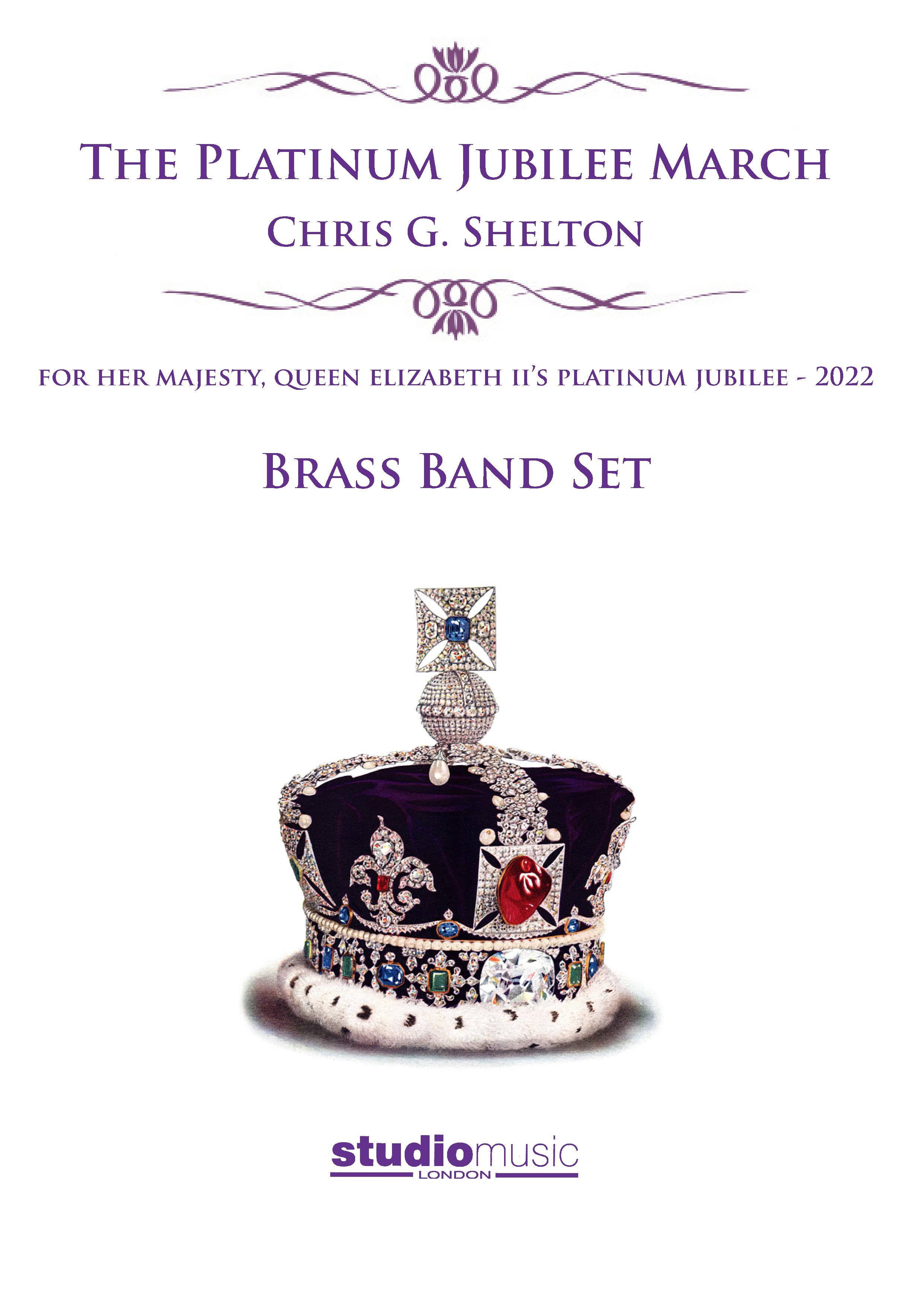
The Platinum Jubilee March (Brass Band - Score and Parts)
The Platinum Jubilee March was written to celebrate Her Majesty, Queen Elizabeth II's seventy-year reign as monarch of the United Kingdom. Its premiere was televised live around the world as part of the Queen's Birthday Parade which marked the start of the national Platinum Jubilee celebrations.The Queen's Birthday Parade 2022 saw the First Battalion of the Irish Guards trooping their colour. To reflect this, the march begins in a celebratory style and features a melody based around the opening motif of Let Erin Remember - the regimental slow march of the Irish Guards. In traditional style, the march develops excitement both harmonically and melodically, creating a strong sense of drive before reaching a stately trio. This section has a very regal and noble feel, lending subtle harmonic nods to two of the most quintessentially British composers, Gustav Holst, and Sir William Walton. The march culminates in a bold grandioso, featuring semi-quaver lines that are underpinned by a driving trombone countermelody. A forthright restatement of the introductory fanfare brings the march to a very definite and resolved ending.
Estimated dispatch 7-14 working days
-
 £44.95
Sweet Name (Flugel Horn Solo with Brass Band - Score and Parts)
The music was written at the request of Richard Woodrow of The International Staff Band in 2018. It is a big band setting of William Henry Rudd's melody The Saviour's name (T.B. 119), to which we associate the following words by Frederick Whitfield (S.A.S.B. 94):There is a name I love to hear,I love to sing its worth;It sounds like music in mine ear,The sweetest name on earth.O how I love the Saviour's name!The sweetest name on earth.
Estimated dispatch 7-14 working days
-
 £38.95
Unity Series Band Journal - Numbers 498 - 501, October 2021
498: Prelude - Armageddon (Munashe Chikwezvero)This prelude to worship is based on the tune Armageddon (T.B. 181) and features the well-known hymn Who is on the Lord's side? (S.A.S.B. 992) by Frances Ridley Havergal499: Joshua (William Gordon)An easy-listening swing setting of the spiritual Joshua fought the battle of Jericho.500: Trombone Solo - O save me, dear Lord! (Erik Silfverberg)This devotional setting of the song I bring thee my cares and my sorrows by General Evangeline Booth, is scored here as a trombone solo.501: This is my desire (Gavin Lamplough)Meditative music based on two popular worship songs, Reuben Morgan's This is my desire (S.A.S.B. 397) and Martin Smith's Thank you for saving me (S.A.S.B. 477).
Estimated dispatch 7-14 working days
-
 £38.95
Unity Series Band Journal - Numbers 474 - 477, February 2019
474: Prelude - Tell me the old, old story (Munashe Chikwezvero)Arabella Hankey's verses (S.A.S.B. 150) were originally written in 1866 while the author was recovering from a serious illness. The music was then added by William Howard Doane in 1868. This prelude comes to us from a Salvationist composer from the Hunyani Corps in the Zimbabwe Territory.475: My Redeemer lives (Marcus Venables)This lively arrangement of My Redeemer lives (S.A.S.B. 223) was written for the North York Temple Junior Band. The music is designed to emulate the more challenging Salvation Army band pieces to which younger musicians might aspire, as well as being a joyful announcement of our Redeemer's resurrection.476: Filte (Roger Trigg)Filte (FAHL-cheh) is the Irish word for welcome. This music was written to commemorate the start of The Salvation Army's work in Ireland. It features the tune The Eden Above (T.B. 503) which is purported to be the first song performed by a Salvation Army delegation on Irish soil. The next hymn presented is King of kings, majesty (S.A.S.B. 376) which has been a significant song in the life of Belfast Citadel Corps in its more recent past. The piece closes with the confident music of the song I believe we shall win (S.A.S.B. 990).477: Chorus Arrangement - Follow, I will follow thee (Morgan Juel Stavik)This is a gentle setting of H.L. Brown's melody Follow, I will follow thee.
Estimated dispatch 7-14 working days
-
 £38.95
Unity Series Band Journal July 2018 - Numbers 470-473
470 Prelude Bow down before him Daniel Elson471 Do not pass me by Andreas Holmlund472 Move, Holy Spirit! Jonathan Rowsell473 Guide Me William Gordon
Estimated dispatch 7-14 working days
-
 £95.00
A Wartime Sketchbook (Brass Band - Score and Parts)
Early in 1941 William Walton, 39, received his call-up papers. He was by then one of the most eminent of British composers and was exempted from military service on condition that he provided music for films deemed to be of 'national importance'. Scoring Lawrence Olivier's Shakespeare epic Henry V in 1943 was the most substantial of these wartime projects. His role in patriotic films from 1941 and 42 like The Foreman went to France, Next of Kin, Went the day Well and The First of the Few was to provide appropriate title music and some underscoring at key moments. Walton extracted the most substantial portions of the latter as the popular Spitfire Prelude and Fugue for orchestra. The remaining music remained unpublished until 1990, when Christopher Palmer assembled the highlights into A Wartime Sketchbook. I was intrigued to hear these examples of Walton's wartime music and having discovered that they would fit naturally and idiomatically onto the brass band, I arranged six of the numbers into a suite for Besses o' th' Barn Band, which I was conducting at the time.In 1995 the brass band suite was recorded by the famous Black Dyke Mills Band as part of an all Walton album which I produced for the ASV label (ASV CD WHL 2093). This award- winning CD also included Walton's First Shoot, in the edition by Elgar Howarth, my transcription of movements from Music for Children and two substantial brass versions by Edward Watson of the suite from Henry V (with narrator) and the March and Siegfried Music from The Battle of Britain music.Prologue: This is the stirring title music from Went the day Well, a screen play by Graham Greene about a German airborne invasion of an English village. The main theme leads toBicycle Chase: Characteristic musical high-jinks for J.B.Priestley's The Foreman went to France.Refugees: From the same film, this is a poignant accompaniment to the long march of refugees. As Ernest Irving, the film's musical director, put it, "this really makes your feet sore and your knees sag."Young Siegfrieds: This lively movement comes from the music that Walton composed for The Battle of Britain in 1968, with the assistance of Malcolm Arnold, but which the film's producer rejected. It portrays first the Berliners, cheerfully ignoring the black-out and then, in the trio, the Young Siegfrieds of the Luftwaffe, courtesy of a parody of Siegfried's horn call from Wagner's opera.Romance: A soldier and a Dutch refugee snatch a few tender moments together in Next of Kin.Epilogue: At the end of The Foreman went to France, the French look forward with hope and optimism to eventual liberation.- Paul HindmarshDuration: 14.00
Estimated dispatch 7-14 working days
-
£40.00
A Wartime Sketchbook (Brass Band - Score only)
Early in 1941 William Walton, 39, received his call-up papers. He was by then one of the most eminent of British composers and was exempted from military service on condition that he provided music for films deemed to be of 'national importance'. Scoring Lawrence Olivier's Shakespeare epic Henry V in 1943 was the most substantial of these wartime projects. His role in patriotic films from 1941 and 42 like The Foreman went to France, Next of Kin, Went the day Well and The First of the Few was to provide appropriate title music and some underscoring at key moments. Walton extracted the most substantial portions of the latter as the popular Spitfire Prelude and Fugue for orchestra. The remaining music remained unpublished until 1990, when Christopher Palmer assembled the highlights into A Wartime Sketchbook. I was intrigued to hear these examples of Walton's wartime music and having discovered that they would fit naturally and idiomatically onto the brass band, I arranged six of the numbers into a suite for Besses o' th' Barn Band, which I was conducting at the time.In 1995 the brass band suite was recorded by the famous Black Dyke Mills Band as part of an all Walton album which I produced for the ASV label (ASV CD WHL 2093). This award- winning CD also included Walton's First Shoot, in the edition by Elgar Howarth, my transcription of movements from Music for Children and two substantial brass versions by Edward Watson of the suite from Henry V (with narrator) and the March and Siegfried Music from The Battle of Britain music.Prologue: This is the stirring title music from Went the day Well, a screen play by Graham Greene about a German airborne invasion of an English village. The main theme leads toBicycle Chase: Characteristic musical high-jinks for J.B.Priestley's The Foreman went to France.Refugees: From the same film, this is a poignant accompaniment to the long march of refugees. As Ernest Irving, the film's musical director, put it, "this really makes your feet sore and your knees sag."Young Siegfrieds: This lively movement comes from the music that Walton composed for The Battle of Britain in 1968, with the assistance of Malcolm Arnold, but which the film's producer rejected. It portrays first the Berliners, cheerfully ignoring the black-out and then, in the trio, the Young Siegfrieds of the Luftwaffe, courtesy of a parody of Siegfried's horn call from Wagner's opera.Romance: A soldier and a Dutch refugee snatch a few tender moments together in Next of Kin.Epilogue: At the end of The Foreman went to France, the French look forward with hope and optimism to eventual liberation.- Paul HindmarshDuration: 14.00
Estimated dispatch 7-14 working days
-
 £40.00
Abide With Me (Euphonium Solo with Brass Band - Score and Parts)
My arrangement of William H. Monk's tune of 1861, uses the euphonium soloist as the central figure for the melodic line in the three verses. Surrounding the solo line is an irregular pulsed figure in the percussion to give the music an unsettled feel whilst the muted ensemble lightly colour the melodic contour of the soloist. From the low beginnings of the piece, where no high instrumentation is used, we are led through the darkened texture to a bright finale, although the sense of the forbidding is always present.Abide With Me has always been a favourite hymn of mine and it was when watching the film 28 Days Later that I believed it would make a rather striking arrangement for brass band. This was confirmed further when the hymn was used at the 2012 opening ceremony of the London Olympics. The juxtaposition between the static, slow moving melody and the rhythmic effects of the dancers was something that I thought could be captured in an arrangement.- Paul McGheeDuration: 5.00
Estimated dispatch 7-14 working days
-
 £29.95
Judd: Marching to Glory
This energetic piece focusses on the Christian's life goal of 'marching home to Glory' which is described in the first verse of William James Pearson's song.We are marching home to Glory, Marching up to mansions bright,Where bright golden harps are playing,Where the saints are robed in white.There's a golden harp in Glory,There's a spotless robe for you;March with us to the hallelujah city,To the land beyond the blue.
Estimated dispatch 7-14 working days
-
 £44.95
Judd: Supremacy
This challenging work leads us to contemplate the need we have to acknowledge Christ as supreme in our lives. The three tunes contained are all strongly associated with words which speak of supremacy with the finale, based on the hymn tune 'Pembroke', outlining words penned by William Booth 'My Lord who reigns supreme'.
Estimated dispatch 7-14 working days