
Results
-
 £154.99
A Road Less Travelled By (Brass Band - Score and Parts) - Sparke, Philip
A Road Less Travelled By was commissioned by Palangos Orkestras for the Championship Section of the 2020 European Brass Band Championships held in Palanga, Lithuania.The following was written by the composer, Philip Sparke:The title alludes to a poem by American author, Robert Frost, which appeared in his 1916 collection, Mountain Intervals: The Road Not Taken.In common with most of my larger works, this piece in not programmatic, but purely abstract; there is no extrinsic musical story. The choice of title shares my view of how composers can often develop. There can be no 'destination' in a composer's career, but rather a continuing journey to an unknown place. From piece to piece a composer needs to decide his or her next steps, never really knowing where they might lead. As Frost so eloquently describes, these sorts of instinctive decisions guide all our lives.Set in three movements, which play without a break, A Road Less Travelled By opens with a Moto Perpetuo firmly rooted in classical language, form and syntax. A continuous river of semiquavers, veering from melody to accompaniment and back again, adds drive, every and motion. The second movement, Nocturne, is in the form of a free fantasia; solos for vibraphone, flugel horn and euphonium set the stage for a central cornet solo, quietly echoed by the full band. A triumphal climax is reached before the movement dissolves into a Scherzo Finale. Mercurial and quixotic in nature, this third movement starts jovially until trios for trombones and horns darken the atmosphere. A change of mood and meter leads to a reprise of the opening and a return of the cornet melody, this time accompanied by figures derived from the scherzo theme. A brief coda based on earlier material drives the piece to a close.Duration: 15.30
Estimated dispatch 7-14 working days
-
£36.50
A Road Less Travelled By (Brass Band - Score only) - Sparke, Philip
A Road Less Travelled By was commissioned by Palangos Orkestras for the Championship Section of the 2020 European Brass Band Championships held in Palanga, Lithuania.The following was written by the composer, Philip Sparke:The title alludes to a poem by American author, Robert Frost, which appeared in his 1916 collection, Mountain Intervals: The Road Not Taken.In common with most of my larger works, this piece in not programmatic, but purely abstract; there is no extrinsic musical story. The choice of title shares my view of how composers can often develop. There can be no 'destination' in a composer's career, but rather a continuing journey to an unknown place. From piece to piece a composer needs to decide his or her next steps, never really knowing where they might lead. As Frost so eloquently describes, these sorts of instinctive decisions guide all our lives.Set in three movements, which play without a break, A Road Less Travelled By opens with a Moto Perpetuo firmly rooted in classical language, form and syntax. A continuous river of semiquavers, veering from melody to accompaniment and back again, adds drive, every and motion. The second movement, Nocturne, is in the form of a free fantasia; solos for vibraphone, flugel horn and euphonium set the stage for a central cornet solo, quietly echoed by the full band. A triumphal climax is reached before the movement dissolves into a Scherzo Finale. Mercurial and quixotic in nature, this third movement starts jovially until trios for trombones and horns darken the atmosphere. A change of mood and meter leads to a reprise of the opening and a return of the cornet melody, this time accompanied by figures derived from the scherzo theme. A brief coda based on earlier material drives the piece to a close.Duration: 15.30
Estimated dispatch 7-14 working days
-
 £34.95
The Southern Cross (Brass Band - Score and Parts) - Bowen, Brian
The Southern Cross is one of several excellent marches by Brian Bowen in which he carried on the more sophisticated pattern of British marches by Wilfred Heaton, Leslie Condon and Ray Steadman-Allen. It was written for the Box Hill (Australia) Corps jubilee celebrations in 1970 and formed part of the band's repertoire when it toured Great Britain in the same year. The first half of the march features part of the song, 'March on!' by Klaus Ostby, an early pioneer of Salvation Army music in Scandinavia. The contrapuntal layering of melodies in the trio, especially in the finale where 'March on!' sounds one more triumphant time, is notable, as is the shift to a slower, more stately tempo. The harmonic and rhythmic style also represents the more modern sounds of Salvation Army brass band music in the late 1960s and early 1970s. Right from the opening gestures, listeners at early performances knew that a page had turned in the evolution of the Salvation Army march.
Estimated dispatch 7-14 working days
-
£17.50
The Southern Cross (Brass Band - Score only) - Bowen, Brian
The Southern Cross is one of several excellent marches by Brian Bowen in which he carried on the more sophisticated pattern of British marches by Wilfred Heaton, Leslie Condon and Ray Steadman-Allen. It was written for the Box Hill (Australia) Corps jubilee celebrations in 1970 and formed part of the band's repertoire when it toured Great Britain in the same year. The first half of the march features part of the song, 'March on!' by Klaus Ostby, an early pioneer of Salvation Army music in Scandinavia. The contrapuntal layering of melodies in the trio, especially in the finale where 'March on!' sounds one more triumphant time, is notable, as is the shift to a slower, more stately tempo. The harmonic and rhythmic style also represents the more modern sounds of Salvation Army brass band music in the late 1960s and early 1970s. Right from the opening gestures, listeners at early performances knew that a page had turned in the evolution of the Salvation Army march.
Estimated dispatch 7-14 working days
-
 £40.00
Abide With Me (Euphonium Solo with Brass Band - Score and Parts) - McGhee, Paul
My arrangement of William H. Monk's tune of 1861, uses the euphonium soloist as the central figure for the melodic line in the three verses. Surrounding the solo line is an irregular pulsed figure in the percussion to give the music an unsettled feel whilst the muted ensemble lightly colour the melodic contour of the soloist. From the low beginnings of the piece, where no high instrumentation is used, we are led through the darkened texture to a bright finale, although the sense of the forbidding is always present.Abide With Me has always been a favourite hymn of mine and it was when watching the film 28 Days Later that I believed it would make a rather striking arrangement for brass band. This was confirmed further when the hymn was used at the 2012 opening ceremony of the London Olympics. The juxtaposition between the static, slow moving melody and the rhythmic effects of the dancers was something that I thought could be captured in an arrangement.- Paul McGheeDuration: 5.00
Estimated dispatch 7-14 working days
-
 £164.99
Diamond Concerto (Euphonium Concerto No.3) (Euphonium Solo with Brass Band - Score and Parts) - Sparke, Philip
Diamond Concerto was commissioned by Musikverein Morschied from Germany - Dr. Eric Grandjean, conductor - for a special concert featuring Steven Mead as guest soloist. Together they gave the world premiere on 28th April 2012 in the town theatre of Idar-Oberstein. The commission is a highlight in the 30-year friendship between composer and soloist, which has included many mutual CD projects and concerts and, now, a concerto. Sparke had Steven Mead's special euphonium sound in his head throughout the composition process and made free use of the variety of styles which the world-renowned virtuoso has made his own during his highly successful solo career.The village of Morschied lies to the west of Frankfurt am Main in the area known as the German Road of Precious Stones, which is famous for its thriving gem industry. Because of this it was decided to give the commission a local connection by choosing the title, Diamond Concerto. Each of the three movements is named after a famous diamond:Earth Star is rather stern in mood, opening with a free fantasy for the soloist over a static chord from the band. This leads to an Allegro Moderato in minor mode where small motives are gradually repeated and developed by both band and soloist.Ocean Dream uses a varied quote from the composer's Music for Battle Creek, including a melting slow melody that was originally written with Steven Mead in mind.Blue Heart was written, at Steven Mead's suggestion, in bebop style and takes the form of a jazz waltz. The quasi-improvisatory central section features a call-and-response passage for the soloist and upper woodwinds.Duration: 16:45
Estimated dispatch 7-14 working days
-
 £19.95
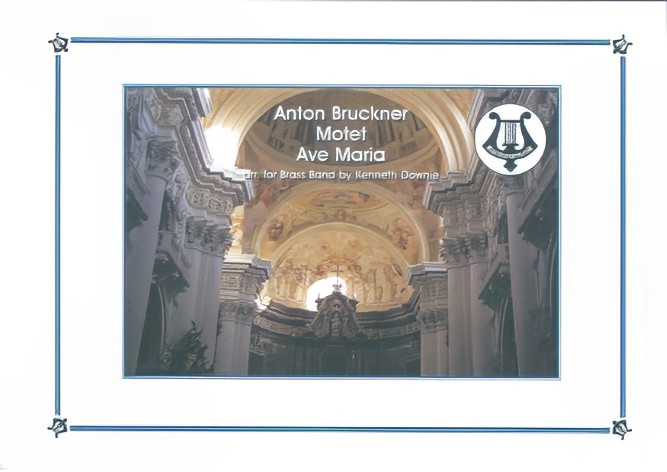
Ave Maria (Brass Band - Score and Parts) - Bruckner, Anton - Downie, Kenneth
The great 19th century Austrian composer, Anton Bruckner is most famous for his nine published symphonies and his sacred music (for organ and for voices). This motet, for unaccompanied voices, was written for Linz Cathedral where Bruckner became organist in 1855. Although this arrangement for brass band is far removed from the original, it is felt that the beauty of the music will come over in a new way.
Estimated dispatch 7-14 working days
-
£9.95
Ave Maria (Brass Band - Score Only) - Bruckner, Anton - Downie, Kenneth
The great 19th century Austrian composer, Anton Bruckner is most famous for his nine published symphonies and his sacred music (for organ and for voices). This motet, for unaccompanied voices, was written for Linz Cathedral where Bruckner became organist in 1855. Although this arrangement for brass band is far removed from the original, it is felt that the beauty of the music will come over in a new way.
Estimated dispatch 7-14 working days
-
 £24.95
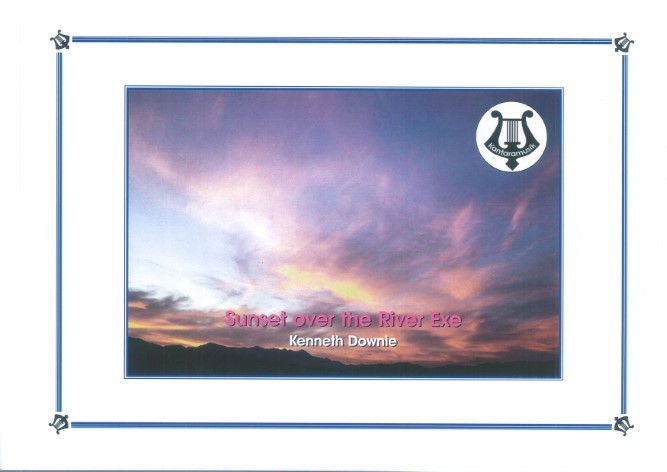
Sunset Over The River Exe (Brass Band - Score and Parts) - Downie, Kenneth
From the little office in my garden where the composer does all his writing,there is a beautiful view looking westward, over the River Exe, in south Devon. It is a constant inspiration and makes me most grateful every time it is looked at. This little nocturne is the result of many musings and hopefully it will conjure up the atmosphere of the scene for all listeners.
Estimated dispatch 7-14 working days
-
£12.50
Sunset Over The River Exe (Brass Band - Score Only) - Downie, Kenneth
From the little office in my garden where the composer does all his writing,there is a beautiful view looking westward, over the River Exe, in south Devon. It is a constant inspiration and makes me most grateful every time it is looked at. This little nocturne is the result of many musings and hopefully it will conjure up the atmosphere of the scene for all listeners.
Estimated dispatch 7-14 working days
 View Music